
AndrewD
[HoMe Moderator]
12829

Ultra-Chron – when no ordinary chronometer will do
The Longines Ultra-Chron automatic high-beat-rate wristwatch was introduced in 1967 to mark the 100 year anniversary of the company which was founded in 1867. Longines went on to produce several variations of the Ultra-Chron, including different case shapes, between 1967 and 1975.
High-beat watches were intended to provide greater consistency of rate in different positions and be more isochronous. A number of companies produced such watches, although Girard-Perregaux is said to have been the first to bring these to market in 1965 (showcased at the Basel fair of 1966), with Longines being the second in 1967. Most high-beat watches oscillate at 36,000vph, although 28,800vph was also considered a high rate at the time. To achieve the faster rate, 21 teeth were used in the escape wheel instead of the usual 15. The mainspring was also thicker and larger to provide adequate power. The early GP watches had a relatively short power reserve and many consider that Longines was the first company to release a practical hi-beat watch.
A number of movements were used in the Ultra-Chron over the nine years of production. These included the Cal. 430 (centre seconds), Cal. 431 (centre seconds with date), Cal. 432 (hours and minutes only), Cal. 433 (date only) and some interesting manual wind movements which featured a hacking second hand which would stop when it reached the 12 mark (the Cal. 6952 with date and Cal. 6972 with day and date). The later Cal. 6651 and Cal 6652 models beat at a slower 28,800vph, but also had “Ultra-Chron” on the dial.
Longines advertising from the period spruiked “The world’s most accurate watch. Guaranteed accurate to within a minute a month”. That translates to an accuracy of better than 2 seconds per day. Only a handful of these watches were released with COSC chronometer certification, but the non-certified watches performed well within COSC specifications.
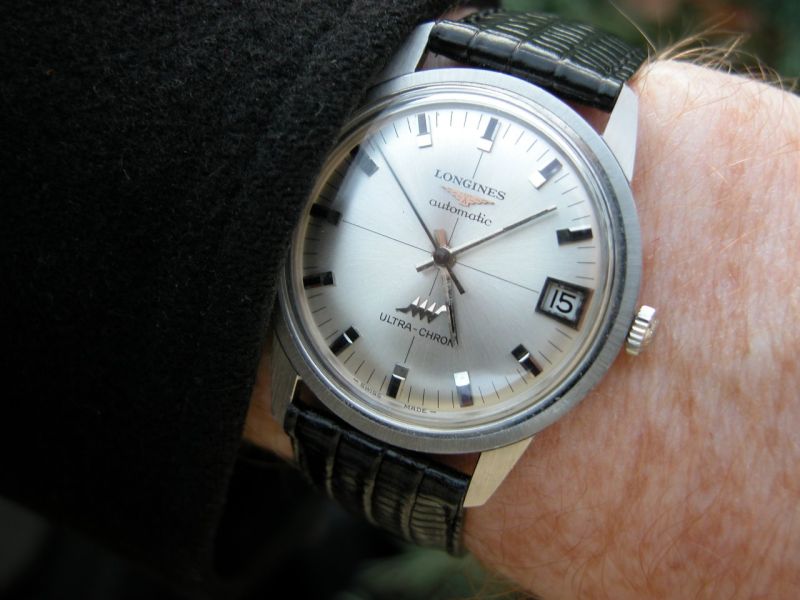
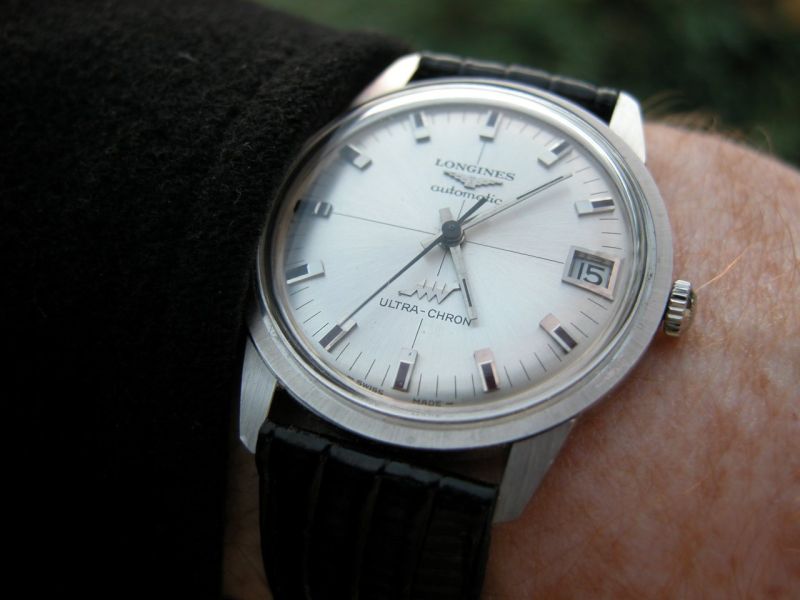
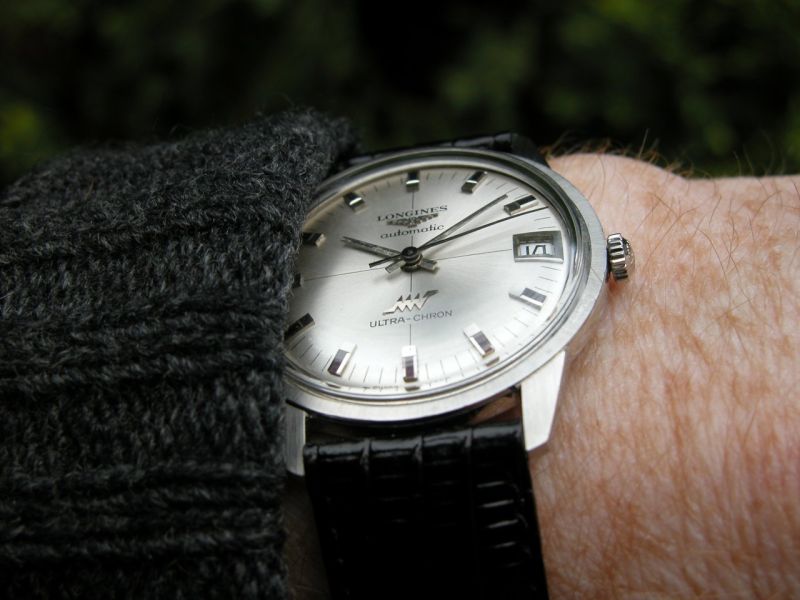
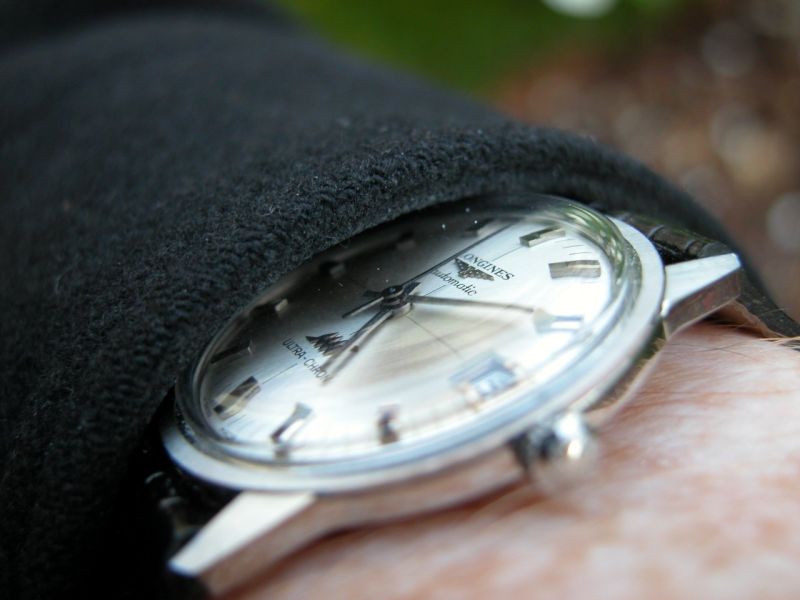
The Longines Ultra-Chron shown here has a case measuring 34 x 9mm, but the tapered back allows the watch to sit flat on the wrist and appear quite slim. The case is a single piece and the movement, dial and crystal is literally popped out (quite loudly) by removing the crown and stem and pumping air into the case. This single-piece construction adds to the water resistance of the watch.
The Cal. 431 movement has a central second hand (the best way to view the high-frequency movement in action as the hand glides around the dial) and a non-quick-set date at 3 o’clock which jumps instantaneously at midnight. It has 25 jewels and is 25.6 x 4.80mm in size (note the Cal. 430 has 17 jewels and is 4.30mm high). The movement is engraved with “adjusted in 4 positions and temperature” as well as with the escapement speed of “36000”. The central automatic bi-directional, bi-metallic winding rotor is mounted on ball bearings and has a heavy tungsten-carbide perimeter. The centre of the rotor is pieced with the flying hourglass symbol of Longines and acts as a shock absorber. The power reserve is 42 hours. The escapement features a screw-less, three-spoke, glucydur balance with a KIF-ultraflex shock absorber, fine regulation by an eccentric screw and a flat Nivarox, non-magnetic, self-compensating hairspring. The movement was made in-house by Longines, but utilized the Clinergic-21 Swiss-anchor escapement, so named because of the 21 teeth of the steel escape wheel. The fourth wheel has 100 teeth and a pinion with 7 leaves. The seconds hand is driven indirectly. The high-beat escapement is dry-lubricated with molybdenum bisulphide.
It is difficult to precisely date this particular watch. As with Omega, and many other companies, movement serial numbers can be used to determine the approximate year of manufacture. The Ultra-Chron’s released in 1967 had serial numbers in the 13 million range and in 1968 the 14 million range. There was an anomaly in numbering for a period, probably in 1969, when “50 million” numbers were used. This example has the serial number 50,790,282. I would appreciate if anyone could shed some light on why this occurred and what year of manufacture this might represent.
The features that attracted me to this watch are the radially brushed dial (measuring 29mm), the faceted polished hour markers and silver baton hands, the large easily read date display, the slim-line case and the ‘gliding’ second hand.
I would love to see other examples of the Ultra-Chron or any other high-beat watches, so please share them here.
Regards
Andrew
Ps. this information was gleaned from various Internet sources. As usual some of it may be incorrect and I would value any corrections or further information you could provide.
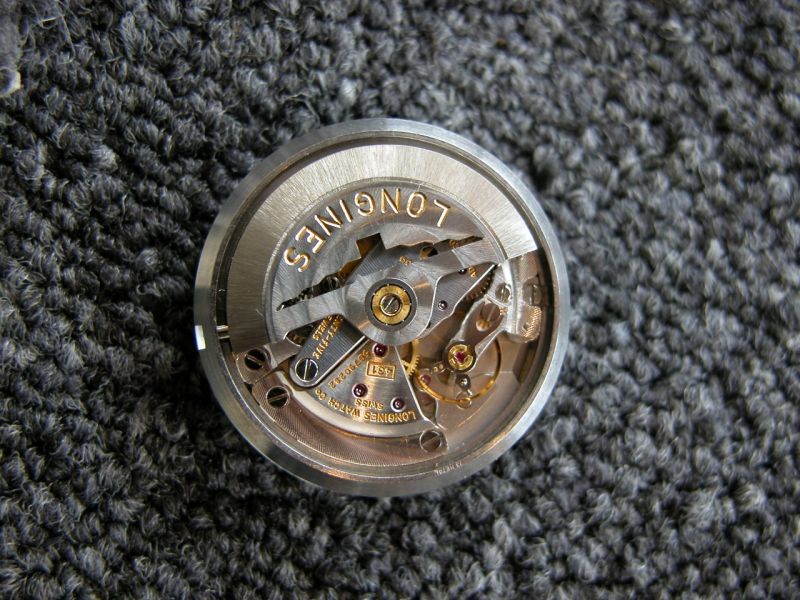
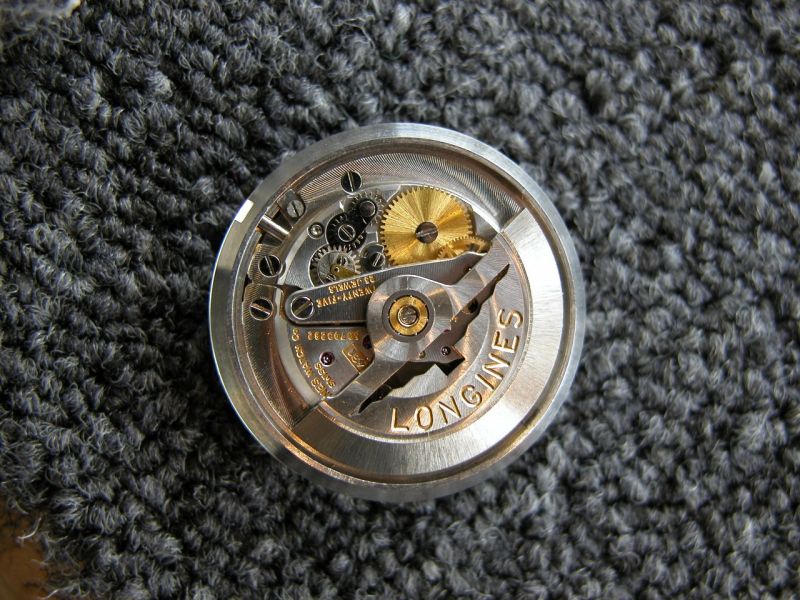
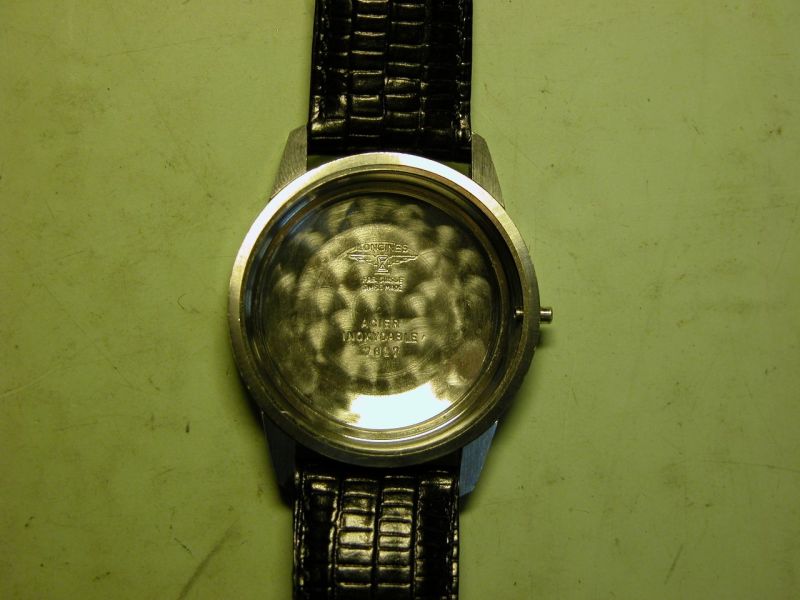
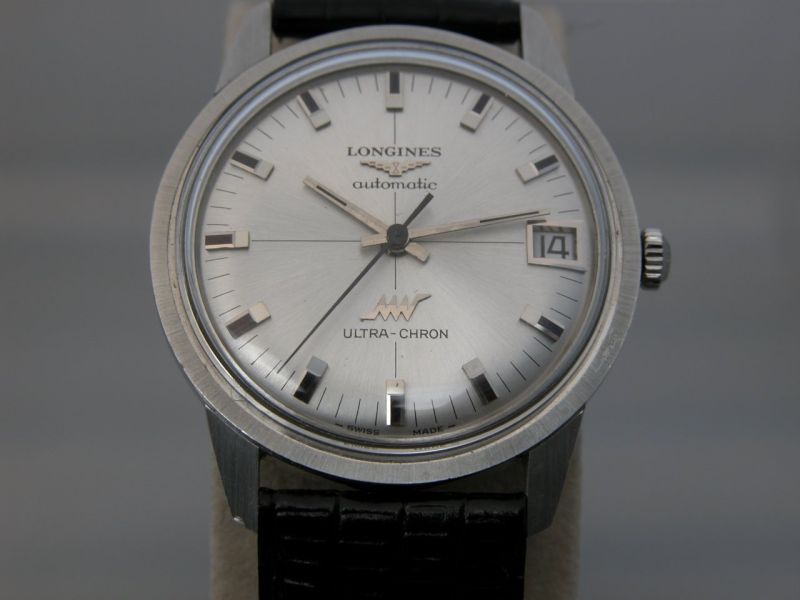


Ultra-Chron – when no ordinary chronometer will do
Thank for sharing, I heard about....
Longines Cal. 990

Holy guacamole! That's a fine example of high-performance . . .

Andrew, the Ultra-Chron was without a doubt Longines flagship model
The 1970’s were cool, but …
Very nice, Andrew...
Range …
Yes...

Great post, Andrew and a fine watch
Cal. 69XX
“Needs no batteries …”
A shot in the foot …
Hi-Beat Trivia ...

Classy watch, Andrew!
I was thinking EXACTLY the same thing! LOL
Andrew, you are more than meets the eye! LOL!
Case opening …
I use a syringe just like this...
You had me worried …
LASER SKIRMISH?! Tell me more!
Skirmish
Great looking Ultra-Chron!
Thx
Ultra-Chron 431
Hi Ian ...
Stunning!

A real charmer - congratulations
Thanks for revisiting the Ultra-Chron, Nomer ...

IMO it dates...
Thanks Erich ...
I'm new to this thread and have a question
hi Craig and welcome to...
Thanks G.
Thanks G
you cant do that, but...
Welcome Craig, and congratulations ...

Thank you, Andrew.

the ultrachron was a revolution for its time
Newbie with a question
