
Modernahab
1134

Annual Calendar Reguator 5235G: an undervalued gem?
Let me be frank: I’m not a huge fan of Patek Philippe in general. (Ducks a barrage of rotten fruit.) Before you start flaming, let me tell you that I enjoy the level of finishing Patek applies to its higher end products and appreciate the quality of the brand’s complications. By and large, however, Patek’s contemporary design language doesn’t do much for me – and I’m a retired design professional. Time was, Patek was adventurous and clever in its designs. By time was, I mean the early-to-mid 20th century. Yet now I find most of the current catalog uninspired to downright ugly. Yes, there are exceptions. I think the 6119 and 6196 are solid designs. However, I also think that Patek’s mechanically outstanding perpetual and annual calendars are often let down by awkward or undistinguished dial layouts. I’ve never been in love with Gerald Genta’s style, so paying whole number multiples of retail for a Nautilus strikes me as pure folly.
Besides aesthetics, I have no love for Patek Philippe’s approach to potential customers. I can readily afford Patek products at retail prices, but I refuse to debase myself in front of an AD to get on a waiting list or to buy a slew of products I don’t want for the privilege of handing over money for a watch I actually want. On top of that, Thierry Stern’s tactless and detestably arrogant public utterances are a discredit to the brand and reveal him as the kind of person I’d rather avoid enriching if I can at all avoid it.
That said, there are a few 21st century Patek Philippe offerings that have caught my fancy. I adore my Cronometro Gondolo 5098R and Calatrava Pilot Travel Time 7234R, for instance. Interestingly, this first is an updated revival of an early 20th century design, while the latter was lambasted by many upon release as being “un-Patek” in its style. Neither can really be said, however, of Patek’s Annual Calendar Regulator, Ref. # 5235G, the third Patek product I like enough to own.
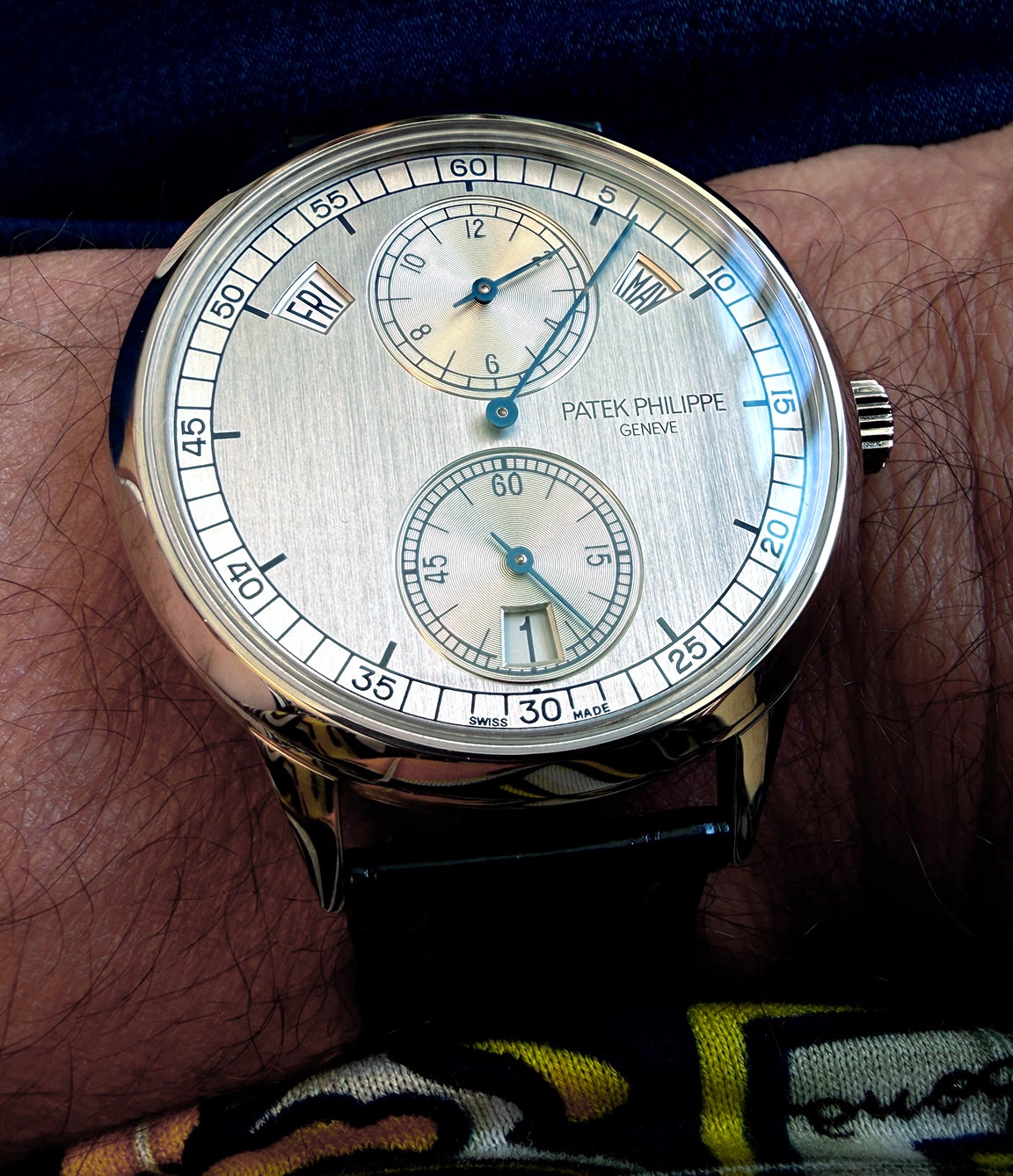
The 5235G is a bit of an outlier in the Patek catalog, past and present. I have no idea how many, if any, other regulator layouts Patek Philippe has produced in its history, but it cannot have been more than a tiny number. Moreover, the company’s execution of this layout in the 5325G is both original and highly effective from a design perspective. Add to this an oft overlooked degree of horological interest, and you have a watch that, in theory, might have merited more attention than it’s ever received from the watch buying public. (Critics are another matter. The 5235G appears to have been greeted with enthusiasm in the watch media at the time of its release.)
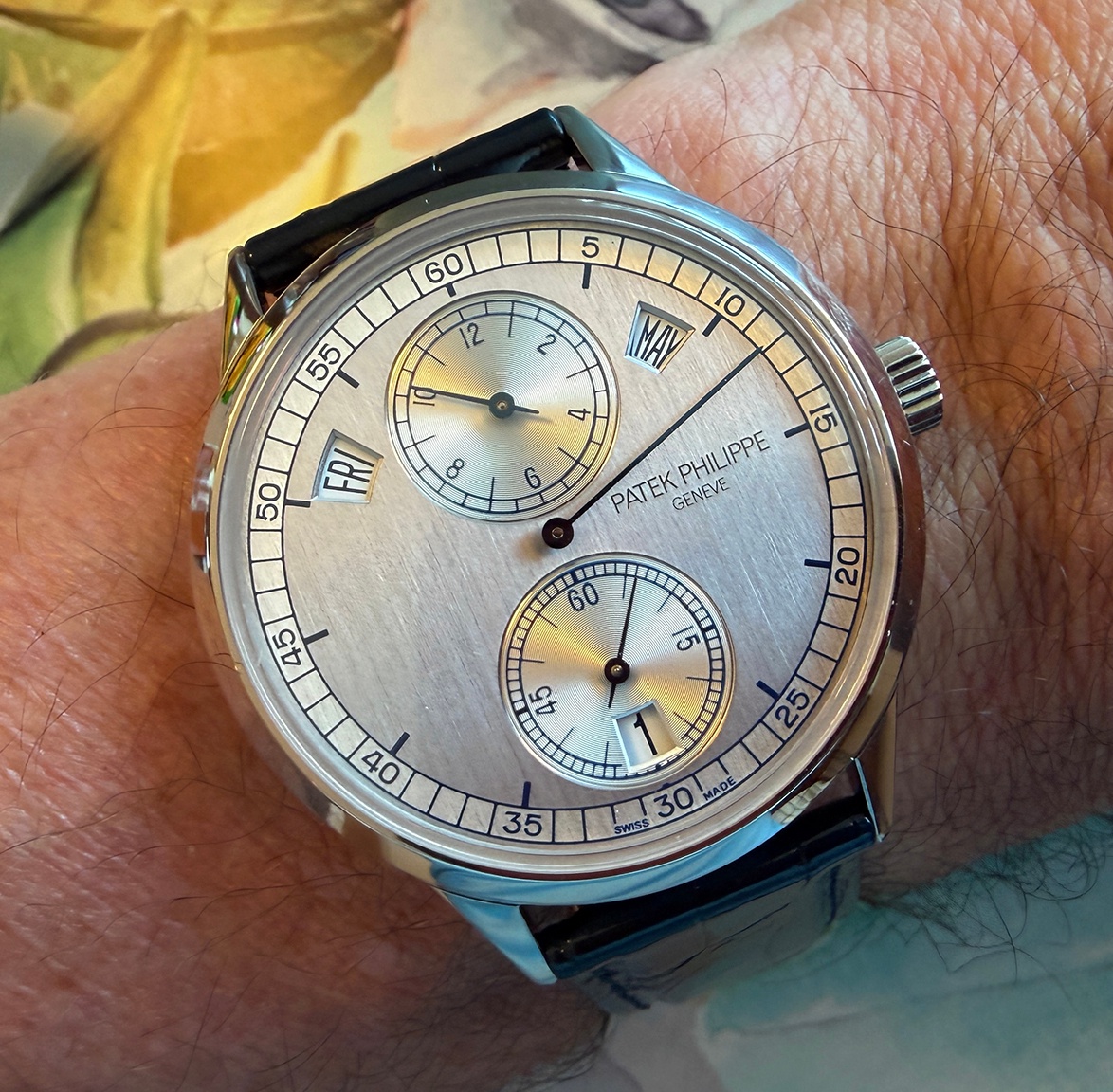
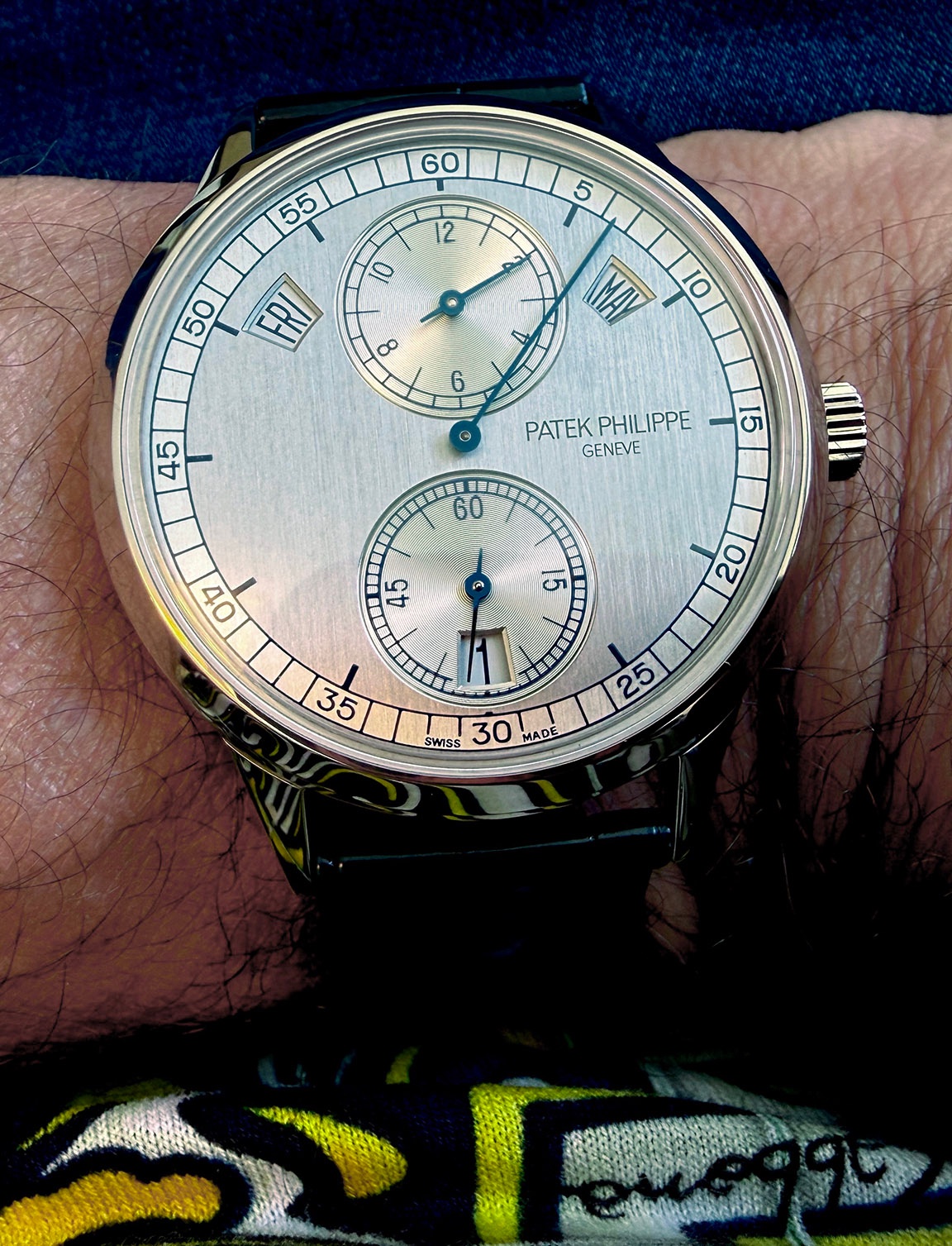
Let’s start with the design. The regulator layout is exceptionally well-balanced in the context of the annual calendar complication, and while the very, very slight asymmetry in the placement of the day and month displays has been commented on, the overall presentation benefits from thoughtful placement of subdials, windows, and text, and from pleasingly well-calculated proportions. Though never to my knowledge described as such, the 5235G dial is essentially a sector dial. The broad central sector allows for plenty of breathing room between the displays while offering ample visual interest through the play of light over its silvery vertically brushed surface. The sharply engraved and unfilled ‘Patek Philippe - Genève’ text to the right of the pinion contributes to an overall contemporary appearance, with its crisp, modern font reflected in the printing throughout the dial.
The subdials for hours and seconds at 12:00 and 6:00, respectively, are recessed and very finely snailed, causing them to “pop” quietly, yet effectively, from their surround. The bevel-edged trapezoidal day and month windows flank the hours subdial, their positions familiar from other, more frequently seen annual calendar references from Patek. The date window, also beveled, is integrated into the seconds subdial, though its lower edge interrupts the seconds scale. (I’ve seen this same layout better executed in Chopard’s LUC Heritage Grand Cru, but then again, I’ve seen far, far worse.) Circular brushing on the outermost sector housing the railroad minute track introduces yet a third finish, so that each area on the dial emerges with a subtle contrast that shifts with the ambient lighting. Slender blued steel hands and deep blue numerals add quiet spice to the otherwise monochrome composition.
At this point I’d like to pause and address the elephant in the room. Why, you may ask, am I writing about the now discontinued 5235G and not the current charcoal dial/rose gold 5235R? I was actually quite excited at the release of the rose gold model. I generally enjoy the dark gray/black dial and rose gold aesthetic (as in my IWC Portuguese Perpetual Calendar) and imagined that the 5235R would appealingly enliven the original design. As it turns out, that was kind of yes-and-no.
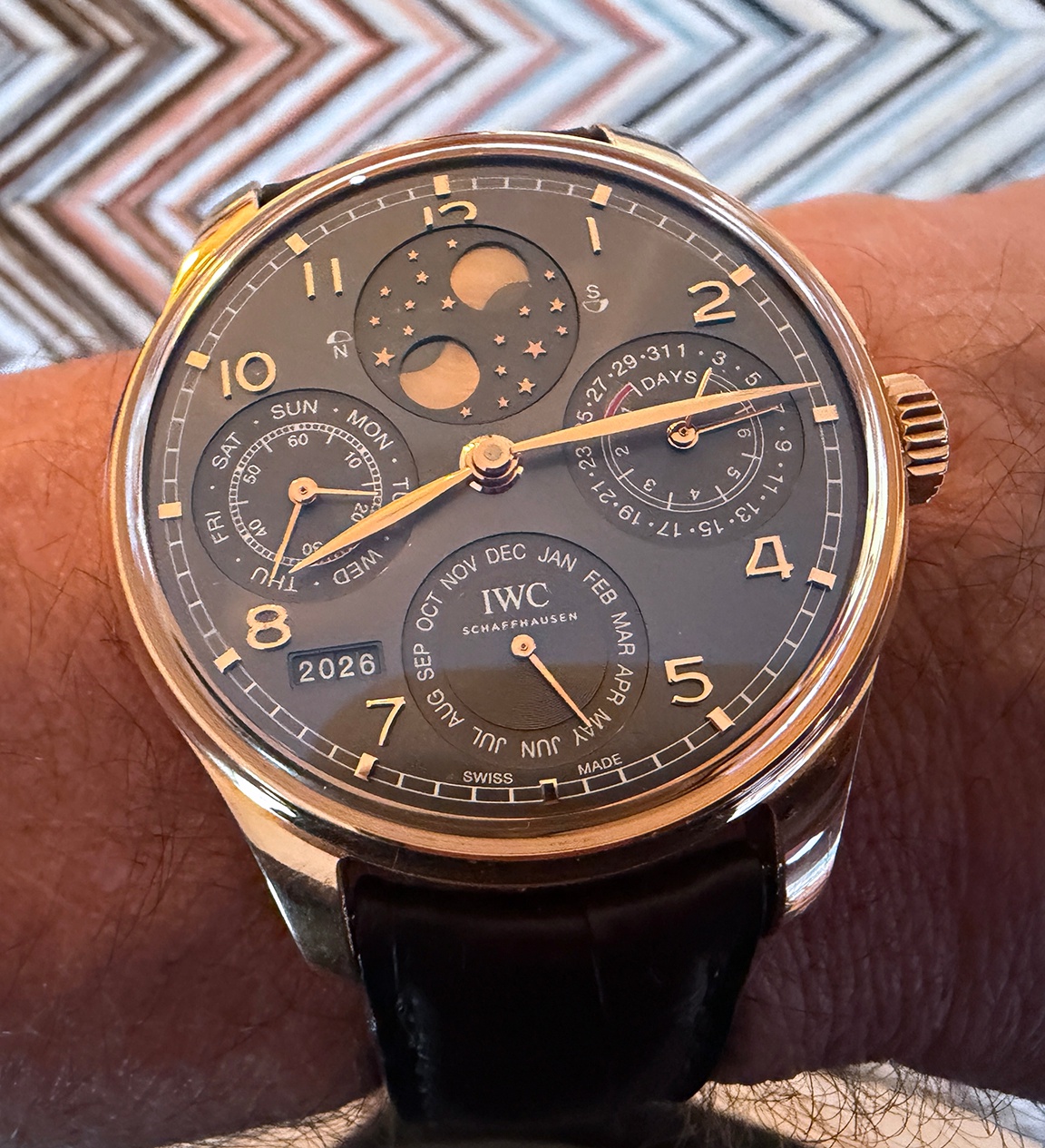
To my eye, the IWC Portuguese Perpetual Calendar does gray on gold very well.
When I had the opportunity some while back to handle the 5235R, I came away with the impression of a great design having been botched. Yes, the case and dial appear livelier than in the white gold predecessor, but not necessarily in a good way. What had been elegantly understated in white gold and silver wound up looking ostentatiously garish to me in rose gold and near-black. Moreover, the 5235R suffers from a shortcoming common among watches with very dark dials: compromised legibility. Reflections that glimmered softly on the 5235G’s dial became harsh and distracting on its successor. Then we come to the hands. The blued steel hands on the 5235G are elegant. The white painted hands on the 5235R look, well, cheap. They could actually be crafted from platinum, for all I know, but I’m afraid they look just like plastic. Not a good look for a complicated watch from Patek Philippe.
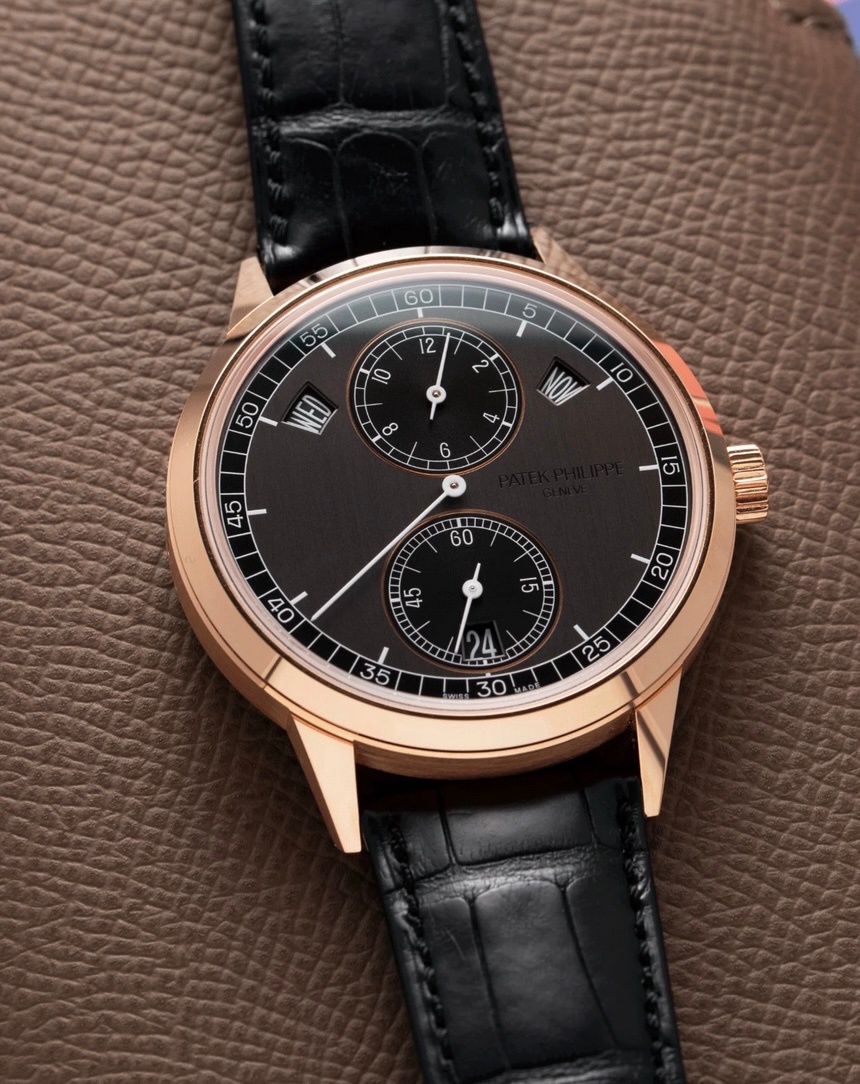
The 5235R looks sharp in photos, but I don't think it holds up well in comparison to its predecessor when seen in the metal. (Image by S.Song Timepieces)
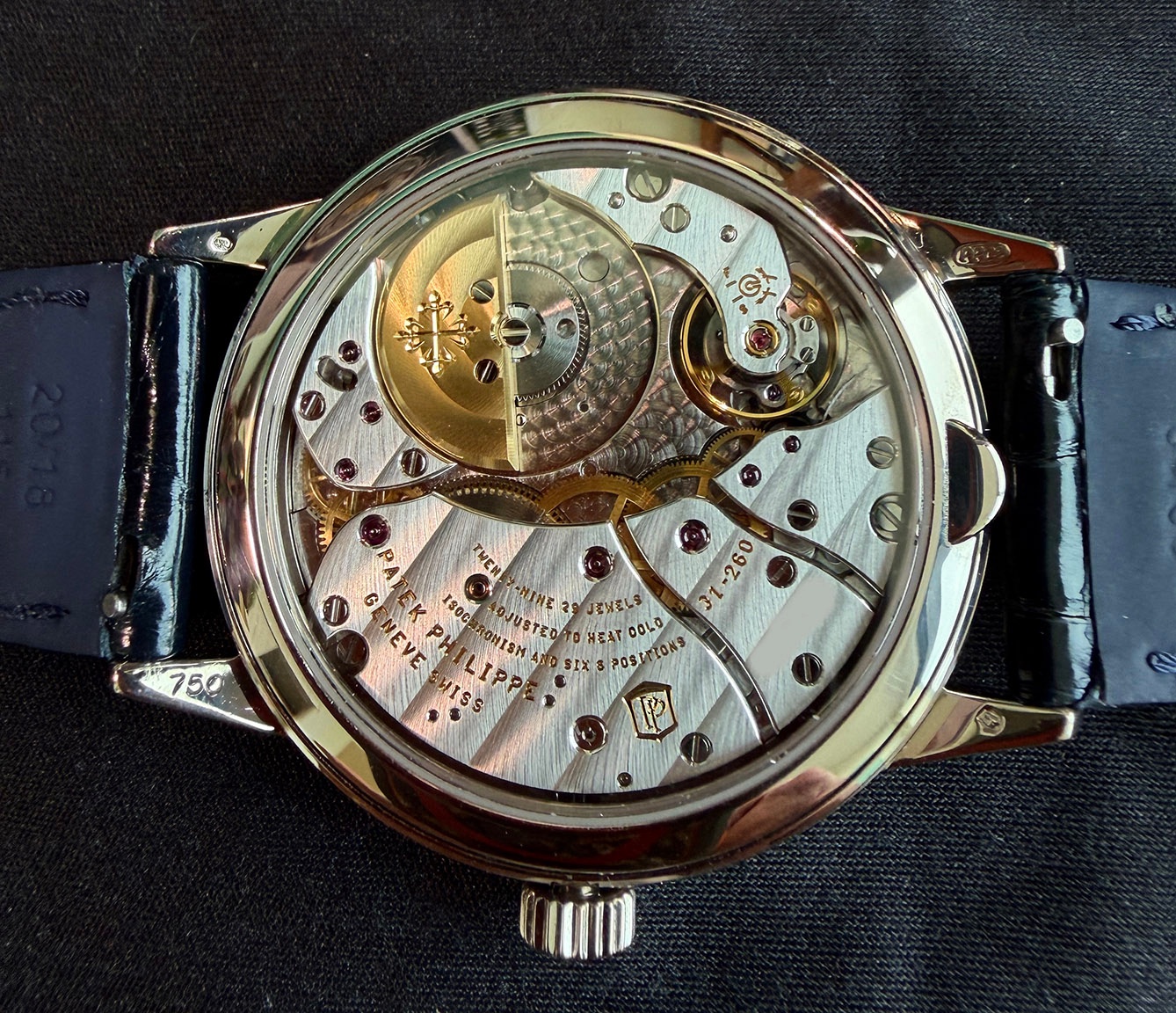
OK, enough digression. From the dial to the case. The case geometry employed here had, as I understand it, appeared infrequently prior to the 5235G in 2012 – perhaps even only once, in the Perpetual Calendar Ref. #3448 of the 1960s. The 40.5 mm by 10.2 mm case may be large for some, but it is elegantly slender and well-proportioned to the movement it houses, which I can’t always say of Patek’s products. A sharply indented break in surfaces separates the sloped, polished bezel from the brushed case band. The case band likewise transitions sharply to the polished snap-in case back, whose sapphire window is, as mentioned above, nicely filled by the automatic caliber 31-260. The lugs are slender and very angular, their polished upper surfaces tapering to a narrow tip. Lug width is 20 mm and lug-to-lug, the 5235G comes in at 47.6 mm. The watch was originally supplied with a navy blue square scale alligator strap and an angular white gold pin buckle with the company name in engraved relief with a funky mid-century modern-looking font. The case’s overall gestalt is one of quiet sophistication and distinctly modern style, very much in keeping with the dial design.
The distinctive design alone would be enough to garner my attention, but the mechanical features of the 5235G are noteworthy as well. The manufacture caliber 31-260 REG QA, introduced in the Annual Calendar Regulator, was among the first regular production Patek movements to incorporate features developed in the company’s Advanced Research initiative. To wit, the “Silinvar” component set, including the silicon Spiromax balance spring, silicon Pulsomax escapement, and silicon Gyromax balance. These are integrated into a well-finished microrotor automatic caliber whose 33 mm diameter and 5.08 mm depth allow for the case’s slender elegance. The balance beats at an unusual 3.2 Hz and the power reserve is rather modest, at approximately 38 hours. (This may have been improved in later iterations.) The 22k gold microrotor is beveled and engraved with the Patek Philippe Calatrava cross logo. Plates and bridges are finished with côtes-de-Genève and perlage, edges are beveled and brightly polished, and the jewels and polished screws are countersunk in beveled housings. Engraved text is crisp and finely detailed. All in all, limited power reserve aside, the movement is functionally impressive and a pleasure to look at.
I very much enjoy wearing the 5235G and find myself wishing that Patek Philippe would have gone further with this aesthetic, or at the very least, maintained production of the 5235G alongside its more flashy rose gold successor. Despite my admiration for this watch, I suppose I can see that in either guise it’s just a bit too offbeat in style and peculiar amidst the brand’s other offerings to garner wider appeal. On the other hand, that’s to the advantage of those, like myself, who love it: as opposed to more popular Patek models, the 5235 in either metal sells for below retail on the secondary market, with current prices for the 5235G, including box and papers, running from about US $39,000 to $44,000. Even if it does not appeal to your sensibilities, I recommend having a look at the 5235G, should you have the opportunity, if only to see what Patek Philippe was capable of outside of grand complications 10 to 15 years ago.
As always, feel free to correct me if I am in error anywhere (except my taste), and thanks for reading!




Annual Calendar Reguator 5235G: an undervalued gem?

Like you, I am not the biggest Patek fan. Only a few watches please me, and a lot, like the 5110P, the 5100, the 5070, the 5970, the 5960, and a very few others.

I enjoyed your in-depth review very much.

Thank you for this love letter to the 5235G. To me, one of the most original releases in Patek’s modern history. The dial treatment and case are fantastic and the movement significantly better finished than anything that is not a PCC or up.

I could not agree more.


It’s time will come (well it’s now)

Excellent review

First of all, an outstanding review of a very special watch.

Thanks for a comprehensive review of the 5235 ! Well done in explaining your thoughts. This regulator


Outstanding review Many thanks

