Hi everyone,
As I said in my previous pre-review
of the 5230 reference, two of the main novelties from this
2016 Basel fair have particularly attracted attention -- the new World
Time references:
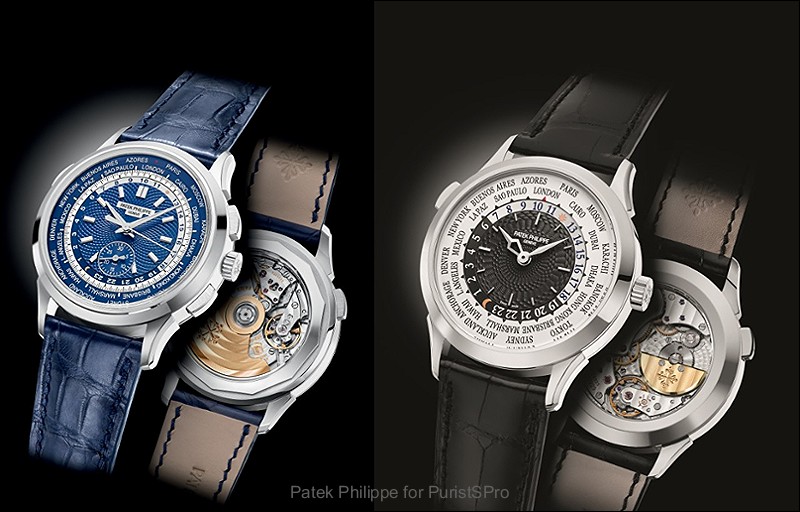
Patek Philippe 5230 World
Time only and
Patek Philippe 5930G World
Time Chronograph, inspired from
the unique 1415-1 piece from 1940.
To begin with, you may want to
refresh your memories by reading an article I wrote in late 2015 about
the history of Patek's World Time
pieces, here:
www.watchprosite.com
I find it interesting that these are two very
different offers; to me it is not just a simple version and a more
complicated
same one. The 5230 follows in the line of its predecessors in a
perfectly
updated way, whereas the 5930 is more impressive and more complicated.
There is a touch of casual and sport for dynamic people in the latter
that I think is very attractive.
I have made 2
threads in order to make it more readable with our forum
display.
This one is about the new 5930 World
Time Chronograph. You'll find the 5230's post here:
www.watchprosite.com
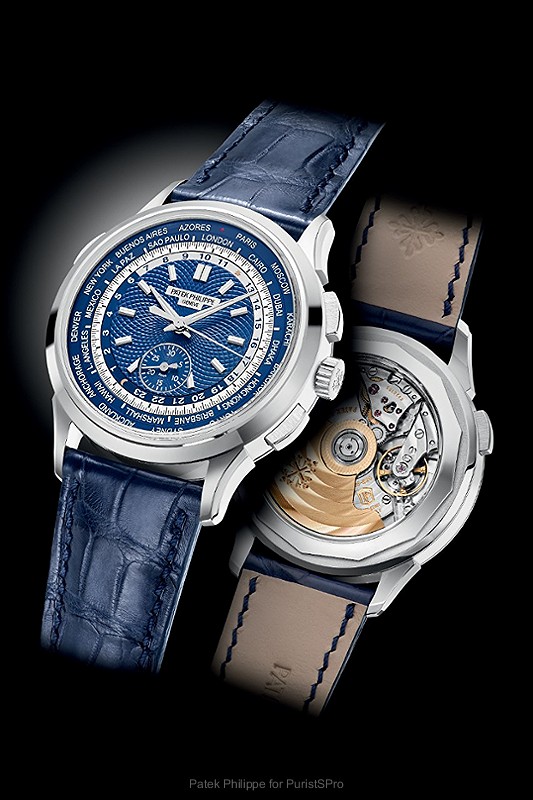
THE PATEK PHILIPPE 5930 WORLD TIME
CHRONOGRAPH
This new reference occupies a new spot in the collection and
is inspired by an old piece we hadn't seen for a very long while. As I
reminded in my WT historical article, the previous (and unique) model
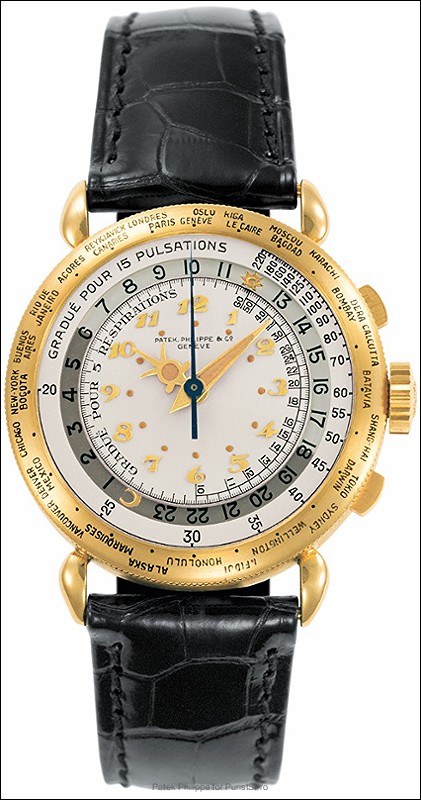
was born in 1940, at a client's request. It was the 1415-1 you see here
below. It features a
dial with pulsimeter
and asthmometer scales, and probably belonged to a physician (cf my WT
article linked in my introduction for further details). Thus, with the
reference
5930, Patek Philippe is now adding the World Time Chronograph as a new
member
to its regular collection. The unique
1415-1:
This reference represents a complication
combination we have only seen once before in Patek's collection, even
though the chronograph range of Patek ranks among the most eclectic,
extending from manually wound classics with horizontal clutches and the
world's thinnest split-seconds chronograph with two column wheels to the
monopusher chronograph with a minute repeater and an instantaneous
perpetual calendar. Now, the new 5930 brings together what is so
compellingly complementary.
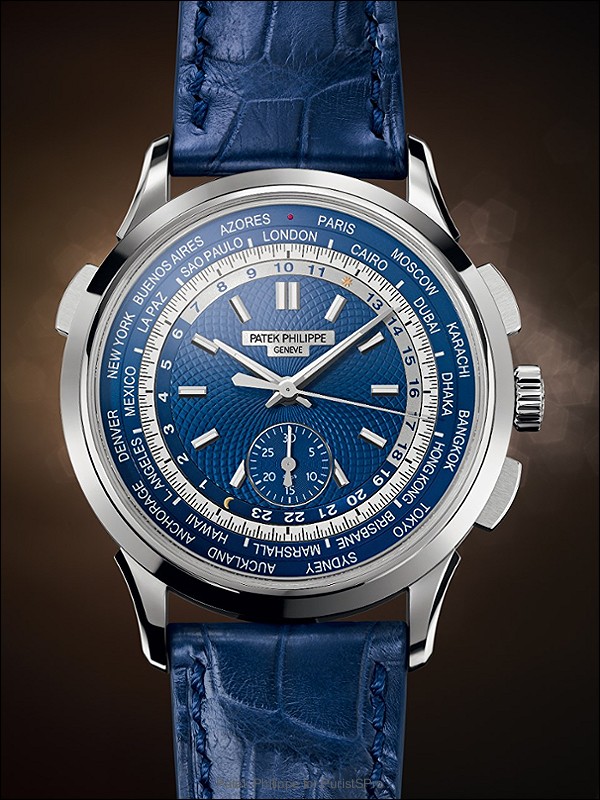
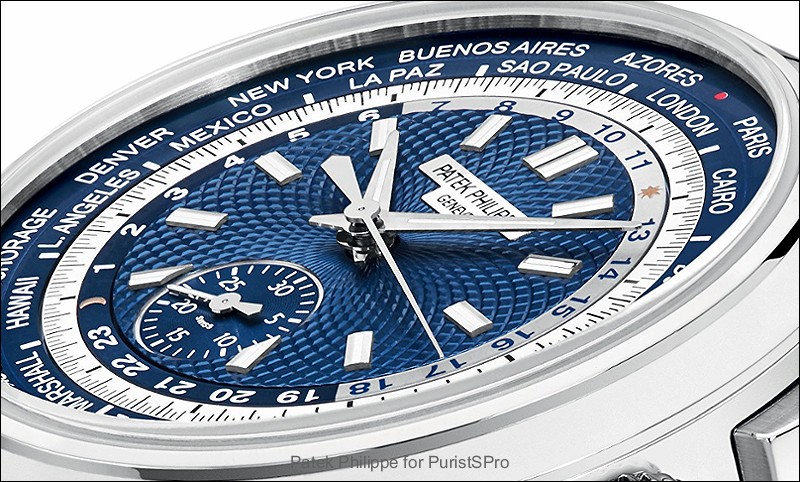
The first thing you can notice is that it
is all blue (yes it is). From what I understand and from what I could
see in the videos and some live pictures, the blue has a little grey hue
in the metal. In many fields, as paint colors, clothing, fabric in
general, whenever you have a color mixed with a touch of grey, it gives a
more sober but also more elegant feeling. Patek Philippe has applied
this principle to the color for this dial as well. This is particularly
something which changes with lighting and from which angle you look at
the watch.
The result of
this color choice seems to be a much more subtle look and more refined
feeling whereas the impression I had when looking at the first pictures
from the press release was that it looked sportier or more casual as the
blue tint looked more "electric". I felt there was
something missing, especially from Patek. Hence, I thought it didn't
attract me very much at first. However, it seems in the end that this
color detail changes everything and that it is much more elegant and
Patek-like than we thought. More than that, it might be a stunning move.
To be confirmed in the metal of course but I'm sure you will tell us as
well if you handle it whether at Basel or later.
It is mounted on a hand-stitched matt
navy blue alligator strap with large square scales to match the dial,
equipped with a fold-over clasp.
ABOUT THE AESTHETICAL
ORIENTATIONS
The
5930 reference is 39.5x12.8mm (whereas the
5230 is 38.5x10.2mm). What is really interesting is that the brand
decided to maintain the watch under 40mm while the watch looks a little
more casual and is thicker. I wondered first if it was not a will to
keep it in the traditional side. For instance, the 5960 model housing a
28-520 and an additional complication module (Annual Calendar) is
40.5x13.55 mm. This shows the size has been maintained quite low for
what it offers movement-wise.
This
being said, and after a few days, there is something I found
interesting from the very few wristshot pictures I could see:
the fact the watch is not on the big width side (above 41) makes the
watch have a very nice traditional look. Let me
explain.
It reminds me of complicated
models we saw in the 1950's - 1960's. At that time, I
remember seeing watches that were sometimes thick and more complicated
but which remained in smaller case sizes (usual for that time). When you
see the 3970 on a wrist for instance there is also this small diameter
and thick feeling I like a lot, related to that older period. I like it
because it reminds me of these older times aesthetical standards. Again,
to be confirmed in the metal but it will bring a very nice and
authentic additional vintage spirit to the watch; like a nice
traditional complicated and thicker watch from several decades ago. I
like that spirit very much and this is again a move from Patek I find
very interesting and I wouldn't have thought of.
Furthermore, the angled bezel top
side is much more visible compared to the usual 5296-5396-5496 one, or
the 5170's (similar style). Baron underlined it was a nice detail we saw
also in the 3448.
Finally, the overall impressions I
have from the dial is the same spirit, especailly the hands's shape and
the markers, altogether with the other decoration elements in this dial.
Very 1940's-1950's. It is not just about adding one or two details in a
classical watch. It is a whole new complete and homogeneous
design.
Please,
have a look at the video at the bottom of this article to have a better
idea of what I mean (especially at the beginning), even if you won't
see it on a wrist.
As both
the Chronograph and the World Time complications remain quite complex,
keeping thickness quite low seems to have been a real
challenge. When compared to the VC
(42.5x11.62mm, with 37 cities) for instance, I think I prefer having
this kind of size, so that it sits more comfortably on the wrist. It
doesn't feel oversized and less elegant on the wearer. Especially when
you consider the fact the 5930 offers a vertical clutch Flyback
Chronograph as well.
Something we learn in the video down below is that,
in order to gain
space and reduce the thickness of the movement, the aesthetical parts
(dial) are merged with the movement elements. Another interesting detail
about the fact that Patek uses room in the watch as efficiently as
possible to make the watch as thin as it can be. It is easy to compile
mechanics but to do so in a limited space is even more of a challenge
which is observed in the final result and wearability.
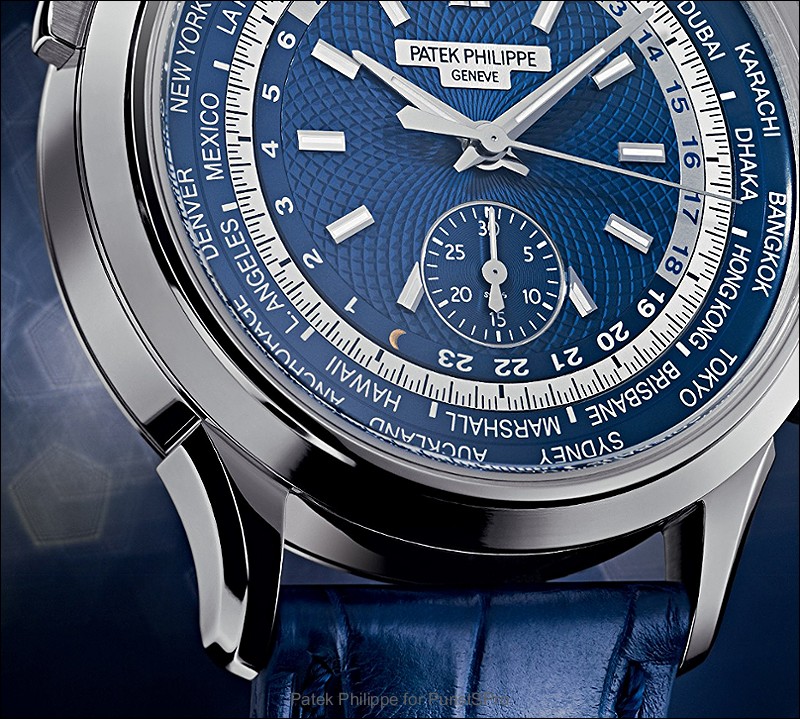
It has been updated with new cities for some
time zones – for instance Dubai instead of Riyadh or Brisbane instead
of Nouméa – and takes into account the fact that Moscow changed its
local time from UTC+4 to UTC+3.
A small gap
between the city disk and the 24-hour ring accommodates the seconds
scale for chronograph measurements. It is a narrow white circular scale
with fourth-of-a-second graduations. This subdivision reflects the
movement frequency of 4 hertz (28,800 A/h), which allows times to be
stopped to an accuracy of one-eighth of a second.
The dial has been designed to provide an
optimized legibility. Considering that this is a World Time model, I
find the dial very clear to read.
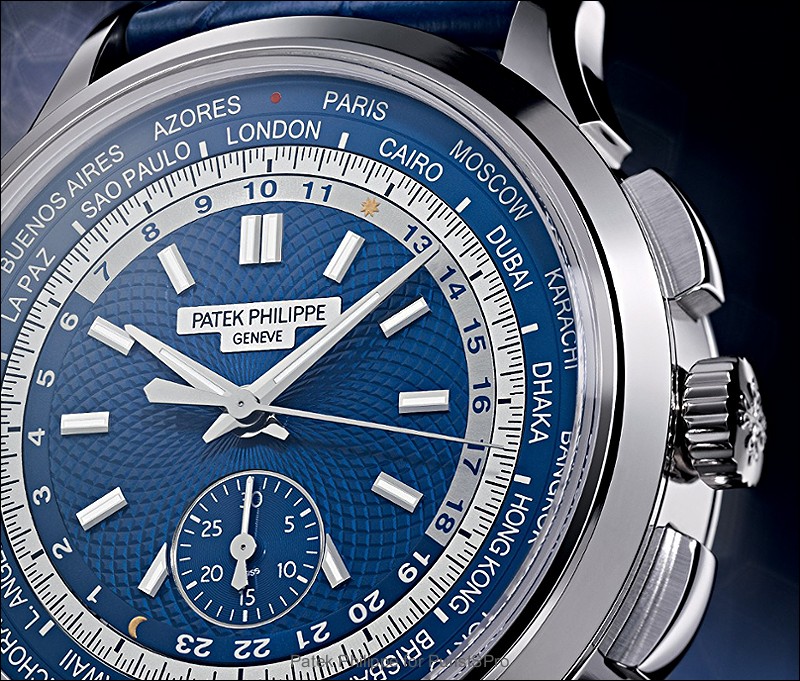
It sports a subtle manually guilloched
decoration (a bit like the 5110's) interrupted only by the white gold
index markers and the 30-minute chronograph counter. This subdial stands
out with a delicate white gold surround, the white minute scale, and
the discreet circular-grained finish. I'm not sure I like this subdial
size or position. No other place to put it considering the 28-520 (at
least I don't see one) but this is the only issue I have with this watch
to date.
One detail I like a lot is
the plaque holding the Patek Philippe logo. I find it very qualitative
and don't remember if it was used before (maybe someone does?). It
matches very well with the silvery elements (the 24H ring, the
chronograph's scale, etc...) and the silvery general
decoration.
Finally, when having a look at these hands, I
think after seeing now the 5204 and the 5905P, that I like their style a
lot. Not the fact they are less classical than traditional leaf hands,
they are just from another era, like the Dauphine hands are also. I
would say earlier for these hands, like the 1950's perhaps. The fact
they have a line of lume inside is of course part of the impression, and
they wouldn't have been the same without it. The hands are facetted
with 3 different levels. A very nice design imho that we will certainly
see again in the future.
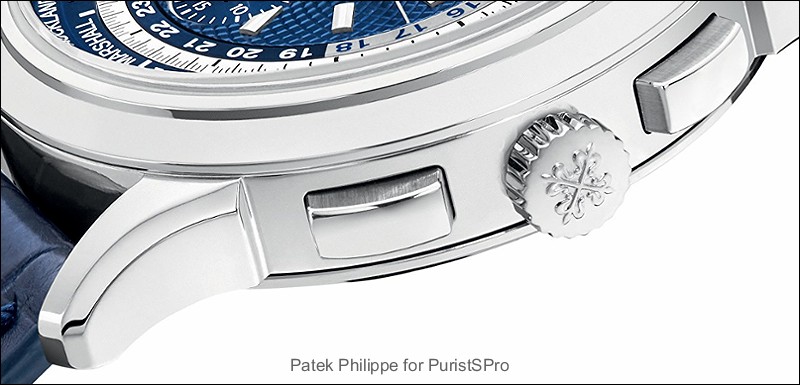
It features the same winglet-style strap
lugs that were a key design element of the 1940s and 1950s World Time
watches. The time-zone correction button is still at 10 o'clock and has
the same rectangular profile as the two chronograph
pushers.
It is my
taste talking, but I find this side case gorgeous. The lugs count for a
huge part in this feeling.
As a side note, you know that I'm not keen on using
magnifying glasses
to look at movements as they are hand-decorated elements and that it
can't be perfect at this magnifying rate. It is something to be admired
at the 1:1 scale, imho. The same way, don't forget that these pictures
are massively cropped and that a dial always looks more interesting and
pretty when all the elements are smaller. We even have a better overall
picture of the watch, it balance and how all the elements work together,
compared to seeing them separately on a big picture.
ABOUT THE
MOVEMENT
The biggest difference from its ancestor is that
both the World Time and the Chronograph complications have significantly
evolved since 1940, as you can imagine. Thus, the combination of both
is a totally different mechanism from its ancestor.
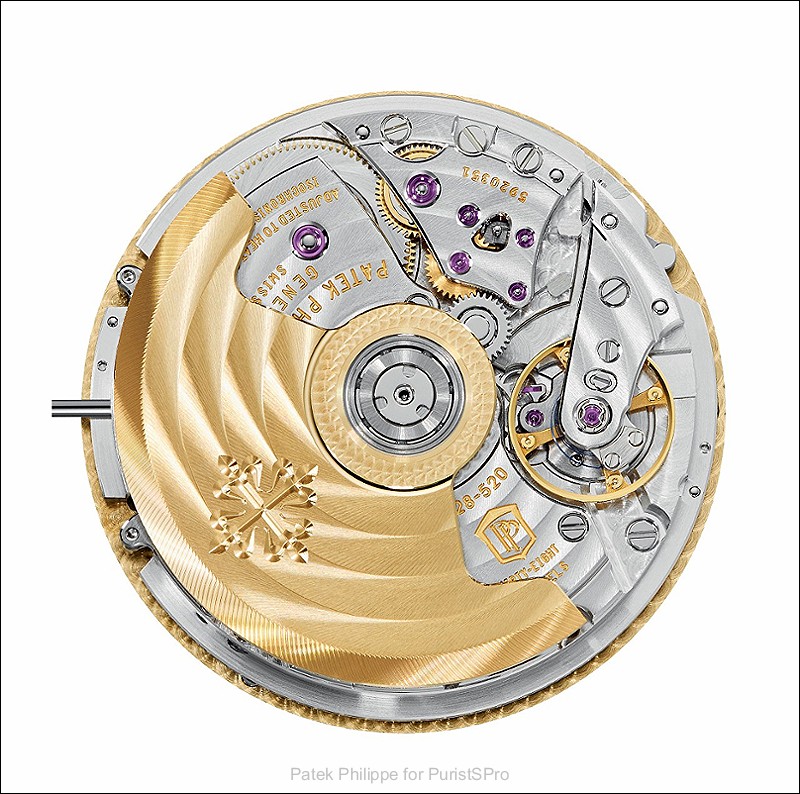
The movement
used as a base in the 28-520 caliber is the same we saw in the 5960 or
5905 families but the chronograph movement and the World Time mechanism
were enhanced with extensive modifications in order to adapt the
chronograph's minute counter to the WT's cities and 24H/Day-Night rings
mechanism.
As Patek says, axes were shifted, bridges
thinned and newly designed, and component clearances changed - so such
so that the caliber CH 28-520 HU can legitimately be called a new
movement. It embodies everything that belongs to Patek Philippe's proud
watchmaking heritage while featuring technical and functional
innovations that make it a latest-generation movement. This also applies
to its operation, in line with Patek Philippe's commitment to
user-friendliness. The chronograph has a start/stop pusher at 2 o'clock
and a reset pusher at 4 o'clock that also doubles as a flyback pusher.
When it is pressed while the chronograph is running, the sweep hand
flies back to zero and a new time measurement is started automatically.
Because the chronograph hand is powered via a vertical clutch, it can
also be used as a permanently running seconds hand without risking undue
wear and without affecting the rate accuracy and power reserve of the
watch.
We'll see that in the review later in the
year.
The
caliber hosts the purple-blue shimmer of the patented Spiromax balance
spring in Silinvar (silicon-based material).
A last note about the WT + Chronograph combination. I don't
really agree with the question about the coherence. What is the link
between the AC and Chrono in a 5960? THe chrono and PC? etc... if you
closely have a look at complications' combination in any brands, you'll
see they mostly don't have anything in common.
I can
understand though the fact that there would be more reasons to find this
kind of "symbiosis" between a WT and a Chronograph. As Moritz suggested
in another thread, a 12H counter instead of 30 minutes one would have
been quite cool indeed (a kind of additional Dual Time display or for
flights!).
Here
is the video from Mr. Philip Barat, head of Patek Philippe
Developement
presenting the new 5930 reference. Take the time to listen to how the
dial is included in the movement's developement in order to use space
the most-optimized way.
CONCLUSIONIt
is funny how I evolved from a quite neutral/colder reaction as it was
not a watch I felt was for me, prefering several other references
launched in Baselworld, to a quick progression toward the very first
steps of the podium. I of course have to confirm this when I'll be able
to handle it in one month or so but it is very promising and ended to be
something I'm eagerly looking forward to discover.
I
read earlier this could be the 5524 Pilot of 2016. I must say that I
disagree. First, I think that time will strengthen the legitimacy of the
5524 in the collection as it has already, after a whole year, widened
the horizon but I also think they are not at all representing the same
spirit. This is definitely not a watch made to broaden the "audience"
whatever the consequences. How many times has Patek found to be right
launching non-consensual models (remember the first World Time
references as the 515 or 96 HU or the very first 5070)? Of course, it
seems to remain a classical though less traditional piece, in opposition
to dressy models. What matters is that, in the end, it seems to be very
worthy of Patek Philippe and to have its own place in the collection
thanks to its spirit, its elegant casual look and
complication.
I will come back to it but, from my
recent thoughts about the new collection, we had a classical line next
to a chic-sport one (Nautilus). Until last week. Since then, I think we
are getting a 3rd line in the family. The issue Thierry Stern is facing
today is to discover how to bring modernity to the collection and
helping the brand not to stand still, while saveguarding its reputation
of elegance and refinement. Thus adding the good touch of modernism and
not the heavy and fashionable one. I think that the 5230 and 5930 open a
new kind of less classical design pieces but, as it is related to
1950's-1960's elements (which were great years in terms of style IMHO,
think about the Mad Men show) it is going to be a stunning move (between
the Classics and the Nautiluses). By the way the 6300G's side case
decoration (Clous de Paris) reminds me of the lighters from that period
as well (though they were also used during the
1930's).
You know where I imagine wearing that 5930
piece? In the TWA airport terminal in the 60's...
But
I'll develop that later.
We are going to talk a lot
about this one in the next few months once we handle
it.
Pricing will be €.66 870 in
France.
Thank you for reading and I'd like to hear
your thoughts on this one when you feel
ready.
Cheers
Technical
data
Ref.
5930 World Time Chronograph
Movement:
Caliber
CH
28-520 HU Self-winding mechanical movement, column-wheel chronograph,
vertical
clutch, local time, display of 24 time zones, day/night indication
Diameter:
Overall: 33.00 mm
Basic
caliber: 30.00 mm
Time-zone
module: 33.00 mm
Height:
Overall: 7.91 mm
Basic
caliber: 4.9 mm
Time-zone
module: 3.01 mm
Number
of parts: 343
Number
of jewels: 38
Power
reserve: Min. 50, max. 55 hours
Centrifugal
mass: Central rotor in 21K gold, unidirectional
winding
Balance:
Gyromax®
Frequency:
28,800 semi-oscillations per hour (4 Hz)
Balance
spring: Spiromax®
Balance
spring stud: Adjustable
Functions:
Two-position crown:
–
Pulled out: To set the time
–
Pushed in: To wind the watch
Displays:
With hands:
•
Local time in hours and minutes
•
Chronograph hand (trotteuse)
•
30-minute chronograph counter
With
disks:
•
City disk with 24 place names
•
24-hour ring with day/night indication in colors and
sun/moon symbols
Pushers:
Chronograph start and stop at 2 o'clock
Chronograph
reset and flyback at 4 o'clock
Time
zone adjustment at 10 o'clock (synchronized
adjustment of displays in one-hour steps for the hour hand and 1/24th
counterclockwise increments for the city disk and the 24-hour ring)
Hallmark:
Patek Philippe Seal Continued 5
Features
Case:
18K white gold
Sapphire-crystal
case back
Water
resistant to 30 meters (3 bar)
Case
dimensions: Diameter: 39.50 mm
Length
(across lugs): 48.23 mm
Width
(3 to 9 o'clock incl. crown): 42.85 mm
Thickness
(crystal to display back): 12.86 mm
Width
between lugs: 21 mm
Dial:
3-zone dial:
•
City disk blue, names printed white
•
24-hour ring with day/night indication in color and
sun/moon symbols (day: blue numerals on silvery background; night: white
numerals on blue background)
•
Center navy blue, hand-guilloched
Applied
baton hour markers in 18K white gold
•
Hands:
Hours
and minutes: Dauphine hands in 18K white gold, 3
facets, Superluminova coating
Parfil
chronograph hand in rhodiumed steel
30-minute
counter hand, baton style, counterbalanced,
rhodiumed steel
Strap:
Hand-stitched alligator with large square scales. Matt navy blue with
fold-over
clasp in 18K white gold
_______________________________
This message has been edited by Mark in Paris on 2016-04-17 07:01:23