
patrick_y
[PuristSPro Moderator]
33515

Geneva Watch Days 2025: Bulgari X Lee Ufan Octo Finissimo
Bulgari Watch has an incredible design director, Fabrizio Buonamassa, who has incredible taste. A true Italian, he spends a lot of time in both Italy, Switzerland, and in Japan. His unique aesthetic sense and deep relationships with Japanese artists and architects (that he has forged over decades) has brought some of the best collaborations in the entire watch industry to light. Let's explore the latest piece between Bulgari and Lee Ufan, a famous South Korean artist who resides in Kamakura, Japan.

Fabrizio Buonamassa (left) with Lee Ufan (right).
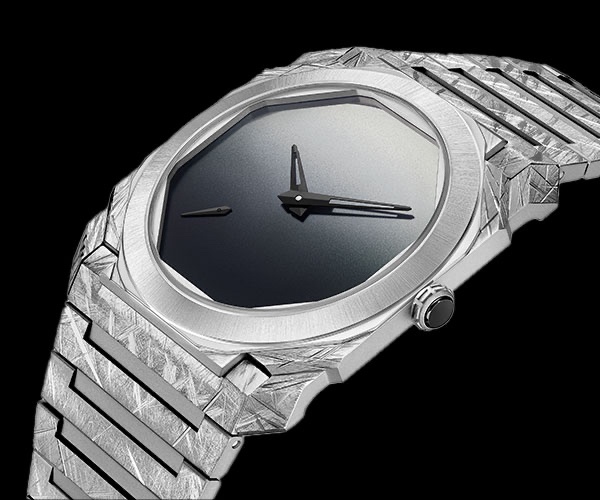
Preface: I suggest you read this article very quickly, comment quickly if you can, and get your phone out quickly to phone your local Bulgari boutique. This one is a winner.
Minimalism. Restraint. These are words that are lost in today’s world. Walk from the bar to your table in even the finest restaurants and you’ll walk past a woman or a man who has put on too much perfume; sometimes many patrons. Stay at the world’s finest hotels and in the breakfast room, you’ll see at least one person dressed in heavily logo-ed attire from head to toe – almost hurts my eyes. First world problems for sure, but where did a modicum of restraint go?
Enter Japan.
The Japanese aesthetic which always was a combination of harmony, nature, minimalism, Buddhist pragmatism, and modesty has created an aesthetic that really works as an art form. The art was well received by industry captains such as Phil Knight (Nike), Steve Jobs (Apple/Pixar), Bill Gates (Microsoft), Lawrence Ellison (Oracle), and many more. And during the Japan heydays of the 1970s through late 1990s, the world’s second largest economy heavily influenced the West and influenced the world in both visible and unseen ways.
Presenting Lee Ufan
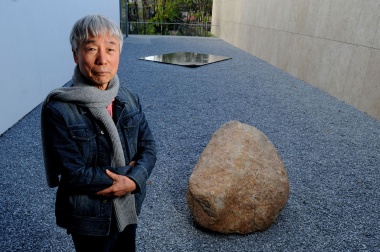
Lee Ufan is a South Korean artist who was trained in Japan. He resides in serene Kamakura, Japan. I can wax poetic about his art for a thousand words, but for the sake of efficiency (and because nobody wants to read a non-expert write about art), I’ll let his art do the talking; and I’ll present two differing styles of his art.
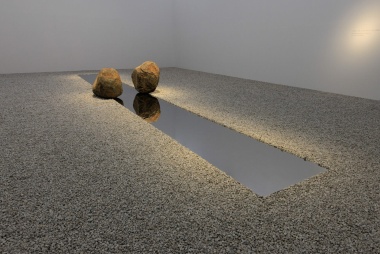
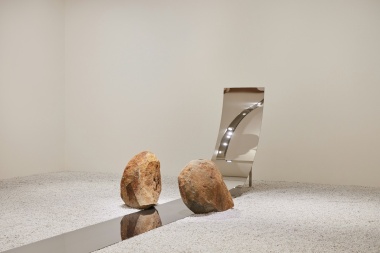
Rock and glass, a juxtaposition of the man-made perfection of a mirror and nature. The mirror can also be seen as representing water – as water can reflect light when it is calm. This art has a Zen effect that induces calmness.
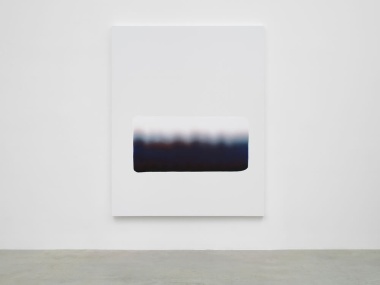
This painting represents something else – I can’t quite put my finger on it, but it reminds me of a Mark Rothko. As it gives me a similar feeling of calm a Rothko does, just a slightly different cooler/modern feeling (Rothko feels warmer).
Presenting the Bulgari X Lee Ufan Octo Finissimo
The Bulgari Octo Finissimo is a wonderful canvas for artists and architects. And the latest collaboration shows a canvas that has been well purposed. Please watch the Bulgari promotional video, as the still photos show a gradiant in the dial’s color that isn’t quite the same as in reality.
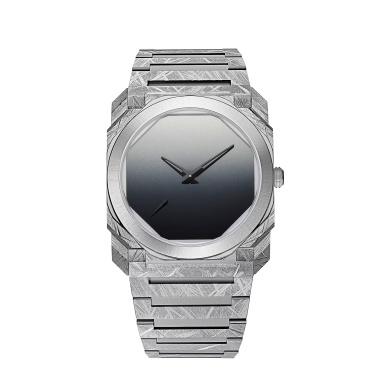
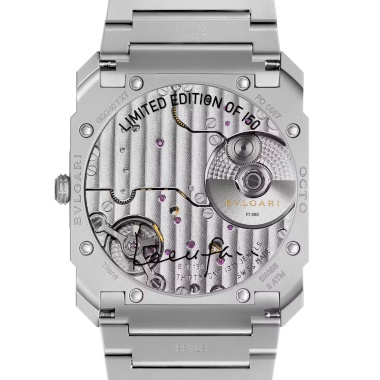
Each watch is made from titanium, however the bezel is actually made of brushed stainless steel. The markings on the titanium parts are done by hand using files, chisels, and other tools. Each piece will be unique, since they're all done by hand. The photo shows a gradient in the dial, in reality, this gradient does not exist, it's just how the light hits the dial. 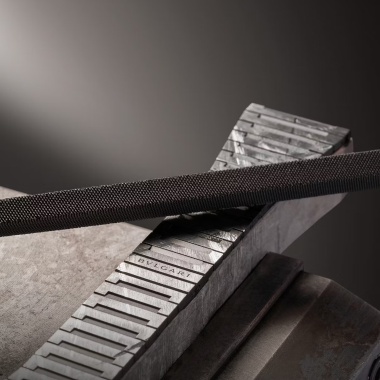
The case and bracelet are made of Titanium and are "filed" with tools to create the rocky and bark-like texture. The dial represents a black mirror, and the combination is a juxtaposition of natural harmony and man-made art. The recessed parts of the bracelet are left in their original sandblasted finish. Giving a nice contrast. The whole piece is a work of art - and a balance of exuberance and restraint.
In addition, the production is also heavily restrained; only 150 pieces for worldwide consumption. The Tadao Ando and the Kazuo Sejima Octo Finissimos are heavily treasured objects for their owners. If this watch appeals to your Zen, then I suggest you call your Bulgari dealer quickly!
Additional Bulgari Octo Finissimo Content:
Geneva Watch Days 2025: Bulgari X Lee Ufan Octo Finissimo

That really is a stunning looking Bulgari Octo Finissimo.
Agreed!

Quite cool and imaginative.


I really want to like Bulgari but they have had my Finissimo GMT for 9 months...
It's been 9 months already?

Until I read that the bracelet is filed to get that texture...
Yes, cost would be high. As meteorites are fairly expensive.
Ah ha.
Yes! Agreed!

This LE embodies the Finissimo aesthetic
Tasso Ando first LE
I agree with you on the Tadao Ando. That one was AMAZING. My favorite too.
One of my absolute favorites! This one is up there on my list!
