
DeGeus
278

ref. identifying
Hallo Thom.
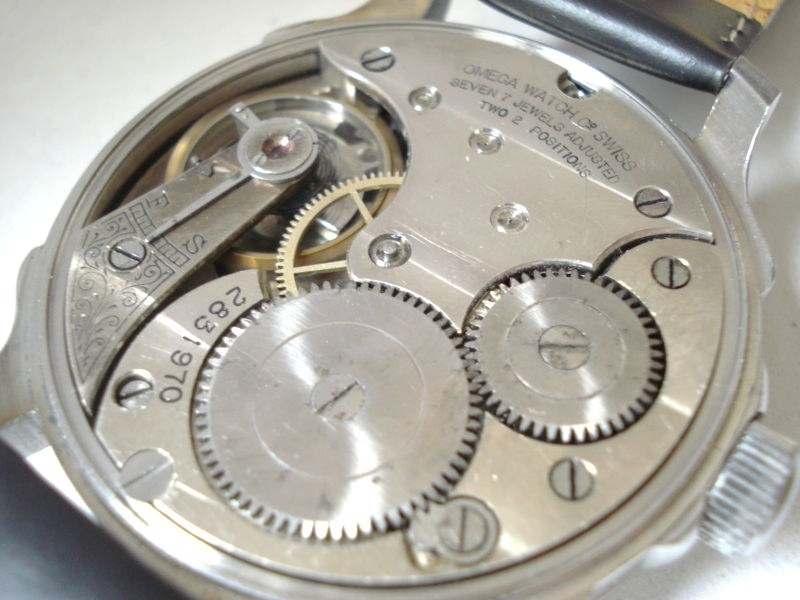
This is the very movement which made Omega famous; when it was introduced (size 19''') it was actually called caliber "Omega" (the wellknown story about the namegiving by banker Rieckel). It proved to be a big succes and within a couple of years it was available in sizes 15 - 17 - 18 - 19 - 20 lignes (for men) and 10 - 11 - 12 - 13''' (for ladies). Moreover, practically all sizes were offered both in Lépine version and Savonette.
And that's not all: depending on what accuracy you wished for (or money to spend!) the customer could choose from qualities -or grade A (basic), B (most current), C (very fine) and D (top notch!).
In the example you have brought forward in your post 19'''LOBNN 15p: 19=size, L=Lépine, O=Omega, B=grade, NN=negative stem mechanism by Omega, and the number of jewels.
To determine the size by the naked eye and distinguish between 18, 19 or 20''' is rather difficult - you really do need a set of calipers. Your measurement of 40,6mm would indicate that it is in fact a 18'''. However, keep in mind that the (then new) caliber 40.6 (in millimeters) that Omega introduced in 1923 looks very similar.
Concerning the winged wheel at the back-side, this could also be due to a person's jubilee at his company, where he received it as a memorable gift from his (railway)employers?
Apart from all this, i find the fact that it is on many occasions pretty frustating to find so little info on the movement itself : only the brand name and that's it - no Swiss, no jewels, no adjustments, no type of caliber, sometimes not even a visible serial number (at least you have that!).
This was not always the case, proof of which is this 19'''SO grade A (7 jewels) pic:
Help to determine Omega pocket watch caliber

Hi Thomas, I would like to know...
I guess it is
ref. identifying
DDR version
thanks, ben ! always wanted to buy a DDR grade....
some photos of a DDR

Thanks very much for sharing your DDR with us, Fred. Thomas' [tdn-dk] thread is some nine years old - could you possibly . . .

The engraving on the back cover looks very much . . .