
SJX
[Purist]
8540

Les Chronographes Email Grand Feu - Last of the Minerva chronograph movements
Montblanc “Collection Villeret 1858”
Montblanc Collection Villeret 1858
Les Chronographes Email Grand Feu:
Exclusive chronographs with genuine enamel dials
and the last of the 16.29 and 13.21-calibre movements
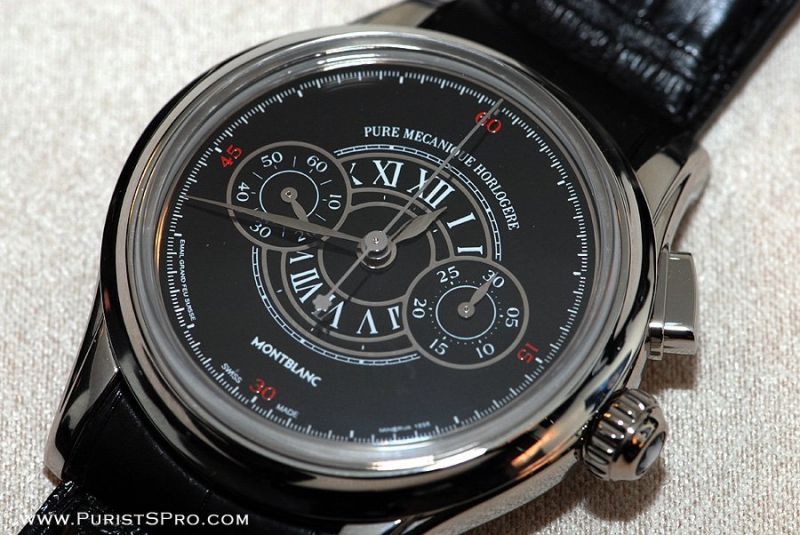
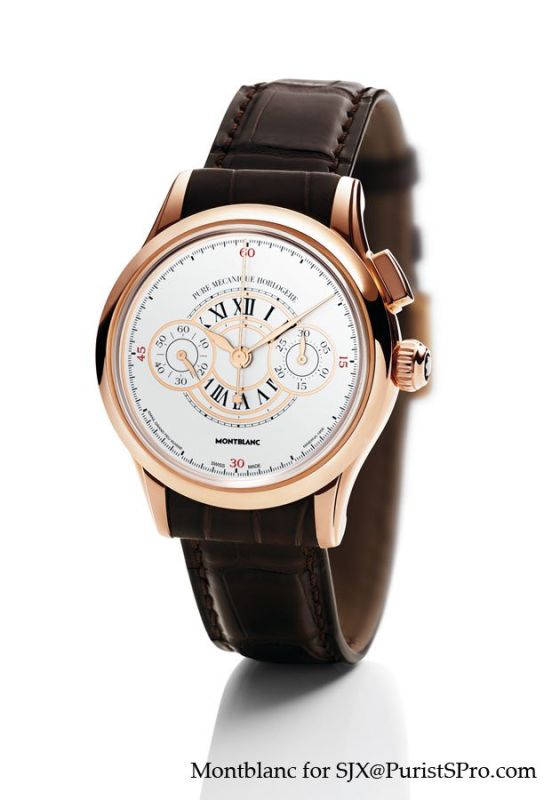
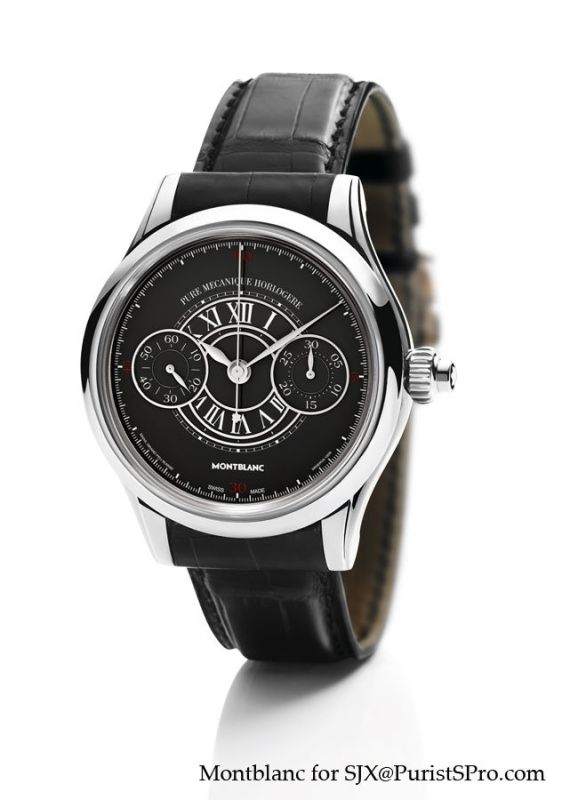
Wristwatches with genuine enamel dials are highly sought-after rarities. Nowadays, these are made by only a handful of manufacturers with an especially rich tradition. This fact alone underscores the significance of the two chronographs in the Montblanc Collection Villeret 1858 Email Grand Feu, which are being launched to mark Minerva’s 150th jubilee. Their most outstanding feature is a dial with genuine champlevé enamel work, beneath which ticks a movement made in accordance with true haute horlogerie tradition. An extra touch of exclusiveness is added by the fact that these are the last of the 16.29 and 13.21-calibre movements.
A true baptism of fire
Of all the enamelling techniques, champlevé is one of the most demanding, because it unites the engraver’s art with that of the enamellist. In champlevé, the craftsman laboriously hand-carves the desired patterns into the material used for the baseplate of the dial with a burin. The Email Grand Feu chronographs have a solid-gold base-plate, which is considerably more difficult to work than the copper plates normally used. After the surfaces have been carved out with the burin, the incisions are filled with enamel in powder or paste form, which is mixed with a variety of metallic oxides, depending on the desired colour. Once the enamel has been applied, the dial is placed in an oven, where the enamel particles are melted at 850°C into a vitreous mass and their colour changes. Since the gold plate of the dial and the enamel expand and contract at different rates during heating and cooling, the reverse side is coated with counter enamel, which prevents the dial from distorting and the enamel from cracking when cooling. The entire cooling process must be slow and controlled, so that any tension in the enamel can be gently dispersed. Only if this is so can we be sure that the enamel will not crack or break.
Once the dial has cooled down, its surface is painstakingly polished with diamond-tipped tools until the enamel and the uncarved parts of the gold plate form a smooth, homogeneous surface. Now, the entire dial is given a colourless, highly transparent coating of enamel – the fondant – which is then fired again and fused to create a protective shield. In a final printing process, the dial receives its numerals and lettering. Among these is the delicately executed inscription EMAIL GRAND FEU SUISSE.
Beauty for all eternity As artefacts thousands of years old have shown, the durability of enamel has been known since time immemorial. Enamel jewellery up to four-thousand years old has lost none of its colour or radiance to this day. The secret of this lies in the vitreous material, on the one hand, and in the metal oxides that produce the desired colour when fired, on the other. The firing process creates a new chemical compound which remains stable indefinitely. This is in complete contrast to the pigments used in the oil colours traditionally used when painting on canvas. The production of a single champlevé enamel dial occupies several highly qualified specialists for days and is bound up with many imponderables. Any piece that fails to meet the required level of perfection is scrapped and work starts again from scratch. Grand Feu enamel dials for the limited edition and exclusive unique pieces The precious Grand Feu enamel dials will be used to highlight the last remaining examples of the haute horlogerie 16.29 or 13.21-calibre chronograph movements. These are the same ones found in the “Grand Chronographe Authentique” and the “Chronographe Authentique” from the first Montblanc Collection Villeret 1858. For the limited edition to mark Minerva’s 150th jubilee, each calibre will be featured in a unique platinum model with a blue Grand Feu enamel dial, eight white-gold watches with a white or black dial, and 58 rose-gold watches with a white Grand Feu enamel dial. In the course of the years ahead, the few remaining movements will be used for exclusive, one-of-a-kind pieces, which will be designed and manufactured to meet the customer’s requirements. As soon as the limited jubilee editions and individual models have been sold, the exclusive chronograph movements will no longer be available.
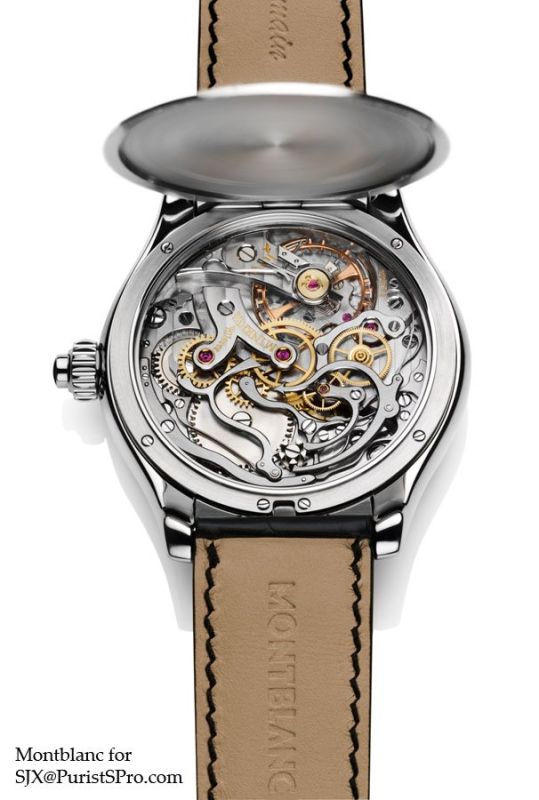
Watches made with all the finesse of traditional haute horlogerie The two 16.29 and 13.21-calibre chronograph movements are manufactured in accordance with all the tenets of traditional watchmaking; the unusually high proportion of finishing work carried out by hand is particularly noteworthy. The plates and bridges are made of rhodium-plated German silver, the bottom plate is circular-grained on both sides, while the bridges are chamfered by hand and decorated with circular-graining and Geneva stripes (Côtes de Genève) on the top surface. In keeping with traditional watchmaking practice, the chronograph is controlled with a column wheel, which the chronograph lever moves into position for each function and locks. A horizontal wheel train mechanism with a large chronograph wheel serves as the clutch. The chronograph‘s “Mise en Fonction” is carried out meticulously by hand, every single part of each movement being aligned with the others to tolerances of a hundredth of a millimetre. One eye-catching feature is the large screw balance with its high moment of inertia, which guarantees a steady, solid rate. These balances are manufactured in the company’s own ateliers, and even the balance springs are specially made. The counting of the active length of the spring and the forming of the Phillips curve are likewise tasks that are carried out by hand in the workshops of the “Institut Minerva de Recherche en Haute Horlogerie”. The frequency of the chronograph movements is 2.5 hertz, or 18,000 beats per hour, which enables it to record short periods of time to an accuracy of one-fifth of a second. Artistic cases made of platinum or gold The cases, made of platinum or 18 ct. gold, are polished on all sides and feature a convex bezel securing high-domed sapphire glass with sharp vertical sides. Closing firmly over the screw-in sapphire-glass back cover is a hinged cuvette that is released using a patented mechanism that is invisible from the outside and mounted on the horns for the wristband. On the outer surface of the cuvette are the engravings “Edition Limitée”, “Montblanc” and “Fait main à Villeret” (handmade in Villeret). The inner surface of the cuvette bears the signature of master watchmaker Demetrio Cabiddu. The movement can be seen behind the sapphire-glass back cover, with its gold-plated engraving: “Minerva Villeret”. The Montblanc symbol, in genuine mother-of-pearl, adorns the winding crown on these watches. 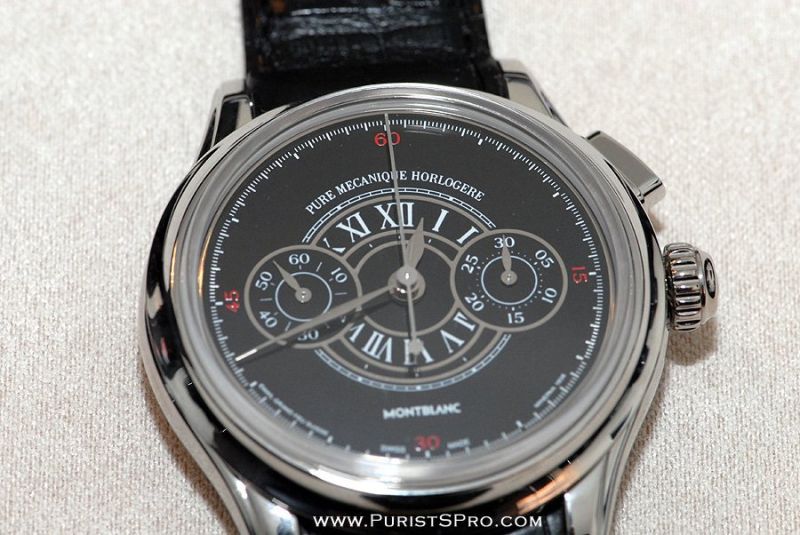
Montblanc Collection Villeret 1858 to mark 150th anniversary of Minerva - and a contest!
Les Chronographes Email Grand Feu - Last of the Minerva chronograph movements
Les Secondes au Centre Retour-à-Zéro - Central seconds zero-reset
And a CONTEST!


The Black Grand Feu Enamel Dial, for me


