
Montblanc Collection Villeret 1858 to mark 150th anniversary of Minerva - and a contest!
Montblanc celebrates the 150th anniversary of Minerva this year with a special collection of watches, including a wristwatch with a zero-reset centre seconds, likely to be the first and only of its kind (Lange zero-reset is subsidiary seconds). A bigger surprise will come later this year, when Montblanc unveils something special for the 150th anniversary. October 2008 will also see the reopening of the Minerva atelier - guests are welcome to visit.
- SJX
Press release:
Montblanc “Collection Villeret 1858”
The latest additions to the Montblanc Collection Villeret 1858
to mark the 150th jubilee of Minerva
and a special surprise for autumn 2008
This year Montblanc is celebrating a major jubilee - it has been 150 years since the foundation of Minerva, a small manufacture specializing in handcrafted watchmaking, in Villeret. The company soon began focusing its attention on timekeeping and has since developed the chronograph to the peak of perfection. Only a handful of watch manufacturers can look back on such a long, uninterrupted history, and over the years Minerva has held fast to the working methods traditionally associated with Swiss watchmaking at its best. This is the art of haute horlogerie, which is practiced largely by hand. Only a select group of master watchmakers today are familiar with the procedures and techniques required for this rarest and most exclusive form of watchmaking. Important components like the generously sized balance with its high moment of inertia are made in-house, the active length of the tailor-made balance springs is counted by hand as it was in bygone ages, and the “Mise en Fonction” of the chronograph control carried out meticulously by hand for each individual movement. Almost two years ago, in order to preserve its authenticity, Minerva joined forces with Montblanc, which is likewise dedicated to the preservation and practice of manufacturing traditions handed down from one generation to the next, in all its business activities. Montblanc is celebrating the occasion with exclusive jubilee additions to the Montblanc Collection Villeret 1858, which will be unveiled at this year’s SIHH (Salon de la Haute Horlogerie) in April 2008. And for autumn 2008, Montblanc has a special surprise up its sleeve to mark Minerva’s 150th jubilee.
Montblanc timepieces comply with the strictest tenets 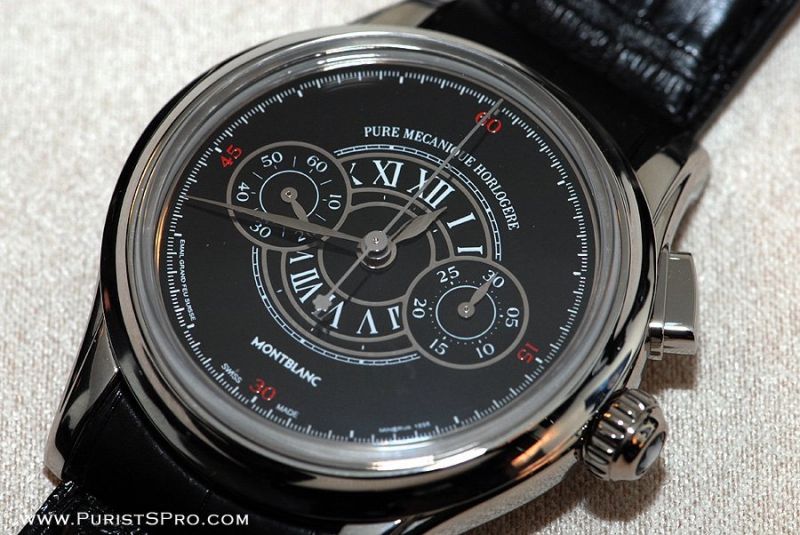
of watchmaking
Since 2007, the name Montblanc Collection Villeret 1858 has stood for timepieces manufactured in accordance with the tenets of traditional haute horlogerie. Each demands such a high level of specialized craftsmanship and finishing that annual production is limited to just a few hundred watches. Movements, of which each a hinged cuvette with a snap closure that is invisible from the outside and is released using a patented mechanism located under the horns. The cases are manufactured in type is limited to a maximum of 288 pieces, have been specially developed for these watches. The figure 288 stands for the sum total of two gross (one gross equalling twelve dozen), which is a traditional unit of measurement in watchmaking. Central to the development of new movements is a focus on classical garde-temps (timekeeper) philosophy, with special attention being paid – in view of Minerva’s history – to the chronographs. In terms of their form, all movements build on the outstanding legacy of Minerva, which sets new standards with the unmistakable aesthetics of its beautifully shaped bridges and levers. The individual parts are finished to a level of perfection mastered by only a very limited number of specialists. The same philosophy, founded firmly on authenticity and craftsmanship that applies to the manufacture of the movements, is the guiding principle for the other parts in the Montblanc Collection Villeret 1858. All the watches come with cases of 950 platinum or 18 ct. gold and a see-through sapphire-glass back under diameters of 47 and 41 millimetres to accommodate the different sizes of movements. The dials and hands are made of solid gold and protected by high-domed sapphire glass with vertical sides: a chevé, as it is known to watchmakers.
Art in the truest sense of the word
Watches manufactured like those in the Montblanc Collection Villeret 1858 are items with a high cultural value and can rightfully be considered very special works of art. In recognition of this – as well as of their extremely limited availability – each timepiece in the Montblanc Collection Villeret 1858 is accompanied by a set of lithographs presented in a leather-bound case: historic depictions of the old Minerva manufacture (the French term traditionally used for a workshop specializing in handcrafted watchmaking), landscape impressions of the Jura mountains, illustrations of watch movements, and a lithograph of the watch in question. The latter is at the very heart of each portfolio because, like the watch itself, it is unique. It bears the watch’s serial number, its number in the limited edition, and the handwritten signature of master watchmaker Demetrio Cabiddu. Each set of lithographs is assembled individually and is thus an element in the philosophy that makes each and every watch in the Montblanc Collection Villeret 1858 something unique.
1858 – 2008:
Rarities manufactured by Montblanc to mark a special jubilee
The parts of the movement and other components used in the manufacture of watches in the Montblanc Collection Villeret 1858 pass through the hands of highly specialized and qualified master watchmakers hundreds of times. This naturally limits capacity, and in 2008 production will reach a maximum of 350 watches. As a tribute to Minerva, the founding year of 1858 will serve as the framework for the limited editions of the various models: Taking the formula 1/8/58 as a basis, production will comprise unique pieces in platinum together with editions of eight pieces in white gold and 58 pieces in rose gold. As if this were not exclusive enough, the various movements will also be crafted as highly individual, unique works of art featuring designs based on the personal wishes of their future owners. For customers purchasing a timepiece from the Montblanc Collection Villeret 1858, this is a guarantee that their choice of wristwatch will exist once, and once only, worldwide. With their authentic haute horlogerie character, the limitation of each calibre to just 288 pieces, and their extremely limited availability (if not uniqueness), the watches in the Montblanc Collection Villeret 1858 meet all the conditions one would expect of a genuine collector’s item. This was the thinking behind the first four lines of haute horlogerie timepieces in the Montblanc “Collection Villeret 1858”, which took the industry by storm in 2007 and was sold out within the space of a few months.
Montblanc founds the
“Institut Minerva de Recherche en Haute Horlogerie”
Since October 2006, Montblanc and Minerva SA from Villeret in the Bernese Jura mountains have been working together on the development and in-house manufacture of prestigious watch movements. The name Minerva stands for traditional, in-house Swiss watchmaking in the truest sense of the term: Firstly, because it implies the development and assembly of its own movements; and, secondly, because it involves a degree of painstaking craftsmanship that is rarely encountered even in the world of haute horlogerie. It was to quell the growing danger that the skills and craftsmanship intrinsic to the art of Swiss watchmaking might drift into oblivion that Montblanc and Minerva joined forces to establish the “Institut Minerva de Recherche en Haute Horlogerie”. Back in 2007, Montblanc made substantial investments to sustain this irreplaceable experience and expertise and to secure it for generations of watch devotees to come. The aim of this institute is to preserve invaluable skills, to build on them, and to propel them to a new level of greatness. The spotlight here will be on training. The newly founded institute is intended to function as a kind of think tank, where young watchmakers can meet up to exchange ideas and be initiated into the old traditions, the expertise developed over generations, the rich body of experience and the mentality typical of the true master watchmaker preserved. This purpose, too, was the reason for the “Fondation Minerva de Recherche en Haute Horlogerie”, whose foundation capital was provided by Montblanc. The foundation will be receiving financial and logistic support for its first non-profit projects this year. There are also plans for exhibitions, workshops and seminars for people in the industry, with a view to making what the institute has to offer accessible to as many interested individuals as possible. In October 2007, work began on a major renovation of the premises that have served as the headquarters of the company since its foundation in Villeret. In October 2008, to celebrate the 150th jubilee, the ateliers will once more be open to interested visitors and collectors.
Les Chronographes Email Grand Feu - Last of the Minerva chronograph movements
Montblanc “Collection Villeret 1858”
Montblanc Collection Villeret 1858
Les Chronographes Email Grand Feu:
Exclusive chronographs with genuine enamel dials
and the last of the 16.29 and 13.21-calibre movements
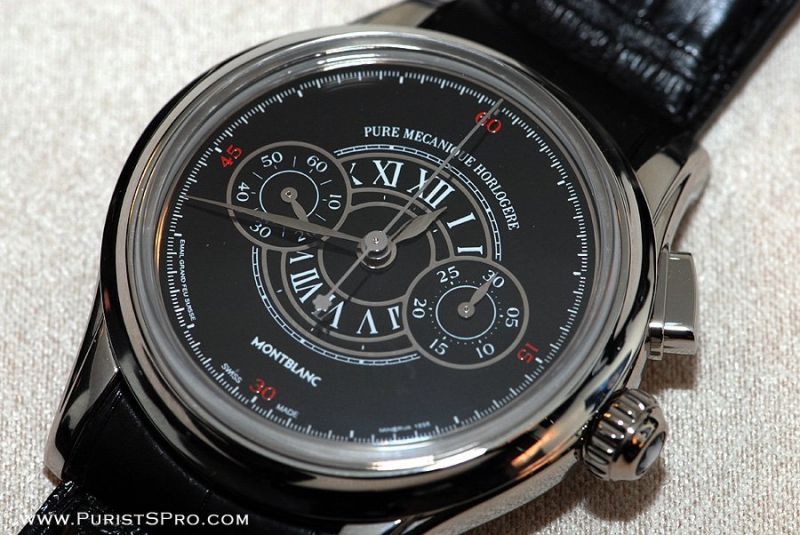
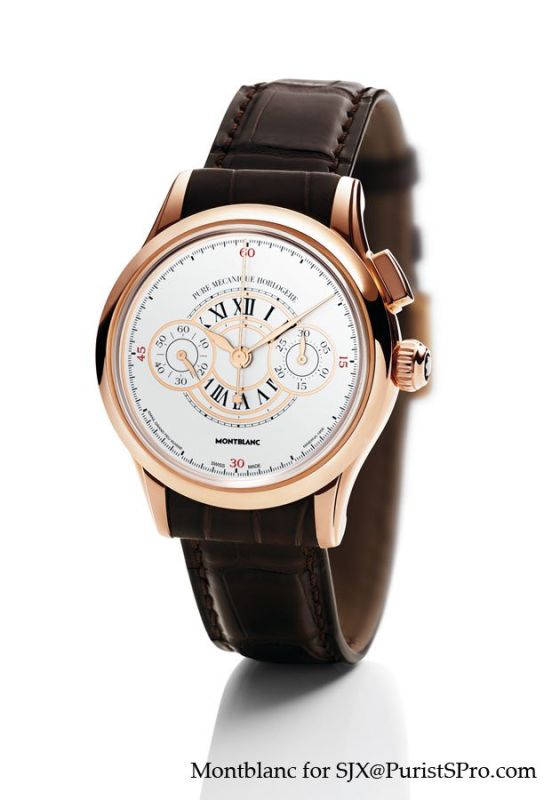
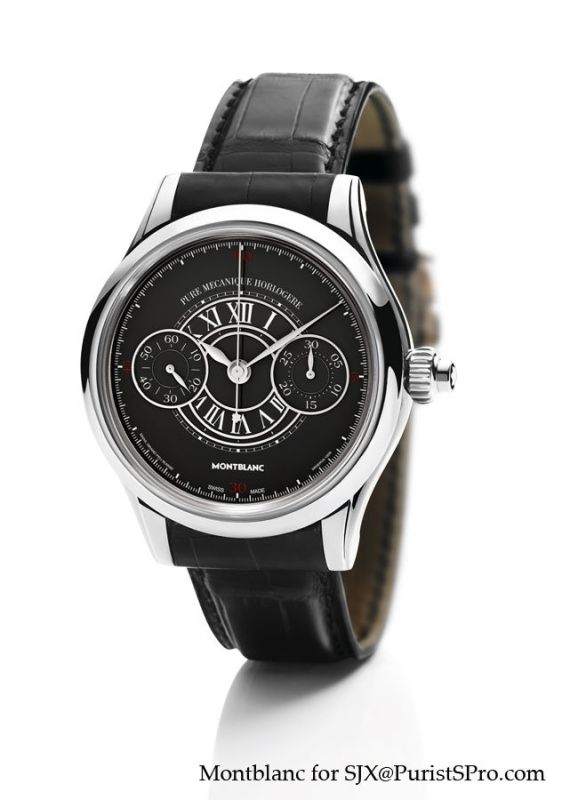
Wristwatches with genuine enamel dials are highly sought-after rarities. Nowadays, these are made by only a handful of manufacturers with an especially rich tradition. This fact alone underscores the significance of the two chronographs in the Montblanc Collection Villeret 1858 Email Grand Feu, which are being launched to mark Minerva’s 150th jubilee. Their most outstanding feature is a dial with genuine champlevé enamel work, beneath which ticks a movement made in accordance with true haute horlogerie tradition. An extra touch of exclusiveness is added by the fact that these are the last of the 16.29 and 13.21-calibre movements.
A true baptism of fire
Of all the enamelling techniques, champlevé is one of the most demanding, because it unites the engraver’s art with that of the enamellist. In champlevé, the craftsman laboriously hand-carves the desired patterns into the material used for the baseplate of the dial with a burin. The Email Grand Feu chronographs have a solid-gold base-plate, which is considerably more difficult to work than the copper plates normally used. After the surfaces have been carved out with the burin, the incisions are filled with enamel in powder or paste form, which is mixed with a variety of metallic oxides, depending on the desired colour. Once the enamel has been applied, the dial is placed in an oven, where the enamel particles are melted at 850°C into a vitreous mass and their colour changes. Since the gold plate of the dial and the enamel expand and contract at different rates during heating and cooling, the reverse side is coated with counter enamel, which prevents the dial from distorting and the enamel from cracking when cooling. The entire cooling process must be slow and controlled, so that any tension in the enamel can be gently dispersed. Only if this is so can we be sure that the enamel will not crack or break.
Once the dial has cooled down, its surface is painstakingly polished with diamond-tipped tools until the enamel and the uncarved parts of the gold plate form a smooth, homogeneous surface. Now, the entire dial is given a colourless, highly transparent coating of enamel – the fondant – which is then fired again and fused to create a protective shield. In a final printing process, the dial receives its numerals and lettering. Among these is the delicately executed inscription EMAIL GRAND FEU SUISSE.
Beauty for all eternity As artefacts thousands of years old have shown, the durability of enamel has been known since time immemorial. Enamel jewellery up to four-thousand years old has lost none of its colour or radiance to this day. The secret of this lies in the vitreous material, on the one hand, and in the metal oxides that produce the desired colour when fired, on the other. The firing process creates a new chemical compound which remains stable indefinitely. This is in complete contrast to the pigments used in the oil colours traditionally used when painting on canvas. The production of a single champlevé enamel dial occupies several highly qualified specialists for days and is bound up with many imponderables. Any piece that fails to meet the required level of perfection is scrapped and work starts again from scratch. Grand Feu enamel dials for the limited edition and exclusive unique pieces The precious Grand Feu enamel dials will be used to highlight the last remaining examples of the haute horlogerie 16.29 or 13.21-calibre chronograph movements. These are the same ones found in the “Grand Chronographe Authentique” and the “Chronographe Authentique” from the first Montblanc Collection Villeret 1858. For the limited edition to mark Minerva’s 150th jubilee, each calibre will be featured in a unique platinum model with a blue Grand Feu enamel dial, eight white-gold watches with a white or black dial, and 58 rose-gold watches with a white Grand Feu enamel dial. In the course of the years ahead, the few remaining movements will be used for exclusive, one-of-a-kind pieces, which will be designed and manufactured to meet the customer’s requirements. As soon as the limited jubilee editions and individual models have been sold, the exclusive chronograph movements will no longer be available.
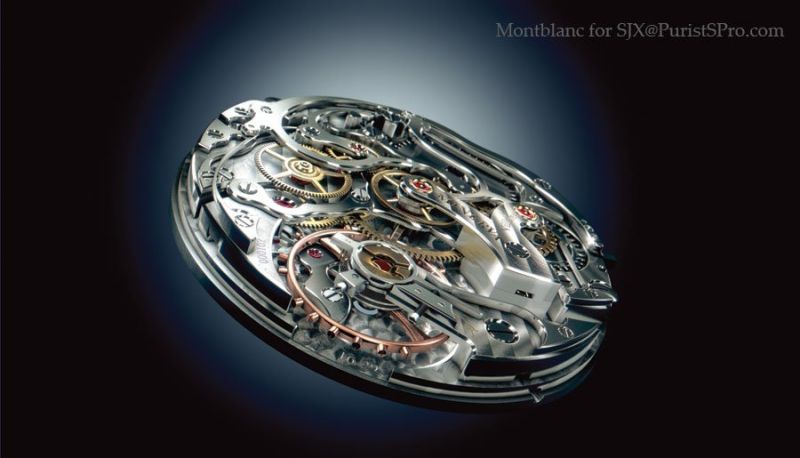
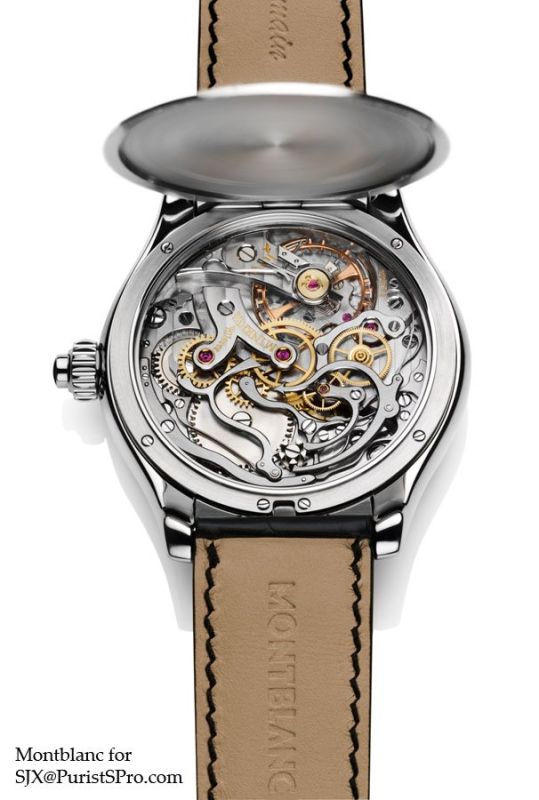
Watches made with all the finesse of traditional haute horlogerie The two 16.29 and 13.21-calibre chronograph movements are manufactured in accordance with all the tenets of traditional watchmaking; the unusually high proportion of finishing work carried out by hand is particularly noteworthy. The plates and bridges are made of rhodium-plated German silver, the bottom plate is circular-grained on both sides, while the bridges are chamfered by hand and decorated with circular-graining and Geneva stripes (Côtes de Genève) on the top surface. In keeping with traditional watchmaking practice, the chronograph is controlled with a column wheel, which the chronograph lever moves into position for each function and locks. A horizontal wheel train mechanism with a large chronograph wheel serves as the clutch. The chronograph‘s “Mise en Fonction” is carried out meticulously by hand, every single part of each movement being aligned with the others to tolerances of a hundredth of a millimetre. One eye-catching feature is the large screw balance with its high moment of inertia, which guarantees a steady, solid rate. These balances are manufactured in the company’s own ateliers, and even the balance springs are specially made. The counting of the active length of the spring and the forming of the Phillips curve are likewise tasks that are carried out by hand in the workshops of the “Institut Minerva de Recherche en Haute Horlogerie”. The frequency of the chronograph movements is 2.5 hertz, or 18,000 beats per hour, which enables it to record short periods of time to an accuracy of one-fifth of a second. Artistic cases made of platinum or gold The cases, made of platinum or 18 ct. gold, are polished on all sides and feature a convex bezel securing high-domed sapphire glass with sharp vertical sides. Closing firmly over the screw-in sapphire-glass back cover is a hinged cuvette that is released using a patented mechanism that is invisible from the outside and mounted on the horns for the wristband. On the outer surface of the cuvette are the engravings “Edition Limitée”, “Montblanc” and “Fait main à Villeret” (handmade in Villeret). The inner surface of the cuvette bears the signature of master watchmaker Demetrio Cabiddu. The movement can be seen behind the sapphire-glass back cover, with its gold-plated engraving: “Minerva Villeret”. The Montblanc symbol, in genuine mother-of-pearl, adorns the winding crown on these watches. 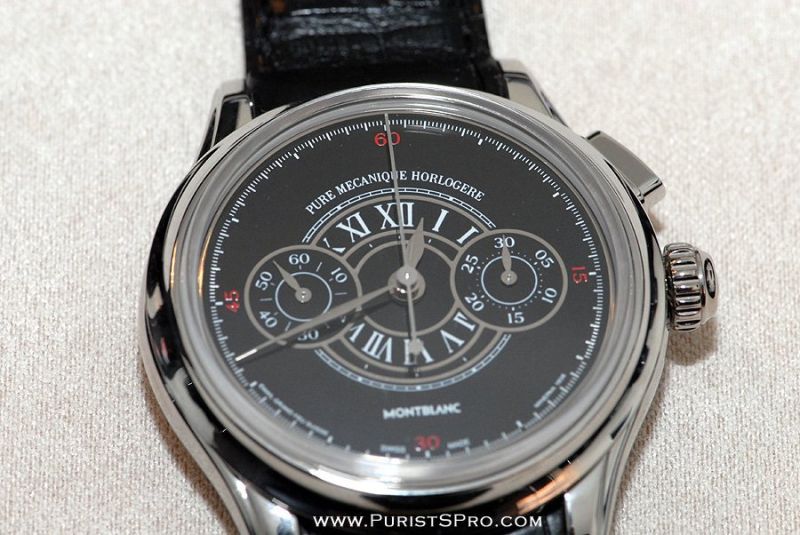
Technical Specifications of the Chronographs
Montblanc « Collection Villeret 1858 »
Chronographe Email Grand Feu
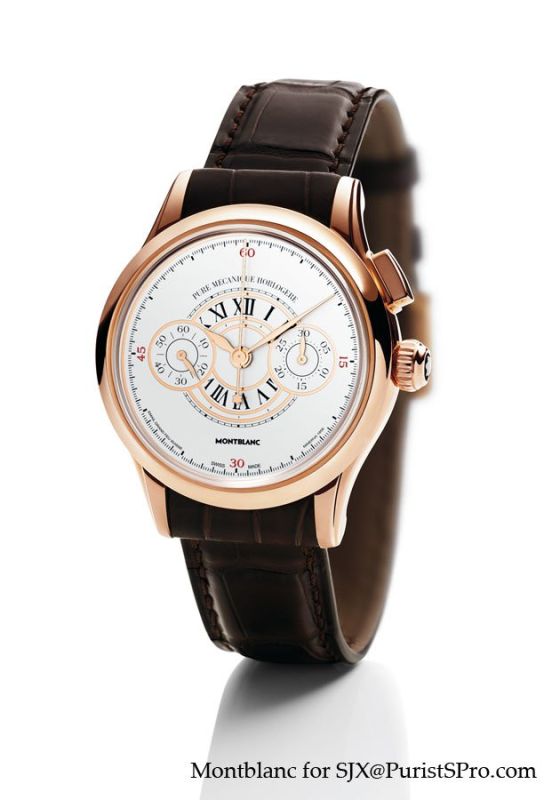
Monopusher chronograph with 30-minute counter
Movement Minerva 13-21 calibre
Movement type Manually wound movement with chronograph, 30-minute counter and small seconds
Chronograph Monopusher mechanism, chronograph with column wheel, horizontal clutch and semi-instantaneous minute counter
Dimensions Diameter 29,5 mm, height 6,4 mm
Number of parts 239 (complete movement)
Number of jewels 22 (hemispherical, cambered, olive-cut)
Power reserve 60 hours
Balance Screw balance, Ø 11,40 mm, 26 mgcm²
Frequency 18 000 beats per hour (2,5 Hz)
Balance spring With Phillips curve
Plate Rhodium-plated German silver, circular-grained on both sides, hand- chamfered edges
Bridges Rhodium-plated German silver, “Côtes de Genève”, recesses circular-grained on both sides
Going train Wheels: 2N gold-plated, circular-grained, chamfered, diamond hubs on both sides
Pinions: polished faces and toothing, burnished pivots
Indications (watch) Centre hours and minutes, small seconds at 9 o'clock
Displays (chronograph) Centre seconds, 30-minute counter at 3 o'clock
Case Limited editions in platinum 950 (unique piece), 18 K white gold (Editions of 8) or rose gold (Editions of 58)
Convex, antireflective 'chevé' sapphire glass and screw-in sapphire glass back under a hinged cuvette
Dimensions Diameter: 41 mm
Height: 13.56 mm
Water-resistance To 3 bar (30 meters)
Horns With patented cuvette release mechanism
Crown With mother-of-pearl Montblanc signet
Chronograph button In the side of the case at 2 o'clock
Dial Solid gold with Grand Feu champlevé enamel
Hands 18 K gold, chronograph hands in Pfinodal
Strap Hand-stitched alligator skin; pin buckle in platinum, 18 K white gold or rose gold
________________________________________________________________________________________
Montblanc « Collection Villeret 1858 »
Grand Chronographe Email Grand Feu
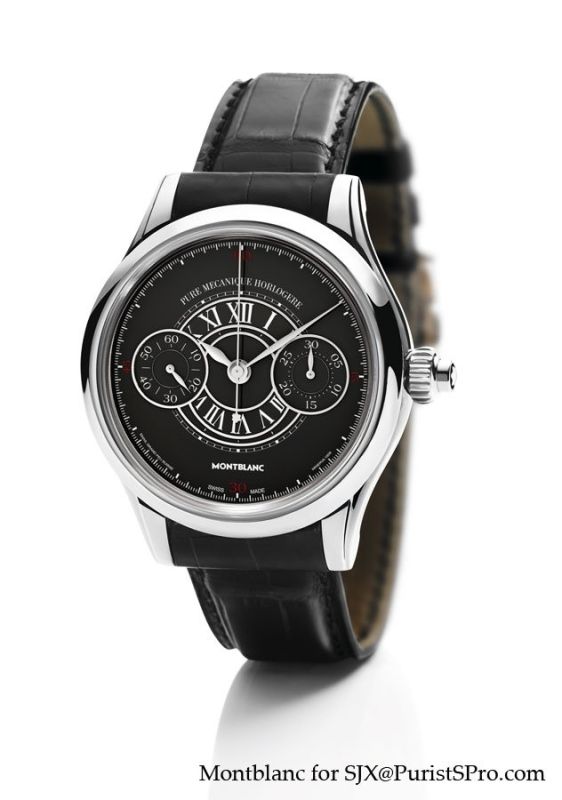
Monopusher chronograph with 30-minute counter
Movement Minerva 16-29 calibre
Movement type Manually wound movement with chronograph, 30-minute counter and small seconds
Chronograph Monopusher mechanism, chronograph with column wheel,
horizontal clutch and semi-instantaneous minute counter
Dimensions Diameter 38,4 mm, height 6,3 mm
Number of parts 252 (complete movement)
Number of jewels 22 (hemispherical, cambered, olive-cut)
Power reserve 55 hours
Balance Screw balance, Ø 14,50 mm, 59 mgcm2
Frequency 18 000 beats per hour (2,5 Hz)
Balance spring With Phillips curve
Plate Rhodium-plated German silver, circular-grained on both sides, hand-chamfered edges
Bridges Rhodium-plated German silver, “Côtes de Genève”, recesses circular-grained on both sides, hand-chamfered edges
Going train Wheels: 2N gold-plated, circular-grained, chamfered, diamond hubs on both sides
Pinions: polished faces and toothing, burnished pivots
Indications (watch) Centre hours and minutes, small seconds at 9 o'clock
Displays (chronograph) Centre seconds, 30-minute counter at 3 o'clock
Case Limited editions in platinum 950 (unique piece), 18 K white gold (Editions of 8) or rose gold (Editions of 58)
Convex, antireflective 'chevé' sapphire glass and screw-in sapphire glass back under a hinged cuvette
Dimensions Diameter: 47 mm
Height: 13,65 mm
Water-resistance To 3 bar (30 meters)
Horns With patented cuvette release mechanism
Crown/ chronograph With integrated button in the crown at 3 o'clock and the Montblanc signet
button in mother-of-pearl
Dial Solid gold with Grand Feu champlevé enamel
Hands 18 K gold, chronograph hands in Pfinodal
Strap Hand-stitched alligator skin; pin buckle in platinum, 18 K white gold or rose gold
Les Secondes au Centre Retour-à-Zéro - Central seconds zero-reset
Montblanc “Collection Villeret 1858”
Limited jubilee edition with two newly developed
watch movements: Montblanc Collection Villeret 1858
Les Secondes au Centre Retour-à-Zéro
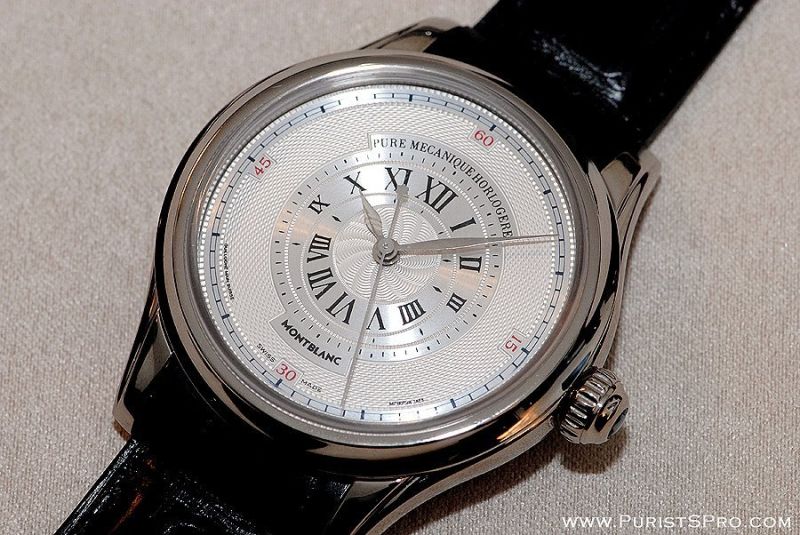
Seconde au Centre Retour à Zéro Calibre 13-18 in white gold
Photo: Anthony Tsai
In 2008, the Montblanc Collection Villeret 1858 Les Secondes au Centre Retour-à-Zéro represents the launch of a group of exclusive timepieces designed to commemorate the founding of the Minerva manufacture 150 years ago, and from which the current “Institut Minerva de Recherche en Haute Horlogerie” has evolved.
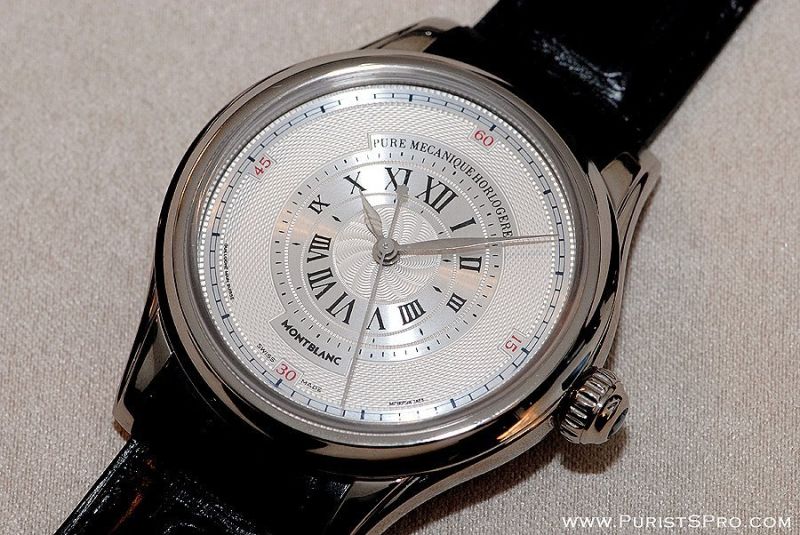
As an interesting innovation, inspired by the company’s garde-temps philosophy, the Montblanc Collection Villeret 1858 now includes two new, specially developed movements with a “Retour-à-Zéro” function that makes it easier to set the time exactly to the second. It is probably the first automatic zero-resetting mechanism with a large, solid central seconds hand. When the winding crown is pulled out, the seconds hand is automatically returned to zero and locked in this position while the hour and minute hands are set to the correct time. If the crown is pushed back into the case on the last tone of a time signal, the watch restarts exactly to the second. The automatic resetting mechanism requires subassemblies that are similar to those found in a chronograph. The seconds hand, for instance, is mounted on a large fourth wheel, which is connected to the drive wheel by a horizontal clutch. On the other hand, the winding stem needs to be linked to a lever mechanism. When the crown is pulled out, the mechanism first releases the horizontal clutch and then, with a hammer, moves the large fourth wheel on the seconds hand via a cam to the zero position and fixes the seconds hand in this position.
Each of these steel levers is carefully chamfered, and has hand-shaped sides and fine, satin-finished surfaces. As with the chronographs, the “Mise en Fonction” for the zero-resetting mechanism is carried out meticulously by hand, every single part of each movement being aligned with the others to tolerances of a hundredth of a millimetre.
The new movements are known as the 16.18 calibre for the “Grande Seconde au Centre Retour-à-Zéro” model with its 47 mm case and the 13.18 calibre for the slightly smaller 41 mm “Seconde au Centre Retour-à-Zéro” model. They are classic slow oscillators and feature large, heavy screw balances with a frequency of 18,000 beats per hour (2.5 Hz), which breaks down time into fractions of one-fifth of a second. The plates and bridges are made of rhodium-plated German silver, the bottom plate is circular-grained on both sides, while the bridges are chamfered by hand and decorated with circular-graining and Geneva stripes (Côtes de Genève) on the top surface. All the pinions have polished faces, arbors and wings. Like all the other calibres in the Montblanc Collection Villeret 1858, these two movements will also be limited in the course of the next few years to 288 (2 x 144=2 x 12 dozen=2 gross) before production is permanently discontinued. The tools machined specially for these movements will then be stored away, so that original spare parts can be made at any time, as required.
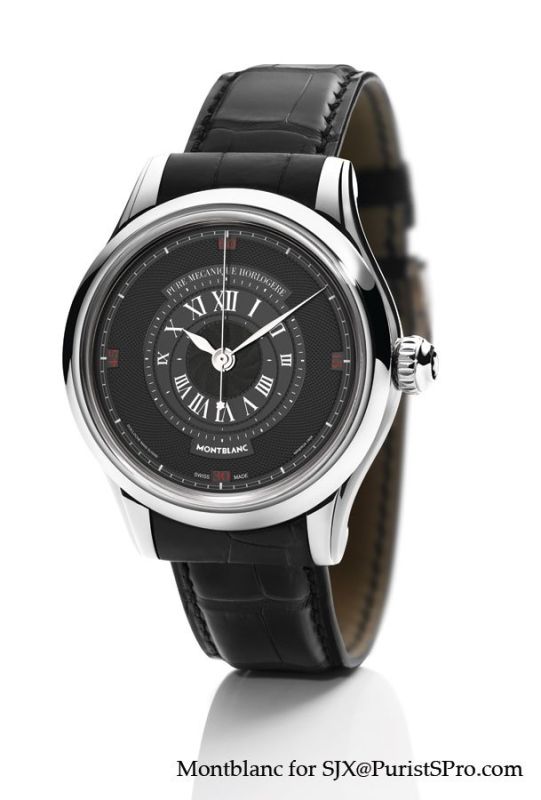
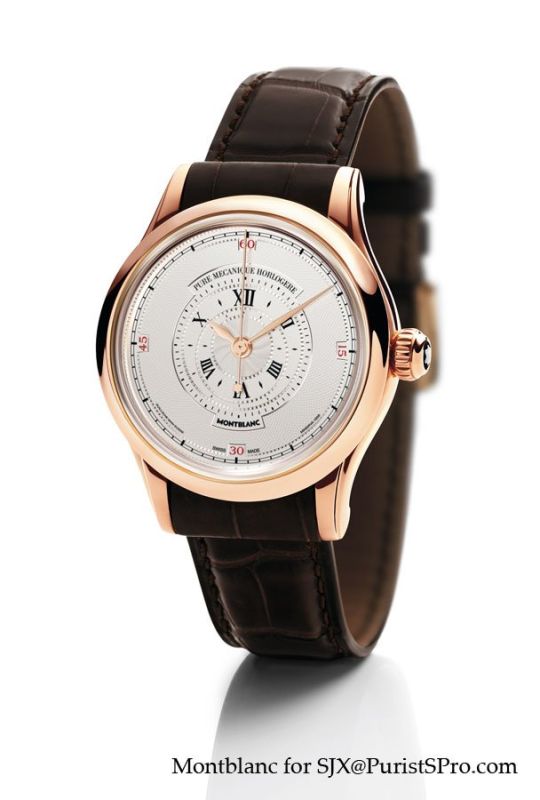
Technical Specifications of the Zero-Reset watches
Montblanc « Collection Villeret 1858 »
Seconde au Centre Retour-à-Zéro
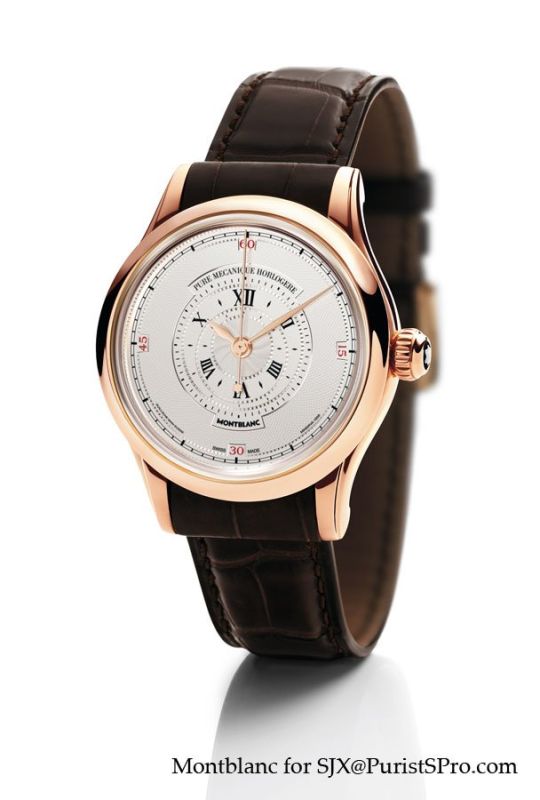
Handwound movement with Retour-à-Zéro function
Movement Minerva 13-18 calibre
Movement type Manually wound movement with Retour-à-Zéro function activated by pulling out crown and horizontal clutch
Dimensions Diameter 29,5 mm, height 6,4 mm
Number of parts 196 (complete movement)
Number of jewels 21 (hemispherical, cambered, olive-cut)
Power reserve 60 hours
Balance Screw balance, Ø 11,40 mm, 26 mgcm2
Frequency 18 000 beats per hour (2.5 Hz)
Balance spring With Phillips curve
Plate Rhodium-plated German silver, circular-grained on both sides, hand- chamfered edges
Bridges Rhodium-plated German silver, “Côtes de Genève”, recesses circular-grained on both sides, hand-chamfered edges
Going train Wheels: 2N gold-plated, circular-grained, chamfered, diamond hubs on both sides
Pinions: polished faces and toothing, burnished pivots
Indications (watch) Centre hours, minutes and large seconds
Case Limited editions in platinum 950 (unique piece), 18 K white gold (Editions of 8) or rose gold (Editions of 58)
Convex, antireflective 'chevé' sapphire glass and screw-in sapphire glass back under a hinged cuvette
Dimensions Diameter: 41 mm
Height: 13,56 mm
Water-resistance To 3 bar (30 meters)
Horns With patented cuvette release mechanism
Crown With mother-of-pearl Montblanc signet
Dial Solid gold, with hand-guilloched decoration
Hands 18 K gold, large seconds in Pfinodal
Strap Hand-stitched alligator skin; pin buckle in platinum, 18 K white gold or rose gold
________________________________________________________________________________
Montblanc « Collection Villeret 1858 »
Grande Seconde au Centre Retour-à-Zéro
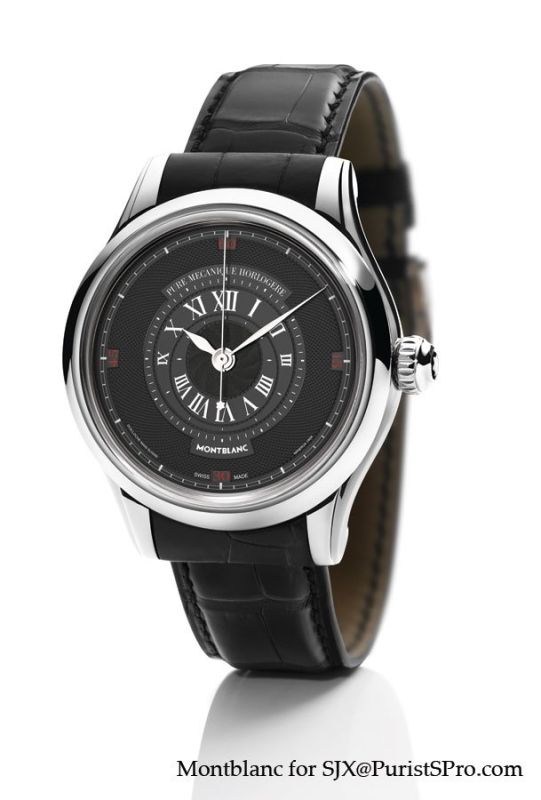
Handwound movement with Retour-à-Zéro function
Movement Minerva 16-18 calibre
Movement type Manually wound movement with Retour-à-Zéro function activated by pulling out crown and horizontal clutch
Dimensions Diameter 38,4 mm, height 6,3 mm
Number of parts 209 (complete movement)
Number of jewels 21 (hemispherical, cambered, olive-cut)
Power reserve 55 hours
Balance Screw balance, Ø 14,50 mm, 59 mgcm2
Frequency 18 000 beats per hour (2,5 Hz)
Balance spring With Phillips curve
Plate Rhodium-plated German silver, circular-grained on both sides, hand-chamfered edges
Bridges Rhodium-plated German silver, “Côtes de Genève”, recesses circular-grained on both sides, hand-chamfered edges
Going train Wheels: 2N gold-plated, circular-grained, chamfered, diamond hubs on both sides
Pinions: polished faces and toothing, burnished pivots
Indications (watch) Hours, minutes and large centre seconds
Case Limited editions in platinum 950 (unique piece), 18 K white gold (Editions of 8) or rose gold (Editions of 58)
Convex, antireflective 'chevé' sapphire glass and screw-in sapphire glass back under a hinged cuvette.
Dimensions Diameter: 47 mm
Height: 13,65 mm
Water-resistance To 3 bar (30 meters)
Horns With patented cuvette release mechanism
Crown With mother-of-pearl Montblanc signet
Dial Solid gold, with hand-guilloched decoration
Hands 18 K gold, large seconds in Pfinodal
Strap Hand-stitched alligator skin; pin buckle in platinum, 18 K white gold or rose gold
Grande Seconde au Centre Retour à Zéro Calibre 16-18
And a CONTEST!

I was fortunate enough to see both chronos at my AD yesterday.

Great report to follow.
Good source of info as usual. 
I do love the Chronographe Email Grand Feu Calibre 13-21 in white gold mainly because of the very well balance on the dial.
Cheers

The Black Grand Feu Enamel Dial, for me
If I had to choose, this one would be my pick.
Why?
For the grand feu enamel dial, first, as they are few watches and comapnies to have the knowledge to make such dials, and to work on enamel, with UN, Patek, and JLC.
Then because its bi compax look speaks to me.
After, because of its movement, even if I stilll think that this is a good and a bad thing...
A good thing, because this movement looks good, nice, and well finished.
A bad thing because Minerva gives legitimity to Montblanc...What if Montblanc didn't get Minerva movements???
Still appealing watches?
I also find that this not necessary a good thing that Minerva is so " fashion " these days...
We find Minerva movements even in Panerai watches..Or Ferrari..
Esthetically speaking, actually, I find this BGFED appealing and nice.
My 0, 00000000000002 Euros cents...Aaah this weak USD! LOL
Best.
Nicolas
Dials are probably done by Donze Cadran


A daydream....
Great shots and info, thanks. Just spent ten minutes wistfully wishing that someone would produce that last dial in a wristwatch....
Cheers,
pplater.
Grand Chronographe Email Grand Feu Calibre 16-29
would be my choice. I have always been enamoured by the understated apperance of monopusher chronos, and the movement looks wonderful. Furthermore the dial is balanced (but would imho be better without pure mechanique horlongere), and the timeless qualities of enamel is appealing in a wristwatch
Jon

Chronograph with black Grand Feu enamel dial because I just like chronographs [nt]

HI SJX
Lovely pics!! For me it would be the Chrongraph black enamel dial. Looks wonderful both at the front and back, who could resist that 'dragons tail'
Cheers,
Tim

Email Grand Feu is my favorite
Although housing the Minerva movement gives Montblanc the technical legitimacy to play in the big league, incorporating true enamel dials on its watches really gives the brand an artisanal push upward.
Having seen how difficult it is to make an enamel watch, I truly applaud Montblanc's effort!

My favorite is the...
…Grand Chronographe Email Grand Feu Calibre 16-29. A beautiful piece that becomes even more elegant with the back cover that unveils its wonderful movement.
Marcelo

Jia Xian, thanks for the post and contest again.
Cheers!
Lionel
Contest Answer - My Favorite is: Les Secondes au Centre Retour-à-Zéro

I prefer the central zero seconds hand
...because it has a date and a very chic but low key dial. I also appreciate its original complication which I find practical when you reset your time to the atomic clock.
Kind regards,
Yves
Chronographe Email Grand Feu Calibre 13-21
Chronograph with black Grand Feu enamel dial
Is my choice... simple dial, unique pusher layout... very striking watch.

Manual-wind with central zero-reset seconds