
patrick_y
[PuristSPro Moderator]
33547

Swiss Franc CHF Currency On A Tear
RED ALERT!
For our members who are constantly wiring monies to Switzerland (probably to pay for our mechanical watch, clock, music box, chocolate bars, and/or belt buckle bills) there is a big problem heading our way... The Swiss franc has been getting extremely strong. Skyrocketing in fact. The Swiss franc has gone up 13.31% in the past 12 months! And about 7 percent in the past two weeks!
This means there are huge economic repercussions, and since most watches and most high-value watch parts are made in Switzerland, the average cost of watches will go up. The Swiss watch industry has also diversified away from Chinese watch parts due to the need of sourcing parts from multiple factories (including domestic factories) during the pandemic when parts supplies were interrupted. Thus, Chinese parts have decreased. And yes! That affects WPS readers too - even though WPS tend to focus on higher-end Swiss Watches from Patek Philippe and Vacheron Constantin (which do use some Asian-sourced parts), a rising tide lifts all boats.
There are dozens of reasons why the Swiss franc is appreciating in value. Switzerland saw less inflation during the pandemic. Thus, products in Switzerland became more valuable and thus, there was more demand in the currency as there was more trade to do with Switzerland.
Furthermore, even despite the failure of the banking system, and the dramatic collapse of Credit Suisse, Switzerland is still a major country for storing assets. With the conflict in Ukraine, Swiss banks have been seeing an increase in deposits. Furthermore, wealthy individuals are pulling out of the stock market - this pull out of capital markets means that there is a lot of cash sitting around. Often, family offices will consider storing a portion of the money in Swiss banks. Swiss banks can store different currencies; Francs, Euros, and Dollars; but many will opt to convert their funds to Swiss francs - and this has lead to an increase in demand for Swiss francs as well.
Large watch brands are often currency hedged. So this won't affect them too much immediately. But this is not the case with smaller brands and independents.
I spoke with some independents about this problem and they confessed to me that they see their customers balking at the higher prices. I asked one - someone who can afford a $100,000 USD luxury mechanical product can surely afford a $110,000 USD watch and this independent told me that while the client could afford it, sometimes it's going from $95,000 USD to $105,000 USD, and that six figure mental barrier is damaging and the clients are definitely noticing the increase and they feel clients are less eager to make acquisitions. Also, independent watchmakers sometimes have customization details to work through or other problems and production snags. Thus there is stress on both the sales side and the client side, when the price increases so much in a short period of time while the client is still in discussions about the customization details. One independent I spoke with told me they expect to lose a sale or two from clients as the clients are just unhappy about the exchange rate - and this being a luxury purchase, clients need to feel good about their purchases.
For our readers in Switzerland, this is good news, as you have more purchasing power. And possibly less competition!
What does this mean for readers of this site whom don't live in Switzerland? As the Swiss franc continues to increase, watch collectors can expect to pay more for Swiss products. Swiss watch companies who do their accounting in Francs will have to charge more Euros, Dollars, Yen, and Yuan for their products to keep their profit margins. Will the market bear these increases? Probably - since the watch market is still very warm.
You might say this is a good time to buy a German watch - always wanted that Lange! Well, Lange does do its accounting in Euros. BUT, Lange seeks to position itself as a top level brand - which means it has to charge as much as other top level brands to preserve its image. So, this rising tide of the Swiss franc does lift all boats...
The Swiss government is attempting to control the Swiss franc and to curb this massive appreciation. But, it's not very successful so far. Historically, in times of war, Switzerland's long banking history, political neutrality, and physical insulation from war has always made Switzerland a place to bring money to in times of conflict. We're in a conflict now. Also, in the 1970s, The US dollar saw massive inflation, and at this time there was also a notable amount of appreciation in the Swiss franc. We're in a similar situation now.
The luxury world is still heavily dominated by the US dollar. Graff Jewelers quotes all their prices in dollars despite being a UK firm. The United Arab Emirates - where Dubai and Abu Dhabi are meccas for luxury shopping - has its currency pegged to the US dollar since 1997. Luxury goods buyers throughout the world - especially in Asia and the Middle East often think in terms of US dollars. Thus, the biggest watch brands won't be able to increase their prices too much. But watches are still hot - so they will be making some adjustments - adjustments that are not in your favor!
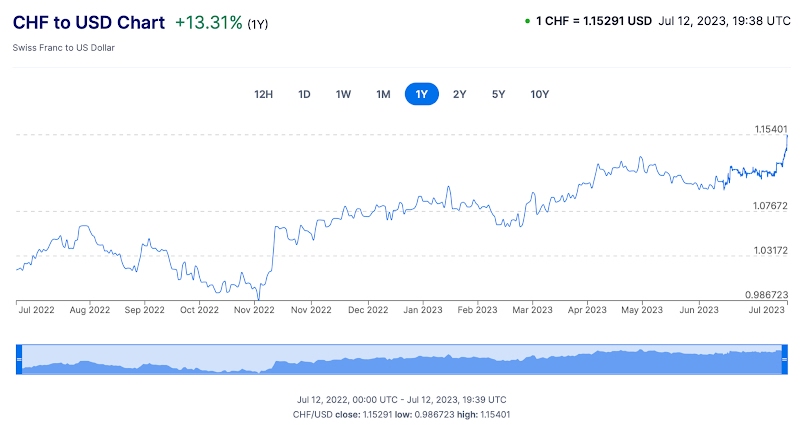
Chart from Xe.com a currency trading website. This chart shows the CHF has appreciated 13.31% to the US dollar in the past 12 months. About 7% of that is in the past two weeks!

Discussion
Joepny applies F. Scott Fitzgerald and Ernest Hemingway quotes to watch collecting, discussing mistakes, the hobby's allure, and master watchmakers. A humorous take on horology.
22 replies4236 views

Reference Guide
Explore a collector's in-depth review of the A. Lange & Söhne Odysseus in stainless steel. Discover its unique design, bracelet comfort, and finishing quality.
42 replies2349 views

Discussion
Explore the debate on precise time setting in luxury watches. Patrick_y praises Glashütte Original's zero-seconds reset and minute detents, challenging Swiss brands like Patek Philippe to innovate.
50 replies13058 views

Discussion
L'Hebdo article featuring Dr. Bernard Cheong discusses the growing influence of watch collectors, their expertise, and impact on independent brands.
2 replies937 views

New Release
Explore Watches and Wonders 2026 highlights: Rolex Oyster 100th, Patek Philippe Nautilus 50th, Vacheron Constantin Overseas 30th anniversaries. Discover new micro-rotor movements and collector reactions.
41 replies1813 views

Market
Explore the strategic shift from multi-brand to mono-brand luxury watch stores. Patrick_y analyzes financial risks, brand messaging, and collector preferences.
43 replies15706 views
Swiss Franc CHF Currency On A Tear
RED ALERT! For our members who are constantly wiring monies to Switzerland (probably to pay for our mechanical watch, clock, music box, chocolate bars, and/or belt buckle bills) there is a big problem heading our way... The Swiss franc has been getting ex...

You're most welcome!
A few members asked me why this was happening off line. And I think the most well accepted explanation was the fact that the world's wealthy have been divesting out of the stock market and sitting on more cash. And a portion of that cash has gone into the...

Personally, I agree that it is a non-issue for most people spending $$$ on a watch
If you can afford 6 figures for a watch, it is not really a big deal. Mentally I already calculated this into the price of my voutillainen as I always figure FX will work against me lol

Dear m2
Do not forget that the rich are the "most price sensitive".... Called "complaining at a very high level"
I agree. I'm more in the price sensitive camp.
Unlike M2, I do not plan ahead for major currency fluctuations. I expect currencies to be fairly stable. I guess I'm not a great chess player today - I didn't predict this unexpected move!
Should've done that a long time ago!
That actually would've had more positives than negatives. Especially since most of the economic system in Canada is quite similar to the economic system in USA. But bigger powers at be were against this.
Perhaps this may increase the value of
watches on the secondary market as a side effect. What are your thoughts on this and also how it may affect auction prices? Thanks for any insight.
You bring up a good point!
It's definitely possible - if brands increase the prices of new watches, used watches should increase as well. Rising tide should lift new boats and used boats! The big problem is that big brands need to generally have stable prices. And this will hurt th...

What about saying USD is getting weak?
Try checking USD against Mexican Pesos, now I cannot afford going there anymore lol… Also remember in 2015, PP decided to decrease their price by 7% because of CHF? I will never forget because I bought my very first PP in 2014 and never expected a dream m...
That's true too! USD is getting weaker.
I did not enjoy Cabo the last time I was there. Stayed at the Waldorf Astoria and the JW Marriott and was far from impressed. The bill was sky high too. I'd say save your money and go to the Maldives instead! The Peso is in demand. Billions of dollars of ...
The USD is historically low....
... With this fact in mind, some CH investors are also exchanging CHF into USD and investing in treasury bills and / or gov. bonds that are actually yielding over 5%... Again, they do take the risk in the fx, knowingly that USD is histrocally very low. I ...
A Dodge DEMON in Europe would be VERY EXPENSIVE TO FUEL!
Fuel costs around 1.27 Swiss francs a liter in California, USA. Much less than fuel in Europe. But a Dodge Demon DRINKS A LOT OF GASOLINE! Probably more than double the typical petrol car in Europe! So it costs a lot to operate, even in USA. Now imagine i...
A friend here has a Demon. Considered what people usually driver here, i think demons are really a bargain heheheh
Ideally you gain on the currency as well, but i am afraid for the moment it goes rather the other way, but the ccy risk taken is usually part of the strategy.
Here in California...
Here in California it's really become Tesla-Country. In fact, it almost looks communist! Everybody drives the same car. At an intersection in my town (which is a high percentage Tesla town), it's not unusual if 30% or more of the cars are all Teslas. Almo...
Smaller players are definitely getting whacked
...and it's a double whammy, too. on one hand there's the watch bubble deflating over the past year, and on the other there's the more recent spiking swiss franc. a sharp example of this could be ming, which prices its wares in chf. look at listings on c2...
Good idea! We probably all have too many watches...
The vast majority of our readers have multiple watches - and generally enough to last the rest of their lives. Many of our readers (possibly still a majority) have so many watches that they could live multiple lifetimes with the watches they currently hav...

i always observe the CHF and USD exchange rate
and it has been going on a wild run for the last year. but even if you zoom out to a 10 year window i believe we are in an all time high. i have watches ordered (from independents) and they were supposed to be delivered later this year but i am seriously ...
Hmmm, I don't blame you!
The rates are definitely sky high! And still climbing! It's now 1.16 USD per CHF so it's climbed another percent in a short period of time!

Great analysis 👏 Yet 'Cry Me a River' for Independent Watchmakers
Dear Patrick, Thanks for your deep dive analysis. It's really got me thinking, and as a Swiss, I feel I need to add my own thoughts into the mix. A strong Swiss Franc can really stir the pot for businesses that depend on exports. Our central bank has limi...
I completely agree!
This definitely makes me slow down on new orders. I don't need to order more watches. But I feel for our readers whom have watches on order already - and those watches are undergoing these noticeable price increases just from the exchange rate alone. But ...
Inflation in CHF
The question is why do Swiss brands constantly increase their CHF prices... Inflation never been more than 3.5% or so but we have seen double digit increases over the last 1-2 years. Often cited here JLC and so on...🤔
These executives need to get big numbers to get their bonuses...
Management compensation structure is all about growth. And these executives need to strike while the iron is hot. Many brands' boards didn't limit the executive on how much percentage they can increase the prices. A lot of the executives are mercenaries. ...