
foversta
[PuristSPro Moderator]
20814

The Saxonia Dual Time: the practical travel watch
The Saxonia Dual Time was unveiled at the 2011 SIHH and symbolizes the evolution within the Saxonia collection. When you come back to the first steps of the contemporary history of Lange & Söhne, in 1994, the Saxonia was at this time the simplest round watch of the collection with an unique complication : the big date display. Then, it lost this role, the 1815 becoming the true entry level watch. Years later, the Saxonia was removed from the catalogue and it came back as a specific line.
We have to understand that things have evolved a lot since the context at the beginning of the 2000's : the 1815 is not an entry level watch anymore and the Saxonia handwind is assigned, due to its less typical design, due to the use of a classic Lange movement (the L941,1) to be the most suitable watch to discover Lange world at a more affordable price.
But at the same time, the Saxonia line is not composed anymore by « simple » watches only. The range of complications available is getting broader giving the proof that rather being « an entry level collection », the Saxonia line is more based on a specific aesthetical approach and on useful and practical complications.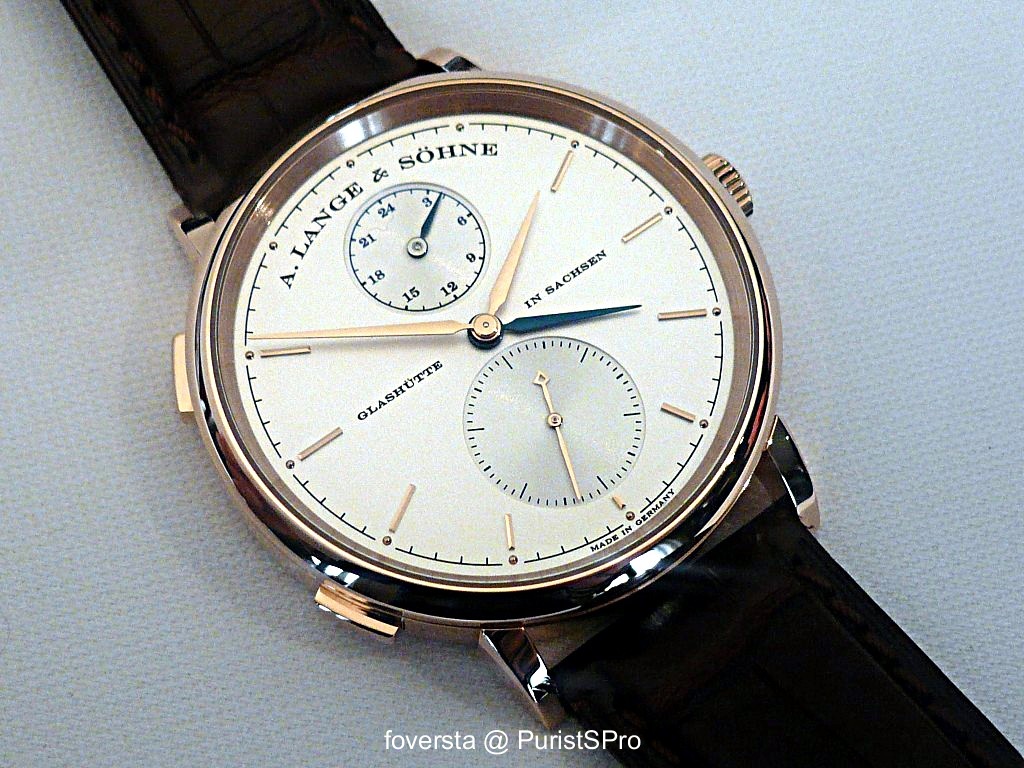
A Saxonia watch has, what I call, a « soft design » less inspired by the traditional German dial features and which gathers a lot of details which make its owner's life... easier. The purpose of a Saxonia watch is more to be a perfect day-to-day watch rather than a pure watches collector timepiece.
It is the reason why additional complications have been added like the Annual Calendar in 2010 and this year, the second timezone display. I remember very well a friend's comment at the 2010 SIHH when he saw the Saxonia Annual Calendar : « Hey, that's a perfect business watch ! ». I do believe that we can say the same about the Saxonia Dual Time. Old Lange collectors or fans of the brand may feel disppointment because they don't experience the same excitement in front of such watch than in front of a Datograph. But I'm pretty sure that with these Saxonia watches, Lange has the objective to meet the expectations of new clients who wish to find in them a combo between the Lange quality and a practical side.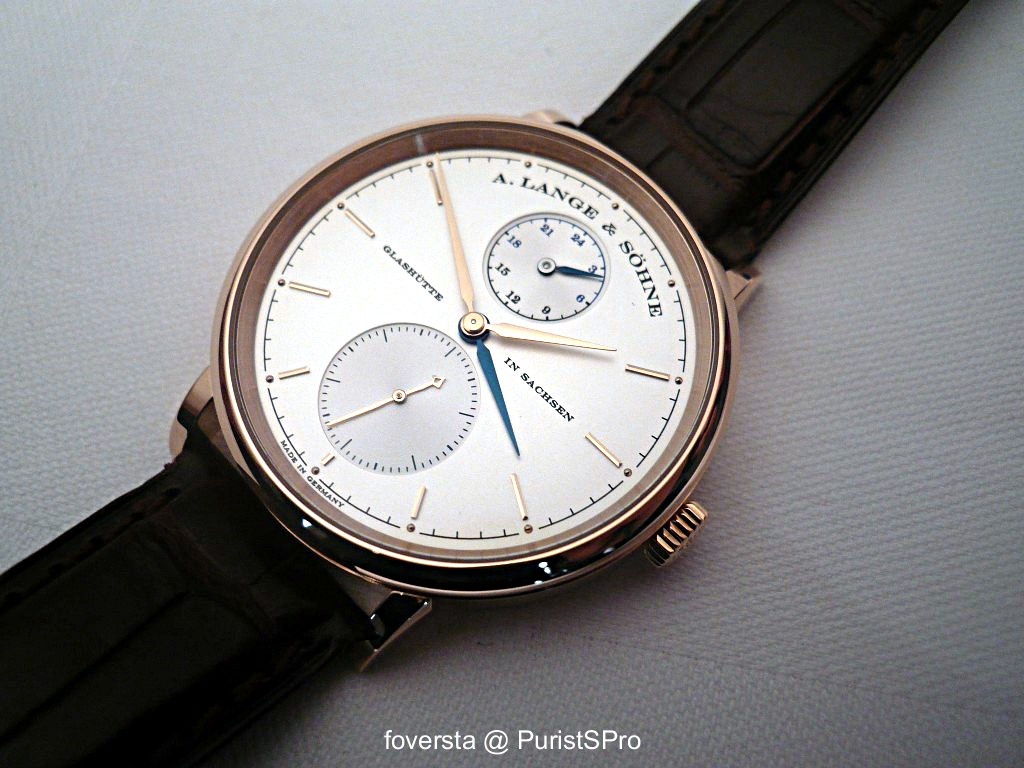
That is, for my point of view, the idea behind the Saxonia Dual Time. And this strategy has more impact than we may think, it also influences the type of movement used : we will come back to this point.
I had the chance to handle several times the Saxonia Dual Time, first at the 2011 SIHH and several months later. The Saxonia Dual Time is not a surprising watch : if you are used with the JLC Master Hometime, you get the trick. Even if the Saxonia Dual Time doesn't have a date display, it works the same with the concept of hometime (which is a « fixed » parameter) and of local time (which can be set using the pushers located left side). If the JLC has a 3 positions crown, Lange solution gave priority to the use of pushers. In fact, the Saxonia Dual Time is closer to the Patek 5134 in its way to operate the complication. 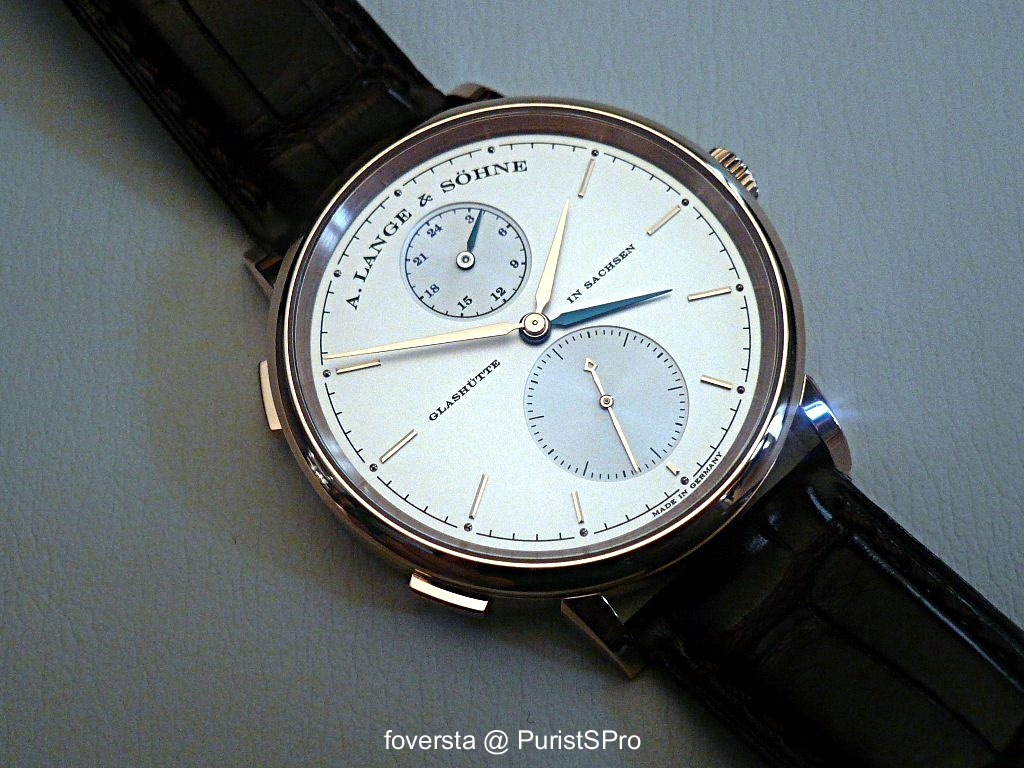
I would say that the JLC system is maybe more elegant because all the watch functions can be operated through an unique « device », the crown. But I find Lange one more practical and you don't feel the need to pull the crown : top and bottom pushers are used to set the local time with steps of 1 hour.
As always with this kind of watches, you have first to set the hour of reference, the hometime. It is displayed on the dial by a superb blued hand which brings a touch of colour on the dial. Of course, when this time is set, we have to be very careful about the 24 hours display which is related to this hand. When you stay at home, the local time is the same than hometime. In that case, the blued hand is hidden by the gold hand. But obviously, you can use this watch even if you don't travel, if you have constant relationships with people located in a specific timezone. So with the pushers, you set the hours hand of the local time. Of course, all the indications related to hometime (the hours hand, the minute hand which is shared by the local time and the hometime, the 24 hours display) are not influenced by this operation.
The concept of « hometime » and or « local time » is a relative one. In fact, I prefer to use the « main and secondary » timezones one. If you live in Paris, if you don't travel and if your mother lives in NY, it is better to use the hometime display as the time in NY and the local hand as the time in Paris. Do you really want to wake up your mother at 3 AM in NY due to an inappropriate phone-call ? It really depends of what is for you, the MAIN timezone. Use the watch the most suitable way for you life !
I find that the decision from Lange to use a blued and solid hand is the right one. Frankly speaking, I was never really comfortable with the hollowed hands of the Patek and of the JLC. Of course, it can be easily understood, the hollowed hand preserves the readability of the 24 hours display and has a strong contrast with the hour hand of the local time. But the Lange hand (the typical Alpha hand) is rather thin and its colour even improves the contrast.
Finishings of the dial are flawless, I really like the little contrast between the two subdials and the main dial. You will notice that, in order to preserve the dial balance Lange wrote entirely « in Sachsen ». It is very useful for the ones who often wonder what « I/SA » means.
As you know, in 2011 Lange brought some minor aesthetical changes to the Saxonia collection. You obviously find them again with the Saxonia Dual time. Let's quickly browse them:
DIAL:
* the slender bezel with inclined flange : the watch looks a bit bigger than its actual 40mm diameter
* the longer indices
* the presence of a succint minute scale
* the small second hand has the same color than the big hands
CASE:
* the lugs are shorter and more curved
CROWN:
* the crown is bigger to handle it easier.
To sum up in a few words, the Saxonia Dual Time has a very comfortable case thanks to the lugs shape, it is an easy watch to operate and gets a « softened » design when compared with previous Saxonia. Some may say that the watch lacks a bit of a true german style like the 1815 embodies it. I agree with this point of view as an old Lange fan. But we also have to understand that Lange wishes to enlarge its potential clients base.
Time comes to turn over the watch. And we discover the L086.2 automatic movement with a central rotor.
I'm like the most part of you : I deeply regret that Lange didn't stay with the Sax-O-Mat movement and its ¾ rotor. I find that the L086.2 (which is an evolution of the L086.1 used by the Saxonia Automatic) is not as beautiful than the Sax-O-Mat. But there is a practical reason for this change : the improvement of the power reserve. Thanks to the use of a central rotor, Lange gets the ability to put a larger mainspring which, combined with the reduction of friction losses, allows to improve the power reserve of the watch. This power reserve reaches 3 days which is a good performance : the client can leave the watch during the week-end and get it back on Monday without the need to set the time.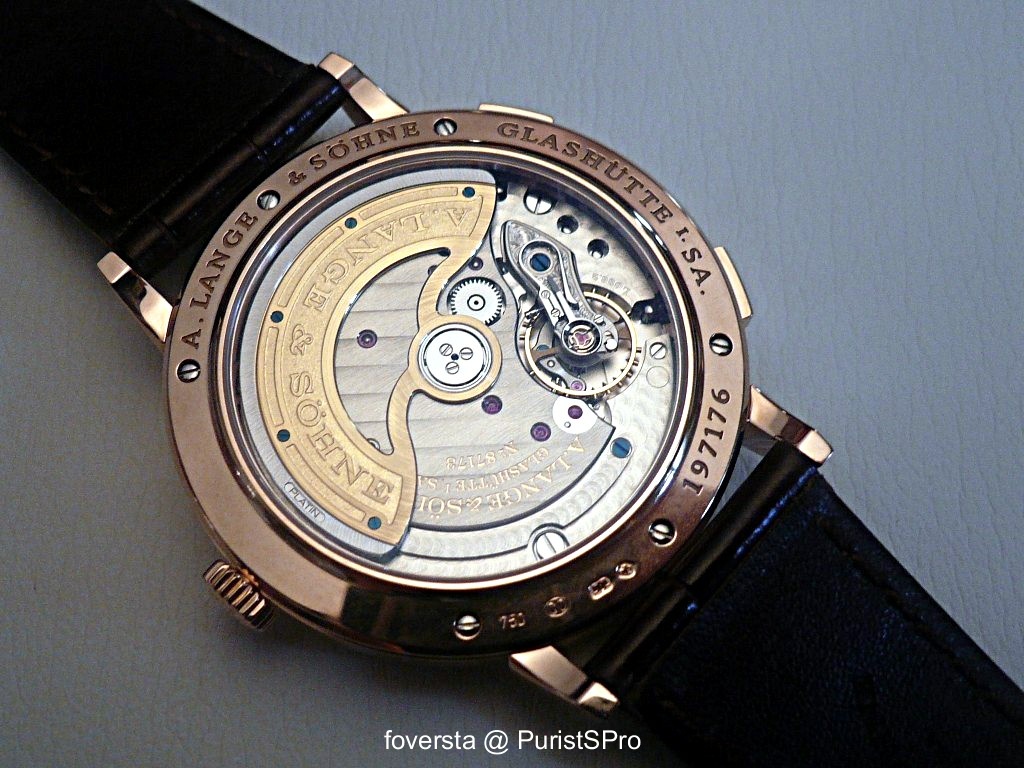
The rotor is gold-plated but hopefully it keeps its platinum centrifugal mass. Again, there is a technical reason behind this decision. The material of the rotor is the same used for the moving dial of the Richard Lange Tourbillon Pour le Mérite. Being gold-plated instead being full gold manages to preserve the height of the movement. Even with the Dual Time mecanism, the L086.2 has a very reasonable thickness of 4,6mm.
Finishings are faithful to Lange standards with the hand decoration, the care of details, the Glashutte ribbings, the chamfered and polished edges. I prefer the view of the Sax-O-Mat but the L086.2 remains a very nice movement.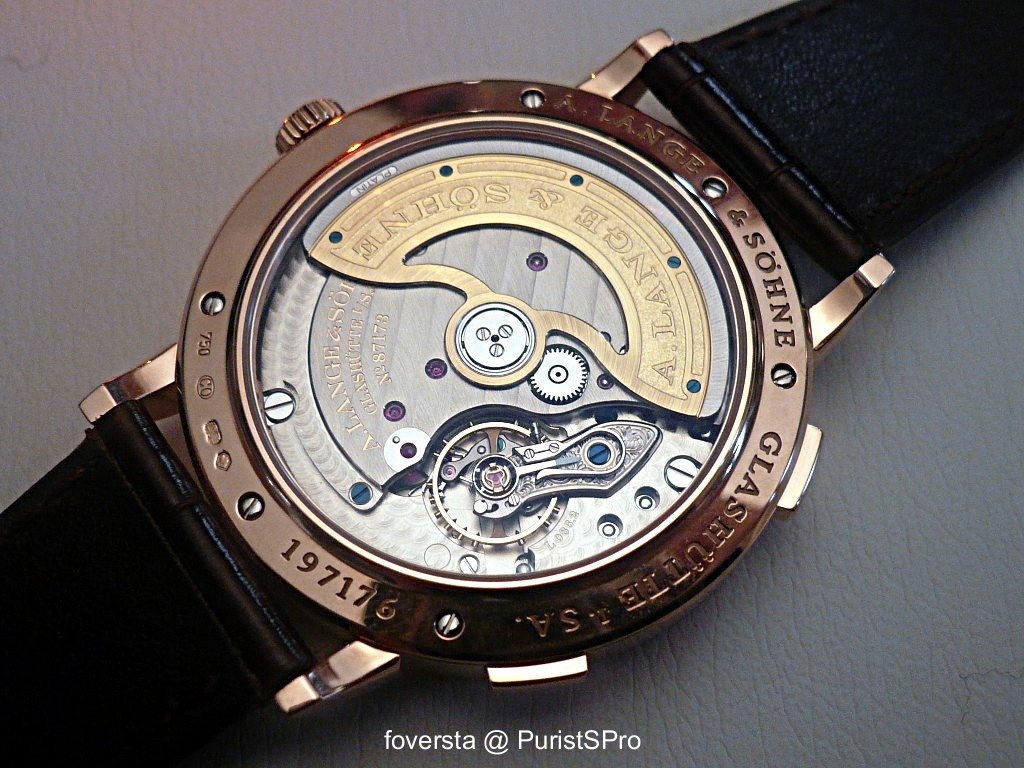
As I said before, the Saxonia Dual Time is a very comfortable watch thanks to its case and lugs shape. Case diameter is 40mm which is for me a right size for this kind of watches. The case is rather thin with a 9,1mm thickness.
The Saxonia Dual Time is not the first « travel » watch by Lange. The Lange 1 Timezone was unveiled 6 years ago. But it is a totally different watch. The main forces of the Saxonia Dual Time are its simplicity, its easy-to-use system and its larger power reserve. The Lange 1 Timezone plays another score : it is a complex watch, a sort of combo between Dual Time and WorldTimer watches. It is not so user-friendly despite a similar power reserve and it is a much more demonstrative timepiece.
The Lange 1 Timezone: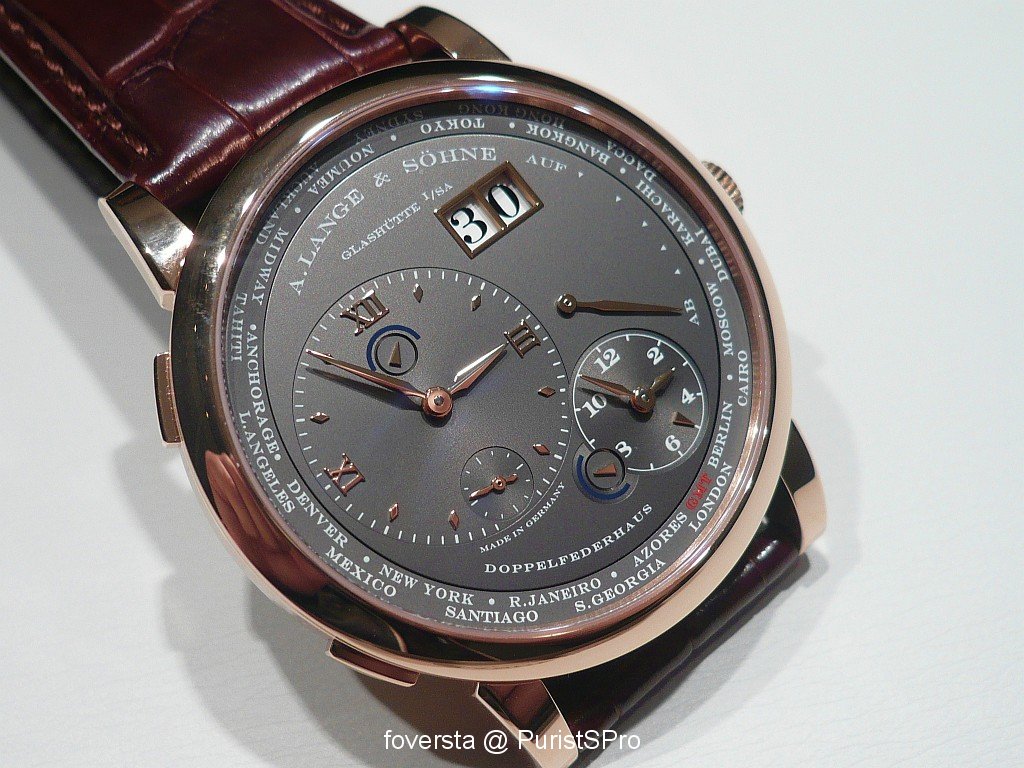
I asked you several days ago which was your fav « travel » watch between them. A small majority was seduced by the practical side of the Saxonia. But on the other hand, some of you highlighted that the Lange 1 Timezone was closer to the Lange spirit with its unusual dial lay-out, the beauty of its handwind movement.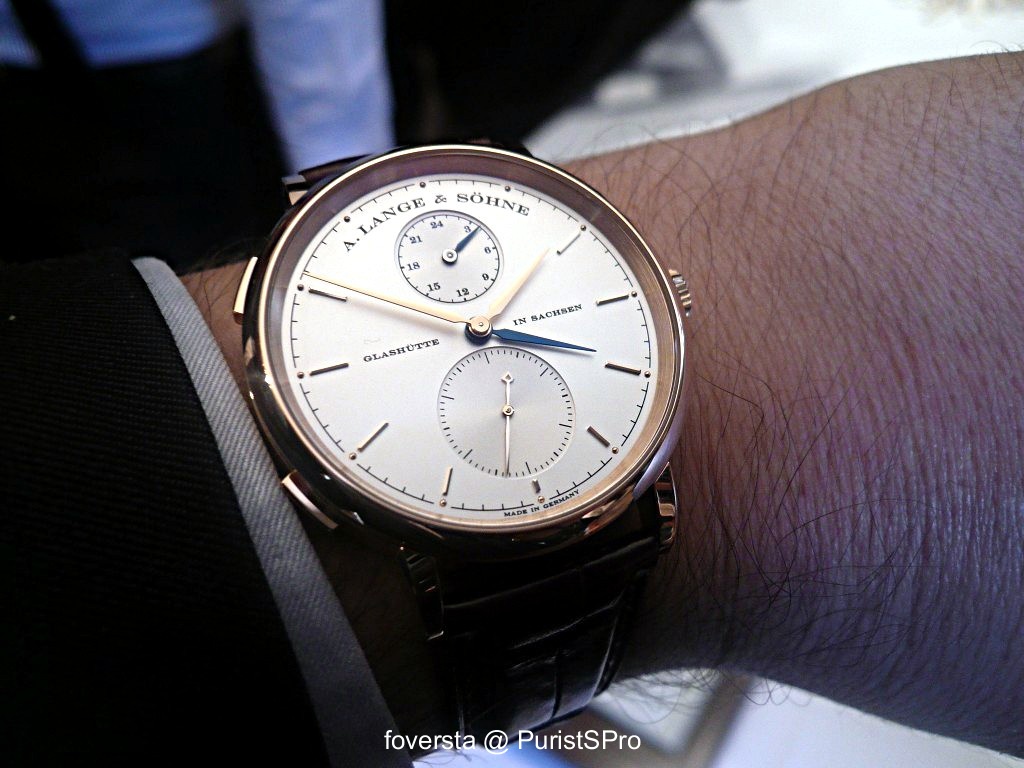
In fact, these two watches don't have the same type of clients. It really depends what you look for. Let's come bck to my friend's sentence of the beginning : the « Saxonia is a perfect business watch ». It is a watch dedicated to become a day-to-day timepiece. The Timezone is a more excessive watch. Its busy dial, its size, its complexity make it more attractive for the people who look for more passion, more excitement.
I will not tell you that the Saxonia is not exciting : it is an excellent watch and I would be very happy with it. But it is too « reasonable » to be really exciting. Maybe I would have expected from Lange some changes in the display in order to bring a more personal interpretation of the complication : there is obviously a feeling of deja-vu in this Saxonia. It could have been an original day&night display for example or the ability to handle the half-hours steps. Lange had and still has all the skills, all the keys to create a more specific watch without losing the practical side which has been highlighted with this Saxonia. It is the reason why I think that a more daring attitude combined with the great talent of the people of the Manufacture would lead to more impressive achievements.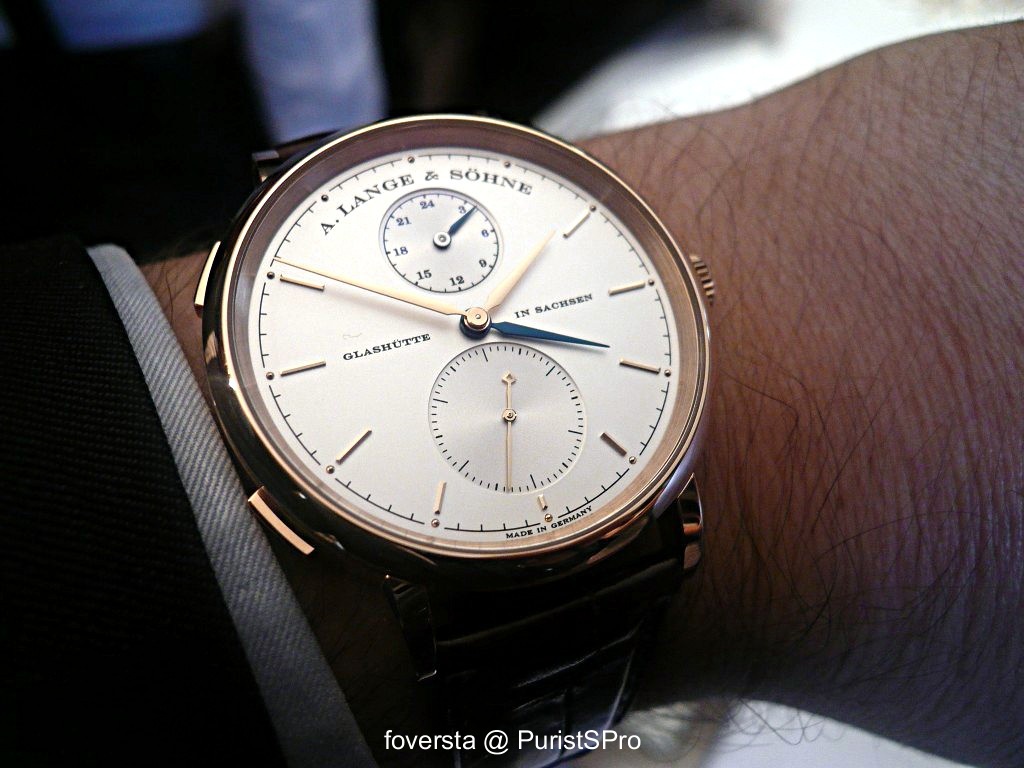
The Saxonia Dual Time is available with PG and WG cases.
Pros :
* a very easy-to-operate watch
* an useful complication
* a 3 days power reserve
* a very appropriate size and the comfort on the wrist
* the usual Lange standards of quality
Cons :
* a lack of personal interpretation of the complication
* the half-hours steps are not handled
* the central rotor movement is not as eye-catching as the Sax-O-Mat despite its qualities.
I would like to thank a lot the Lange team at the SIHH and Lange Western Europe.
Fr.Xavier


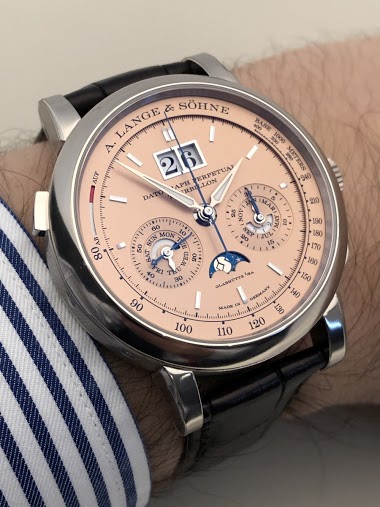
The Saxonia Dual Time: the practical travel watch

I will not change a word, about the Saxonia Dual Time.
You are not old, you are still young...

Agreed about being practical
Thanks Ken!

Thanks Davo!

Sorry, but a dull design that can't beat Patek's 5134, says a moody Count
Thanks Moritz for your words !

Stephen...

great and very fair review
Gorgeous: YES, Practical: perhaps worth checking NOMOS?
Yes Tom, the Nomos has a very specific layout.

Thanks for this Fx
A few thoughts
Your comments are valid Ling.
