The
Lange & Söhne boutique of Paris organizes between the 1st and the 19th of October an exhibition of tourbillon watches that marked the history of the brand since its rebirth in 1994. The tourbillon is considered as one of the most magic and prestigious watchmaking complications but it does occupy a special place in the Lange & Söhne world. The reason is easy to understand: the Tourbillon Pour le Mérite, which was the first wristwatch combining a tourbillon and a fusee and chain transmission mechanism, was one of four watches which belonged to the rebirth collection. Günter Blümlein knew that he had to make an impression and to position Lange & Söhne on the top of the watchmaking pyramid directly with the first models. The Tourbillon Pour le Mérite had the role to demonstrate this excellence of the brand and this is why a watchmaker of the level of Giulio Papi contributed to the development of the watch. Moreover, the Tourbograph was also part of this same approach and involved the same actors. Sadly, it was released several years after Blümlein's death.
From 1994 to today, the same basic principle remains: each tourbillon watch from Lange & Söhne shall include one or more features that prevent it from being considered as an interpretation of a "simple" tourbillon. The exhibition organized at the boutique remembers this established fact by bringing together six major watches that have contributed for different reasons to the development of the reputation of Lange & Söhne for more than 20 years.
I invite you to discover these six watches.
Obviously I can only begin with the
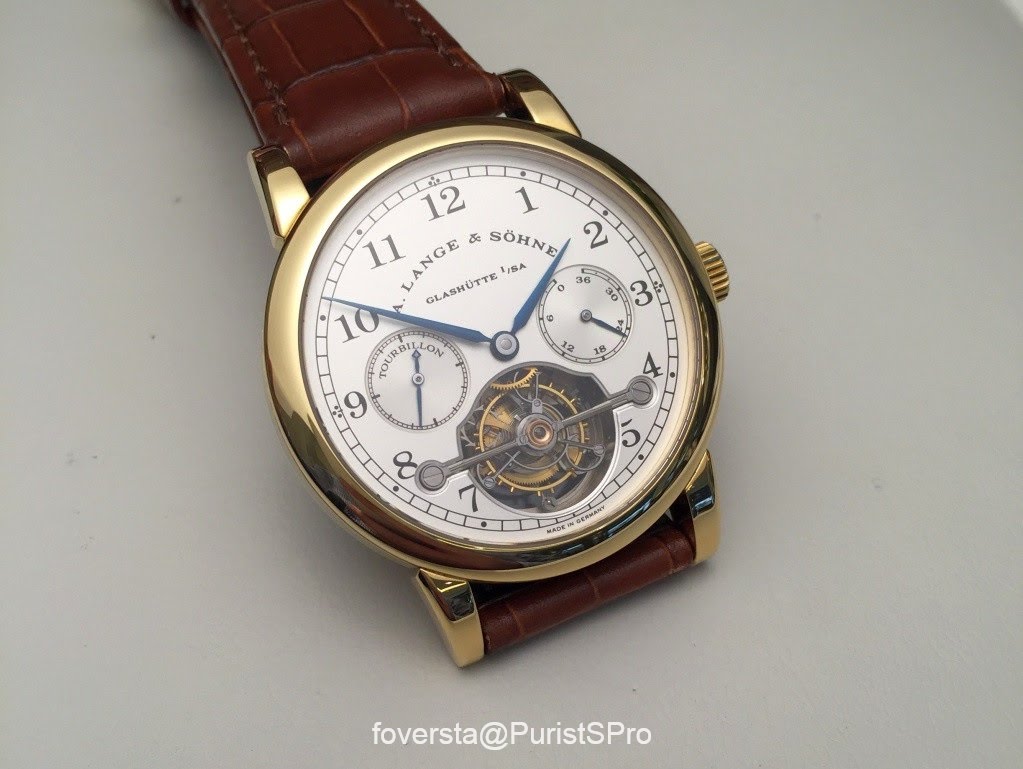
Tourbillon Pour le Mérite. This mythical watch, with a 38,5mm diameter, distinguishes by the shape of the dial opening that widely reveals the tourbillon and by the long transverse bridge. This opening shape will be used again on the Tourbograph and on the Cabaret Tourbillon.
The right sub-dial is dedicated to the display of the power reserve (which length is 36 hours) while the second hand is on the left. The watch is here in its most widespread version (if I may say so), with a yellow gold case with a silver dial. But other versions exist, either in platinum or white gold, my favorite being the one in white gold with a blue dial. There is also an extremely rare version with a diameter of 36mm.
The view of the L902.0 movement can make us appreciate the fusee and chain mechanism that allows the watch to get the terminology "Pour le Mérite". Only in fact watches with this mechanism can receive this label which is not related to the tourbillon. Its frequency is 2.5Hz and I greatly appreciate the particular sound of these low frequency movements. We must again come back to the context of 1994 to understand the impact of such a watch. The finishing of the movement, the presence of fusee and chain mechanism, the two diamonds used as end-stones (characteristic element of the Lange & Söhne tourbillons) made it unique in the top segment of the watch offer in the 90s.

The Tourbillon Pour le Mérite is a model of balance and remains an indisputable reference in the world of tourbillon watches. More than 20 years after its unveiling, it is still among the finest watches ever produced by the manufacture in Glashütte.

The
Lange One Tourbillon was presented in 2001 and made its come-back in 2010 in the context of the collection Homage to Ferdinand-Adolph Lange with a honey gold case. The watch displayed in the exhibition is the first version which is recognizable at first glance by the shape of the opening which slightly overlaps the tourbillon. The 2010 version had a full opening which forced Lange & Söhne to work on the large date mechanism to make it transparent as it became partially visible.
Although the tourbillon cage makes a full revolution in one minute, Lange & Söhne positioned a small second hand inside the time display sub-dial.

The L961.1 movement has a 3hz frequency and a power reserve of 72 hours. You will notice the two engraved bridges:

The diameter of the watch is the traditional one of the Lange One so 38,5mm. The sober opening, the originality coming from the addition of the second hand and the elegance it exudes make the Lange One Tourbillon a highly appreciated piece.

The exhibition gives the opportunity to compare the original version with the
"Handwerkskunst" version which was unveiled in 2014. We find exactly the same dial lay-out, the opening getting its original shape. Obviously, the finishes of the "Handwerkskunst" version are more spectacular but don't minimize the work on the 2001 watch. The black enamel dial is really beautiful and the way it captures the lights is a pure feast for the eyes.

However, the main interest of this watch is not visible in the pictures. It incorporates the stop-tourbillon mechanism that was proposed by Lange & Söhne for the first time with the Cabaret Tourbillon.
The movement has the L961.3 reference in this context. It is much more openworked than the L961.1 allowing Lange & Söhne to combine several decorative techniques.

The diameter of the
Lange One Tourbillon "Handwerkskunst" is still 38,5mm. The dial color slightly decreases the perception of size compared to the original watch:

The stop-tourbillon mechanism offers me an easy transition with the
Cabaret Tourbillon which was the first watch to feature such ability. I must admit I've never been a big fan of this watch despite its technical interest. And yet, being an owner of a Cabaret, I've always loved this rectangular shaped art deco case, elegant and subtle in its original ... "simple" version, or with the moonphases display!
For me the Cabaret Tourbillon suffers from two issues:
- its size, which, without being excessive (29,5 x 39,2mm) is quite imposing for a non-round watch,
- and the very low center of gravity, most of the displays being located in the lower part of the dial.

The L042.1 movement, taking into account the criteria of excellence from Lange & Söhne, also has a rectangular shape. Its frequency is 3 Hz and has a 5-day power reserve. It is the only watch from the manufacture to offer such power reserve length.

The Cabaret Tourbillon on the wrist:

The
1815 Tourbillon is distinguished by the combination of the stop-tourbillon mechanism with the zero-reset one. It was first presented in January 2014 with its pink gold and platinum versions and a
"Handwerkskunst" version was unveiled at the end of 2015. It is the latter that is displayed in the context of the exhibition.
The special decorative approach literally transforms the visual rendering and this version gives off a pretty baroque atmosphere magnified by the "tremblé" finishes of the dial.

The L102.1 movement opens itself, becomes more aerial and takes advantage from the different decorative methods to provide a surprising and refined show. The frequency of the movement is 3hz and its power reserve length reaches 3 days.
 The 1815 Tourbillon "Handwerkskunst"
 is a watch that has a strong presence on the wrist despite its size which is very reasonable (39,5mm diameter). It seizes the light and the contrast between the gold elements and the "tremblé" background is a rare elegance. The decorative style remains very typical, a bit baroque, and I have a preference for the classic versions of this watch, more discreet and perhaps more contemporary:

I started the presentation of the exhibition with the Tourbillon Pour le Mérite, I could only finish it with the
Tourbograph Pour le Mérite, here in the Homage to Ferdinand-Adolph Lange version. The Tourbograph was first presented in 2006 and was a way to close the loop with the Tourbillon Pour le Mérite as the duo Blümlein & Papi was again behind the concept.
The Tourbograph was till the presentation of the Grand Complication in 2013 the most complicated watch ever produced by Lange & Söhne since the rebirth of the brand. It is a kind of concentrated know-how by combining the chronograph with rattrapante, the tourbillon and a fusee and chain transmission mechanism.
The Homage to Ferdinand-Adolph Lange version is distinguished by the finishes of the dial with the guillochage of the central area, the use of a honey gold case, not to mention the special decoration of the movement:

The L903.0 movement surprised by the feeling of depth it provides and the complexity of its architecture. Its frequency is 3hz and its power reserve length is 36 hours. Another specificity is the 60 minutes chronograph.

The Tourbograph Pour le Mérite remains, despite the numerous complications, very wearable. The case has a diameter (41,2mm) and a thickness (14,3mm) which are reasonable for this type of watch. However, the weight is felt strongly on the wrist. But it is a very impressive piece!

If you are in Paris during the coming days, don't miss the opportunity to see these beautiful tourbillon watches which come from one of the most prestigious manufactures in the world. The exhibition held in the boutique of the rue de la Paix lasts until the 19th of October and shall not be missed under any circumstances! Some of these pieces are in fact usually extremely difficult to see. And you can also enjoy the tourbillon watches always present in the catalog like the Lange One Tourbillon Perpetual Calendar or the Richard Lange Tourbillon Pour le Mérite. Difficult to expect a more attractive programme!
Thanks to the Lange & Söhne team of the boutique in Paris for its warm welcome.
Fr.Xavier


