
Ornatus-Mundi
[Zenith]
7136

Physicists on the trail of the 'perfect movement'?
Rarely do basic sciences advance an age-old area of applied technology such as watchmaking, but here we have an exception. An exception that is even more remarkable since it does not bring any fancy modern material and extraordinary new concepts but focusses on the true basic foundations of the established art - in this case: wheels!
Physicists of an international collaboration (Switzerland, Portugal and Brazil) headed by the renowned Swiss Institute for Applied Sciences in Zurich (ETH Zurich) investigated the physical relationships of connected rotating disks (hundreds of them). Their goal was to reduce the energy needed to drive the system.
Their object was a system of smooth (no teeth), flat disks which are individually mounted on one layer. Each disk touches at least one other so that each disk is connected - directly or indirectly - with all others. Here the illustration "Rotating Snakes" by the Japanese artist Akiyoshi Kitaoka:
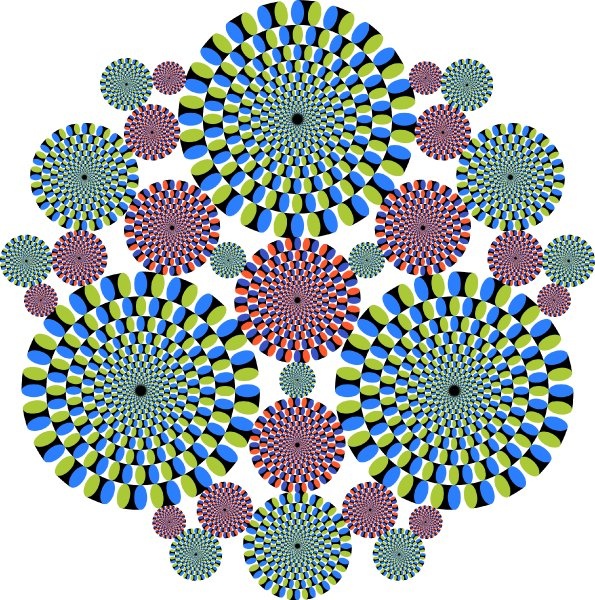
If one disk is now driven and starts to turn, the neighbouring ones will - through friction - begin to turn as well until the whole system is set in motion. In the beginning there will be some slip but at some point the system is synchronised.
Then, the system runs without slip. One prerequisite is that the overall number of disks is even - otherwise it would not be possible for the system to rotate wthout slip.
Of course, there is still friction, and this is the reason why the system needs a constant input of energy. The scientists around Prof. Hans Herrmann tried to modify the system such that it would run with a minimum of energy input.
The group calculated that operating power would be lowest if the mass of all disks is in a ration to their respective radius . The specific mass/radius ratio is thereby not important, important is that all disks in the system have the same mass/radius ratio .
The group calculated and confirmed the above with systems of up to 2000 disks.
Why is that so? Recall Newton's laws of motion which applies to each individual disks:
The acceleration a of a body is parallel and directly proportional to the net force F acting on the body, is in the direction of the net force, and is inversely proportional to the mass m of the body, i.e., F=ma .
Solving the ensuing complex equation for the entire system Herrmann's group concluded:
"The synchronizability of bearings can be maximized by counterbalancing the number of contacts and the inertia of their constituting rotor disks through the mass-radius relation, m?r?, with an optimal exponent ?=?× which converges to unity for a large number of rotors. Under this condition, and regardless of the presence of a long-tailed distribution of disk radii composing the mechanical system, the average participation per disk is maximized and the energy dissipation rate is homogeneously distributed among elementary rotors."
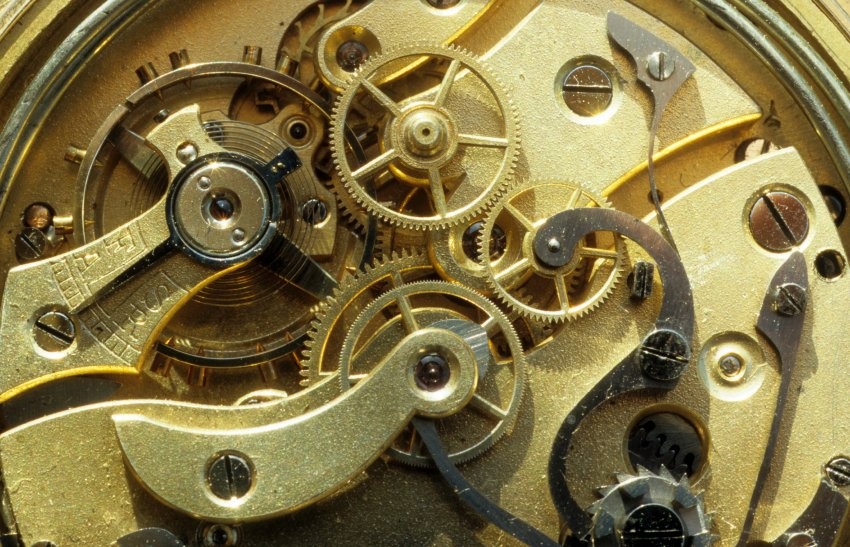
Now back to horology: Certainly we don't have slip here because of the teeth on the wheels. However, the authors specifically postulate that their results, i.e. reducing the amount of energy input, still applies to watch movements. Also here the reduction of energy would require a constant mass/radius ratio throughout the geartrain. If gear wheels are made of solid brass, their mass would be proportional to the square of their radius but not the radius. Thus, wholes are needed to adjust each individual gear wheel to a common mass/radius ratio.
In reality, watchmakers have come close to a 'perfect' mass/radius ratio: watchmakers have cut out much of the mass of the gears and left only spokes. If the number of spokes and their thickness stays constant regardless of the diameter of a wheel the condition of a constant mass/radius ratio is fullfilled.
If you want to read more: The study has been published in journal Physical Review Letters (Phys. Rev. Lett. 110, 064106 (2013)).
Hops you liked my theoretical excursus!
Cheers,
Magnus
This message has been edited by Ornatus-Mundi on 2013-03-12 10:55:07
Physicists on the trail of the 'perfect movement'?
Rarely do basic sciences advance an age-old area of applied technology such as watchmaking, but here we have an exception. An exception that is even more remarkable since it does not bring any fancy modern material and extraordinary new concepts but focus...

Is my mind playing games
That picture is static yet I am sure I see the wheels turning. Tell me I am dreaming. Bill

I showed the picture to my wife
and told: "The scientist have finally found a way to separate healthy people from insane ones. People who think they see some movement in the picture are either crazy or about to become crazy. Thanks God I do not see any movement." My wife is now very wor...

Now I am scared!
1. My Porsche is having export plates and thus, a full insurance is not available 2. Every now and then my wife takes the car. Best, Kari
Dr. Kol
Oh, dear Dr. Kol Porche is a wonderful car! There is a way to insure your Porche :) ...
Great report
Thanks for sharing Magnus, Does the watchmaker use the same theory or do they follow other rules to make the wheel train? Many thanks HT
Interesting
Articles like this, not the fluff of industry ads, are why I read the purists. I begin work on a new watch movement next week, in my small shop, and will keep this in mind.

Isn't your conclusion....
....on spoking based more on watchmakers (and nearly all wheel makers) wanting to maximise Mass to Stiffness, rather than the happy concidence of a constant mass to radius leading to improved synchronicity? (After some quick calcs) minor differences in di...

I'm not sure this is really useful for watchmaking....
This seems to me to only be valid for a system that is running at a constant rate. The gear train in a watch is mostly stopped, not moving at all. Then several times a second it accelerates, turns a small bit and then has a negative acceleration back to t...
I agree...
...very good points, not to mention that even if the motion wasn't interrupted, the gear tooth forms would have to be nigh perfect to provide a constant rotational speed. But then again, I read the paper: my poor brain hasn't been subjected to Eigenvalues...
Don, but wasn't the point...
that they made the distinction between slip and friction , and noted that the condition of a uniform, continuous rotation only necessary because they were working with disks instead of gears? In the former case of course a uniform, continuous rotation is ...
wouldn't this apply nicely to Spring Drive movements?
I'd be interested to see if something similar has already been applied to Seiko's constant roation Spring Drive movements as this would have a close direct application.


very cool stuff
Thought I had replied to this already but I guess not. Let me just say thanks for posting this thought provoking stuff. _john
It seems to me that this result may not hold true at very slow speeds.
At some point, the friction becomes much more important than the momentum. I do not have any math to back it up, just intuition.