panerailover.italia
8

Vacheron Constatin “222” Review
Vacheron Constatin “222” Review 
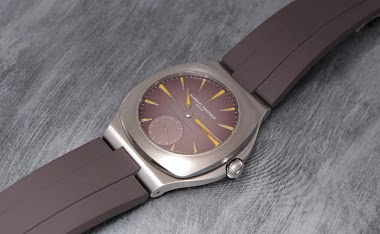
Vacheron Costantin 222 was born in 1977 to celebrate the 222th year of continual watch’s production: it was created by Gerald Gentà, author of other 3 “jumbo”.
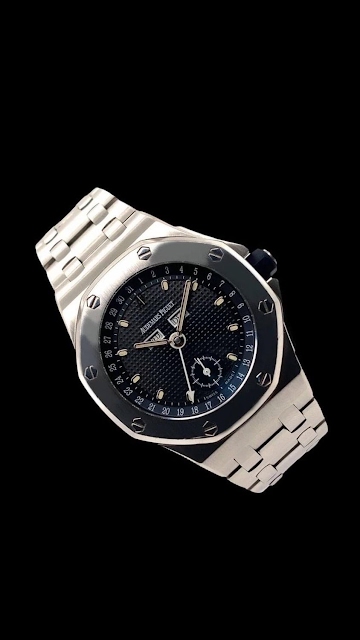
Audemars Piguet 5402 
Patek Philippe 3700 
IWC 1832 
And other beautiful watches… 
All together!
.jpg) >
> 
(In the last two photos Royal Oak is a Jubilee, not a 5402. But I think they forgive me!)
222 was made in 3 version: 37, 34 and lady version: each one was realized in 3 different materials (steel, gold, steel/gold). Its production lasted until 1985.
222 “Jumbo” 


Diameter: 37 mm
Thickness: 6 mm
Movement: VC 1121
Diametro: 37 mm
Spessore: 6 mm
Movimento: VC 1121
“222” on steel was made in 500 pieces. This’s confirmed by number or reference we (me and other Italian owner) have filed (from 5220XX to 5224XX).There were 3 different types of dial.
It’s possible that steel versione was made only in 1977, for anniversary. Infact all serials found are between 5220XX and 5224XX.
“222” have 3 different dial: black, rosee and argentee 


“222” on gold was made in 100 pieces; version in steel/gold on 120 pieces (we have just one serial for steel/gold version, 5367XX, anyone for gold!). 


Case is built in a unique block: its bottom (in which is engraved watch’s name) screws directly on ring nut. Crow is “baionetta” type (I don’t’ know english translation), and to remove it, it’s sufficient to pull (see last picture). 


“222” is antimagnetic and waterproof until 120 m. Bracelet is integrate with case. Clasp is not settable, and sealed with Maltese cross. 


NOS bracelet 


Maltese cross is different in original and new bracelet: 
And at the end of clas new bracelet has engraved "V4" (not in the originale bracelet) 
Box contained, as well as watch and warranty, a moneyclip on the same metal of watch. 


Jumbo’s calibre is the fantastic VC 1120 (today still on AP 15202!)
Designed and manufactured (but not finished) by Jaeger LeCoultre as the caliber 920, JLC has, itself, never used the movement in a watch of its own. First available in 1967, the 920 is used to this day by Audemars (calibers 2120/2121/2122) and Vacheron (1120/1121/1122). Patek Philippe, while attempting to produce a reliable, flat automatic design of its own, introduced the Nautilus in 1970 with the 920 (Patek caliber 28-255), and kept the watch in production for 10 years (then switching to the caliber 335SC).
Errata corrige: today only Audemars Piguet can use this movement.
In simplest form, the 920 is a diminutive 2.45 millimeters with an overlying, full-sized winding rotor. (The Patek caliber 240, with inset micro-rotor, is 2.4 millimeters.) With the addition of simple date function, the caliber 920 thickens to 3.05 millimeters. With date and center seconds, the thickness grows still further to 3.40 millimeters. This last figure suggests most of the reason for the 920's relatively limited use. There are several thinner automatics that provide date and center seconds, including JLC's own caliber 889 (at 3.25 millimeters). But, in its day, the 920 was a remarkable engineering accomplishment. No contemporary Swiss automatic, regardless of thinness, exhibits the refined--and expensive--construction of the 920. And, inarguably, this caliber is among the most beautiful wristwatch movements ever produced. A photographic tour of the Vacheron version of the movement (caliber 1120), beginning with the completely stripped main plate, tells the story. The caliber (in all iterations) is a 12.5 ligne (26 millimeter), 36 jewel design.
12.5 ligne (26 millimeter), 36 jewel.
ESCAPMENT
From the beginning, the 1120 (as well as the Audemars and Patek iterations) were, and still are, supplied with a Gyromax balance. An adjustable mass balance with eight rotatable weights, the Gyromax allows both poising ("balancing") of the balance and rate adjustment without the use of a conventional regulator index. The illustration shows both the KIF shock protection and the engraving on the balance cock showing rate adjustment procedures. The slot in opposing pairs of weights is rotated to the outside of the balance to decrease its effective diameter and increase rate. Rotating the slot towards the center of the balance increases the effective diameter of the balance wheel and slows the rate. 
THE WHEEL TRAIN AND AUTOMATIC WINDING SYSTEMS
The beautifully finished wheel train and (most of) the automatic winding train are shown down. Numbered parts are the (1) center wheel; (2) third wheel; (3) fourth wheel; (4) escape wheel; (5) pallet lever lower pivot; (6) balance wheel lower pivot; (7) lower pivot for first automatic winding transfer gear (mounted on the barrel bridge); (8) switching rocker for bi-directional automatic winding; (9, 10) automatic winding transfer wheels; (11) hand-winding disengagement wheel; and (12) mainspring barrel. 
The fourth and escape wheels share a bridge. The fourth wheel pivot is shown at (2); the unusual shock protection on the escape wheel at (3). The cap jewels on the escape wheel are flat on both surfaces, and use a spring that is rotated out of position to release the jewels for cleaning. 
As illustrated the barrel bridge carries a number of the components of the automatic winding system. The bearing for the winding rotor (1) is bushed rather than jeweled for flatness. A ball bearing transfer gear is used (2). Transfer from the top of the barrel bridge to the underside is handled by a semi-floating double gear suspended on a large diameter center jewel and lower pivot jewel (3). This gear drives the switching rocker. Note (4) the bearing surface for the floating mainspring barrel. One generally sees some wear on this surface in movements that have not been regularly serviced. In this case, the apparent wear did not create out-of-tolerance side-shake (which would allow the barrel to cock and thus require replacement of the entire barrel bridge). The full winding train is shown in greater detail. The lower pivot for the semi-floating transfer gear is shown at (1). Depending on the direction of rotor rotation, the switching rocker (2) shifts to engage one or the other of its transfer wheels with the first intermediate wheel (3). This wheel (3) always rotates counterclockwise for winding of the barrel (4) arbor. During hand winding, wheels (5) and (6) are disconnected (they are coupled with a unidirectional ratchet) and the automatic winding train is completely disengaged. During automatic winding, wheel (6) is driven by the pinion of the brass intermediate wheel (7) and drives the ratchet wheel on the barrel via wheel (5) 

The barrel bridge is shown installed on the mainplate. (The ratchet wheel and crown gear are not installed.) 
An elegant detail of construction is the barrel click in the automatic winding system. The click is mounted on its own bridge and is jeweled top and bottom. 
The winding rotor of the caliber 1120 uses a 21K rim, as well as a full circle beryllium ring. Because of the low-profile, bushed center bearing, the rotor requires support around its periphery. Conveniently, the rotor is released from the movement by sliding a single clip away from the bearing. 
The peripheral support for the rotor is provided by four ruby wheels. Each runs on an axle mounted in a small plate screwed to the mainplate. The beryllium ring of the rotor is fully supported by these wheels. During rotor movement, the ring and wheels provide the caliber 1120 a sound unique among automatics. 
As seen with the rotor installed on the movement, the beryllium ring of the rotor (1) hides all but the outer edge of the wheel plates (2). 
THE KEYLESS WORKS
As in all great calibers, the dial side of the movement (or bottom plate) is no less beautifully executed than the top plate (left). This very thin caliber uses a design for the winding and hand setting mechanism that is both robust and elegant, utilizing many fewer parts than most designs. In the upper left hand corner, the floating mainspring barrel can be seen flush with the bottom plate. 
An examination of keyless works parts at 35 power magnification reveals perfect tooth shape and unimpeachable finish. 
From: http://www.timezone.com/library/horologium/horologium631686780396906210, by Walt Odets
So, some other pictures of “222”! 


“222” 34mm
Diameter: 34 mm
Thickness:
Movement: VC 1124 (JLC 899), with central seconds. 

“222” Lady
Diameter: 25 mm
Thickness: 4.5 mm
Movement: VC 1009/39 (quartz) 




Vacheron Constatin “222” Review

What an amzing review


Wow, That is a review


