219
3826

Historique Racing at Pau
 g
g
[The ERA overtaking the Cooper-Bristol]
The other racing revolved around single seat racing from the Grand Prix racing eras that had been before: from the Bugatti’s of the 1920’s, through the Maserati’s and the Alfa’s of the 1950’s, through to the Lotus, Cosworth, and Cooper’s of the 1960’s. 
[A progression of Bugatti Type 35 and Type 37’s through the chicane]
I have to admit that I have never seen so many Bugatti race cars in one historic race meeting. It is very rare to see a convoy of Bugatti’s at a race meeting in this day and age. It was the circuit where Bugatti’s had raced for the grand prize of motor racing. Unfortunately, at this meeting there were no Bentleys for the Bugatti’s to race against. The last Bentley raced at Pau was a private entry by Tim Birkin in1930. No one had given him a chance, but typical of Birkin, he kept his foot to the floor and raced as hard as he could. Coming up the straight Zanelli’s Bugatti was slowing and had he not spotted Birkin in his Bentley flying up the hill in pursuit. With the Bugatti not moving aside, BIrkin grew impatient and used the horn. This startled the Bugatti driver and he moved. It is believed to be the last time a horn was used in a Formula 1 Grand Prix!
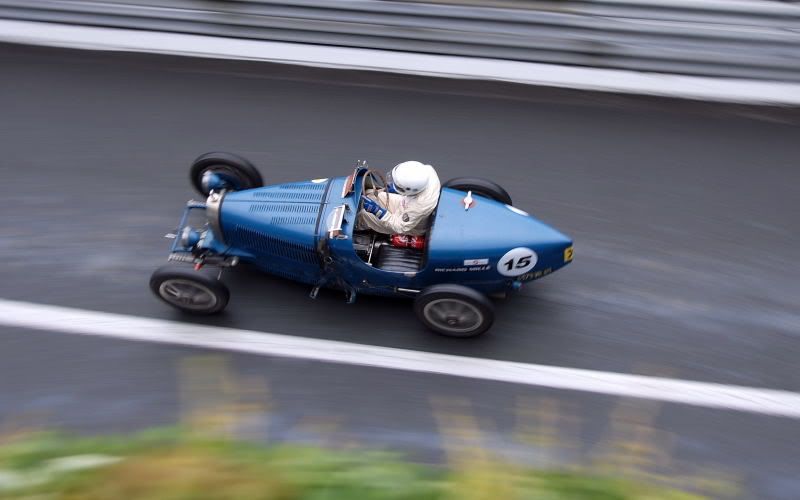
[The Bugatti’s speed up the hill. Note the oil tracks on the road]
What was apparent from seeing the cars race at Pau was the engineering and artistic progression of the Formula 1 car. A (fast) moving museum to the art of the car; how the need for speed sculptured and molded the cars into forms that both reduce the effect of air across the surface, and increase the power through the engine for speed. From the Bugatti’s in the 1920’s where the thin line and tapered end of the car was to define the basic form for Formula 1 cars for the next 30 years. The Maserati and Alfa cars of the 1950’s were basically the same model, only with slightly better aerodynamics and more powerful engines. 
[A stunning Maserati 250F from 1958]
[Both Maserati 250F’s follow each other down the hill]
[The Cooper-Alta from 1953 speeds into the corner]
It took an innovation, a paradigm shift to move the engine from the front of the car to the rear (placed behind the driver). A little known car firm from England, founded by father and son (surnamed Cooper), shifted the centre of gravity for the car from the front to the middle; and with it, they shifted the design of Formula 1 cars until the present. The Cooper Car Company rose to prominence with their rear-engined Cooper Coventry Climax; first with Jack Brabham at the Monaco Grand Prix in a Formula 2 car taking 6th place. But it was Stirling Moss victory in the Argentine Grand Prix in 1958 with a privately entered Cooper that was to make the world sit up and take notice. A revolution and sea-change in thinking about Formula 1 racing car design had been initiated. Lotus and BRM followed suit, with the Italians (Ferrari and Maserati) following soon after. Jack Brabham claimed the Formula 1 crown in 1959 driving the Cooper works car. 
[A Lola Mk 4 from 1962]
[A Lotus 18 from 1960]
The cars are the embodiment of the art of mechanics of racing machines. The Formula 1 cars racing at Pau are from a time when you did not need a software engineer to help you start the car; and where your speed was not controlled from a steering wheel that looked like a gaming consol for an ‘x-box’ on steroids. It required craft and skill to negotiate the turns, to pass your opponent on the track, and where speed and dexterity with the car were required throughout your race.
[The rear-engined Lotus, Cosworth and Cooper speed up the Boulevard des Pyrenees]
Car and engine design were still in the hands (along with the pencil) to design the racing machine. Ettore Bugatti, W.O. Bentley, Ernesto and Ettore Maserati, Enzo Ferrari, John Cooper, Colin Chapman (Lotus), and Raymond Mays (BRM) were the personalities and driving force behind the car companies that either bore their name, or which they had founded. There was generally no committee, no mission statement, just a wish to be the best, to win. The cars became the embodiment of their beliefs. It is little wonder that now such cars are seen as art work, the design and engineering, the craft in the construction of the car and engine, the realization of a machine for a purity of purpose. Even the smallest elements of the cars were thought and re-thought: from suspension pins to the entire engine.
It is no surprise that such cars have become prize possessions in their own right, and as works of art. The sculptured form of the cars, the development of the race engines, makes the cars both art (and adorn many of the world’s museums of modern art), and engineering marvels.
Racing History at the Start Line: Richard Mille, the Grand Prix de Pau, and the RM001
Historique Racing at Pau

Good stuff, Andrew!
Even with the weather not playing along, it was a great event.

Thanks a lot for this superb report Andrew.
Thanks Foversta - when Richard started with the RM001,
The Racing Machine on your Wrist: the RM001

Thanks Andrew...I learn so much about
Thanks Mike - glad to be helping you on your path to your

A tip of the proverbial cap, Andrew. This post resonates . . .
Thanks Art. I agree! Richard will, without doubt, be

Looks like FUN!


Thanks for the report Andrew
I think the RM001 will be an important watch historically

Oooh!
The track was dicey - and there were some accidents.

Thanks for the report..


Richard Mille: When the words ridiculous and

Very true - and good point. The difference was in