
Esharp
1618

Case construction
Kari,
I realized I don't know much about the real difference between the two-part and the three-part cases, so I did a little searching online just now and found an article which said:
"Rather than the normal caseback/band/bezel composition, the Nautilus case was originally ‘monocoque’ – milled from a block of solid steel – with a single bore for the winding stem, and a hinged, screwed-down bezel holding the crystal (its hinges affectionately known as ‘ears’ to fans). As manufacturing techniques have advanced, three-part cases have become as rugged as monocoques, so – save for the mediumsized model – the new Nautilus cases now have the traditional arrangement of caseback, band and bezel..." (QP Magazine, 2007).
Not to hijack this thread - perhaps I should post separately? - but do you think there's merit in this argument, which seems to be saying that the technical advantage of the original construction has now been negated? Or is it marketing sophistry? Does it bolster the argument that the design was intimately linked to the construction, and that therefore one could consider the 37xx series faithful to Louis Sullivan's idea that 'form ever follows function' while the 57xx series is - I don't know how to put this politely - a bit of an impostor?
best
E.

Nautilus choice : 3712 vs 5726 1a
If you had to choose only one Nautilus between the beautiful 3712 and the useful AC 5726 1a, which one would you choose? Heart or brain? Blu or gray? Let me know. Regards Fabio 3712 57261A This message has been edited by fabios on 2014-12-01 23:31:04 This...

Think twice before buying either...
I Hesitated between the same 2 watches, and went for the 5726: because of the symmetry and purity of the dial. However, after just 1 week the watch is faulty - the month stuck on November and did not change on Dec 1. The perpetual calendar is a key featur...

It's annual calendar,
not perpetual. If the watch would have the perpetual movement, it would be: 1. Much slimmer in case Patek would use cal. 240Q 2. I would buy it in steel without any hesitation. Anyhow, watches are mechanical instruments and some problems might always occu...

What are you talking about, if I may ask?
"The perpetual calendar is a key feature" Who told you that there is a perpetual calendar in this specific watch? Cheers, Oliver
Sorry, beginner, I meant annual calendar....
.... Being a key feature. Knowing to change month to Dec after 30 days. Yet being stuck in November
I had both...
but 5726 stayed a week or so and 3712 will stay forever. The spirit of both Royal Oak and Nautilus originally was slimness . Indeed, 3712 is slim and 5726 is not. However, for me the most important thing is that 3712 was the last Nautilus made with a two ...

slimness....
This is something that most wearers today don't realize or appreciate enough. There's something magical about a thin thin watch, how it wears, how it disappears and reappears under one's cuff. Most of us at one point or another give into the impulse of ha...
Case construction
Kari, I realized I don't know much about the real difference between the two-part and the three-part cases, so I did a little searching online just now and found an article which said: "Rather than the normal caseback/band/bezel composition, the Nautilus ...
Tha's one way of saying it.
I spoke with a professor of a technical university who had a look at both constructions. I guess there is no doubt - both are solid and reliable. But: 1. The original construction is more expensive to produce. 2. It looks like the original design is origi...
"impostor"
Back in 1976 (Ref. 3700) they started with a two bodied water resistant case ... today we have a three bodied water resistant case - for several reasons. Good or bad? It all depends on your view, your expectations, your point of view, your needs ... . Tec...
Thank you for your comments Oliver.
It is hard to say what kind of construction is better, what is worse. However, there are two facts very few people, if any, can deny: 1. Gerald Genta designed a two-parts case to Nautilus in 1976. Ref. 3712 is loyal to this design, 5712 looks the same but...
Kari. let me ask one more question - even when there is no answer.
"Gerald Genta designed a two-parts case to Nautilus in 1976" How would he design it today? Best, Oliver
Like you said - there is no answer
because Mr. Genta passed away a couple of years ago. But let me ask you a question; in fact a counter question: In 1976 Rolex had already developed a waterproof Oyster case having a removable case back. Why did Mr. Genta not simply use a similar design bu...
Oliver, let me ask one more counter question - even
there is no answer: If Leonardo had a Leica M, would he have avoided a lot of work and just photographed Mona Lisa? Best, Kari
Thank you!
Kari, Oliver, Many thanks for a very interesting discussion, which raises perhaps as many questions in my mind as it answers. Oliver, you're right, 'impostor' wasn't a great word to use - I'm still not sure what the right word is. I hope you understood wh...
Thanks Esharp,
I am very sure that both Royal Oak and Nautilus could have been designed with a totally different construction. I also believe that the current design of Nautilus is technically as good as the original design. Probably Patek would not be happy with anythi...
3712...
First of all, congratulations on having to make such an interesting decision! I've never been able to compare a 37xx with a 57xx, either the -11 or the -12 model, so I don't have an opinion there, although (as Kari points out) the purists seem to go for t...
My vote when looking on your wrist ...
is for the 3712. Good luck with your decision! Oliver

Two very different watches, different spirit
Nice project Fabios. Personnaly, I love both dials, aesthetically speaking. The question I would try to answer is: do I like its thinness or is it a minor characteristics of the watch? Then: do I prefer the more technical mechanism of the 5726. I bought a...
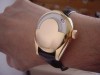
3712 is my choice
I have small wrists and so a watch with a thinner case fits me better. That's why I've never fancied the 5980 or the 5726. And thanks for all the information provided by the Nautilus experts here, I now should love my 3712 even more. ...
Looks good on your wrist.
Enjoy your watch and don't let it go. In addition of being a fantastic watch, it is also rare. Best, Kari

You mentioned Beautiful 3712 and Useful 5726....
Both are relative terms and there are many reasons for getting a watch. I am quite a diversified person, so I chose different functions, brands to own. For me, I chose the 5726 because of the symmetry, and right size/thickness for me, though I had not see...
5726 !
Despite a great majority has chosen the 3712, my choice is the 5726 without any hesitation... By the way, I desgaree when you write the "beautiful" 3712 and the "useful" 5726. 1- I much prefer the grey dial to the blue one, much more elegant and subtle un...

3712,...
having the same set of dial and complication as the 5055. Whichever came earlier, both are winners, quintessential qualities and class of Pateks !