Clavi
788

An interesting interview indeed
Well done Nico and Jérome at setting-up this interview.
Your questions were very relevant and sometimes challenging, and the answers were also interesting.
I share Marc-Andre Strahm and Sebastian Vivas tastes for their favourite vintage watches (there would probably be many more to add, but the list needs to be limited to a selection). I specially like Sebastian ideal re-edition wish of a gem set Duoplan and some ultra-thins, but his comment ("if there’s an expected market") says long about the unlikelyness of this happening too soon.
Now, commenting some aspects of the article (as my annoying self usually does...)
Regarding the 'controversy' over the Calypso hands.
I am quite convinced that Jaeger LeCoultre has had (and maybe still has) these hands in their stock, and therefore I completely believe the parts store manager recollection of having seen them. Actually, these hands can be found on a small number of late memovox E 870, but mostly on same period (1970's) Zodiac Seawolf models (Both the Jaeger LeCoultre and Zodiac cases were sourced from the same supplier and were relatively similar in shape by the way, though only the JLC had an alarm feature).
At that time, I believe that the 'manufacture' Jaeger LeCoultre did not cover all of the aspects of manufacturing it does nowadays, and parts like cases, dials, hands and bracelets were frequently outsourced (while Jaeger LeCoultre was producing the movements and doing the final assembly of the watches).
The Calypso hands were therefore available to be fitted to the memovox 870 at the end of model production I believe (JLC sources would be helpful to clarify dates here).
What I am questioning, is whether these calypso hands have genuinely been fitted to the 859 during the actual time of production of the watch. I have read the story of this 'special order' from an italian retailer, but it seemed to be a second-hand information, not a sure fact. I am very much willing to buy this story if there is actually a trace of this order in the archives (something I don't know), but otherwise my personal hypothesis is that the calypso hands have existed only post polaris production and that they might have been fitted to the Polaris we see with such hands only later. I don't challenge their existence within the JLC parts stock, I am only wondering if they have really been fitted to the 859 at the time of production.
Example of calypso hands on a Polaris II looking Zodiac, note the family look of both case and hands with the memovox 870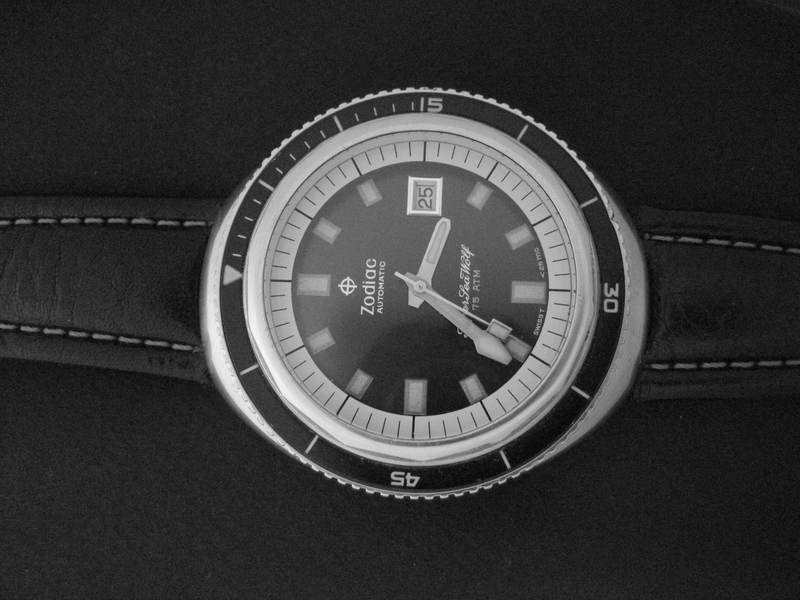
Photo credit "Smitty"
Regarding the Reverso hands, the explanation given that they are found in an Hermes catalog convinces me (I have not found it in my small archive of Hermes ads, but this one is definitively not exhaustive. I would like to see this vintage advert showing these hands).
I think I was surprised initially and expressed doubt over these hands as they are definitively not the usual type of hands found on early black dialed reversos, and therefore I was surprised that this very watch with unusual hands was chosen as an illustration of what an oldtimer reverso looks like.
The fact that the first press releases showing a vintage polaris with incontestably wrong 'spade' hands had bothered me, so that is why I was sceptical on the reverso too, but now I reckon these reverso hands might be good (it seems that even Marc André and Sebastian have not reached a definitive conclusion on that one).
I appreciate the effort Jaeger LeCoultre is doing at highlighting some of its past production and history, which are my primary interest over current production, and I am often critical whenever I spot something I believe is not totally accurate. But I believe this leads to good things in the end as it helps to document the history of the brand in addition to the researches Sebastian is doing.
I still believe that the book "la grande maison", although it is a nice coffee table book that probably pleases most Jaeger LeCoultre enthusiasts, is not enough a reference book for collectors and that there is room for a much more detailed (and probably boring to many!) book which would be a true 'catalogue raisonné' (something that the current book is not despite what the description of Franco Cologni book says.
For example, I was also a bit disapointed recently when I saw that the presentation of historical diving models on Jaeger LeCoultre special dive website ( www.jaeger-lecoultre.com
somehow messed up the models in its 'milestones' presentation (examples: a DeepSea alarm being shown instead of a Polaris II, an E558 caseback being shown instead of the Polaris one... , as well as the previous mix up between calibres shown and the corresponding watches in the official press releases (non-alarm calibre 883 (Geomatic) being shown instead of the 825 memovox calibre, picture of a DeepSea MasterMariner being shown instead of the DeepSea alarm...).
I know these details are of very little importance to the actual buyers of modern products, but I believe accuracy would still be a good thing overall, and help create legacy in the long term.
Now, these comments being made, I am glad to know that the Gallery has found an example of "the first waterproof watch from Jaeger-LeCoultre from 1939".
If I am right, I believe this watch is the rectangular watch using the Baumgarter waterproofing system (isn't it?).
If this is the watch we are talking about, I think this is truly a superb watch, which, as most other rectangular JLCs, is very under-rated today (I believe they are overshadowed by the Reverso, which is a pity as there are many other great rectangular classic JLCs)
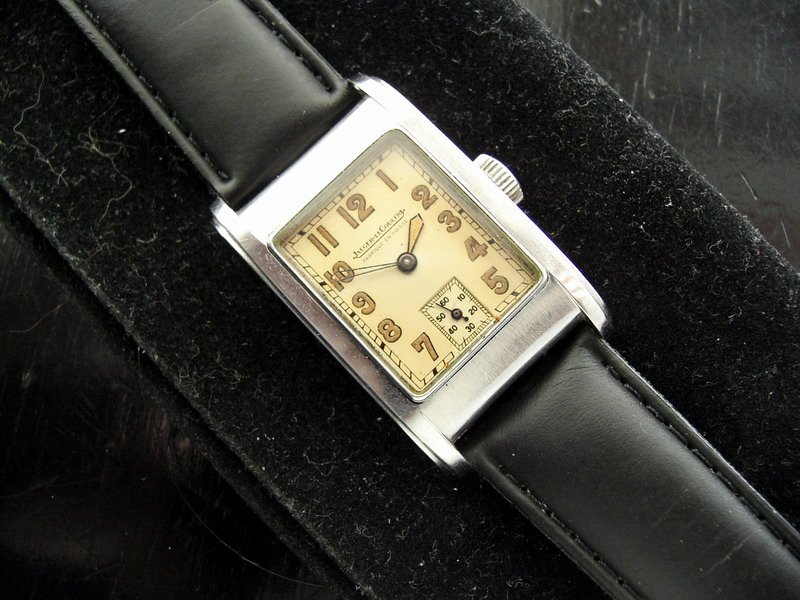
Photo credit Clavi ...
Thank you Nicolas and Jérome for the interview
(ah, by the way the nice Futurematic you have shown in your report is mine, but no problem for using the picture here of course ! )
Here is the typical backside. Don't forget: slide do not lift !
Available on the marketplace
17,804 Rolex listings are live on the eBay market and 1878 collector listings on the WatchProSite marketplace.


Interview from the JLC Heritage Department!


Excellent interview!

Marvelous read

Thank you for that interview, Jerome and Nicolas!
LOL, Herrk,
Here yor go, NIcolas!
Hey, Christian, better, now! LOL
An interesting interview indeed
Absolutely fantastic!

Very interesting, thanks!

Hi Nicolas - great report and


In the 'Duetto' tradition...
Great Read......
Thanks for the effort in interview and the report.
OOOOOO
Maybe, ajlc, maybe soon
