
Ornatus-Mundi
[Zenith]
7136

UPDATE in the recent developments regarding the 'Swiss made' label
Ever since 2007, proposals have been put forward with the aim to strengthen the label 'Swiss Made'.
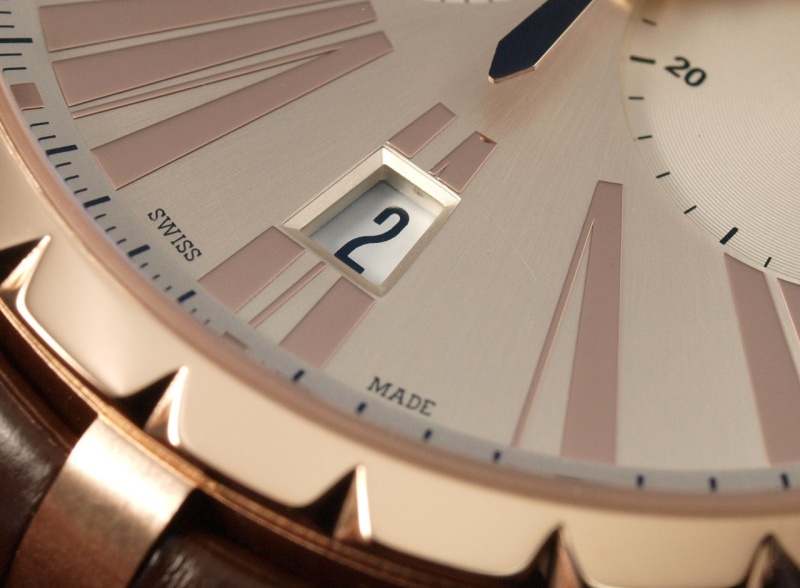
Recall that currently the standard is relatively lax. Wikipedia states the following definitions provided for by Swiss law (ordinance regulating the use of the name "Swiss" on watches, dated 23 December 1971, amended 1995):
"Swiss watchA watch is considered Swiss, according to the Swiss law if:
- its movement is Swiss and,
- its movement is cased up in Switzerland and;
- the manufacturer carries out the final inspection in Switzerland
Swiss watch movementA watch movement is considered Swiss if:
- the movement has been assembled in Switzerland and,
- the movement has been inspected by the manufacturer in Switzerland and;
- the components of Swiss manufacture account for at least 50 percent of the total value, without taking into account the cost of assembly.
If a watch movement is intended for export and will not be cased-up in Switzerland, but it otherwise meets the criteria to be considered a Swiss movement, the watch may say "Swiss Movement" but it may not say Swiss Made on the watch case or dial. A watch that says "Swiss Quartz" is considered to be a proper Swiss watch. However, it is often improperly used by foreign manufacturers to merely indicate that the quartz movement is of Swiss origin."
Requirement 3 for watch movements is the so-called (& famous) 50% rule. The criteria could easily be fulfilled using cheap (asian) labour: Several Swiss watch companies have (more or less unknown to the public) taken Asian cases, dials, hands and bracelets and assembled it with a 'Swiss' movement (i.e. a movement where 51% of its value must be Swiss and at least the last wheel must be added in Switzerland, hence check for all requirements above).
Aware that critical customers assign a specific value for a 'Swiss Made' watch and are, so studies say, prepare to pay a 20% premium for such a watch (or other products), since 2007 the Federation of the Swiss Watch Industry (FH), the industry organisation of the Swiss watch industry, sought to strengthen the designation of origin. The FH has 500 industry members who voted with 87% votes in favour of a reinforcement of the existing criteria.
The new proposal stipulates that for mechanical movements a minimum of 80% of the value of all constituent parts should be Swiss, for quartz movements the value is set at 60%, respectively. Furthermore, construction and prototyping have to be carried out in Switzerland. As a side note, the 60% is not simply an arbitrary number: it corresponds to the rate used in the free-trade agreement between Switzerland and the European Union.
-------
Fast forward 2013: what has been achieved meanwhile, after 6 years? VERY LITTLE (besides imbroglio and quarrelling)! In fact it may look like that the reinforcement may never be implemented.
Why is that so?
The answer to this question as often lies in politics and self-serving interests. First come, first serve: The project to tighten the requirements has to be seen in a broader context of the 'Swissness' discussion in the Confoederatio Helvetica. This discussion is about the 'Swiss Made' label for any industrial product of any industrial sector in Switzerland. Lawmakers in the Swiss parliament are debating back and forth whether to opt for 50 or for 60% of Swiss value generation (i.e. the proposed requirements for quartz watches).
Now here comes a funny practical joke: Swiss journalist Michel Jeannot reports that it is the right-wing, nationalist (or patriotic), conservative part of the lawmakers who oppose the strengthening of the 'Swiss Made' label!
They have substantive support from a conspiratorial Swiss watchmakers who refuse to stand up in public (or even have their names disclosed). They operate clandestinely and claim that the proposed reinforcement would costs 'thousands of jobs' in Switzerland.
The combined forces of conservative politicians and said watchmakers was strong enough to convince economiesuisse, the Swiss Business Federation representing 30,000 Swiss entrepreneurs employing a total of 1.5 million workers (more than 35% of the total Swiss workforce!) to prefer (and lobby!) for a 'flexible' rate - de facto a weakening of the 'Swiss Made' label.
Now, the FH is a member with economiesuisse.
That is bound to change: Today, 28 February 2013, the Federation of the Swiss Watch Industry declared, in a protest to economiesuisse's intention, its intention to leave the organisation as of the end of 2013. I should also state that the FH itself has been accused to be too busy assisting the industry in making sales and building their image worldwide, thereby forgetting that the pertaining laws are still made in Switzerland. And subsequently (and consequently) overlooking its home turf.
In a business situation, it's idiomatic to say "There's going to be reshuffle".
I'll keep you posted!
Cheers,
Magnus

Discussion
Zurich's mayor sparked controversy by ordering Chinese-made watches as city gifts. This incident ignited a debate on 'Swiss Made' authenticity, manufacturing ethics, and industry hypocrisy.
26 replies2801 views

Discussion
Explore the Patek Philippe Sternian Civil Calendar System (SCCS) and Ref. 7140R-SCCS. Discover this BaselWorld 2016 'announcement' and community reactions.
12 replies3299 views

Discussion
Discover the International Chronometry Contest 2009, the first of its kind in the 21st century, its goals, and the debate surrounding its scope and rules.
9 replies1202 views

Market
Understand the USA Tariff 2025 on Swiss watches. patrick_y explains how duties are assessed on components, not just retail price, impacting brands like Patek Philippe and Rolex. Learn about import complexities and stakeholder roles.
29 replies4510 views

Independents
Discover Vortic Watch Co.'s innovative approach to watchmaking, converting vintage American railroad pocket watch movements into modern wristwatches using 3D printing.
9 replies3099 views

Market
Apple Watch sales surpassed Swiss watch industry shipments in Q4 2017. Explore the debate on market impact, sales data interpretation, and the future of traditional horology.
22 replies2873 views
UPDATE in the recent developments regarding the 'Swiss made' label
Ever since 2007, proposals have been put forward with the aim to strengthen the label 'Swiss Made'. Recall that currently the standard is relatively lax. Wikipedia states the following definitions provided for by Swiss law (ordinance regulating the use of...
Like Swiss technology...
such as pharmaceuticals, machinery, as well as cheese and chocolate, it's all about the argent (money). Maybe the watch industry needs a labeling standard like 'Swiss Made - 50' for 50% Swiss made or 'Japan - 100' for a timepiece totally made in Japan, fo...