
Modernahab
1110

Six Travel Watches: A Comparative Review
6 Travel Watches: A Comparative Review
I never intentionally set out to collect travel watches. Yet here I am, having recently purchased a sixth, and finding myself in possession of a small collection of carefully curated timepieces with dual-time displays of one sort or another. These six constitute more examples than I have of any other complication, evidence perhaps of a fascination with the various ways that times in multiple zones can be displayed. Indeed, with no particular horological expertise or deep knowledge of watchmaking history, my focus for this particular ramble will be upon the manner in which each watch displays dual times, with some reflections upon utility and a smidgeon of none-too-deep attention to technical matters. The watches are discussed in the order I acquired them, and I hope some may glean a bit of enjoyment (insight would be too presumptuous) from my musings. Sadly, I am not equipped to photograph movements effectively, so most of what I have by way of original photography are wrist shots. All else has been culled from the makers’ official web sites, CaliberCorner.com, or WatchBase.com.
JLC Reverso Duoface Night & Day, WG, Ref. 270.3.54*
I’ve owned a few Reverso’s in my time, with three in my current possession: the limited edition 1990s rose gold Chronographe Retrograde, the recent stainless steel Tribute Chronograph, and the subject at hand, the white gold Duoface Night & Day, produced from the late 1990’s through the early 2000’s. I have always been a fan of Art-Deco aesthetics, but what intrigues me about the Reverso line is the way two back-to-back dials can accommodate complications. Yes, part of the fun in owning a Duoface is having what amounts to two distinct watches in one, but the recto and verso dials also present a marvelous opportunity to display the time in two different zones with a simple flip of the pivoting case.

The Duoface, in its many incarnations, offers one of the simpler dual-time indications among Reversos, consisting, as it does, of a single manual-wind caliber driving the hands on the recto and verso, with an independently stepwise settable hour hand on the verso. This is in contrast to the various Reverso GMT references, which have featured more complex movements and displays, and even, on occasion, automatic winding (as in the Reverso Squadras of yore). Duoface references in the current catalog generally include a day/night indicator on the verso (local time) dial, but the white gold Ref. 270.3.54 has in addition a day/night indication for the home time on the recto dial. In most Duoface models I’ve seen, the verso (local time) day/night indication is read off of a small subdial in the 6 o’clock position, with or without 24-hour markings, depending upon the reference. The same holds true for the verso of Ref. 270.3.54, but the recto features a rotating disk with a gilded sun for day and a field of gilded stars for night, rotating behind a crescent-shaped aperture at 12 o’clock.
Unfortunately, moving the hour hand for the local time on the Ref. 270.3.54 and its contemporaries in the Duoface line entails use of a recessed pusher adjacent to the crown. The resultant need for a tool (or a ballpoint pen/bent paperclip/etc.) limits the utility of the dual-time function and in the case of Ref. 270.3.54 introduces the risk of scratching the white gold caseband. While this liability has been corrected in more recent Duoface references through the substitution of a slider on the top of the rotating case (hidden at most times), no Reverso in the current JLC catalog appeals to me aesthetically on the level of this white gold Night & Day.
The recto dial on Ref. 270.3.54 is covered in rich, smooth, inky-black semi-gloss resin, with JLC’s elegant “florale” Arabic numerals painted in white, the application thick enough to yield a pleasing three-dimensionality in the wider segments of each number. Sword-shaped white metal hour and minute hands are treated with a central zone of luminous material in a discreet off-white hue. A sunken small seconds subdial at 6 o’clock adds a sense of depth to the dial and balances the night and day indicator at the noon position, while a very fine white railroad minutes track contributes additional visual interest. The night and day indicator, with its gilded components, is generally quite attractive, though one could wish for something more refined than the gradient dot-matrix printing of the sky behind the sun and stars. (Perhaps understandable, though, at the watch’s original US $12,700 price point.)

The verso, by contrast, is silver-toned, with the same sword-shaped hour and minute hands over a vertically displaced sunken dial, in this case with printed block Arabic numerals for “3”, “6”, and “12” and brightly polished wedge-shaped applied indices for the remaining hours, all on a smooth chapter ring. A small 24-hour subdial, its numerals printed on a raised chapter ring, intersects the main dial at 6 o’clock and is flanked by cartouches labeled “Night” and “Day” at left and right, respectively. A larger cartouche bearing the Jaeger-LeCoultre name appears within the central dial. Both dials on the verso side are decorated with a radiating ‘guilloché’ pattern that contrasts with the surrounding Clous-de-Paris texture. Unless someone with more insider knowledge can attest otherwise (I’m talking to you, Nicolas ;-D), I assume that these patterns are stamped and not rendered in actual hand-turned guilloché. (Hence the quotes.) In any case, the recto and verso offer considerable contrast between themselves, while each remaining absolutely consistent with the Art-Deco godron-embellished rotating Reverso case.
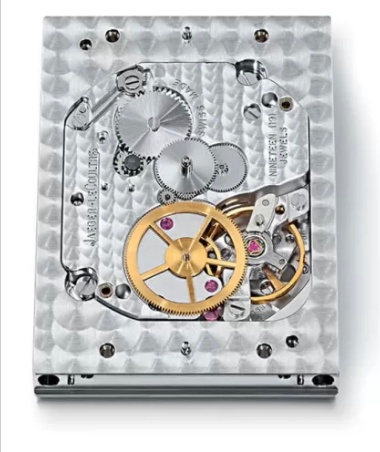
Speaking of which, the white gold case measures 36.4mm x 26.1mm (or 42.2mm x 26.1mm lug-to-lug) and 9.5mm deep, while the lug width is 19mm. Water resistance is rated at 3 ATM. The manual wind caliber JLC 854J measures 22.6mm x 17.2mm x 3.8mm tall, contains 21 jewels, and runs at a rate of 21,600 vph. Apparently, Ref. 270.3.54 was also offered on a white gold bracelet, but I have never seen that variation. In my experience, the white gold Duoface Night & Day wears smaller than contemporary Duoface iterations, which do indeed measure significantly larger, lug-to-lug. While its utility as a travel watch is limited by the recessed pusher for the local time hour hand, it is a very distinctive, versatile (arguably unisex) timepiece that expresses the Reverso’s Art-Deco aesthetics in a highly distinctive manner. I wear it very often, whether I’m traveling or not, most frequently with the black recto side on display.
Glashütte Original Senator Cosmopolite, SS, Ref. 1.80.02.01.04.30
I received the stainless-steel Cosmopolite as a gift the year it was released and may actually have one of the first examples to have reached the US. Whereas the Reverso Duoface Night & Day is somewhat limited in its utility as a convenient travel watch, the Cosmopolite is an entirely different story. The GO offering is all about travel utility, and it could be argued that its advanced and sophisticated travel time functionality was achieved at some cost in terms of other features. To wit, its size. No getting around it – you can call it a hockey puck, you can call it a tuna can, or you can call it the UFO from Independence Day, but in any case, (bad pun!) at 44mm x 14mm, this is one honking big watch. The impression of size is reinforced by the very narrow bezel and the stark white dial on the reference I own, and I have to wonder if the more recently introduced and (to my mind) more casual-appearing blue sunburst-finished dial model might appear somewhat smaller on the wrist. In any case, your interest in owning this watch will probably depend upon its size above all else.

That said, the Cosmopolite wears quite comfortably for me. At an admittedly musclebound 5’ 7” (5’8” before shrinkage) I am not a large person. Nevertheless, perhaps because my 7.25” wrists are rather flat, I’ve been able to wear the Cosmopolite (along with the 44.6mm Arnold & Son Time Pyramid, the 53mm-long Parmigiani Kalpa XL Hebdomadaire, and the 44.6mm IWC Portuguese Perpetual Calendar) without feeling like I’ve snuck into daddy’s closet. Wearability in all the abovementioned watches is enhanced by short, sharply downward-curving lugs, which hug the wrist, rather than appearing to hang off of it. Even so, the Cosmopolite does not always fit easily under a buttoned cuff, which can on occasion limit its wear for me. Mind you, the size of the Cosmopolite is not simply a matter of stylistic excess, as in some other watches, which I will refrain from naming. At 39.2mm diameter, the automatic GO caliber 89-02 that powers the Cosmopolite fills the transparent sapphire case back. I really see no way GO was going to get the case significantly smaller while housing this movement.

So, at the expense of so much real estate, what exactly does the caliber 89-02 do? Plenty, it turns out. The local hours and minutes are displayed conventionally by shapely central blued steel poire hands over the matte white dial, with rectangular blued steel applied indices and black printed Arabic numerals for the hours and a narrow printed minute track. A generous recessed small seconds subdial resides at 6 o’clock, while home time appears in a symmetrically placed recessed subdial of its own at 12 o’clock. Power reserve (a generous 72 hours) and home time day and night are indicated within the home time subdial, while the remainder of the expansive dial surface is put to good use for further indications. In the 9 o’clock position is a recessed printed day/night subdial with a small 24-hours hand for the local time, while at 4 o’clock one finds the beveled trademark (literally) GO Panorama date aperture. With its two neatly nested, same-level, color-matched wheels for the numerals, this is one of my all-time favorite date indications. The Panorama date is adjusted via a recessed pusher on the caseband and tracks with the local time shown on the main dial.
Placed opposite the date at 8 o’clock are two apertures marked “DST” (daylight savings time) and “STD” (standard time), within which appears a major city airport code for the local time in 36 time zones. This is where using the Cosmopolite becomes fun. The airport codes disk is adjusted independently by a crown at 7 o’clock on the caseband. The crown at 2 o’clock winds the movement, and when pulled out, simultaneously changes the home time and local time. The third crown, at 4 o’clock, sets the local time in 15-minute interval jumps, allowing for those time zones that are at other than one-hour increments from GMT.

The system sounds complicated in use but is in fact very simple once the time is initially set. For that, one starts by adjusting the local time to match the indicated home time using the crown at 4 o’clock. The next step is to set both sets of hands to the correct local time using the crown at 2 o’clock. Finally, one uses the crown at 8 o’clock to align the time zone/airport code with the local time. This process, once completed, does not have to be repeated. In daily use, one simply adjusts the local time to wherever one happens to be (or wherever one is curious to know the current time) using the 4 o’clock crown. The date, time zone/airport code, and local day/night indication will follow, while the home time will remain unchanged on the 12 o’clock subdial.
I had no interest whatsoever in the Cosmopolite when it first appeared in rose gold and white gold. The Roman numerals and dial design read as fussy and busy to me, with limited legibility. While some have criticized the starkness of the white dial/stainless steel iteration, the relative spareness and high contrast render the complex indications highly legible, and I find the dual time zones very easy to follow at a glance. My experience with the blue sunburst dial Cosmopolite is limited to a quick peek several years ago, and while the dial treatment is attractive, I recall that legibility was markedly lower than on the white dial. Another criticism I’ve seen aimed at the stainless steel/white dial Cosmopolite is that it looks derivative of the IWC Portuguieser (now “Portuguese”) Chronograph. Perhaps so, but I wouldn’t necessarily consider this a bad thing, given that the Portuguese is a watch design icon and an exemplar of dial legibility. (I do love my Portuguese Perpetual Calendar.)

Flanked by the aforementioned short, downcurved lugs, the case on the stainless-steel Cosmopolite is very simple. A very slender, polished bi-level bezel contrasts with flat, brushed-finish caseband, which in combination do accentuate both the diameter and the depth of the watch, for better or for worse. (One could, I suppose, argue that if you’re going to be a tuna can, just own it.) Water resistance is rated at 5 ATM. The case aesthetics read to me as very “German”, and where the resemblance to the Portuguese is concerned, it’s worth noting that IWC’s Schaffhausen headquarters are located in German-speaking Switzerland.
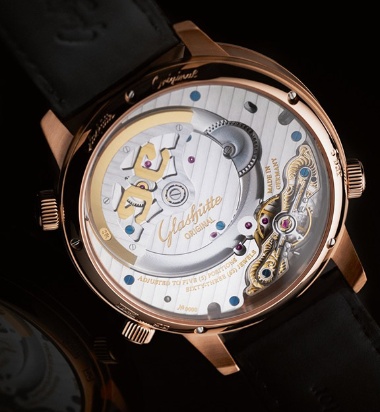
Characteristically German, or more precisely, Glashütte, as well, is the appearance of the caliber 89-02 beneath the sapphire case back. The three-quarter plate, Glashütte ribbing (analogous to Côtes de Genève), and blued screws are all present and accounted for, though you will not find any hand-polished anlage or screw-mounted gold chatons. Overall, the level of finish is nowhere near haute horlogerie, though still several steps beyond industrial. Of interest to me are the hand-engraved balance bridge, duplex swan neck fine adjustment, gold regulating screws on the balance wheel, and the off-center three-quarters oscillating mass. The latter echoes the original ALS Sax-O-Mat, though at a far lower level of finish. All-in-all, I find the movement finishing more than adequate at the price point and the caliber interesting to look at. Functionally, caliber 89-02 runs on a flat hairspring at 28,800 vph, with Incabloc shock protection and a total of 63 jewels. My Cosmopolite currently runs slightly fast but has had no other maintenance issues to date. One of these days I’ll part with it long enough to have it regulated, but I should probably get up off my butt and stick it in the demagnetizer before I do that. Like the Reverso, this is a watch that gets a lot of daily wear for me – though I will say that any watch I don’t wear with reasonable frequency is going to get sold or traded away pretty quickly. ;-D
Breguet Classique Réveil du Tsar, RG, Grand Feu Enamel Dial, Ref. 5707ER 29 9V6
Though the Cosmopolite, complex and functional as it is, may not represent haute horlogerie, the Réveil du Tsar embodies higher aspirations. But wait, you say: the Réveil du Tsar is an alarm watch, not a travel watch. Yes, but… there is a subdial with a 24-hour hand, and the central hour hand is adjustable in one-hour jump intervals. Effectively, the Réveil du Tsar’s central dial indicates local time, while the 24-hour subdial serves to indicate home time. The dual-time and alarm complications, together with a power reserve indicator and on/off indicator for the alarm function, add up to a sophisticated package. And what a package it is!

I find the Réveil du Tsar visually captivating in any guise, but I favor the relatively uncommon grand feu enamel dial treatment above the guilloché models. Don’t get me wrong, I love Breguet’s hand-turned guilloché work on those silver-plated gold dials, and the multiple patterns engraved onto the Réveil du Tsar are a peak visual experience. Nevertheless, a whole other world of artistry dwells within the finely detailed adornment of the grand feu dial. I never tire of examining the tiny fleurs-de-lys in the minute track, the minuscule Breguet numerals on the home time (24-hour) subdial, and the etched micro-signature on the milky-white field of enamel. The enamel dial lends the Réveil du Tsar an entirely different character in comparison to the guilloche-decorated versions, but more importantly, it renders the multiple, complex indications far more legible to me. And there certainly is a lot happening on that not-so-big dial.
As to the grand feu enamel dial itself, central Breguet-style blued steel hour and minute hands move over painted-on Breguet numerals, with a dainty peripheral minute track marked with tiny black stars, simplified red fleurs-de-lys at 1, 2, 4, 5, 7, 8, 10, and 11, and red diamonds at 12, 3, 6, and 9. A double-ended subsidiary seconds hand sweeps over an arc marked with a 30-seconds span at the 6 o’clock position, within which nests a discreet beveled rectangular date window. The dates appear in Breguet numerals over a color-matched background, helping to integrate the date indication with the rest of the dial. Many may object to the date display on principle, and though I do not, I do regret that the Réveil du Tsar does not have a quick-set date mechanism.
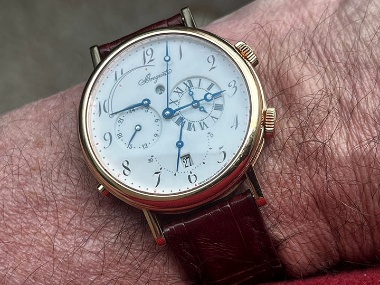
Halfway between the central pinion and 12 o’clock lies a small circular aperture, within which a musical note appears when the alarm function is activated, while a slender hand over a broad, arc-shaped scale between 10 and 12 o’clock indicates the power reserve for the alarm. But that’s not all! At 9 o’clock, a sunken subdial shows the home time with a small, straight hand on a 24-hour Breguet numeral scale, while tiny, blued steel Breguet-style hour and minute hands in a recessed subdial with a Roman numeral scale at 3 o’clock indicate the time set for the alarm. The “secret” engraved Breguet signature appears adjacent to the seconds scale. While I find the signature on Breguet’s metal dials easy to detect and read, this one is far more secretive. Lighting conditions and the tilt of the dial must be just right to locate the elegant script “Breguet” engraving. Is this the most legible dial in creation? Certainly not, but it is an utterly engaging exercise in visual craft and surprisingly easy-to-read, given the amount of information on display.
As opposed to the Cosmopolite, the Réveil du Tsar case measures a svelte 39mm x 11.35mm, with a substantial convex bezel and fluted caseband and its water resistance is rated a 3 ATM. It does wear a bit larger than these dimensions would suggest, however, due to the characteristic Breguet Classique straight, welded-on lugs. A crown at 2 o’clock winds the automatic movement and the alarm mechanism. Pulled out to its second position, it moves the central hours hand in one-hour steps, while its fully pulled-out third position sets the home time and local time simultaneously. When pulled out, a crown at 4 o’clock sets the alarm. Unlike many other alarm watches, the Réveil du Tsar can be set rather accurately to the minute, as indicated on the Roman numeral subdial. A pusher on the opposite side of the case toggles the alarm function on or off with a highly tangible click. Beneath the sapphire case back resides Breguet caliber 519F, the base of which I believe to be shared with Swatch Group sister company Blancpain as caliber 1204H.
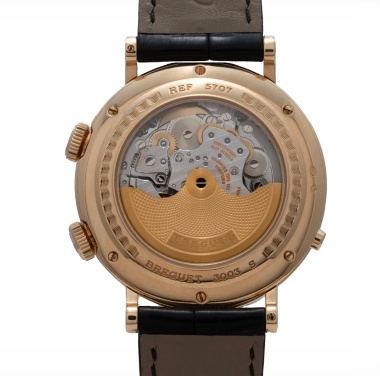
Measuring 27.6mm x 6.2mm, the automatic winding caliber 519F features an inverted straight-line escapement with silicon balance spring, 38 jewels, a 45-hour power reserve, and a rate of 28,800 vph. Finishing is at a high level, with perlage on the base plate, Côtes de Genève and polished bevels on the bridges, and a gold rotor adorned with a barleycorn hand-turned guilloché pattern. Countersunk screws and the hammer for the alarm are brightly polished, though not to the degree of mirror-finished or black-polished. The movement is attractive and fills the case well, even if it does not display the kind of elaborate hand-engraving that went into some Breguet calibers during the Daniel Roth era.
The Réveil du Tsar was the only watch I brought with me on a recent trip to London and Glyndebourne, and it made a fine traveling companion indeed. If the aesthetics appeal, this watch offers a great deal of functionality in an elegant and readily wearable package. Given that Breguet as a house does not arouse the kind of hype (and inflated secondhand prices) that some comparable companies do, the Réveil du Tsar can also be a bargain on the secondary market. As far as I’m aware, the rose gold grand feu enamel dial variant was a boutique exclusive, and I don’t know for how long it remained in production or how many were ever made. Experience tells me, though, that you’d need to wait patiently to obtain one today, with the guilloché dial models appearing much more frequently.
Patek Philippe Calatrava Pilot Travel Time, Mid-Size, RG, Ref. 7234R-001
My wife and I share this watch, which at 37.5mm fits her very delicate wrist as well as mine. There is nothing much new about the 7234R mechanically, as ancestral variants of the 324 S C FUS automatic dual-time caliber have previously powered any number of PP travel watches, including the 4864R and 5134J, to name but two. However, the Calatrava Pilot Travel Time raised quite a ruckus upon its introduction, with critics complaining vociferously that the pilot watch style was not aligned with Patek Philippe’s heritage. I must admit that stylistically, the 7234R calls to mind a Zenith pilot watch, particularly in the scale and typography of the Arabic numerals. However, the 7234R is also among a very small number of PP designs that have appealed to me at all. (Others include the 5098R, 5235/50R, and the 6119G.) In the end the Sterns can laugh all the way to the bank, since the Calatrava Pilot line appears to have been quite successful, with many variants, including those with multiple high complications.
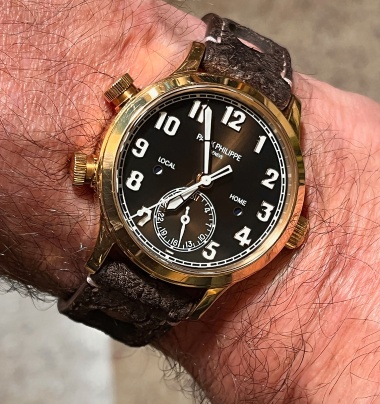
Among the simple Travel Time reverences, the 42mm 5424 in its several guises seems much more popular than the “mid-size” 7234, but I find the two siblings equally appealing. The 7234R features a captivating chocolate/tobacco-brown fumé sunburst dial cased in rose gold of a peculiar tone, distinctly more yellowish than that used for the 5424R, or any of the other rose gold PP references I’ve seen. The case profile is rather chunky at 10.78mm, with a broad, polished, sloped and stepped bezel atop its polished caseband. The wide bezel may help the watch wear somewhat smaller on a dainty wrist, though the relatively large expanse of polished gold ensures that the Calatrava Pilot Travel Time will not go unnoticed. (This is not the watch to wear if you fear mugging and watch theft in your environs, as my wife is quick to remind me.) Patek Philippe rates water resistance as 3 ATM.
Home time and travel time are indicated by lumed rose gold hour and minute hands and a bright, white-painted seconds hand over large, chunky, heavily lumed applied gold Arabic numerals. When at home, the skeletonized white home time hour hand lies hidden under the local time hand. A pair of prominent pushers at the 8 and 10 o’clock positions move the local time hour hand in hourly increments in either direction, while the consequently revealed home time hand remains in the original position. The bold, contrasty dial design and the simplicity of the dual-time indication render the 7234R extremely convenient to use. My only gripe concerns the local time adjustment pushers. These “lock” with a quarter turn in the interest of preventing accidental local time changes, but because they unlock at the slightest touch, they frankly fail in this capacity. The local time is all-to-easily mis-set by accident, and the watch would have benefitted from a more robust locking mechanism on the local time adjustment pushers.
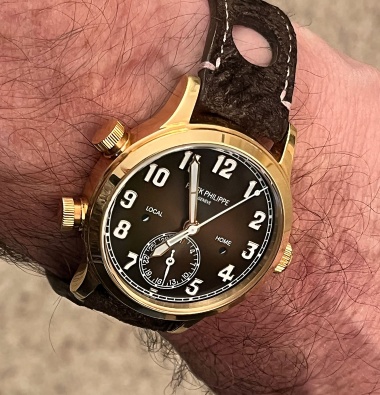
Besides the local time and home time, the dial displays include dots that switch from white to midnight blue to indicate day or night conditions for both home time and travel time. A recessed subdial at 6 o’clock indicates the date with a slender white pointer, but with the tiny markings between numerals at 4-day intervals, I find the darn thing near-completely illegible. The date is adjusted via a recessed pusher, inconveniently placed on the caseband between the lugs at the 6 o’clock position, so that setting the date entails either wedging a tool between the strap and case or removing the strap for better access. Poor design choice, say I.
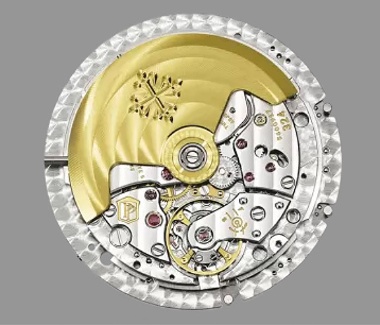
Measuring 31mm by 4.82mm, the automatic caliber 324 SC FUS looks a bit small even in the 7234R case, but it is well-finished, with Côtes de Genève and polished bevels on the bridges and a solid 21K gold central rotor decorated with circular Côtes-de-Genève and a finely engraved detailed Calatrava cross. The caliber employs Patek Philippe’s GyromaxÒ balance and SpiromaxÒ balance spring, contains 29 jewels, and runs at 28.800 vph. What it does not have is a stop-seconds function, though I understand this lapse may have been corrected in more recent iterations of the movement. Power reserve has been variously documented at 38 or 45 hours, though neither is impressive by contemporary standards.
All in all, the Calatrava Pilot Travel Time is a fun, quirky watch with an easy-to-use and easy-to-read dual time function. In fact, outstanding dial legibility (date indication excepted) was a decisive factor in choosing this watch, as it suits my wife’s needs as a person with very low vision. Even considering gripes over the local time pushers’ locks (not) and date indication, the 7234R strikes me as a superb his-and-hers share watch. All you need are a couple of appropriately sized quick-change straps. (I like a dark brown hippo hide perforated racing strap; my wife goes for brown python. Don’t tell CITES!)
Hermès Arceau Le Temps Voyageur, SS, 38mm, Ref. AR10.510
What makes Le Temps Voyageur so appealing to me is the exceptionally clever and intuitive way Hermès has devised for displaying multiple times. I adore my white gold Arceau L’Heure de la Lune, and the dual time indication on the Temps Voyageur uses a variation on the earlier watch’s revolving dials mechanism. 24 time zones, including daylight savings time markings, where applicable) surround the Le Temps Voyageur dial on a raised chapter ring, as typical for many a world timer. The local time is read off of a floating subdial mounted on a central pivot and bearing a bright red pointer on its perimeter. Pressing a pusher on the caseband advances the floating subdial from time zone to time zone, while the local hours hand jumps to the appropriate Hermès Arceau-font Arabic numeral, the floating dial maintaining an upright position throughout. There is no locking mechanism on the Temps Voyageur local time adjustment pusher, but because it is discreetly sized and partially protected by the distinctive Arceau case anatomy, accidental activation has occurred less frequently for me than with the PP 7234R. The conventionally positioned crown on the Temps Voyageur pulls out to two positions. Partially extended, it adjusts the home time independently. Fully extended, it adjusts home time and local time simultaneously.

To set the Temps Voyageur initially, one first aligns the floating local time dial with the home time zone, then sets the time to the current home time. Finally, one pulls the crown partway out and moves the home time indicator at 12 o’clock to match the local time. This need be done only once. Thereafter, one just uses the pusher to adjust the local time when traveling (or when simply curious). Intuitive, as I said, and utterly charming. In the meantime, the home time hours appear on a 24-hour scale beneath an aperture at 12 o’clock. So long as you possess the visual acuity to read the small floating local time dial, the dual time feature is both super-easy and fun to use.
Below the floating local time dial, Hermes has executed a lacquered map of fantasy continents and oceans, all bearing equestrian names. Cute, though I think the design could have done with some more contrast – the details are not always easy to make out in anything less than blazing daylight. The dial surfaces on the 38mm stainless steel Le Temps Voyageur that I own are decorated in shades of deep blue, but there is also a platinum and black DLC-coated titanium model with a 41mm diameter and monochrome dial. While I like the color scheme of the platinum model very much, I’ve found DLC coatings to be far less durable than advertised and avoid them at all costs. I would welcome an all-white metal cased version with a monochrome dial execution, but the stainless-steel reference with the blue dial is fine and dandy for now.

The stainless-steel case on this watch merits some discussion. While nowhere near as thick as the L’Heure de la Lune, it’s still a might tubby for its diameter at 12.4mm thickness. With water resistance rated at 3 ATM, this is not a watch to wear in the pool. The innertube-shaped polished bezel is echoed around the case back, with a straight, polished caseband and the local time adjustment pusher sandwiched in between. The unique asymmetrical Arceau lugs had me thinking that the Temps Voyageur would require some sort of proprietary (and costly) Hermès strap, but the cleverly disposed lugs in fact accommodate either a conventional straight-end or curved-end strap. Said lugs curve downwards at their extremities, allowing the 38mm Temps Voyageur to drape comfortably atop a narrow wrist.
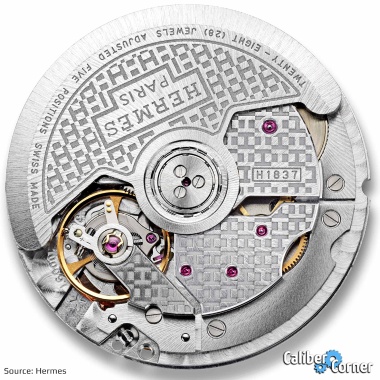
The 26.6mm Vaucher-produced automatic caliber H1837 with Chronode dual time module that powers the Temps Voyageur fills the case back on the 38mm model rather well, though it might look off-scale in the 41mm platinum/titanium version. The movement features a none-too-generous 40-hour power reserve (reduced, no doubt, from the base movement’s 50 hours by having to rotate the floating dial) and runs at a conventional 28,800 vph. Movement decoration, as with the L’Heure de la Lune, is far below the standard set by the case and dial – barely more than industrial, with its fugly stamped Hermès “H” pattern. Hermès would have been better off to my mind had they used a solid back with some sort of nifty equestrian or travel-themed engraving. Whatever can be said of the movement finishing, the fun in the Temps Voyageur is all on the topside, with which I can entertain myself handily while sitting in an airport or waiting on “hold” on the phone.
Jaeger-LeCoultre Duomètre Unique Travel Time, White Gold Paris Boutique LE, Ref. 600.3.16.S
And finally, to perhaps the most horologically complex of our six: the JLC Duomètre Unique Travel Time (UTT). I had my eye on this thing since it came out over a decade ago but only pulled the trigger recently. I was highly intrigued by the hammered dial limited edition that debuted in 2015-or-so but eventually sprang for the first-release 100-piece Paris Boutique LE in white gold. In the end, I decided that the more subtle grained silver treatment on the Paris Boutique LE was the more effective (and wearable) design choice as a background to the many indications on the UTT dial, cool as the hammered texture is in isolation.

As a matter of fact, the UTT rivals the Réveil du Tsar in the complexity of its dial. Home time appears on a subdial at 2 o’clock, while local time is read off of a symmetrically placed subdial at 10 o’clock. Local minutes are indicated by a blued steel hand, while local hours appear in digital form in an aperture at 12 o’clock on the subdial. Both are easy-to-read, yet distinct. There is a central seconds hand that serves both time zones. Below the two time readouts, in the 6 o’clock position, lies a domed polar projection of the Northern Hemisphere, with oceans painted (lacquered?) in blue and continents rendered in frosted rose gold. A GMT ring marked with the hours + or - GMT and a revolving day/night indication surrounds the hemisphere. This readout gives some approximation of the relative time around the world, but without marked time zones and a precise indicator, I would not class this as a world time complication. It is nonetheless useful for tracking night and day how far local time is off from GMT.
Once initially set, use of the dual time feature is extremely easy: pressing each of two pushers at the 8 and 10 o’clock positions on the caseband moves the digital local hours and GMT back and forth. Functionally, this is analogous to the local time adjustment on the PP 7234R. Ironically, while a weak locking function on the 7234R’s large local time-setting pushers leads to easy and frequent accidental adjustment, I find the UTT’s pushers, more streamlined and with a very positive “click” when depressed, much less prone to unintentional activation. Less simple is the initial setup of the travel time complication, though as with the GO Cosmopolite, the description is more challenging than the execution. As with the Cosmopolite and Le Temps Voyageur, it is a process that will not likely be required often – so long as the UTT’s two mainsprings run down at once.

Flanking the little globe on the UTT’s dial are a pair of symmetrical power reserve indicators. Why two? Here is where the Duomètre mechanics come into play. The hand-wound caliber 383 inside the UTT has two spring barrels and gear trains serving as independent power sources for the home time and local time, which are co-regulated by a single escapement. The rationale for dual power sources is that setting the local time will not impede the accuracy of the home time. I’m honestly not sure how much this matters in practical terms, but it’s damn cool. Caliber 383 features of greater utility include the ability to set the local time to the minute, bestowing even greater accuracy and flexibility than does the GO Cosmopolite’s caliber 89-02. On top of that, the shared seconds hand snaps to the “0” position when the crown is pulled out to set the time and the local time minutes hand jumps precisely from minute marker to minute marker during setting.
Caliber 383 provides a 50-hour power reserve for each spring barrel, contains 54 jewels and 489 parts, and runs at 28,800 vph. Finish quality may fall slightly short of Breguet’s and Patek Philippe’s (never mind ALS), but is still quite high, with perlage on the mainplate, sunburst finishing on the wheels, counter-sunk blued screws, and Rayon de Gloire and polished bevels on the bridges. As much as the dial, the view of caliber 383 through the sapphire case back is a feast for the eye, and any shortfall from haute horlogerie finishing standards is not liable to easy detection without magnification. Caliber 383 measures 7.25mm thick according to JLC, and while I can find no dimensions for the movement diameter, it seems to fill the UTT’s 42mm case quite comfortably.
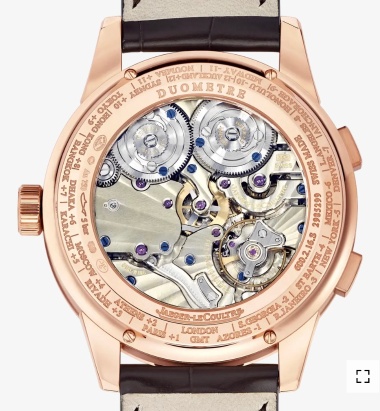
At 42mm x 13.6mm tall, the UTT is a substantial watch, though a smaller case might cramp the caliber and/or the multifarious dial displays. A polished, sloped bezel of modest dimensions and straight, a brush-finished caseband appear well-proportioned, and short, downturned lugs on the white gold case contribute to comfort on the wrist. JLC claims water resistance of 5 ATM. While it features one of the higher water resistance ratings among the six watches considered here, there’s no way to construe the UTT as a sports watch. Indeed, none of these six purports to be a rugged instrument for wear during athletic activities or in challenging environments. While I wouldn’t call any of them true “dress watches”**, they are all versatile in wear and can look as good with shorts and a polo shirt as with a business suit. For an active-wear travel watch, one could look to various Rolex offerings, Grand Seiko’s GMT references with screw-down crowns and 10 ATM water resistance, Omega’s Planet Ocean or Seamaster world timers, or the like.
In Parting
So, there you have it: one simple guy’s impressions of six diverse travel watches. As mentioned at the start, I enjoy the creative means the various houses have found to display multiple time zones and appreciate the spectrum of design choices and styles these watches encompass. For others, inherent limitations, such as size (the Cosmopolite), cost (the Breguet and the UTT), or water resistance (all of them) will diminish their appeal. I’ve got a gripe here or there about one or another of them myself, but I love them all.
What’s next for me? I’ve been intrigued by the Arnold & Son Globetrotter, though it’s >17mm case depth would limit my wearing opportunities to short sleeves. The enamel work on some of the PP world timers is impressive, but the aesthetics of the 5231, the 5131, and their brethren are not to my taste. More to my liking, and high on my list, is Breguet’s Classique Hora Mundi 5717 in rose gold with the western hemisphere on the enamel dial. I’m no longer one to rough it much when traveling, but I might eventually explore some sort of dual-time sports watch. Along those lines, I’ve considered the Omega Seamaster Worldtimer but haven’t convinced myself regarding its appearances in any of its present variations. Now if GO were to introduce a dual-time complication in its Sea-Q collection, that I could go for. In the meantime, if anybody has a line on a reasonably priced Hora Mundi… ;-D
Thanks so much for reading, and please provide corrections for any blatant misinformation!
* I have seen the white gold Duoface Night & Day referred to as Ref. 272.34.40 in one source, but I have also found said source (not to be named) prone to many an editorial lapse.
** To me, “dress watch” equates to a precious metal cased time-only watch of discreet and slender proportions and with a clean, crisp design. Examples might include the PP Calatrava 6119, the Breguet Classique 5967, or the VC Traditionelle Hand-Wound.
This message has been edited by KMII on 2025-11-16 08:39:10
Six Travel Watches: A Comparative Review

Wonderful group of travel companions.

What a post! Thank you very much for sharing

Nice read


Very nice write up, thanks for sharing your detailed thoughts.


A fantastic review - thanks so much for this 👍🏻🙏🏻🙏🏻🙏🏻

My friend, you have a very interesting collection of Travel watches. I am a big fan of this complication, too.
Good question!
Yup - that would be just my kind of trick! ;-D

Cool article. I kind of love the concept of travel watches but the most traveling I've done is to Hawaii and when I get there I don't even care what time it is.
