rdenney
371

The Ebel Classic 100 Anniversary Limited Edition
By request (I'd posted this watch in a Wristscan thread), I'm showing a few more pictures of this lovely watch.
Ebel, as a company, has seen some ups and downs, and currently it's been more in the downward direction, sad to say. The company was founded in 1911 by Eugene and Alice Blum, and was one of the first watch companies to enjoy substantial female ownership and focus. The Blums were quite central in the culture of La Chaux-de-Fonds, particularly among Jewish watch entrepreneurs. That group included names like Ditisheim (Movado, Vulcain), Schwob, Blums and Picards (Invicta--the real one, plus the International Horology Museum), and Blum (Ebel), among many others. The feminine influence was integral to Ebel from early on, but they still divided their resources equally between watches for men and women. The one common thread, perhaps, is a certain elegance often not seen in these days when many watches for men need to display overt masculinity. So, even Ebel's most masculine designs--the BTR collection of 2007 and the Tekton collection of 2009--have a smoothness and sparkling beauty about them.
Alice Levy Blum was the spiritual leader of the Ebel watch company, even when her husband was followed as CEO by her son Charles in 1931. It was Charles who instituted the General Electric precision control system that was innovative at the time among the etablissage producers of the upper Jura. Ebel made watches in that time for many companies, including some haute-horlogerie names, so that most of their production left their workshops with other brands on them. One exception to that was a series of military watches in WWII that were made for the RAF under contract. In the USA, the Ebel brand was all but invisible.
Charles had several children, and Pierre-Alain Blum left Switzerland to earn his way in the United States. But Charles had some problems with his health, and in 1969 felt as though Pierre-Alain was the only one of his sons with the business acumen to succeed him as the head of Ebel. So, he called him back. Pierre-Alain was a bit of a l'enfant terrible, as it turns out, and he had been quite successful in his early career in New York and didn't really want to come back. When his grandmother Alice Levy Blum passed away in 1968, Pierre-Alain was still living in New York.
But come back he did. And soon after he arrived, he worked a deal with another young watch executive soon to make a big mark on the watch world: Alain-Dominique Perrin. It was Perrin, with Rupert Johann's backing, who used profits from the Must de Cartier product line to finance the reintegration of the Cartier companies, creating Cartier International. Perrin and Blum were friends, and they worked a deal to create a joint venture to develop and produce watch cases, dials, and, eventually, quartz movements. This company was CEC, and it was operated and principally owned by Ebel. Ebel thrived when the rest of the Swiss industry was collapsing during the quartz crisis, because of their line of chic watches for men and women using manufacture quartz movements of good quality. Based on his arrangement with Perrin, Pierre-Alain Blum was able to buy his father out entirely by 1975. In 1978, he oversaw the design of the Sport Classique, with its signature wave bracelet. During the 80's, Ebel rose to become on of the most important watch companies in the Swiss industry. In 1982, for example, their watches were 100% Swiss, and Ebel employed 500 workers in five factories around La Chaux-de-Fonds. This was the Ebel that had the wherewithal to ask for and purchase all the remaining stock of El Primero ebauches that Vermot had squirreled away in the rafters of Zenith.
Blum was wildly successful, making not only his own Ebel watches, but making most of the quartz watches for Cartier. He enjoyed that success, it must be said, and was one of the first watch-company rock stars to emerge. He famously supplied all the watches to the cast of Miami Vice, which was certainly not my favorite TV show of the time but which undeniably led the mullet-and-Armani style trends of the period. (Armani looks foolish on me and thank God I've never had a mullet. But I digress from my extended digression...) In order to avoid giving all his profits up in taxes, Blum invested in other enterprises, including Authier skis, Look ski bindings, a hotel in Basel, and a movie production company. Ebel remained solidly profitable during this period, but those other investments did not. When the Savings and Loan Crisis hit in the early 90's, the resulting credit crunch and his leveraged position became unsustainable. So, he took on a non-family investor in the form of Sandro Arabian (a name well-known to Breguet and Vacheron Constantin enthusiasts). Thus, in 1994, ownership of Ebel passed to Investcorp, which did very little with it except for running Blum off after a year or two (though the local press reports of the time, which comprise the bulk of my research, were undeniably biased in support of PAB--a famous and well-loved Fonniere). In 1999, they sold Ebel at substantial profit to LVMH, who did not want it competing with Zenith and Heuer, and in 2004, despite an informal attempt by Blum to buy it back, they sold it (at a substantial loss) to Gerry Grinberg of the Movado Group.
Whatever one might think of that, nobody can say that Movado didn't make a go of it. They poured money in to create new lines (Brasilia, BTR, Tekton) and produced a new catalog that came out in 2007. I own catalogs from all the major companies of quality, and the 2007 Ebel catalog earns a spot right in there with the best of them. But the watch styles were a bit too polarizing, and their goal of selling 100,000 watches a year was unrealistic especially with the downturn. They kept at it for about five years, but in 2012 they sold their exclusive version of the Lemania 1340 to Ulysse Nardin and have diminished back to a brand mostly aimed at ladies watches. Before doing so, however, they had a centenary to celebrate.
In 2011, they made several special editions to mark their hundredth year, including some special versions of the BTR Chronographs (with a special guilloche dial, blued hands, platinum cases, and the original 1911 logo), and they inaugurated their Classic 100 line with a limited anniversary edition. That was a return to a simple three-hand watch, and a departure from the Sport Classique design with its exposed bezel screws and hexagonal shape. This was the first Ebel in a very long time to use a standard spring-bar strap attachment and a simple round case. But despite that, the Ebel heritage of elegance comes through.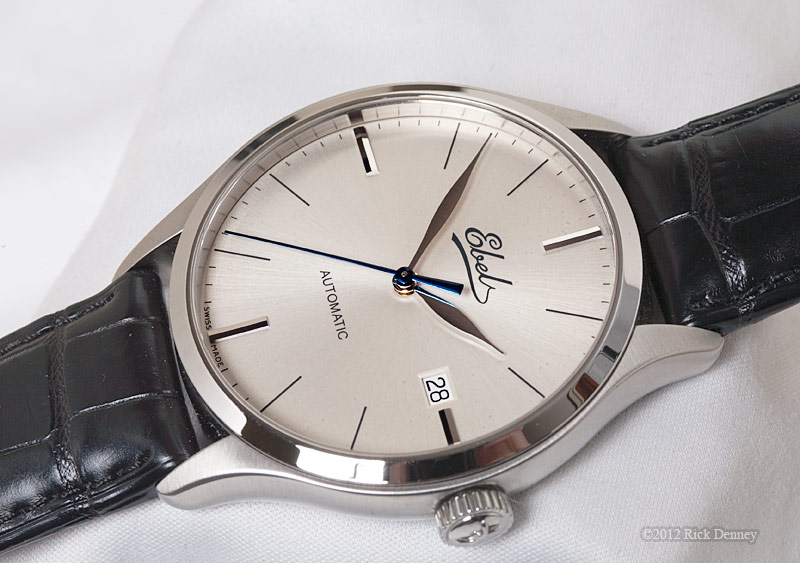
The case is 40mm, 9mm thick, and it comes only in stainless steel. Ebel made 1911 of these, and their retail price was 1911 Euros (they apparently chose the denomination that fit the price and not the reverse!). The case itself gets the Ebelian superfine brushing that leaves brush marks just barely visible to the naked eye. The case is brushed across its thickness, rather than along it as with most of my other brushed-case watches.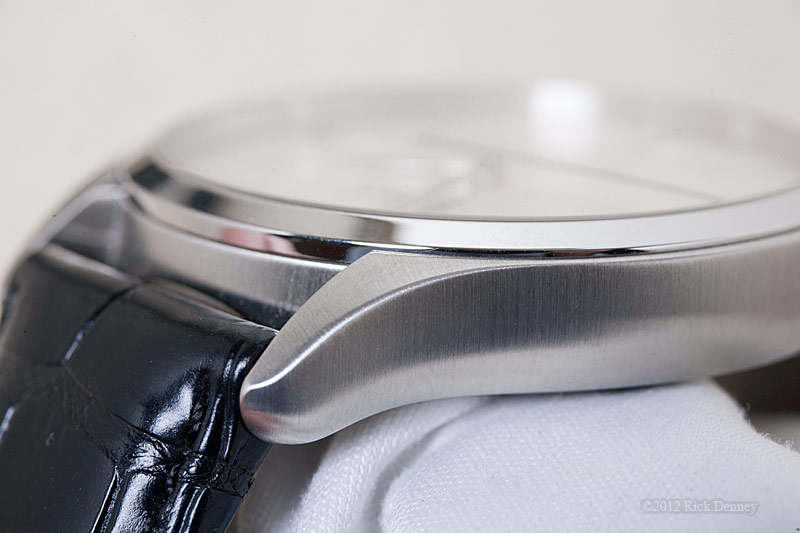
The dial is also very simply treated, with a radially brushed silver surface that was popular in the 50's and 60's, and manages not to look like a vintage inspiration in this case.
But the hands are the real treat on this dial. The minutes and hours hands are leaf-shaped and diamond black polished, with crisp edges that holds up to close scrutiny. The seconds hand is blued, which adds the only color to this monochromatic watch.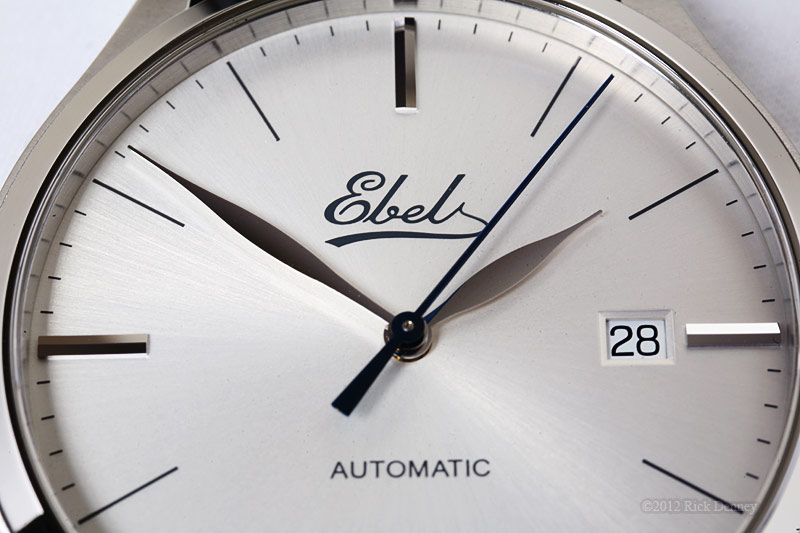
The date display is the only point of contention on this dial, but I actually like date displays on watches and find myself looking for them on those watches I own that don't have them. The dial markings use the original 1911 Ebel logo, and otherwise would be downright minimalist in the Nomos tradition if it weren't for those hands. I can only attribute the difference to this: They speak French in the upper Jura, and this watch has the French polish lacking in many of today's severe designs.
The polished bezel holds a flat crystal with anti-reflective treatment on both sides. The bezel sets into the case in such a simple way, and yet the effect is completely harmonious to my eye: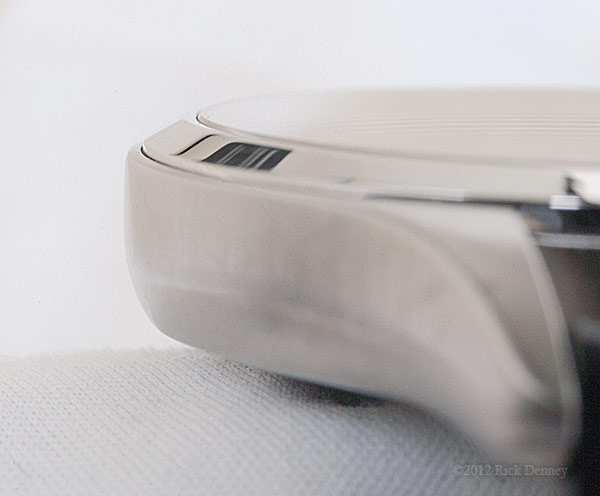
And even though the case has the straight sides (versus watches of the 60's and before that had very little exposed edge and deeply domes backs and crystals), the rounding on the wrist side means this watch is, like all the Ebels I own (even the biggest of them), extremely comfortable to wear.
Ebel manages to round corners that are usually crisp and provide sharp corners and edges where many cases will have a fillet. The way the lugs flow into the case illustrates the effect: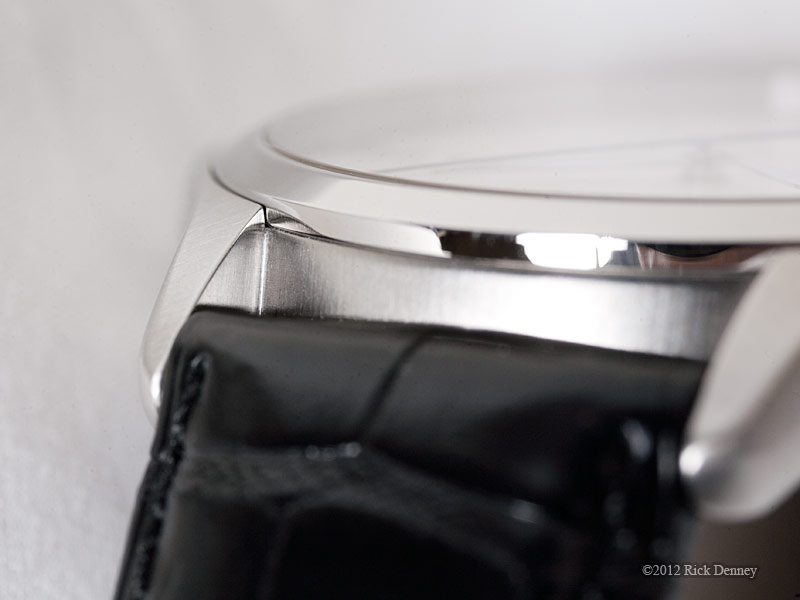
The movement is an ETA 2892A2 in Top Grade. In the 90's, Ebel used the Lemania 8810 for its three-hand watches, and when Lemania was sold to Swatch, they used Girard-Perregaux movements, until Sowind would no longer supply them. (In days of old they used whatever movements from Ebauches SA that would meet their needs, but then so did just about everyone else except those who used JLC ebauches or made their own.) They switched to ETA movements in the early 2000's. But the 2892 is not a bad choice: Thin, accurate, and sturdy. They used that thinness to keep this watch down to 9mm, which isn't as thin as it could have been, but these days seems thin enough.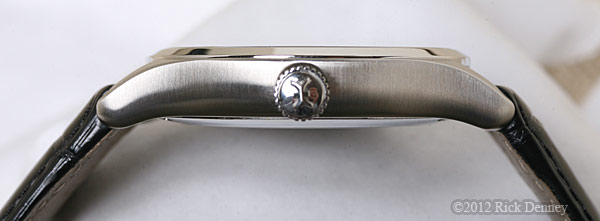
As with nearly all Ebel watches that used supplied movements, the caseback is solid, smooth, and rounded for comfort.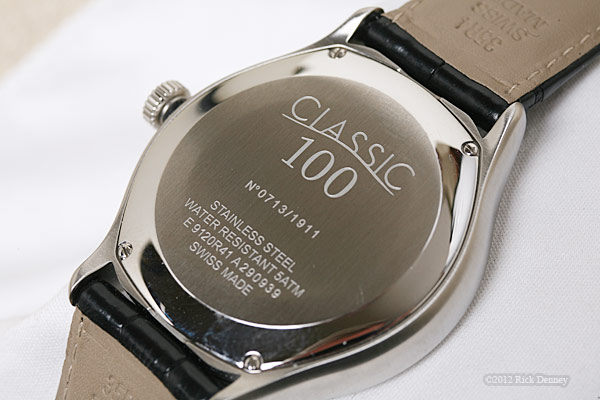
And, unlike all previous strapped watches since Ebel patented their unique strap deployant in the 80's, this watch uses a pin and buckle. But, like all Ebels with reptilian straps, the skin is genuine and the quality of the strap is on a par with the best I've seen (certainly at the same level as the Camille Fournet strap I bought for my vintage JLC). (I have since found an Ebel deployant that fits this strap.)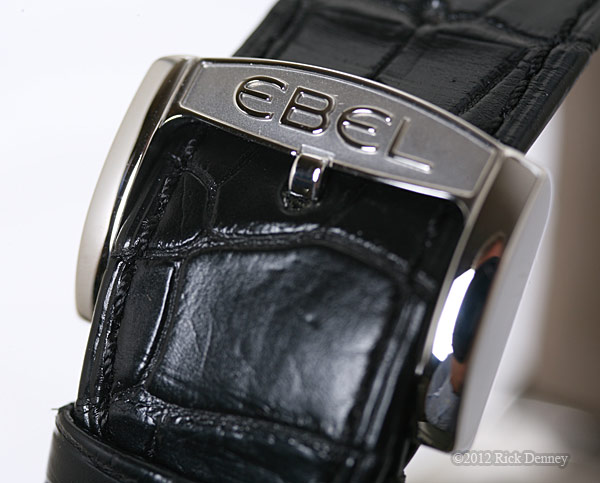
When I saw this watch on the Ebel web page, I was rather unimpressed. It seem completely lifeless and uninteresting. But when the Redhead and I were vacationing in Switzerland in 2014, we stopped to shop on Watch Row in Interlaken, and found this one at Kirchhofer's. In three dimensions it completely compelled me. Some members of this forum are heavy hitters; I am not, and the Redhead's automatic pursuit of a discount resulted in a polite blank stare. (She received the same response when she attempted the same tactic at the Zenith boutique in Geneva, when she bought her Heritage Star Elite.) Consequently, this is the only Ebel for which I have paid full retail. The USA is the dumping ground for Movado overstock, and I have ridiculously benefitted from that with all my many other Ebel purchases, but not in Switzerland. It must be said that the display lights must have affected this watch, because last year the movement suddenly started running quite slowly, and my timing machine revealed very low amplitude. I delivered it to the Movado Group repair facility in New Jersey on December 11, and it was ready to be delivered to my house on December 28, working perfectly.
So, there you have it. One of the most non-characteristic Ebels of the last 35 years, yet still quintessentially an Ebel, and one of my favorite watches.
--Rick
This message has been edited by rdenney on 2016-02-22 16:24:41 This message has been edited by rdenney on 2016-02-22 16:36:30
The Ebel Classic 100 Anniversary Limited Edition

A stately watch, indeed

Got much more than I bargained for!

Yes, as I said, a point of contention. But then I saw this...

Fantastic write up....

I always felt that EBEL...
Let's hope.

Rik, thank you very much for this first hand experience with a few lesser discussed...
