
pingtsai
[PuristSPro Moderator]
2063

A Look at the Bulgari Ladies' Watch Story
We've previously shown a pictorial history of Bulgari's mens' watches spanning the last 80 years. It only seems fair to represent the feminine counterpart as well. Although the collection is less extensive and complicated in terms of the movement, it is no less impressive from an aesthetic standpoint. Many of Bulgari's ladies' watches get their inspiration from jewelry having intricate shapes and utilizing precious metals and gemstones.
What's in a legacy? Part III
A Look at the Bulgari Ladies' Watch Story
By Ping Tsai
© January 2011
The Early Years of Art Deco
Bulgari has been selling jewelry inspired watches since the 1920s. The design of the pieces followed the current trends at the time which reflected the Art Deco style. The movement got its name from the “Exposition Internationale des Arts Décoratifs et Industriels Modernes” which was held in Paris in 1925 and showcased jewels in a creative new style. Art Deco styled watches and jewelry often consisted of linear geometrical shapes and incorporated stylized decorative elements from nature. Gemstones with contrasting colors were also frequently used in the designs. The different elements were used in an eclectic manner. Some were even reinterpretations of elements that originated from Oriental cultures and ancient Egyptian art.
Below is a Bulgari platinum, white gold and diamond wristwatch from the mid 1920s. The geometrical shapes present in the case and bracelet are reminiscent of the style that was popular at the time. In this example, the large pave set diamonds are arranged decoratively on the case as well as lining the individual segments of the bracelet. The watch was manufactured in France. However, its rectangular shaped dial is inscribed with the name, “BVLGARI ROMA”.
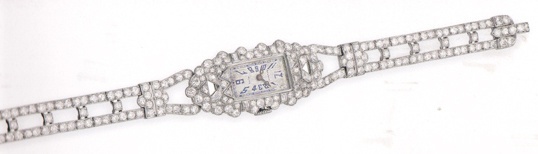
Bulgari Diamond Watch from the 1920s
During this time, Bulgari also used “domed calibré-cut colored gemstones” to construct the stylized floral motifs that can be seen in the several of their ladies wristwatches. Below are two examples of this technique from the 1920s. The watch to the left
uses emeralds and diamonds in a rather linear fashion. The one to the right incorporates red gemstones to create stylized leaf motifs on the surface of the elongated diamond encrusted case. Both pieces are reflective of the popular Art Deco style at the time.
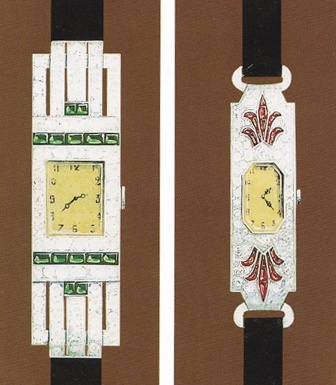
Art Deco styled Bulgari Watches from the 1920s
The following is another Bulgari watch from the 1920s. This one is a lapel watch made of platinum, onynx and black enamel. The back side of the case is decorated with pavé-set diamonds framed by the black onynx. The dial is in the classic upside-down style and displaying the name “BULGARI” which matched the company’s logo at the time, using “U” instead of “V”.
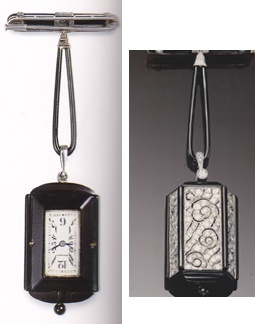
Vintage Bulgari Lapel Watch
In the early 1900s, the first watches with a matching pin were made to wear on a lady's lapel. In 1915 the lapel watch was improved: the watch face was upside-down so the wearer could read it more easily. Historically, lapel watches were often worn by nurses and other medical personnel. They were very practical, and designed to be read "hands-free". The faces are upside down (12 at the bottom and 6 at the top), so that they're oriented correctly for one to be able to read them by just glancing down. Also, the location of wear kept the watches cleaner and germ-free without any watchband interference or concerns when you wash your hands.
Bulgari’s logo was changed after the death of its founder, Sotirio Bulgari in 1932. Sotirios’ sons, Constantino and Giorgio, took on a grand remodeling of the interior and exterior of the first store at Via dei Condotti in Rome between 1932 and 1934. The company’s name changed from “S. BULGARI” to “BVLGARI.” The new engraved sign on the store front used block capital letters as reminiscent of ancient Roman inscriptions. Since then, the company has continued to embrace its rich Greek and Roman heritage in its logo as well as many of its designs .

The Serpent Watch and Tubogas
In the 1940s, Bulgari incorporated the snake motif into the design of some of their ladies’ watches. The popular pieces were sculpted interpretations of the coiled serpent. These flexible gold "snake bracelet-watches" were meant to be worn wrapped around the wrist with one end consisting of the serpent's head adorned with jewels and hiding the dial of the watch. In ancient Roman times, the image of the coiled snake symbolized immortality and was often used in talismans that people wore for good luck or to ward off ill-fortune. For Bulgari, the snake has become a signature design theme used throughout their history.
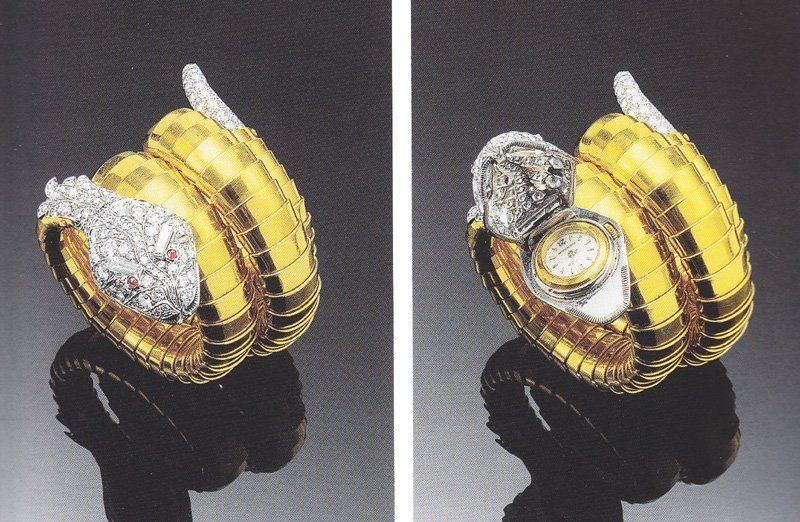
A gold and diamond serpent bracelet-watch by Bulgari from the 1940s. The flexible links are in polished yellow gold, tail and head set with diamonds, movement by Movado concealed in the jewel head.
Bulgari's initial three coil gold snake wristwatch with diamonds, such as the one in the photo above, was extremely successful. In the decades that followed, 1950s and 1960s, Bulgari expanded upon the theme by introducing other versions of the watch such as ones with polychrome enamel scale-like linking which were sometimes decorated with gemstones.
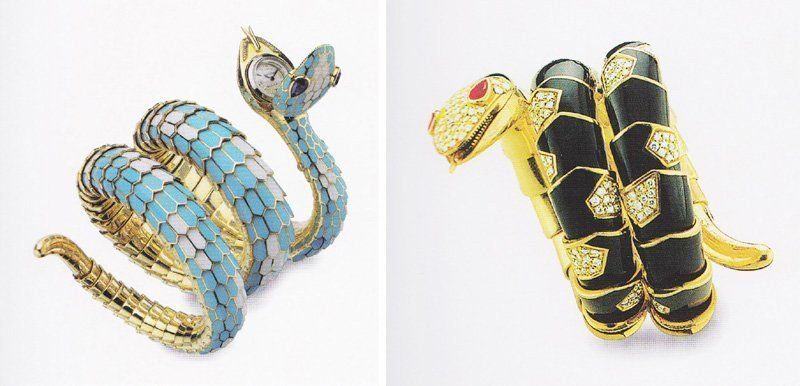
Two gold and enamel snake-bracelet watches. Left one (1965) consists of turquoise and white enamel scales, pear shaped sapphire eyes, and a movement by Jaeger-LeCoultre. Right one (1970) is decorated with black enamel scales with pave set diamond accents and pear shaped ruby eyes.
Bulgari's coiled snake watch underwent further evolutionary changes in the 70s. The new watches were more stylized designs inspired by the original forms. They were made up of plain flexible links, employing a technique known as Tubogas linking and consisted of geometrically shaped open dials instead of the previously concealed snake head dials. Interpreting the snake as a simpler form was a significant reflection of Bulgari's use of stylized shapes from nature which characterized much of their design practices in the 1970s. The coiled Tubogas bracelet watch has become one of Bulgari’s trademarks.
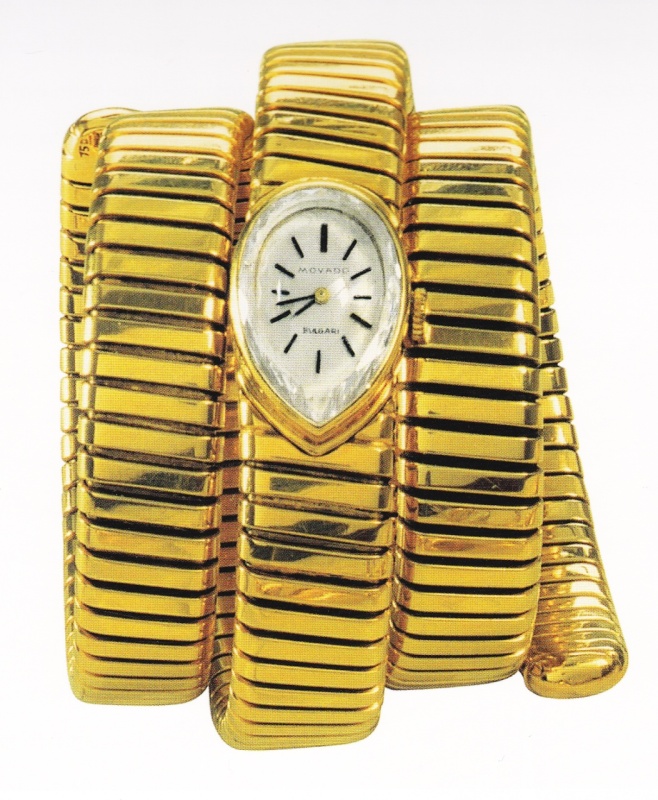
Example of a coiled Tubogas bracelet watch in yellow gold with tear-drop shaped dial from the 1960s.
Making a gold Tubogas bracelet requires hours of skilled craftsmanship. The process involves wrapping two long gold strips with raised edges around a core which is made of either copper or wood. The edges of the strips then interlock and fit together without any soldering. The copper or wood core is then taken out. This is done by either physically pulling it out or dissolving it in acid. The process creates a band with great flexibility.
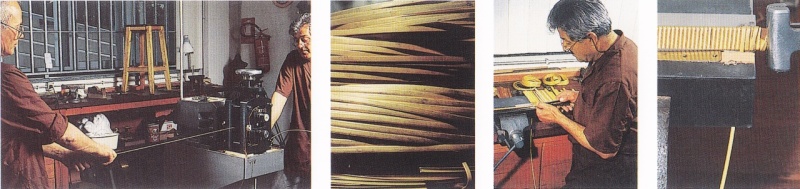
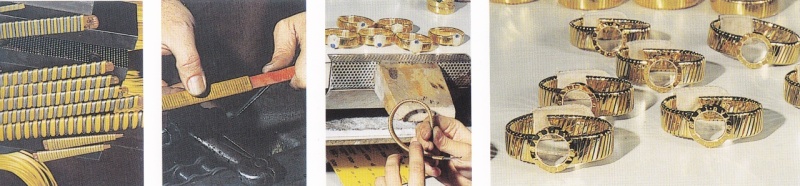
Making of Tubogas bracelets
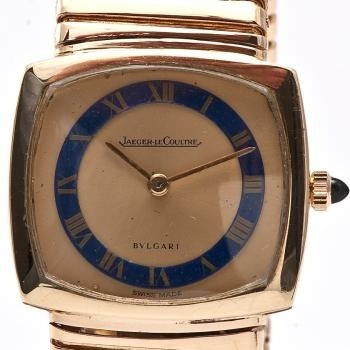
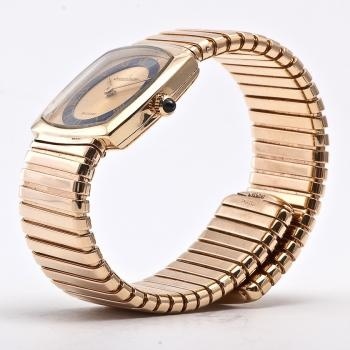
A vintage automatic Bulgari Tubogas bracelet watch
In 2009 , to celebrate Bulgari's 125th anniversary, the company presented a new collection of coiled snake watches called Serpenti . The new collection comes in a variety of forms, transforming its sinuous and flexible body into wrap-around bracelets, rings and jewel-watches. Sixty years after Bulgari first launched coiled snake watches, they reinterpret the concept with the Serpenti Collection by combining the classic Bulgari style with contemporary and elegant line. The new collection includes five models in pink and white gold, single or double coil by playing on colors through refined decorations with diamonds, colored gemstones and mother-of-pearl on the scales (individual links which simulate the scale of the snakes).
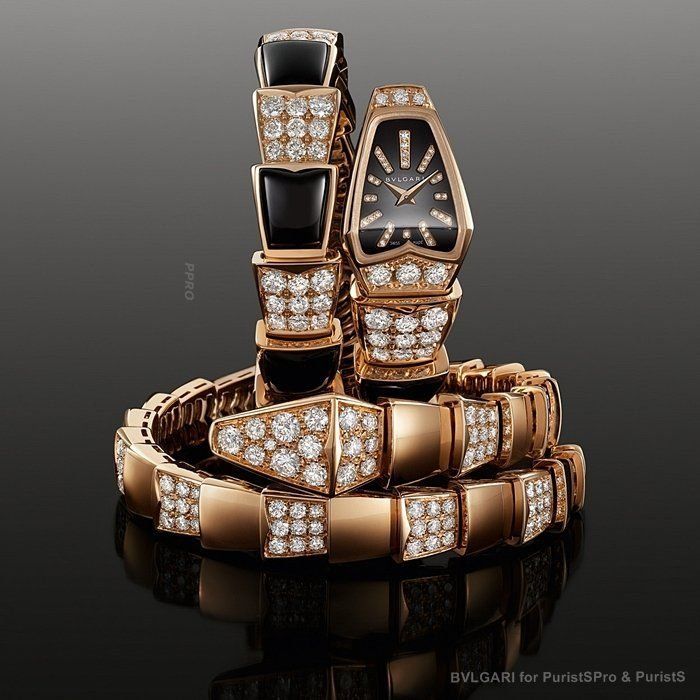
Watches from the 2010 Bulgari Serpenti Collection
The “Parentesi”
In the 1970s, Bulgari often made ladies’ versions of their men’s watches. They also produced ladies’ timepieces that complemented some of their most successful lines of jewelry. One example is the Bulgari Parentesi watch.
Bulgari often used “modules” in the design and creation of some of its jewelry. These were elements with well defined shapes that were interesting enough to stand on there own without excess ornamentation. They could be repeated and linked to create a homogeneous piece of jewelry. In the 1980s, the iconic Parentesi module became one of the most popular jewelry designs to wear and be copied. Gianni Bulgari came up with the design while doodling to demonstrate that a successful jewelry design can be inspired by a graphic pattern. He drew a series of double, square and round brackets. After further stylization of the simple graphic pattern, it was developed into what is now the Parentesi module which can be adapted to all jewels. It can be used by itself in a ring or repeated many times to form a necklace or watch bracelet. Different combinations can be formed with modules in various metals, finishes and precious stones.
Parentesi pieces are produced by casting the modules in a process called “micro-fusion.” Each module is then attached to one another by an “interlocking mechanism of hinges.” They can also be connected by stringing them on chains to form more flexible jewels. The modules are machine-made but carefully finished by hand. Therefore the quality of the finishing is largely dependent upon skilled manual workmanship which is always a priority for Bulgari. The first watch encased in a penannular bangle dates back to 1985.
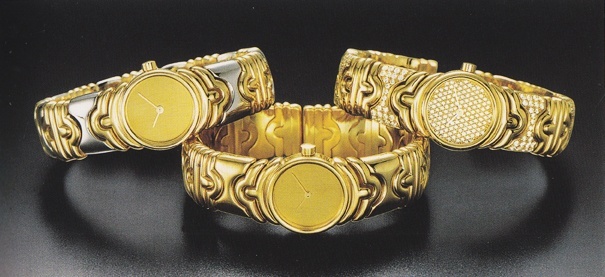
A selection of Parentesi Wristwatches in gold, gold with steel, and gold with diamond.
Additional Bulgari Ladies Watch Lines
The success of Parentesi inspired Bulgari to create other groups of modular jewelry and incorporating wristwatches into those lines as well. Another jeweled bracelet-watch was released in 1989 for the Alveare collection. The dial was hexagon shaped, mimicking the honeycomb pattern of this module. In 1990 the Antalia watch was created too. This watch consisted of a gold hinged penannular bangle which could be covered by different colored interchangeable leather straps. Following the Antalia was the Farfalla watch which resembled a colorful stylized butterfly and was the perfect accompaniment to the Naturalia collection in 1992. The Trika watch was released in 1995 and had a new design with a square case and rounded edges. The dial was decorated with a gold circle and set with pavé diamonds. The bracelet was extremely flexible and made up of a braid motif.
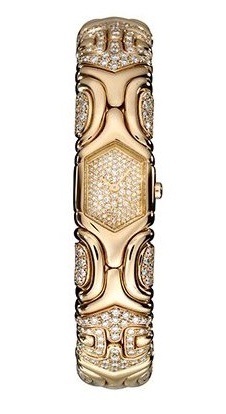
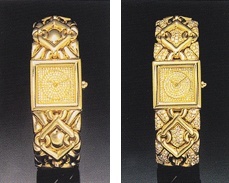
Alveare and Trika watches by Bulgari
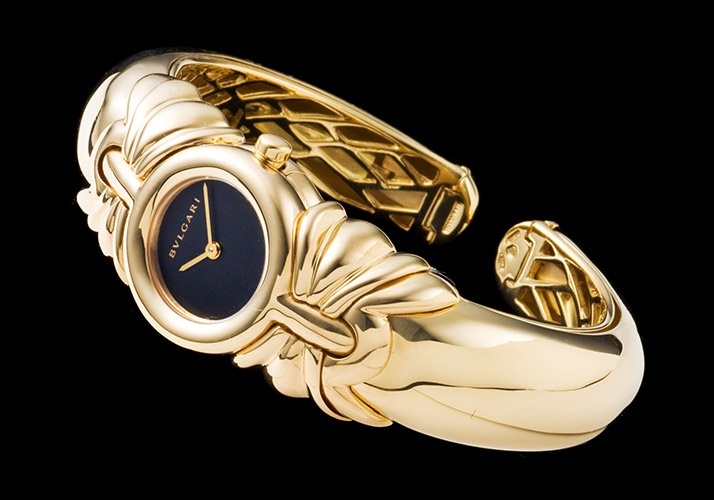
Antalia watch by Bulgari
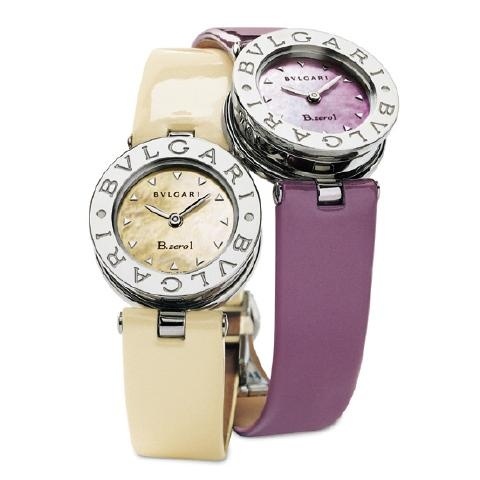
The Ovale watch was launched in 1999 equipped with an elegant oval dial and flexible bracelet with elliptical shapes. In 2002 Bulgari designed a B.zero1 watch complementing the iconic ring. The cylindrical case held the classic B.zero shape and the circular bezel displayed the double “BVLGARI” logo. The watch was offered in different colored mother of pearl dials with matching leather straps or metal cuffs and bracelets. The Lucea watch was released in 2003 with a square case and Astrale in 2006 with a circular case. The Astrale watch consisted of colored gemstones of various shapes and cuts resembling constellations in the sky.
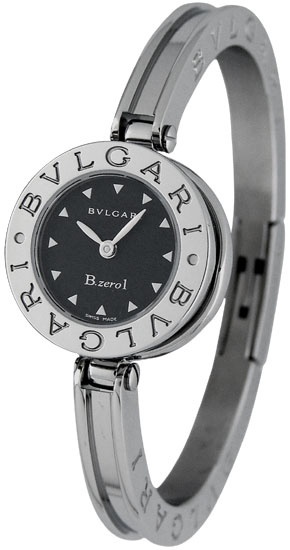
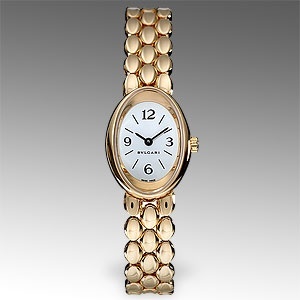
Bulgari B.Zero and Ovale Watches
In 2005, Bulgari created their first luxury digital watch called Ipno. It incorporated the innovative design and use of steel, ceramic and diamonds in a “cylindrical form with an unusual time adjustment device.”
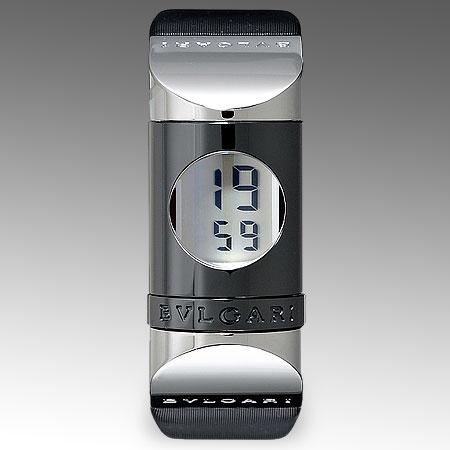
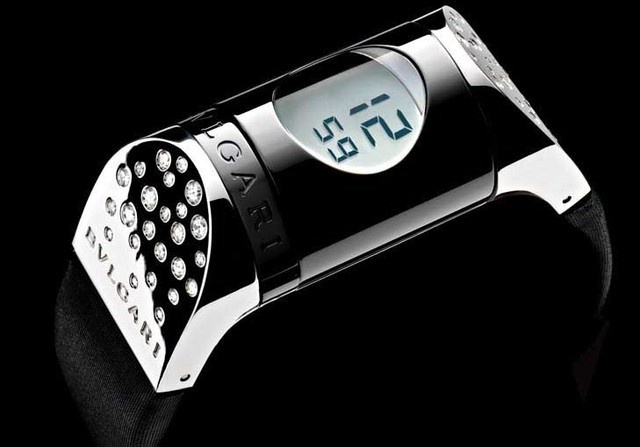
Ipno watch
The Assioma D was launched in 2007. The “D” in the name represented Diva, Donna (Woman) and Diamonds. The watch was modeled after the previous Assioma men’s version. The shape of the case was narrowed and made more feminine. The female version still included two bridges and the “BVLGARI” logo still engraved on the arched part of the bezel. The Assioma D was offered in yellow, pink and white gold with and accented with varying number of diamonds.
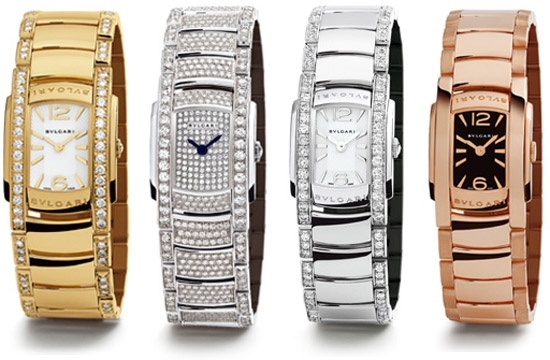
Bulgari Assioma D Watches
Throughout history, Bulgari has created watches exclusively for women that reflect their superb craftsmanship in jewelry design and construction. The resulting efforts are collections upon collections of unique, feminine and elegant timepieces that women can appreciate and adorn in the most luxurious manner.
Reference for photos and information: "BVLGARI" by Daniela Mascetti and Amanda Triossi
Copyright January 2011 - Ping Tsai & PuristSPro.com - all rights reserved
Comments, suggestions, and corrections to this article are welcome.


A Look at the Bulgari Ladies' Watch Story

I love the Art Deco watches....

Excellent read Ping. This is the reference article for Bulgari

I've been following BVLGARI for years and still learnt


Never thought the brand from such angle...

I still have so much to learn about Bulgari, Ping!


A fascinating history...


Thank you for this article, Ping . . .

Nice work!

Tubogas and the Serpenti collection
