
cazalea
[Seiko Moderator]
20996

More Mirai Information: Technology
The sales lady gave me a handful of brochures, which I failed to include in my previous article. Can we take a quick look now instead? If the thought of fuel cell vehicles, gives you a headache, you'd better stop now. If instead you feel like this,

then please read on:
Support for the Fuel Cell Mirai
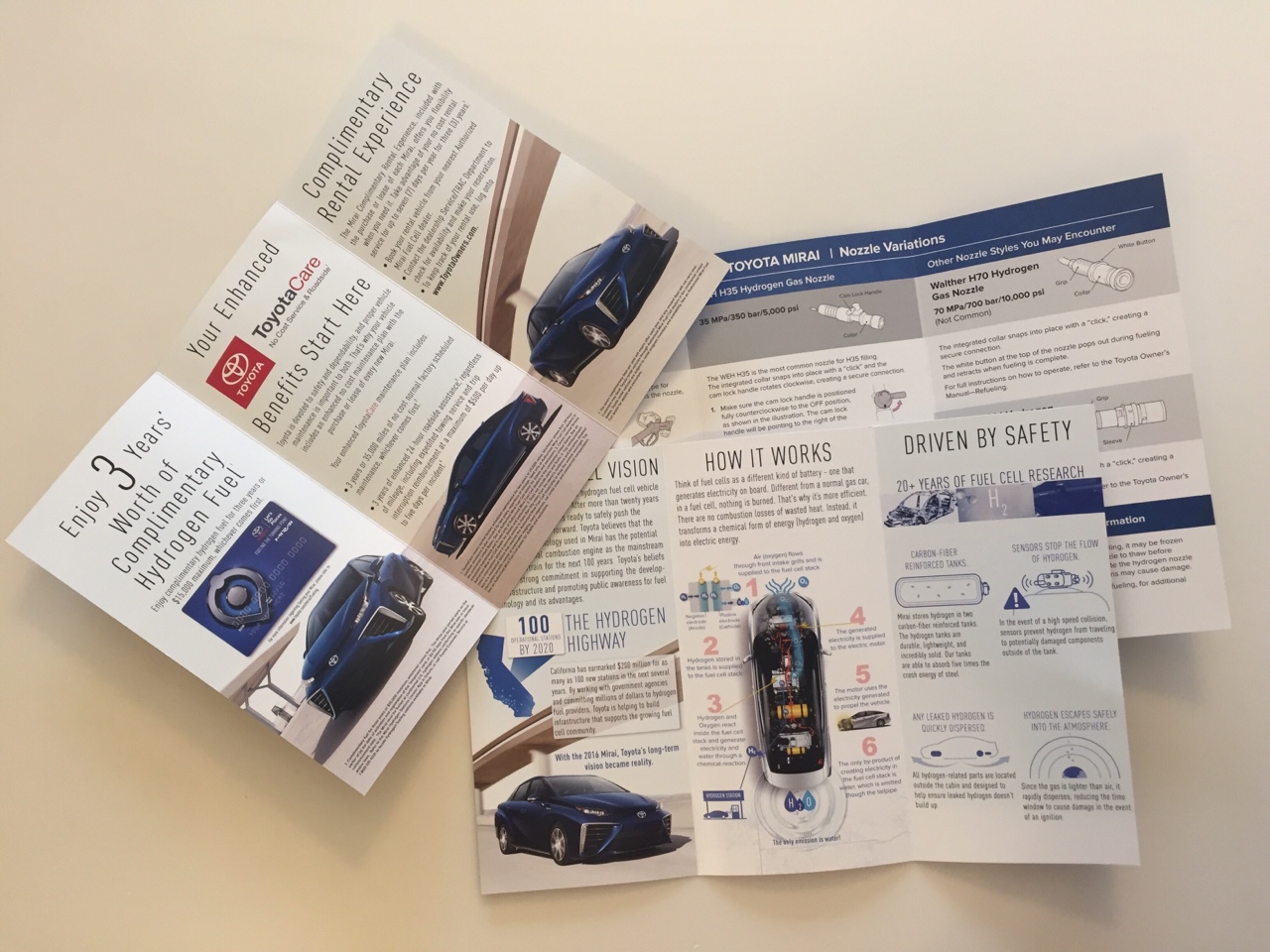
The first brochure describes the "enhanced" experience that you receive with your Mirai. It comes down to 3 things - a 3-yr parts, service and maintenance plan, 3-yr roadside assistance, and 3-yr complimentary rental car (for 7 days each year). The alternative fuel components (fuel cell, tanks, batteries, etc) are warranted for 8 years / 100,000 miles, which is required by the state of California.
These are conventional plans that are offered in the Mirai purchase or lease experience, and they mirror what virtually all other manufacturers offer. My Fiat 500e has the same coverage, with the exception that we can rent from Enterprise, National or Alamo for up to $500 per year, whereas with the Mirai you can only borrow a loaner car from a Mirai dealer, for 7 days each year.
With both companies there is a special support team to answer questions peculiar to this vehicle, using a special phone line. There is a navigation app that knows where you are, and it polls the hydrogen stations every 15 minutes to see if they are open and the pumps are available. Thus it can direct you to the nearest operating hydrogen station.
Fueling the Mirai
Fueling the Mirai
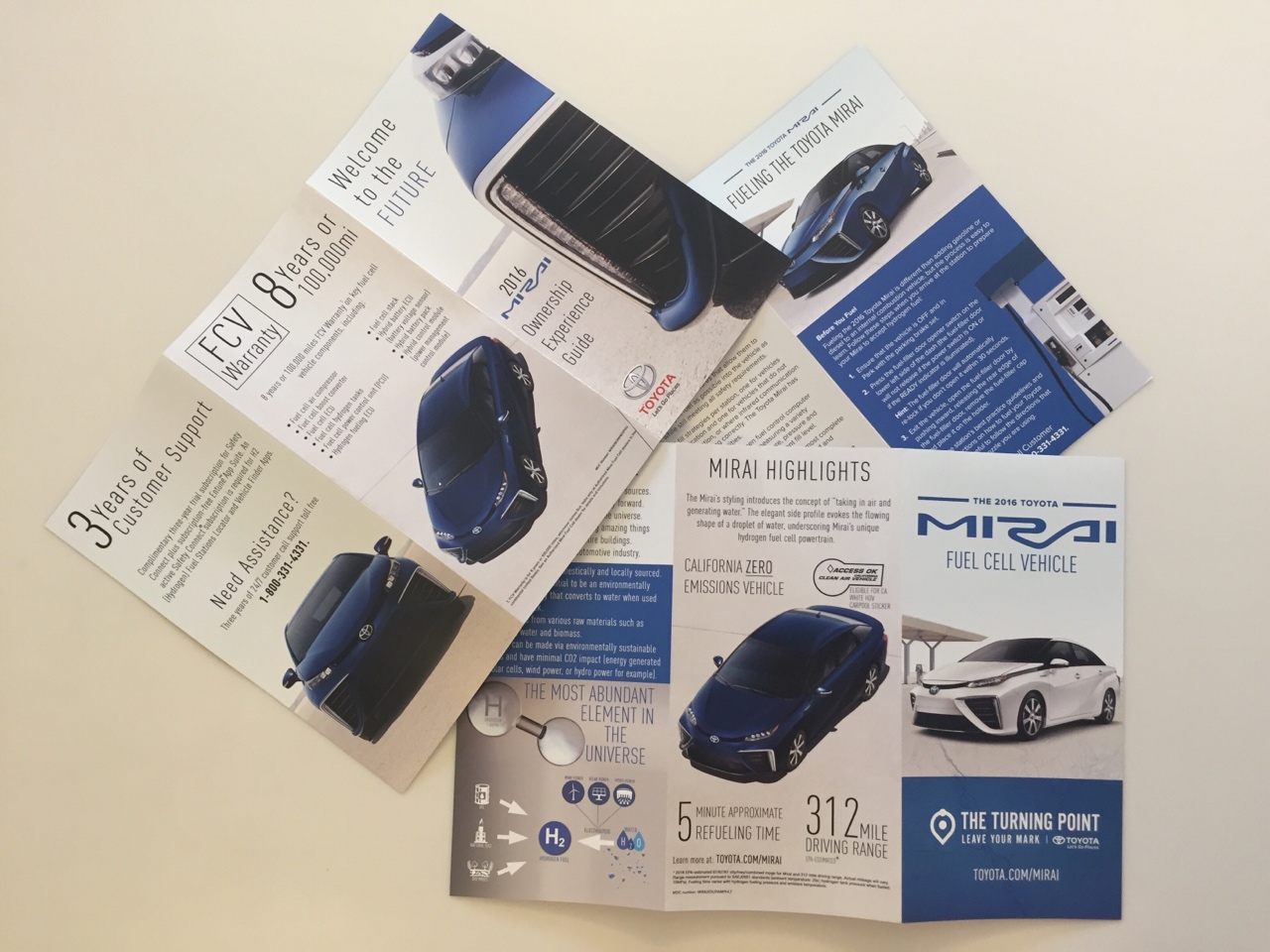
A whole brochure is devoted to fueling. Due to hydrogen's combustible nature, you have to be careful. So the fuel cap won't open if the car is running. Once you are ready you plug the nozzle onto a fitting on the car. This looks just like the fitting on your gas-fueled barbecue tank. It locks on and you can start the fueling process. Because the hydrogen is stored as a compressed gas in 2 strongly armored tanks under the car, the station must "force in" the new fuel.
There are two pressures available in California fueling stations - 35 [that means 35 Mega pascals / 350 bar / 5000 psi] or 70 [70 Mega pascals / 700 bar / 10,000 psi]. IF you pull up and connect to a 35 pump, it can only give you a half-tank of fuel. A 70 station can fill the tanks to capacity. The higher the pressure, the more hydrogen can be forced into the tank.
The car "talks" to the pump and works out the best combination of pressure, temperature and flow to fill your car. This could take 5-15 minutes depending on the ambient temperature, election, etc.
A kilo of hydrogen has about the same energy density as a gallon of gasoline. Due to the conversion efficiency of the fuel cell / electrical powertrain, the Mirai carries only about 5 kilos of hydrogen, which gives a range of about 310 miles depending on driving style and conditions.
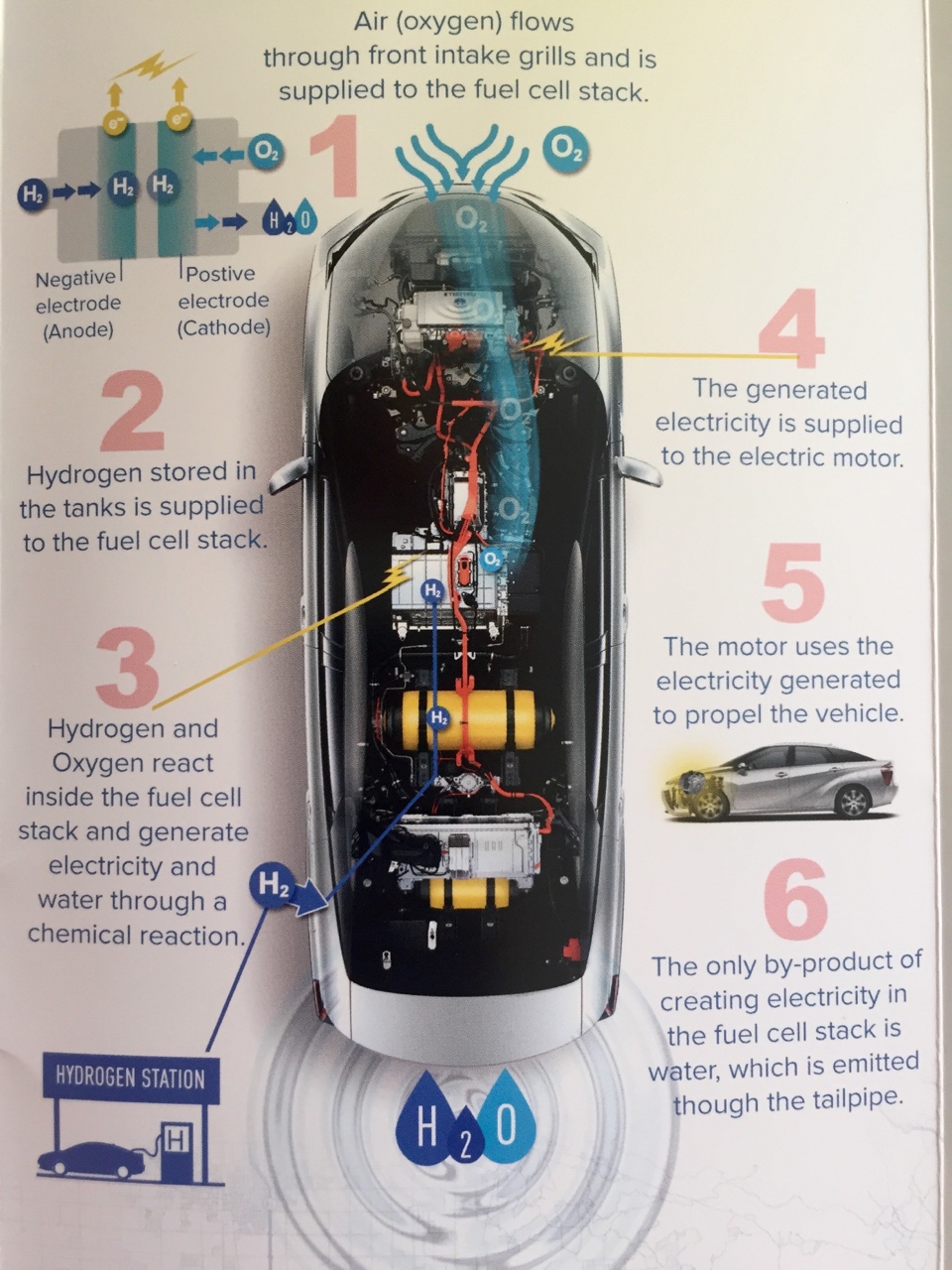
The final brochure explains how the car works. Or rather - how it converts hydrogen into electricity - after which it works like any electric car. Eventually, much of the hydrogen will be delivered by electrolyzing water, with electricity from mostly renewables—solar, wind, bio-mass, but today the hydrogen that powers a fuel-cell vehicle comes mostly from fossil fuels (natural gas). Methane gas from decomposition of plant material in landfills is also used. High temperature steam is blasted into the methane which drives out hydrogen gas. It is possible to make hydrogen gas by electrocuting water - cracking the water molecules with electricity - but it takes a lot of water and also electricity which today makes it too expensive. Once we have enough low-cost solar, wind or hydroelectric energy (will that ever happen?) we can get hydrogen from water with no byproducts or waste.
Price of the fuel:
Hydrogen fuel prices range from $13 to more than $16 per kilogram (kg), but the most common price is $14 per kg (equivalent on a price per energy basis to $5.60 per gallon of gasoline), which translates to an operating cost of $0.21 per mile. All automakers are including three years of hydrogen fuel with their initial sales and lease offerings, which protect early buyers from these high fuel prices.
Industry estimates assume hydrogen may drop to $8-10 per kg range by 2020 to 2025. Since Fuel Cell vehicles are about twice as efficient in extracting energy as a gasoline-powered vehicles, they can travel about twice as far as a conventional vehicle on the same fuel energy. At $3.50 per gallon for gasoline, a conventional vehicle costs about $0.13 per mile to operate. A fuel cell vehicle using $8 per kg hydrogen fuel would cost about $0.12 per mile.
Lots of IFs and BUTs at this stage, and that's the price we pay to be early adopters of a new technology (fuel cells are ~ 40 years old).
Thanks for reading all this. If you did, you are a PuristS techno-geek!
Cazalea
This message has been edited by cazalea on 2016-07-23 08:30:32
Test Drive and Review: Toyota Mirai Fuel Cell Vehicle
On a nice sunny Friday morning, Mrs. Cazalea and I headed for Tustin Toyota to take a long-awaited test drive in a real production Toyota Hydrogen Fuel-Cell Powered Mirai. Regular readers of this site may remember my report from the LA Auto Show about 18 ...

Interesting stuff....
I kept noticing them on the roads in the past few months since they first began deliveries and unsurprisingly it did not leave me terribly impressed. It would appear from your writing that you were not particularly impressed either. Granted, it is their f...
Well, Fuel Cell Vehicles are "new" in one sense
But the manufacturers like Honda, Toyota, Mercedes-Benz, BMW, etc have been working on them for decades. The trouble is they have too many constraints right now. They have to meet safety standards while hauling around two tanks of 10,000 psi hydrogen. The...
Would definitely be curious....
to read your impressions after having used the car for a while. Ironically, I was watching a little bit of TV tonight and this ad came on.... Toyota Mirai Ad

Thanks for another great review.
The car does seem a little on the ugly side but maybe one can get used to it. I find the prius super ugly but they sell like hot cakes. Enjoy the weekend. Ps i love the citroen dash console. Looks like a spaceship.

You have to use half a tank of fuel for return trip to the gas (literally) station?
I got my Casio calculator out to work out that it takes 140 miles journey round trip to fill a 310 mile capacity. You are left with 240 miles when you get home but need to reserve 70 miles for the next run to the gas station. Thus your usable range is 170...

Yes, that's why I need to wait until the station opens 10 miles from home
which is in-between my favorite local watch boutiques. Alternatively, my wife's father who we are visiting 2-3 times a month lives near 3 stations in Torrance - one of them offers FREE hydrogen - so we could fuel up there. But it still doesn't make sense ...

Thanks for this!
It seems that the product will still need a while to be a practicable solution for many people. The driving like a Prius may not wow us enthusiasts but it shows that the technology is ripe for mass use - if you have a gas station nearby. Still very intere...

Kudos for the innovative effort to Toyota...
...there are so many aspects and prospects of this development but here are few of my own initial considerations. I am not sure of the clean energy production/utilization/wastage ratios with the comparables that being the most important reason to sway awa...
More Mirai Information: Technology
The sales lady gave me a handful of brochures, which I failed to include in my previous article. Can we take a quick look now instead? If the thought of fuel cell vehicles, gives you a headache, you'd better stop now. If instead you feel like this, then p...
More Mirai Information: Price
Buying an alternative fuel vehicle in California is very complex. Here's how the Mirai stacks up: 58,335 initial price LEASE $5000 down ( $3650 down + $1400 tax, license, registration, etc.) $540 / month ( $500 month lease payment + tax) $5000 rebate from...

Thank you for this informative post ... but
why must Toyota design their very ugliest cars when creating high mpg vehicles? I'm stunned by how super-ugly the new Prius is--even super-uglier than the first models... And this model here is only slightly less horrid, chuckle.... But credit where credi...
An owner offsets the Toyota Ugliness
This is the newest-generation Prius, decorated my one of my neighbors. Actually, I like it. Cazalea ...

It's actually quite nice, once you
Stop rubbing your eyes and shaking your head in disbelief. It accentuates the better points of the car. Mike
Errrr ... one question though ..
That red convertible (don't ask me what it is) with the white stripes also happens to belong to that same neighboor ?
Red Mustang Convertible
There is a surplus of them in my neighborhood! Here is is from a couple years ago: AND ALL THE REST!!!! ...
Ummm
It looks like 1970's tube socks.... chuckle... Cazalea I certainly admire your watch collection though here we may differ haha.

Excellent work.
This is another of your superlative reviews. Really appreciated. I've always been astounded by the pressure the Hydrogen tanks have to take. I am wary enough filling scuba tanks... Great job. I wish I had a chance to drive one.
Great post again Mike ...
.. yes i watched all videos till the end. Pretty amazing to finally see this technology going ... errr ... onroad . Unfortunately Toyota again has a name to keep up ... of keeping things ugly and un-exciting ... like most other brands producing electric c...