
SuitbertW
2411

Hello, Moritz,
I'd like answer some of your remarks point by point , as I find them a bit unclear:
"....the hairspring clamp is movable, but for adjusting the balance wheel to the hairspring."
At least technically, that's incorrect. Adjusting the hairspring relative to the balance wheel, can only be done
by moving the inner collet on the balance arbor (die Spiralrolle auf der Unruhwelle).
"....The article does not say unfortunatelly that the hairspring length is variable - so I assume it is fixed."
The hairspring length isn't fixed, depending on where it's exactly placed in the "clamp" some variation is possible. This is different form
a usual "stud" where the end of the hairspring is fixed.
"...The swan neck ( Ruecker) and this particular hairspring clamp together are a mechanism to adjust the pivot ( Hebestift / Hebelstein) of the balance that hits the ancher and subsequently the anchor wheel. ( Abfall-Regulierung )"
That is basically correct, although a "pivot" would be "Unruhzapfen" and "Hebelstein" would be the impulse jewel.
What I tried to point out in my first post, that the swan neck micrometer screw is for adjusting the symetry of beat (or called more shortly, the beat) is exactly that, "Abfall Regulierung" ;-)
"...I was thinking the old 1815 chrono was ment, where they do not serve any purpose."
Even with a classical (non freesprung) hairspring system, adjustable inertia screws can be quite helpfull for pre adjustement and adjusting to positions....
First Gyromax movements form PP for example were also featuring this double adjustement and werent true freesprung systems.
Best regards
Suitbert
Purpose of swan-neck in Lange 1815 chronograph

The swan-neck is again a spring itself ...
Yes - but
I can see clearly the "lever" = Rueckerhebel ...
Actually I think the answer is a little different
It looks deifferent but should do the same job...
Sorry but that's incorrect
I am not a watchmaker, that is true but ...
Inertia vs. hairspring length
It's a freesprung system....
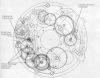
confusing: is the spring length fixed one or movable = variable???
Hello, Moritz,
Thank you for the details, Suitbert ...

I loved your explanation
Hello, Stephen,...
Thank you for this
Small theory.