
Purpose of swan-neck in Lange 1815 chronograph
Dear Sirs! I was checking the balance system in the 1815 chronograph. What is the purpose of the swan-neck adjustment system in that watch? I see no hairspring key, which is usually connected to that part.

The swan-neck is again a spring itself ...
that will adjust the hairspring key very, very accurately. As you will know, the pace of the swinging system is adjusted by altering the hairspring length with the hairspring key. With the swan-neck you can now adjust the hairspring key itself through the...
Yes - but
Thanks. Krtek is great, has a nice taste! My problem is still the following. When you look closer on the adjusting system of the 1815 Chronograph (or Richard Lange Referenzuhr) I see NO ANY key. Neither pins, nor screws - nothing. I can see a Philips curv...
I can see clearly the "lever" = Rueckerhebel ...
... on pictures of the 1815. That would mean that there has to be also something like an hair spring key somewhere, where this little lever is attached to. There are also not many other ways left to adjust the hair spring: - over the mass ( like Patek's G...
Actually I think the answer is a little different
The new 1815 Chrono, and the RL, actually use an adjustable-maxx "gyromax" style balance to control rate. What looks like a swan neck regulator is in fact a beat adjustment mechanism. If you look at the free-spring Langes (like the RL and new 1815 Chrono)...
It looks deifferent but should do the same job...
Still there is that lever that regulates the hairspring key. The new mass elements on the balance are possibly just decorative, like the former balance screws are. At the end of the day the balance will be adjusted by laser, I read in an article somewhere...
Sorry but that's incorrect
ThE weights aren't decorative. It's a true free sprung balance a la the Patek gyromax. The apparent swan neck regulator in these watches only adjusts the beat. I have this info from Lange direct.
I am not a watchmaker, that is true but ...
from my layman point of view and looking at what I can recognize in the movement: the lever is there. The swan neck, the mass-weights on the balance, the srews ... all is at the end regulating the beat. Same the hairspring key does. It all effects the bea...
Inertia vs. hairspring length
I see the 6 mass on the balance. It has influence on the inertia of the balance itself, since the inertia radius varies by rotating those excentrical masses. My original question was the adjusting method of the active length of the hairspring which also h...

It's a freesprung system....
Hi, it's a freesprung hairspring, i.e. the actual length is fixed. Different from the commonly used systems, where the hairsrping end is either glued, laser welded or fixed with a conical pin to the hairspring stud - the Lange system is a sort of clamp, f...
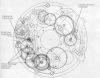
confusing: is the spring length fixed one or movable = variable???
Managed to find a review of the RL, released when it came out: the hairspring clamp is movable, but for adjusting the balance wheel to the hairspring. The article does not say unfortunatelly that the hairspring length is variable - so I assume it is fixed...
Hello, Moritz,
I'd like answer some of your remarks point by point , as I find them a bit unclear: "....the hairspring clamp is movable, but for adjusting the balance wheel to the hairspring." At least technically, that's incorrect. Adjusting the hairspring relative to ...
Thank you for the details, Suitbert ...
At least in one point we agree: the swan neck is not really "necessary" and that Lange uses it as a trademark, to make the watches look better. And they do look good! That is also a big reason why we love watches ... Regards Moritz

I loved your explanation
Hi there SuitBert, Thank you very much for the explanation. Oftentimes this issue about free-sprungness, and the presence of the swan neck regulator despite the latest models from Lange mainly being free-sprung, comes onto my mind. I still don't really ge...
Hello, Stephen,...
re. the freesprung principle, let me try to explain it with a comparison. Imagine a guitar with it's strings. If you pluck an empty string - you could call this string freesprung. It has a fixed length and only it's physical properties limit the base freq...
Thank you for this
Hi there SuitBert Your analogy makes it easy for me to understand the idea of freesprung-ness. So by moving back and forth the index regulator, this adjusts the oscillating speed of the hairspring? Or the rate stability of it? And in that case, if say tha...
Small theory.
Hi Stephen, Imagine a simple system, where the balance is only one point, rotated around an axis by the spring. 1. Momentum (of balance) contains mass and velocity values. Position of mass can be variable by the construction, velocity will change continuo...