
SuitbertW
2411

Hello, Stephen,...
re. the freesprung principle, let me try to explain it with a comparison.
Imagine a guitar with it's strings. If you pluck an empty string - you could call this string freesprung.
It has a fixed length and only it's physical properties limit the base frequency. Now, press down the string with
your finger towards the fret board and pluck again - now it's not freesprung anymore. Your finger pressing it
towards the fret board is like the index regulator to the hairspring - frequency will be higher of course. Moving up and
down your finger on the fret board is exactly the same as moving back and forth the index regulator on a "non freesprung"
hairsrping.
Acoustically, the "empty" string will allways create the more "perfect" (i.e. less disturbed") vibration. That's exactly the same for hairsprings,
the "dead" end of the string(spring) between finger(index pins) and peg (hairspring stud) will allways create some disturbations.
Of course in very complicated circumstances a very good watch regulytor can sometimes make use of those
disturbations to average other disturbing influences from the escapement, for example. That's one reason precision watches form the past
often still had non freesprung balance systems - despite the fact that theoretically a freepsrung balance would be superior.
Personally I find it quite interesting, it's one of the fewer occasions were a theoretically superior system finally is found to be superior for
large series production - while a the theoretically lesser sytem is perhaps offering more for the absolute specialists in introducing wanted errors.
It should be said though, suitability for mass production of freesprung hairspring has seen a tremendous evolution thanks to new
production methods/machines and the pioneering companies, mainly Rolex.
Best regards
Suitbert
Purpose of swan-neck in Lange 1815 chronograph

The swan-neck is again a spring itself ...
Yes - but
I can see clearly the "lever" = Rueckerhebel ...
Actually I think the answer is a little different
It looks deifferent but should do the same job...
Sorry but that's incorrect
I am not a watchmaker, that is true but ...
Inertia vs. hairspring length
It's a freesprung system....
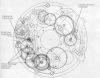
confusing: is the spring length fixed one or movable = variable???
Hello, Moritz,
Thank you for the details, Suitbert ...

I loved your explanation
Hello, Stephen,...
Thank you for this
Small theory.