
Ornatus-Mundi
[Zenith]
7136

The Pilot Collection
The focus of Zenith’s offerings this year were perfectly clear even to the least sensitive and uninitiated person once the booth was entered:

The company reconsidered its rich history in aviation timekeeping which encompassed board instruments like altimeters and dash clocks as well as precision pilot’s watches with chronograph and/or world time function. The watch on the left is the timepiece worn by Louis Blériot during his heroic first crossing the Channel – 40 kilometres of ocean – in a flying machine:
“I am very satisfied with the Zenith watch, which I usually use, and I cannot recommend it too highly to people who are looking for precision” [Louis Blériot on 19 March 1912]
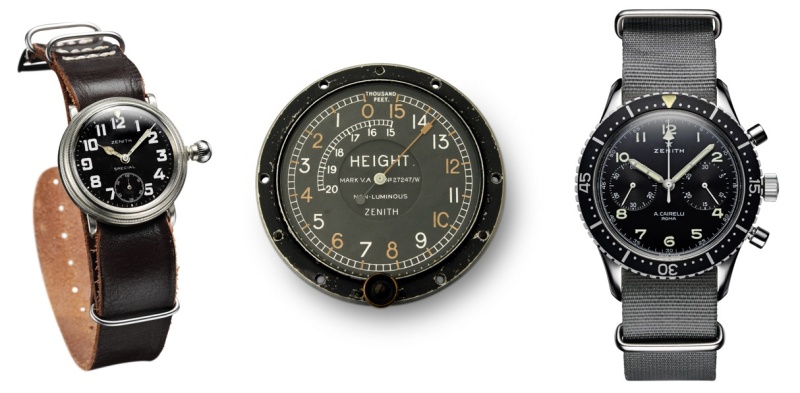
A few years later, as of 1939, Zenith presented a new dashboard instrument, the Montre d’ Aéronef Type 20 which became standard equipment for French aeroplanes at this time - lauded by aviation builders and professionals alike for its reliability, sturdiness and accuracy (bimetallic balance wheel coupled with a self- compensating, anti-magnetic hairspring and a Swiss lever escapement).
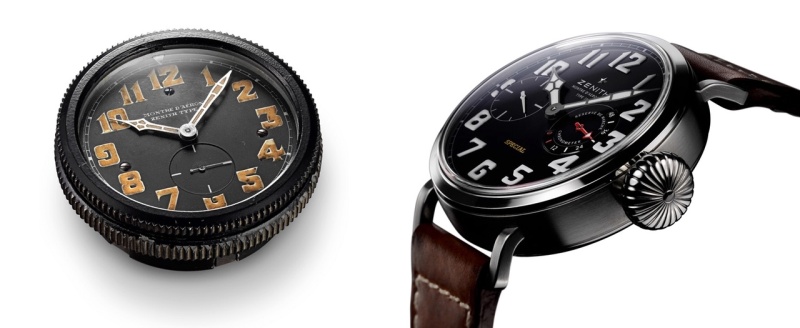
It was this exact watch that inspired Zenith to create a tribute to its ancestor, the new
Montre d’ Aéronef Type 20
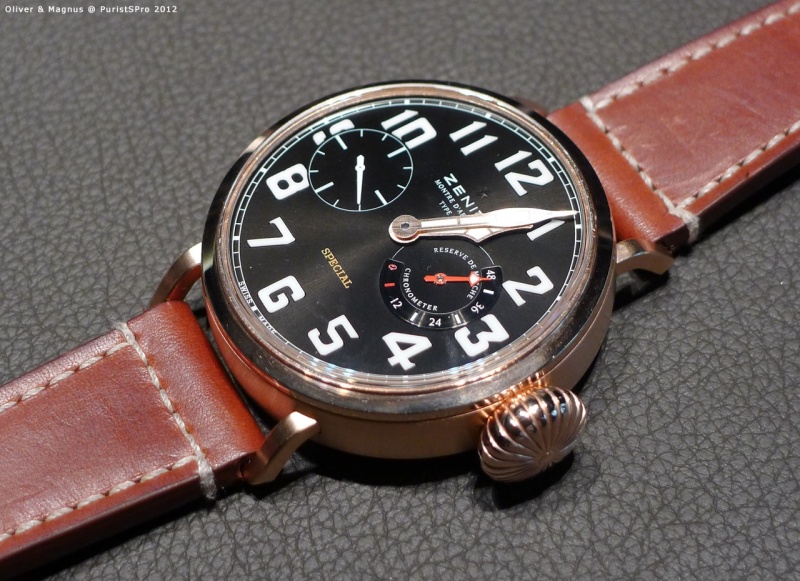
‘Oversized’ is certainly an adequate adjective to describe a 57.5mm wristwatch (or clock?). And ‘oversized’ watches were the trend of the recent years, fueled by numerous offerings from 700€ ETA 6498 driven watches to creations of respectable houses. But 57.5mm? Now that the trend is fading/reversing?
Well, the bottom line is: THIS WATCH MAKES SENSE!
First, it’s a true tool watch and thus in a different league from its mere mortal wristwatch competitors. Second, its size is determined by the magnificent and certified outstanding Chronometer calibre 5011K, which has a diameter of 50mm. Third, it’s a collector’s item just because of point (2).
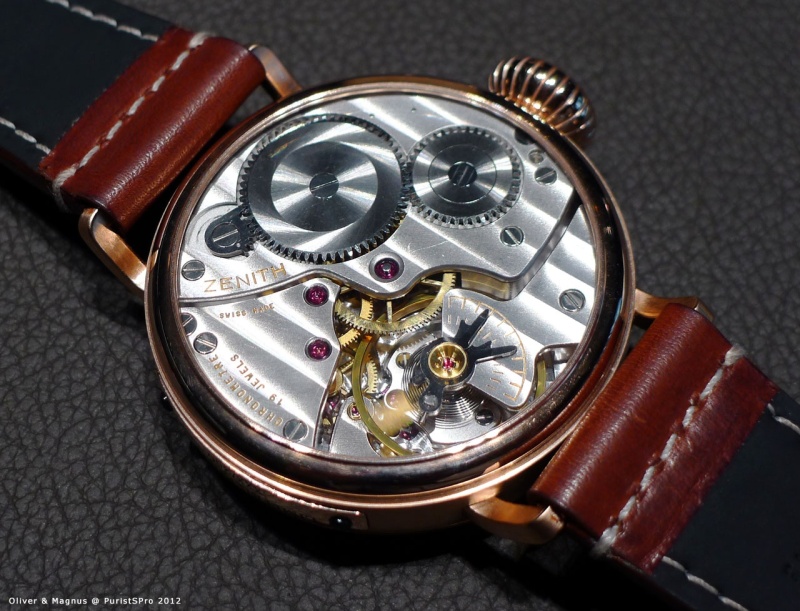
The Cal. 5011K is a renowned Chronometer grade movement used as well in deck and dashboard Chronometer clocks. Here is the fully data set:
- Movement: 5011K, manual
- Caliber: 22``` (Diameter: 50 mm)
- Thickness: 10.00 mm
- Components: 134
- Jewels: 19
- Frequency: 18’000 VpH – (2.5 Hz)
- Power reserve: min. 48 hours
- Breguet spiral
It was originally introduced around 1960. It's so well designed that it holds several chronometric records. In 1967 it was named the most accurate chronometer ever tested by the Neuchatel Observatory. It is considered the most precise movement in the world in its category.
The calibre has been in continuous production since then and used in competition timepieces, marine chronometers, pocket watches, and watch making school watches. Only 50 or so can be made per year.
“Oscillating at 18,000 vibrations per hour, the 5011 calibre has a separate mechanism for stopping the seconds hand and synchronising the hour. It features shock-absorbers on the balance-wheel and escapement [-wheel] arbours [see arrows in image below!], fine adjustment, and a self-compensating anti-magnetic Breguet overcoil balance spring, as well as a mobile stud-holder, double-arrow index regulator, and the Zenith winding-crown stem attachment system. All these assets combine to ensure that the watch gives a first-rate performance without losing its vintage feel.” [Press Kit, corrected!]
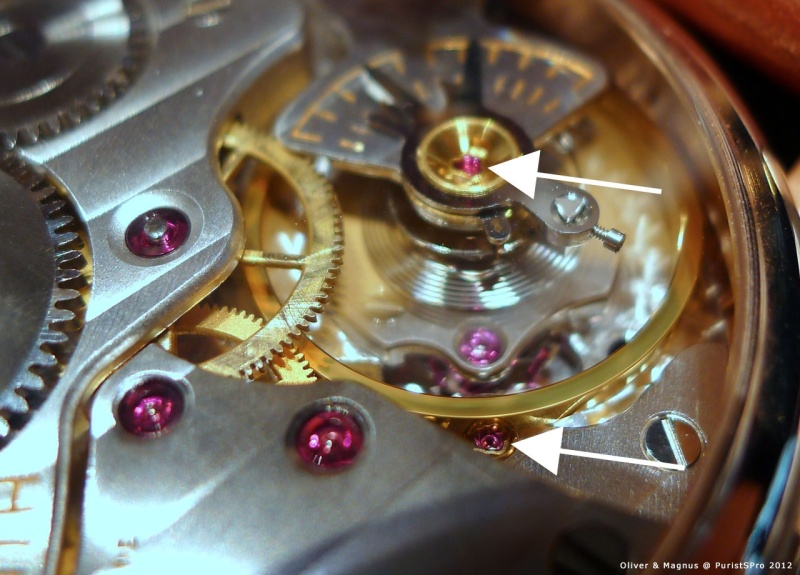
“The notched crown is reminiscent of those on antique aviator watches, which allowed pilots to set the watch without taking off their gloves. The 27 mm space between the lugs accentuates the shape of the extremely refined lugs that attach an antiqued leather strap sewn and topstitched entirely by hand. Adding to the vintage feel is the black dial, which is easily readable thanks to luminous elements. Beneath the impressive sapphire crystal (glare proofed on both sides), the raised numerals of the chapter ring are made of entire blocks of Superluminova. The time is indicated by hands that are also enhanced with luminescent material.” [Press Kit]

It's an exceptional watch that really looks, feels and sounds like a true chronometer (listen carefully, we could not stop discussing the piece ;-():
Now to the question you all were waiting for: How does it wear? After all, the proof of the pudding as they say, is in the tasting.
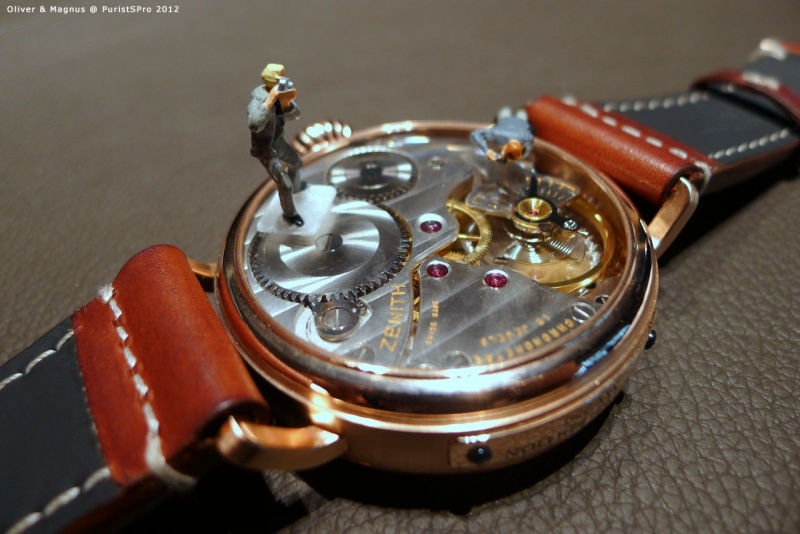
Our answer is: it depends. On your wrist, your shirt, the light, the angle of view, your taste. Certainly (and surprisingly) its not too heavy (probably thanks to the shallow case). But the light can make the difference between wearable…
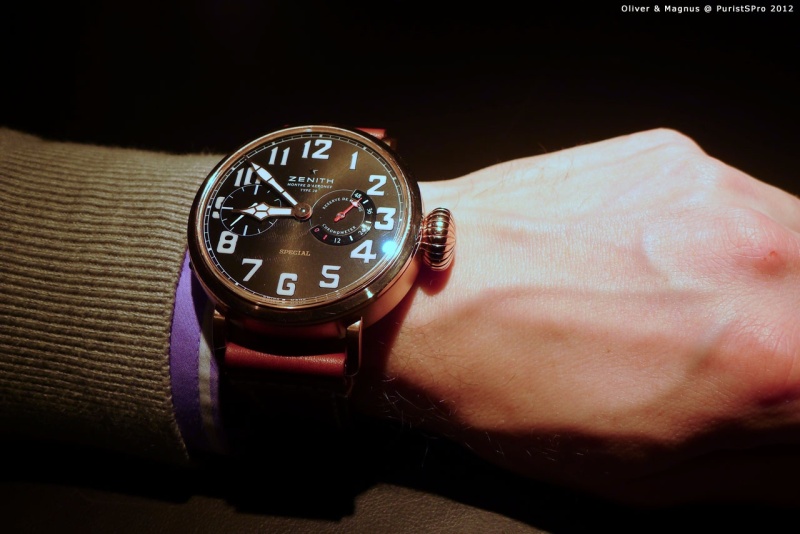
… just ok…
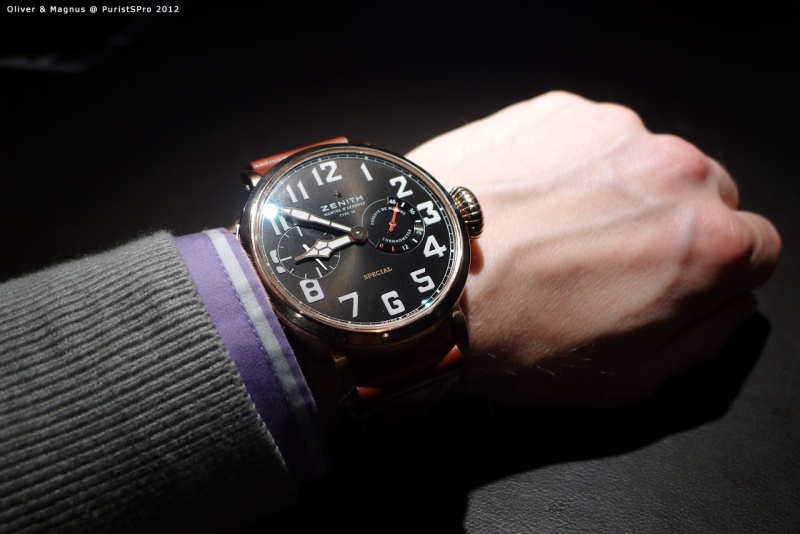
… and simply too big:
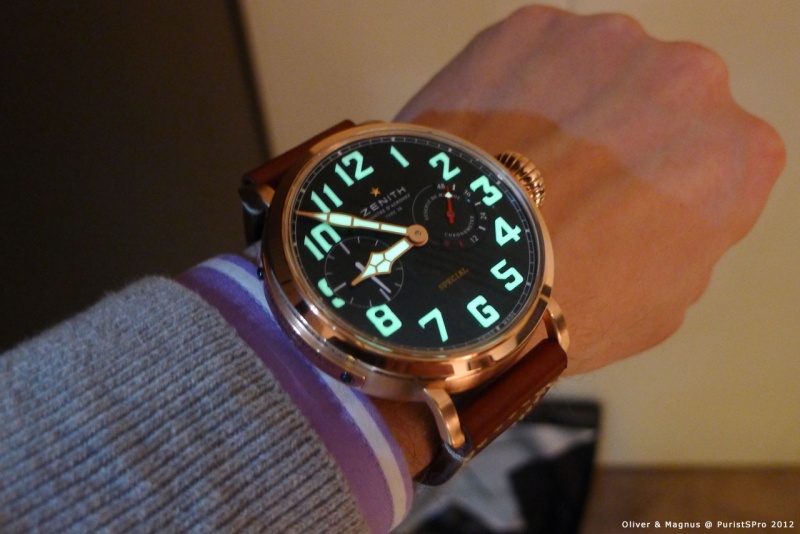
The Montre d’ Aéronef Type 20 comes in a limited edition of 250 pieces in titanium and 70 in red gold. A pity that we could only inspect the former one. The titanium version is closer to its original conception, likely lighter and may even sound better.
Big Date Special
In a comparatively ‘diminutive’ size of 42mm Zenith presented its Pilot Big Date Special watch with en El Primero calibre. The case is crafted with classically styled alternating polished and satin-brushed finishes that match well with the matte black dial (sandblasted five times!).
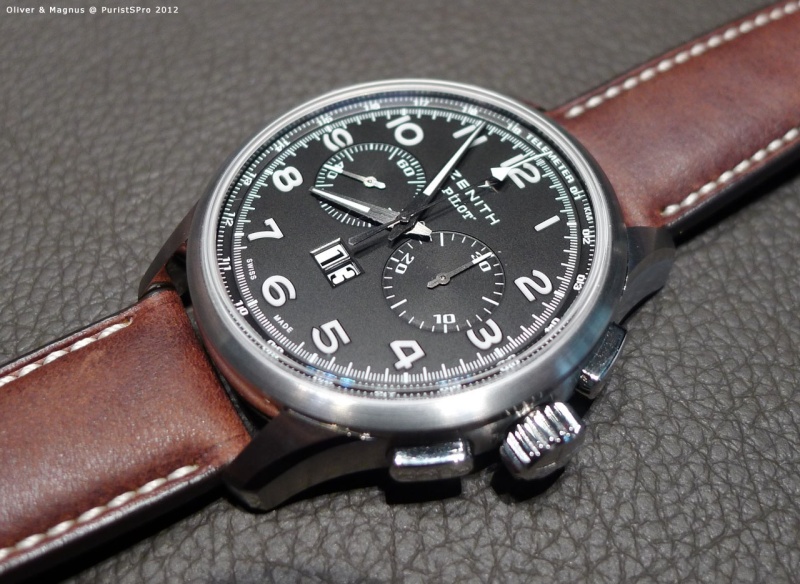
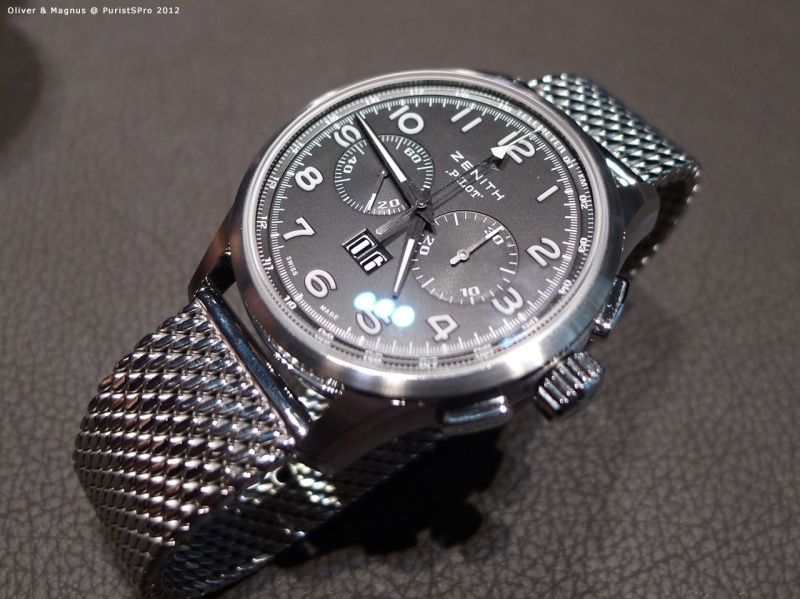
The chronograph comes on an ‘antiqued’ calf leather strap or on a Milanese-style steel bracelet, both of which are good choice for this type of watch.
An interesting detail (which is also present on the Aéronef) is the technique behind the luminous material. Instead of luminescent paint the raised numerals are made of entire blocks of Superluminova:
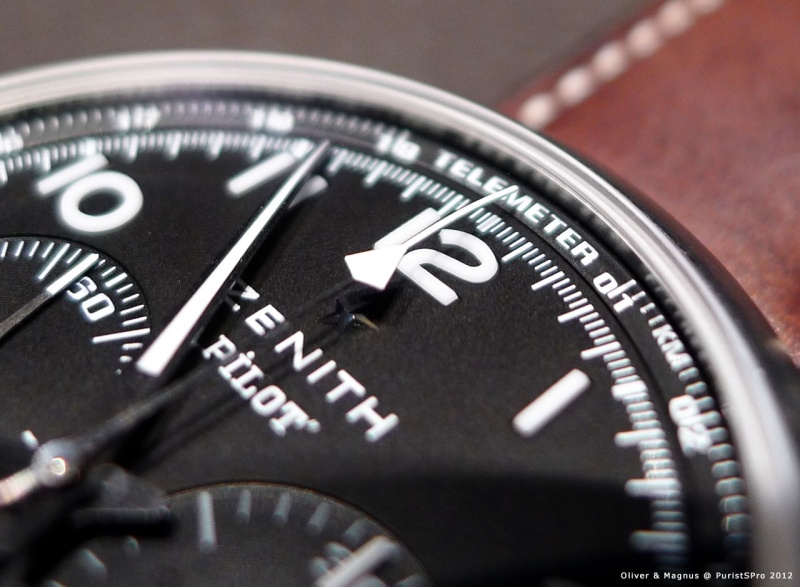
It's pleasant to wear on the wrist, even if the date window looks much like an (superfluous) afterthought:

Doublematic
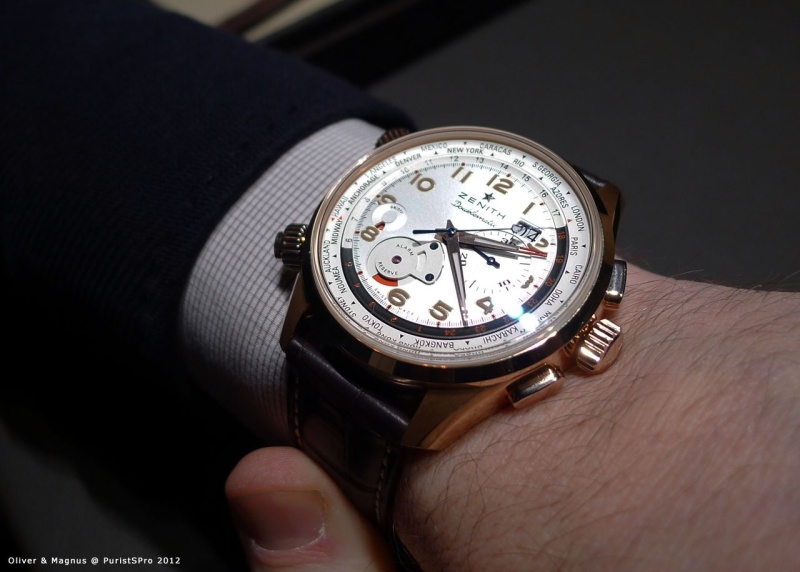
Last of the three novelties in the Pilot collection is the new Doublematic, an automatic chronograph with a world time and a big date display as well as an alarm function.
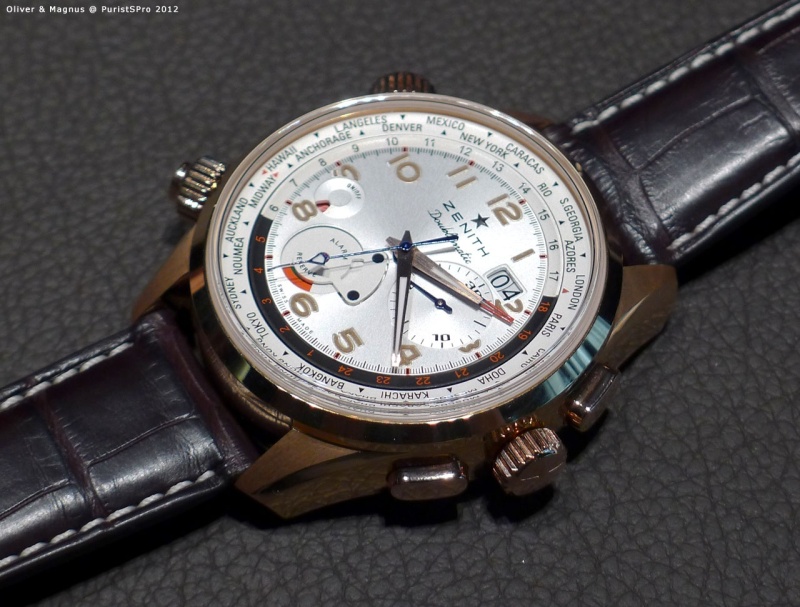
The world time function is a classical two-disc implementation, whereby the one disc at the flange reveals the time in each iconic city, while a second disc indicates day or night.
The movement it built upon the El Primero chronograph with a seconds and a 30 minutes counter as well as 50h of autonomy. A second barrel drives the alarm function, whose status is indicated at 08:30 (on/off window) and 07:30 (alarm power reserve), respectively. A second hour hand (below the main hour hand, with a red tip) indicates the alarm time. The alarm acts – like the Blancpain Alarm GMT watch – on a gong encompassing the movement. It’s rather loud and with a pleasant sound.
The case is rather large with 45mm and comes in either red gold or steel. It’s a worthwhile travel watch and offers – like the mentioned Blancpain – enough versatility to accompany a seasoned traveler for both casual and more formal business use. Our only criticism is that a power reserve for the main train is missing: What is a power reserve for the alarm worth if you cannot gauge whether the autonomy of the main clockwork is sufficient to trigger the alarm the next morning? The same applied to the Blancpain, btw.

Baselworld 2012 - Official PuristSPro Report: Zenith
[ Note: due to an exhausted batterie our main 'horological' camera was defunct, thus we had to rely on a compact camera. For 'better' picture please take a look at François-Xavier's report ! Apologies from our side!] Zenith was one of the most anticipated...
The Pilot Collection
The focus of Zenith’s offerings this year were perfectly clear even to the least sensitive and uninitiated person once the booth was entered: The company reconsidered its rich history in aviation timekeeping which encompassed board instruments like altime...

100% convinced !
Thanks for this post Magnus! I want need that Montre d'Aéronef type 20. The case, dial, hands the look perfect. The movement? No discussion, that IS perfect. The size,? Big but who cares ? But the Pilot big date and the Doublematic are amzing pieces too. ...

+1 to that Bruno
Dear Oliver and Magnus thank you for another great report.. definitely worth waiting for Best Damjan

I applaud...
...the audacity of the revisited Type 20, but much like the Panerai Egiziano, cannot imagine wearing one! I do like the new pilot chrono, but wish Zenith would've omitted the big date. Still, it is attractive -- and wearable at 42mm! I'm loving your write...
The El Primero Collection
Espada The El Primero family gets a new addition with the introduction of the time-only El primero calibre 4650 B. Essentially it’s the famous calibre stripped of its chronograph mechanism – just like the ETA Valgranges movement is to the Valj...
The Captain Collection
Chronograph The legacy Zenith watch with a lot of design cues taken from the past. We were shown a 42mm El Primero chronograph in red gold with an appealing frappé ‘dial (egg-shell’-like in both colour and surface): An easy watch to wear, well proportione...
the egg-shell like dial is awesome
must see it irl I think I'll have to cancel a Panerai .... Zenith is imo more interesting this year
The Ladies Collection
For the female audience Zenith offers two new watches in a cushion-shaped case with either a moon phase (Elite-based) or a chronograph (El Primero-based) complication: The dial diameter is almost as large as the outer dimensions of the case, leaving four ...
The Academy Collection
Christophe Colomb Equation of Time A watch that at first was presented to us by Mr Nataf, in a - please excuse! - rather horrendous case design. That design we guess was in part responsible for the initial rejection of this watch by a large group of watch...

I had the good fortune to put on wrist the bubble tourbillon
at the Zenith boutique in HK (causeway bay I think it was) and while it is not for me, it is very very interesting and surprisingly, not uncomfortable to wear.

Are we not lucky that you are like chalk and cheese?
Dear chaps, Since you have such diametrically challenged wrists, perhaps all wrist reviews should be on the Oli-Mag wrists? To assess the aesthetics and comfort.......... Regards, MTF
We are happy to deposit our addresses...
for the upcoming truckloads of watches that will arrive at our doorsteps. We are also accepting the immense burden that comes with it ;-) Cheers, Magnus
Our Conclusion!
The “crazy” days are over and Zenith bethinks its own roots. Zenith is back and the wide range (classical basics … sophisticated complications) looks like they are ready to attack Omega, IWC, JLC, Blancpain etc. Like in the past they offer serious watchma...
Thanks for the detailed report and the fine pics.
In what way are the hands flawed? And what was wrong with the subdial design of the Captain Chrono? Is the large seconds hand on the Doublematic running seconds or for the chrono? So to be able to tell the time somewhere you have to turn the crowns every ...
Some answers...
1. ) Captain chrono - as we have written in the watch's description the dial has a logical flaw: "subdials for permanent seconds and chronograph hour counter same design, chronograph minute counter different – did the designer work on Piguet 1185 movement...

Small error on your behalf ...
On the Captin chrono, it is indeed the minute counter that has the same design as the permanent second, while the hour counter is different. Please note, this is not the Piguet, which has the permanent second at 6. The Captain design makes sense, since cl...
Thanks for the clarification
I really couldn't see the logical flaw that Magnus was seeing. The Captain Chrono has the same subdial layout as every other EP. The complain then was that the hour counter doesn't have a ring around it? Like Marcus says, that was probably to give it a ce...
Its still wrong in my book...
ok, I mixed up the hour and the minute counter of the chronograph (thanks Marcus for pointing this out), but that does not change anything substantially regarding the point we wanted to make. The criticism is more conceptual, because the function and desi...
Not an easy change though
I wouldn't call it a design error on Zenith's part. It's very logical- a matter of function. The EPs development follows from pocketwatches, hence the running seconds is opposite the crown and not at an angle as with later movements (JLC/AP/VC/BP). I forg...
Rick, ...
where did I ask to relocate the counters and subdials? I also was not criticising that the different subdials are located where they are. I was just saying that the design of the subdials does not match their function and thus is inconsistent and lacks lo...
Thanks
So the Doublematic doesn't have a running seconds, right? After reading your description, the Doublematic seems far less practical than I thought. The hour hand represents time at your site of departure. To tell time at some time zone you are travelling i...
Great job!
Thank you for the detailed report and excellent photographs! The only discrepancy has already been addressed by Marcus, that is, the El Primero has the hour subdial at "6" while the FP1185 has the seconds subdial (continuous running) at the same position....

Many thanks for another great report, Magnus and Oliver
I saw most news at the after-Geneva-Basel exhibition at Türler in Zürich - except the Montre d´ Aéronef Type 20 and the Christoph Colomb. The doublematic offers a very desirable combination of functions, but the dial layout didnt win m...

Excellent reportage
Thorough, well-organized and with intelligent discussion. Gentlemen, this is head & shoulders above anything available on the 'net to date. Thank you.
The zenith of purists' report
Thanks Oliver and Magnus for the report that I finally finished reading this week. Yes - it took that long! In the last 3 years, Zenith has changed towards another zenith in their history, we hope. Regards, MTF