
cshimokita
[Photo Forum Moderator]
10714

Studio arrangement - Part II
Summary of US Patent 8676045 (see the previous thread: Studio arrangement - US Patent 8676045): A subject can be photographed on an elevated platform with the appearance of a seamless background by employing one or more rear light sources and one or more front light where the ratio of the intensity of the rear light sources to the front light source is approximately 10:3. The subject will be reflected in the (e.g. plexiglass) platform surface.
Part II will attempt to explain what a contrast ratio of 10:3 means and one technique that can be used to setup a contrast lighting environment... Please jump to the end to see an example if the details are not your thing ;-).
Exposure Value defined
I will be using Exposure Value (EV) to explain and measure the lighting environment, so I will include a brief explanation.
Exposure Value (EV) is a relationship between the f-stop and the shutter speed independent of ISO and amount of light measured... For each value of EV the pairs of f-stop and shutter speed are arranged to give the same exposure results... it's a reference number, it does not indicate how much light is available. You might see LW (Lichtwert) on equipment made in Germany... it has the same meaning as EV. EV0 is defined as F1.0 at 1 second and any equal value pair.
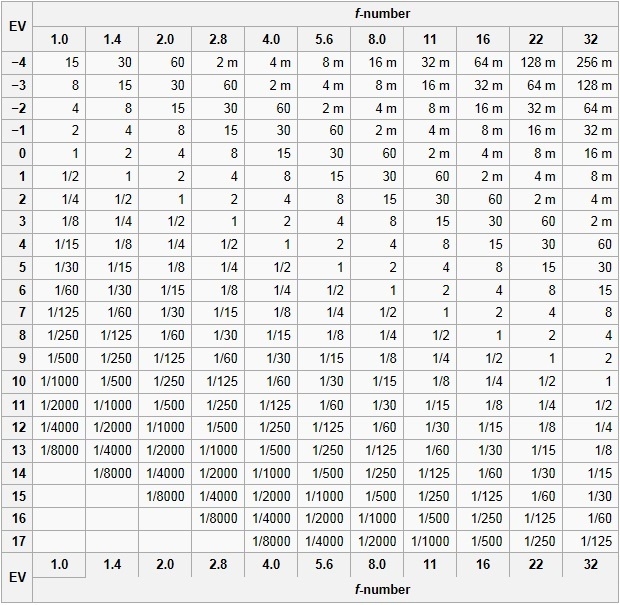
Table 1: EV Reference Table
To repeat: EV is a reference number, it does not indicate how much light is available. The reference becomes specific when you are considering a particular ISO. For example the EV12 pairs might be used when photographing "areas in open shade, clear sunlight" at ISO100. Written using conventional notation as follows: When photographing areas in open shade and clear sunlight use EV10012. You would get the same results in open shade and clear sunlight by using EV40014.
EV at ISO100 has become an ANSI Standard / industry benchmark and many times you will see an EV reference for a specific lighting situation. For example: "in this light I recommend to use EV12", what is implied is that you could use EV10012 or any equivalent exposure & ISO pairing.
Contrast Ratio
Contrast ratio is the difference between two sources of lighting. A convenient way to establish and talk about the contrast ratio is by using EV. Take a look back at Table 1... If the difference between the two light sources is 1 EV (the ISO does not matter), then the light is doubled or halved and the contrast ratio is 2:1
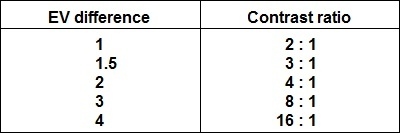
A contrast ratio of 10:3 is the same as 3.333***:1 which implies a delta of 1.74 EV (21.74=3.333***). So all we have to do is insure that the difference between the two light sources is 1.74 EV (the ISO does not matter). Fortunately a flash meter can provide the measurement that we need. If you are using fixed lights then a standard light meter will do the job...
Setting up the lights...
For my test I used two x Nikon SB-28 electronic flash units in manual mode and a Sekonic L-758D light (flash) meter in incident measurement mode. I used the light meter to trigger flash units via a synchro cord. The camera was set to manual mode. Here's how I did the test...
1) One flash behind the camera, ceiling high, thru an umbrella and the second flash behind the platform bounced off the background.
2) Turn off the background flash, point the meter toward the main flash and take a measurement
3) Store the result in memory and select the "Delta EV" function on the Sekonic L-758D
4) Turn off the main flash, activate the second flash, point the meter toward the background and take a measurement
5) Continue to press the measurement button and read the Delta EV value indicated on the meter
6) Adjust one or both of the flash units (increase or decrease the power ratio) until the Delta EV is approximately equal to 1.74
7) Point the meter toward the camera lens with both flash units active and get an exposure setting to use as a starting point. Connect the flash units the camera and take a test shot
Remember that for the most part changing the shutter speed only effects the ratio between ambient light and flash... use the f-stop to adjust the overall exposure. The 10:3 ratio is not set in stone ;-)
Okay, so here is the result...
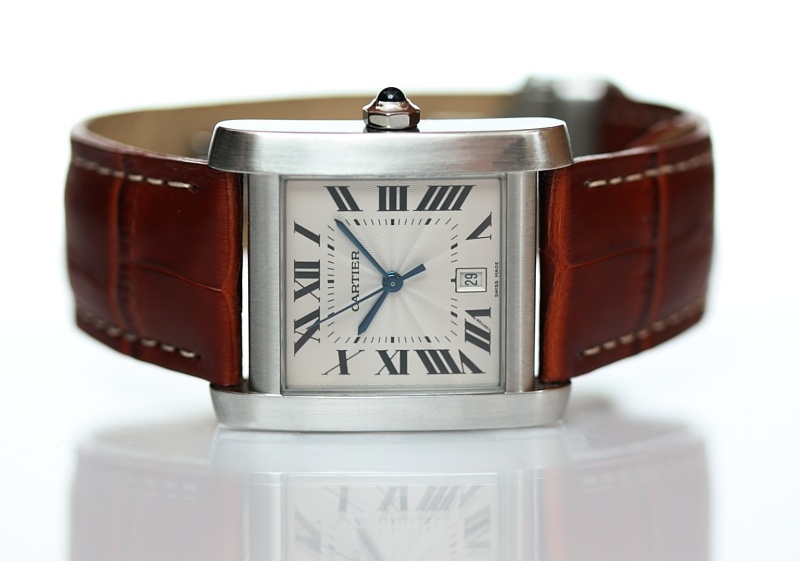
Cartier Tank Française Yearling
Conclusion: Every tiny scratch in the plexiglass will show up... if you're going to do this, pick up a new one and take care not to scratch it. The purpose of this studio setup is to have a floating object against a seamless background, so don't give up your light tent ;-). Adjusting the lighting to get the 10:3 ratio is very quick and painless... something that is potentially useful to know how to do. Spend half a day testing this setup and you will definitely increase your knowledge about lighting with flash.
Thanks for reading,
Casey
Studio arrangement - Part II

Casey, truthfully...
John, thanks for your input as always...
Casey, never to disparage your great skill...
artistic intent and technique...

All I know is ...
Thanks Echi...

Any reason to use this highly complicated setup over 10 minutes of Photoshop? ...
Because ROI is not the only game in town ???