Comments:


A Different Viewpoint
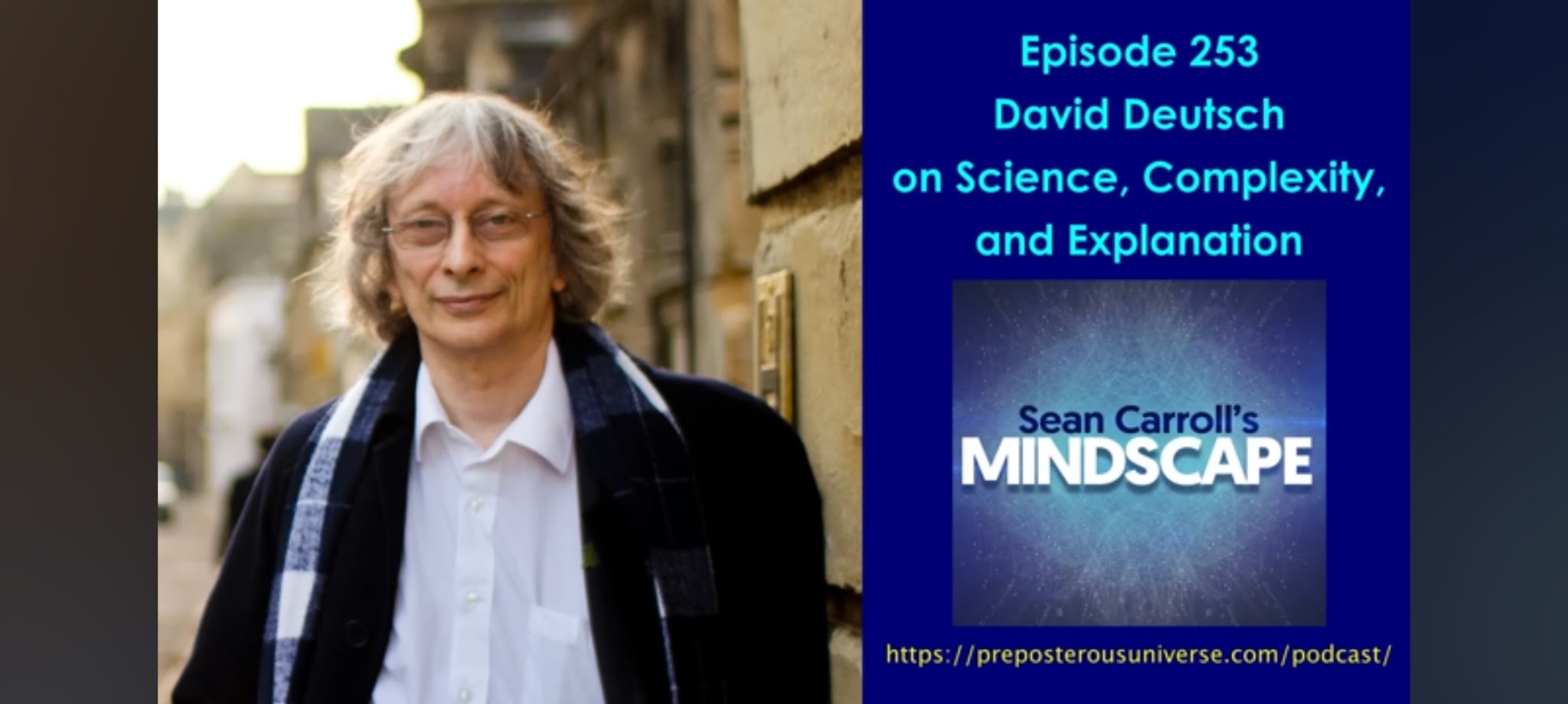
For the science geeks here, I just wanted to share this relatively recent interview with Dr. David Deutsch on the Mindscape podcast with Dr. Sean Carroll. I've listened to it three times over the past few months........
Believe it or not…
just two days ago, my friend and I got into a bit of a heated discussion about physics (yes, I know that may be a very odd topic for casual conversation)…and it wasn’t the first time, although I had never previously engaged so vehemently as I did this time. I won’t bore you with the specifics, but this podcast comes at an interesting time. I haven’t finished it all yet, but I am sharing it with my friend who will certainly appreciate the podcast guest and topic.
Deutsch....
Is a wonderfully oddball physicist whose beliefs and work are as against-the-grain relative to contemporary academia as it gets. He believes neither general relativity nor quantum mechanics to be sufficiently accurate theories of the universe. It's going to be fun, to say the least, to bear witness as to how it all pans out at some point in the future....
Then he’s my guy and I’m going to really enjoy listening to the rest of the podcast👌🏽
Thank you for sharing this.
I may be wrong...
But don't most physicists believe that neither quantum nor relativity to be able to explain the universe? Hence the search for the grand unified theory?
In any case, thank you for pointing me to the source of my commute listening for the next few weeks!
In any case, thank you for pointing me to the source of my commute listening for the next few weeks!
I couldn't conceivably substantively speak....
of the prevailing opinions of professional physicists, but my take on your question is that most working physicists adhere to those two theories in and of themselves (for the extraordinary effectiveness of what they can explain), but are of course looking at how best to unify them - the purported grand theory. However, Deutsch here doesn't even adhere to those two theories individually, much less in unison. His evident professional objective is to find substantially new alternatives to both general relativity, and contemporary quantum mechanics (his insistence on basing 'his' QM on the Heisenberg interpretation due to its locality, and building from there). Personally, I am not a professional physicist, so I don't have objections to either the Schrodinger version of quantum mechanics, or to Heisenberg's, whether the universe splits into multiples upon an observation event solely locally, or to the 'edge' of space (another theoretical concept altogether) is simply a fascinating concept to ponder........ thanks for looking and commenting, much enjoyment listening to the Mindscape podcast! Filip
Thank you for sharing!
Listening to this podcast made me revisit some topics that I haven't thought about in years.
It seems to me that the major points Prof Deutsch makes all boil down to - Bayesian priors, credencies as he calls them, are actually conditional on a pre determined set of outcomes but the true possible set of outcomes is not really known or knownable. So the input probabilities are conditional and not absolute. That also creates a self affirmation paradox.
He does admit that the paradigm Bayesian statistics provides applies very well in practice for certain types of problems but he is highly uncomfortable with the applications to major physics theories.
I understand his criticism from the point of view of logic, but I think it leads down a rabbit hole as his proposed alternatives (consistency as opposed to probability based) lack clarity or conviction as it became very obvious throughout the conversation.
For me the only takeout, and frankly not a very profound one, is that one has to be aware of the "infinite variance" challenge in certain types of problems.
What rubs me the wrong way is that Prof Deutsch seems to like being contrarian for the sake of it. It is extremely easy to find flaws with pretty much everything in life, infinitely harder to provide alternatives.
For example recently he posted the following on Twitter :
In an irrational education system, those who can best game the exams come out on top. Those who are actually competent can make it too but not as well.
In an irrational electoral system, those who can game it come out on top, and those who are competent do something else.
The statement is extreme and obviously ridiculous. What are the meanings of "irrational" or "competent" here? Yes - we all know that there are plenty of brilliant minds who dropped out of high school or college. Yes, there are people who are very good at passing tests but lack creativity. Education systems don't work for 100% of people. But implying that if you succeeded academically, that somehow makes you less competent ?? He is falling exactly into the same trap he tried to set up for others (the banker and feminist example).
The underlying theme in Deutsch's thinking seems to be that we have to blow up everything apart to accommodate corner cases and avoid inconsistencies. Yet, based on what I have seen, his attempts to provide answers as to what should come afterwards are so weak that it is hard for me to take him too seriously.
It seems to me that the major points Prof Deutsch makes all boil down to - Bayesian priors, credencies as he calls them, are actually conditional on a pre determined set of outcomes but the true possible set of outcomes is not really known or knownable. So the input probabilities are conditional and not absolute. That also creates a self affirmation paradox.
He does admit that the paradigm Bayesian statistics provides applies very well in practice for certain types of problems but he is highly uncomfortable with the applications to major physics theories.
I understand his criticism from the point of view of logic, but I think it leads down a rabbit hole as his proposed alternatives (consistency as opposed to probability based) lack clarity or conviction as it became very obvious throughout the conversation.
For me the only takeout, and frankly not a very profound one, is that one has to be aware of the "infinite variance" challenge in certain types of problems.
What rubs me the wrong way is that Prof Deutsch seems to like being contrarian for the sake of it. It is extremely easy to find flaws with pretty much everything in life, infinitely harder to provide alternatives.
For example recently he posted the following on Twitter :
In an irrational education system, those who can best game the exams come out on top. Those who are actually competent can make it too but not as well.
In an irrational electoral system, those who can game it come out on top, and those who are competent do something else.
The statement is extreme and obviously ridiculous. What are the meanings of "irrational" or "competent" here? Yes - we all know that there are plenty of brilliant minds who dropped out of high school or college. Yes, there are people who are very good at passing tests but lack creativity. Education systems don't work for 100% of people. But implying that if you succeeded academically, that somehow makes you less competent ?? He is falling exactly into the same trap he tried to set up for others (the banker and feminist example).
The underlying theme in Deutsch's thinking seems to be that we have to blow up everything apart to accommodate corner cases and avoid inconsistencies. Yet, based on what I have seen, his attempts to provide answers as to what should come afterwards are so weak that it is hard for me to take him too seriously.
I have to say....
I totally agree with your observations. I wasn't aware of his comments on Twitter as I don't use or generally view the platform. Personally, I am on the side of Dr. Carroll's views and opinions, that's why I diligently listened to the vast majority of his interviews, and why he makes an excellent host to listen to even when a contrarian like professor Deutsch engages him in a debate. The most curious and perplexing proposition Deutsch espouses is the one he elaborates on somewhat in the last twenty minutes of the conversation - the field theory where they are allowed to remain continuous, but fail to commute.... I will make sure to read his upcoming book in order to see what that entails when fully elaborated on, my own knowledge isn't up to snuff for me to innately discern this from a fairly casual talk like this one.... Thanks for looking and chiming in! Cheers, Filip