
PP Caliber 240 – a thin base movement … (Good or bad?)
… born in 1977 (!) and still one of the center pieces/workhorses in the current collection.
Good or bad?
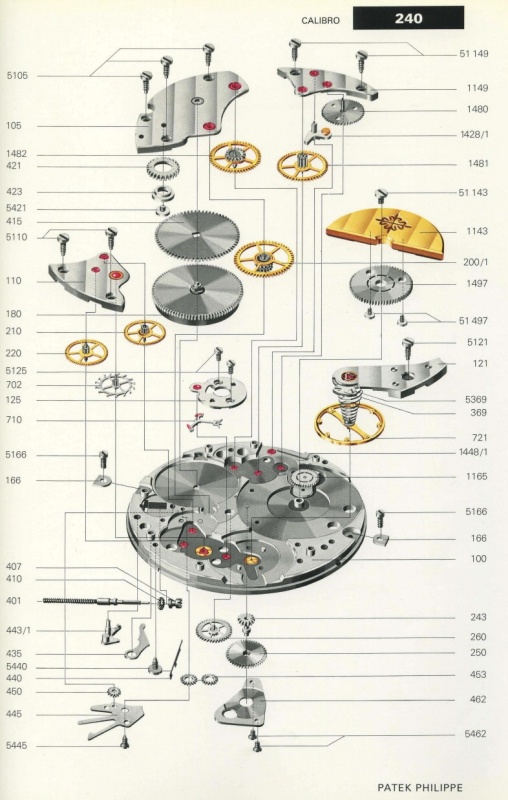
Some thoughts:
- Reliability? Proofed.
- Beautiful in the (classical) quality of workmanship and finish? Proofed.
- A good base for adding complications, which are still looking “thin” afterwards? Proofed.
- A good base for testing innovations? Proofed.
From time to time we have discussions that some are not
happy with the small size (for today)
or that it is used in so many different watches
– in different price ranges.
Variations of the caliber 240 which are available in the current collection:
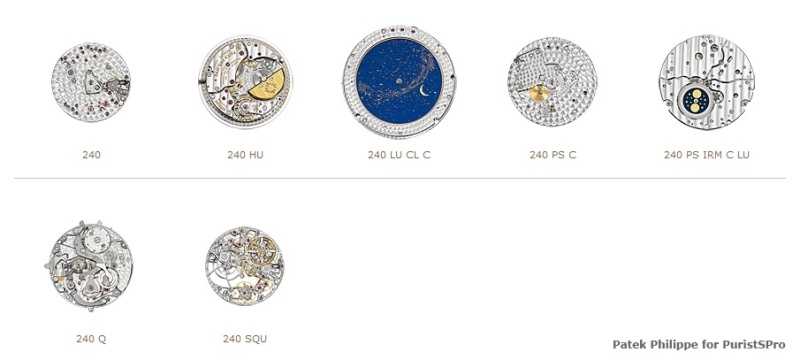
Examples:
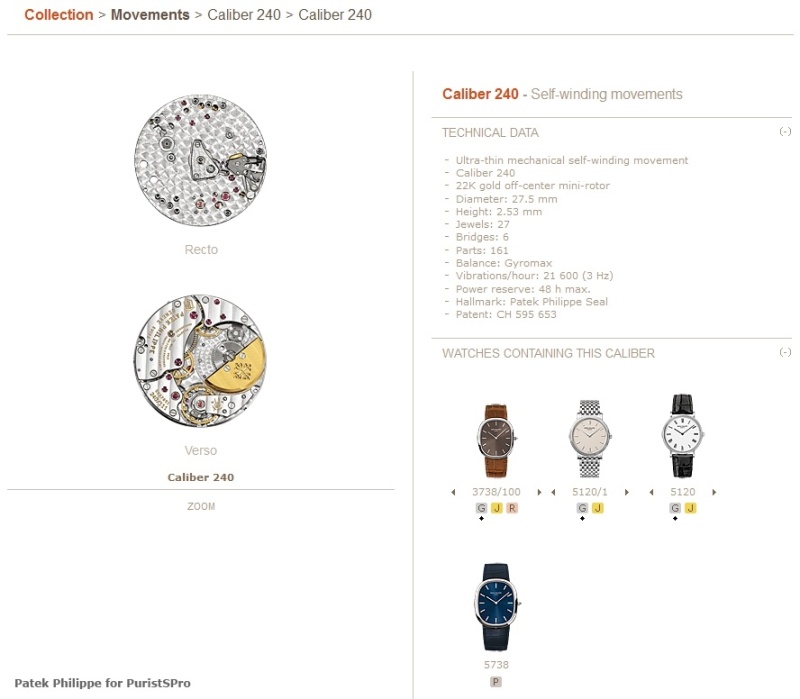
The “simplest” version may be small for today (at least for
some), but the younger/bigger brother caliber
260 is already
“tangible” and could be a very nice successor. Could this be
the future?
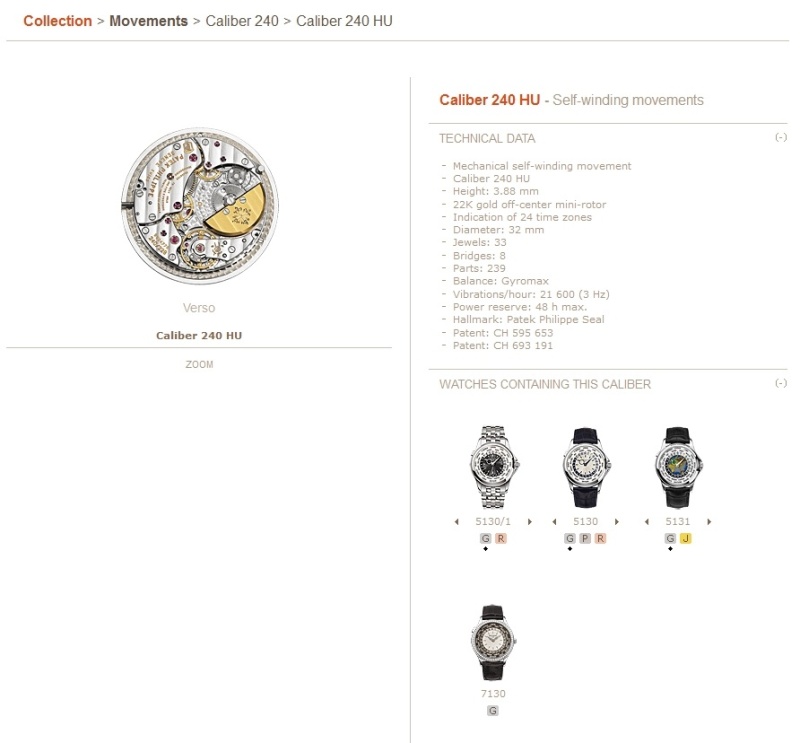
HU=Heure universelle; one of the most charming complications in the collection and a love affair for so many PuristS.
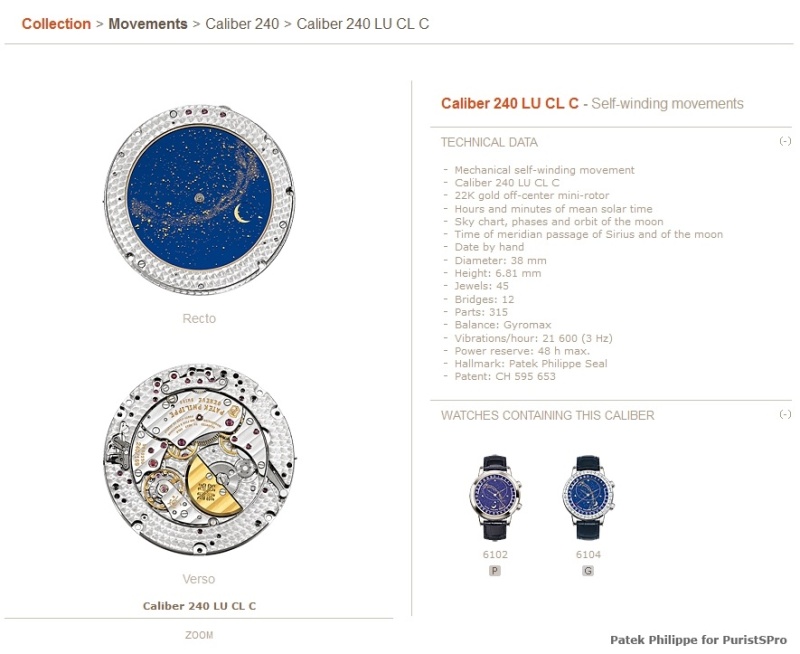
LU CL C=Phase de lune Ciel Calendar; pure romance and a feast for the eyes.
On top the watch is wearable with a 42mm case, isn´t it?
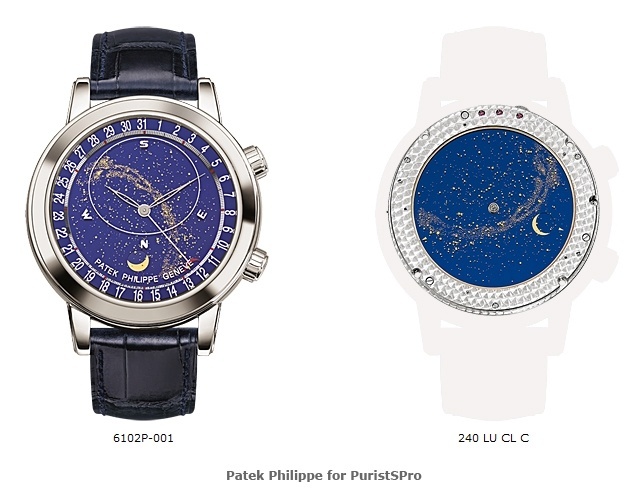
Does the complete movement look tiny or small? No, not at all.
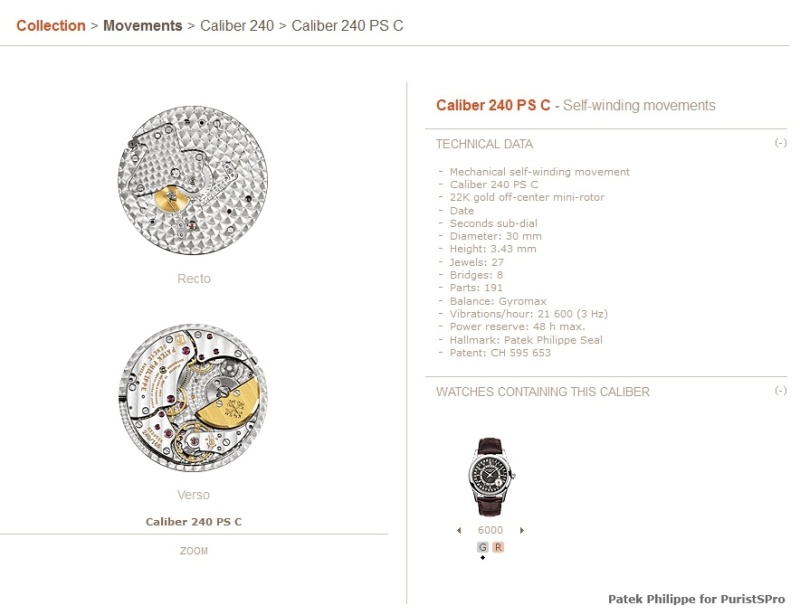
PS C=Petite seconde Calender; an useful and affordable complication in the world of Patek Philippe.
Nothing more, nothing less.
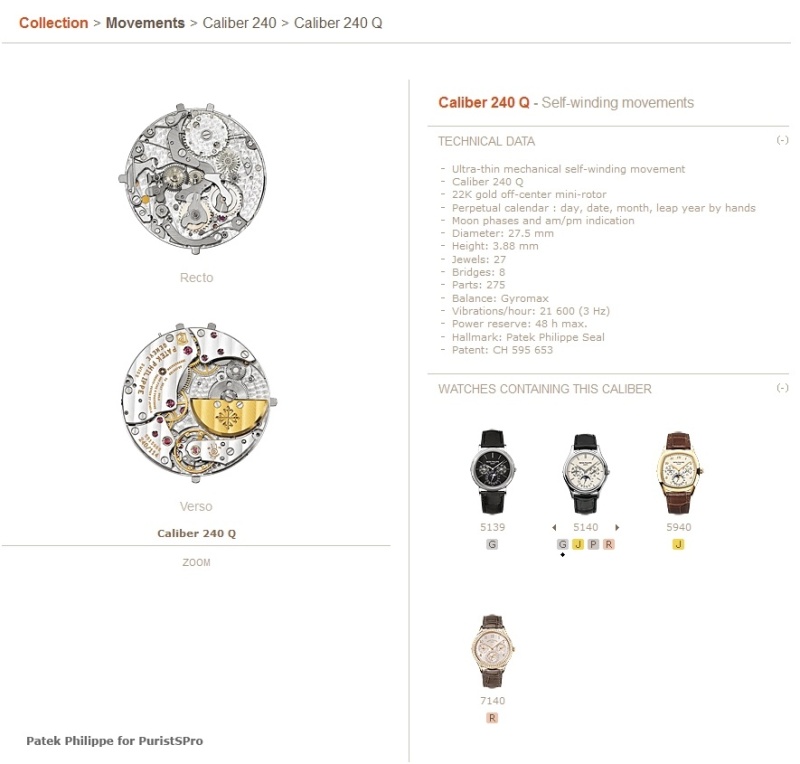
Q=Quantieme perpetuelle; probably the most addictive
complication for a lot of Patek Philippe collectors,
which is (somehow!)
affordable for a “wider” target group. To reach a total height of 3.88mm
(movement including
perpetual calendar module), 2.4mm for the base movement
doesn´t hurt. Therefore the caliber 240 was actually
“born” and therefore it
still works perfect, doesn´t it?
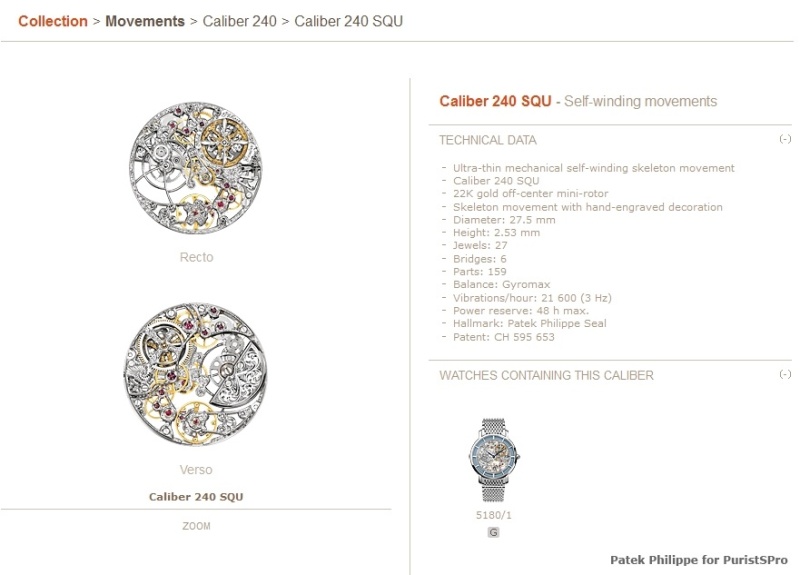
SQU=Skeletonized; a very special version which asks for exceptional skills and a sophisticated taste.
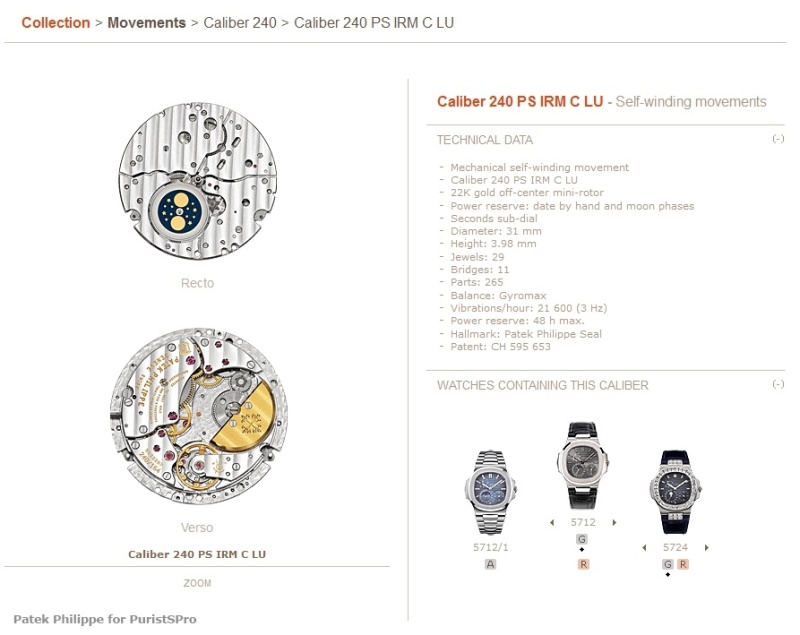
I guess not, as so many of you love that movement in that watch. But I could imagine something based on the
caliber 260 in the Nautilus collection ...

Personal conclusion:
Even after so many years I still see a (strong) future in
the Patek Philippe collection, especially when “bigger” complications
have
to be added or for some very classical watches. But I also mentioned before
that I hope to see more watches with the
new caliber 260. Is it really a
successor or could it be even better as a new brother, a new member in the
family?
So, now it is up to you. Good or bad?
Looking forward to your thoughts!
Oliver

I have no problem with the Cal 240 or the latest version, the 260.
It is what I consider to be a great movement.
Now, what I am not pleased with is to see the same movement ( or almost ) on a simple Calatrava AND in a watch like the Celestial.
Ir is not a question of size, well, not mainly, it is just the perception I have of a brand like Patek, which claims for excellence.
It is ok for a Panerai, or a Rolex, not for Patek.
Ok, they can use ( a bit ) the modular conception ( QP or WT or Moonphase ) but in a 200 000 Eruos watch, I am expecting something else.
Something more coherent with the Patek Status...
My 2 JLC cents.
Nicolas
Why am I not surprised ...
Celestial - what in specific are you missing in that case or does it just have to be the latest and fanciest kid on the block?
Oliver
It is rather simple.
Why I didn't get, and won't get a Langematik Pepetual?
Because it houses the same Cal than the Langematik Anniversary, with a module.
Why won't I get a patek QP? For the same reason: I already own a 5110P, so the same Cal 240 with a different module.
Why will I not get a Celestial ( if I ever could? )
Because I don't get why such an horological brand such as Patek dare housing the same Cal for such a prestigious watch ( with a different module ) than the watches above mentionned.
For brands such as Patek or Lange, which are horological brands, I want one movement for one watch, one different movement for each watch I am considering.
After all, this is my personal definition of a luxury brand, and my platinum rule.
Or I missed something about the luxury and excellence side of Patek " products "...
Which is highly possible...

Best,
Nicolas.
This message has been edited by amanico on 2013-02-26 14:20:42

I beg to differ Nico...
Sorry for not having been clear enough...
I have no problem with the Cal 240 as a base for a QP.
I agree that it is a fine offer from Patek.
BUT I can't have two Patek watches sharing the same calibre, the noly difference being the module. ( WT, and QP ).
I already have the WT, so I can't, due to my platinum rule, go for the QP.
And even less for the Celestial, for the same reason, to be clear.
Best,
Nicolas

Rules rules rules.... I thought they were made to be broken?!
I would not blame anyone for breaking the rules...
I would not have any clients, hence no funds for my watch projects.
I have on problem to own several Rolex using the same calibre ( or almost ).
I make a big difference between Rolex and Patek, though.
In terms of complications, finishings, most of all.
There are only two brands with which I have such a severe rule: Patek, and Lange.
For example, as I owned, and will own a Langematik Anniversary, I passed on a watch I love a lot: The Langematik Perpetual, because it shares the same movment ( + module ) than the Anniversary.
Patek claims its excellence. On a 200 K Euros watch, I am a bit disappointed to see that it has, basically, the same movement than on a simple Calatrava.
I expected more than that from Patek.
And don't get me wrong, I am totally in lve with the case and the dial of the Celestial, which is one of the most poetic watch of the market, but also one of the most pragmatic, with its calibre borrowed ( or shared, as you want ) from ( or with ) simpler and much more affordable watches.
I may miss something, but isn't Patek synonym of Luxury?
Isn't a 200 K Euros watch synonym of Luxury?
Pragmatism and economics don't work with Luxury, from my point of view.
Luxury... A word which shouldn't be bandied about, as well as .... Excellence.
Best,
Nicolas.
Nicolas i'm going to have to unleash my lawyer...
);) Don't use the word " Horse " here in France, please. Or you may eat it. ;) [nt]
hahahaha.... Actually horse meat is one of the best!

As I disagree to some extent, I may explain
You know that I disagree with you on that point, but not totally.
No it is not the Swiss tradition to have a specific calibre for each watch. It is purely a Lange thing AFAIK and it makes sense on a marketing side, but not on a technical or industrial side. One calibre per reference means many many references to develop, make reliable,.... meaning more expensive watches in the end, for no technical result.
I could have agreed on a requirement for a better finished version of the same base calibre. But that's not part of the Swiss tradition either (even if there are counter examples in the past like the same base calibres used by JLC and VC in the 40s and 50s with different bridge designs and finishes, but even this didn't last to this day, when AP and VC for instance case JLC automatic calibres produced, finished and assembled by JLC exactly like JLC finishes its calibres for its JLC watches, with just different engraving and rotor).
And the finish is linked to the design of the bridge too. You could for instance imagine better angling on an upscale calibre 240, to attain a finish level comparable to what they do on their minute repeater calibres, but they didn't make that choice (they could have done). For me they clearly have three kinds of finishes today. A simpler one, in the rounded Genevan style of bridge design for the 215, 315, 240 and automatic chrono, a slightly better finish for the manual wind chrono (5170, 5270 and 5204), and a top finish for the ultra thin split seconds chrono, tourbillon and/or minute repeater calibres, more comparable to what the top independants do.
Maybe the Celestial is the one watch that is crossing borders....
Then would have they created that watch it if they had had to develop a specific base calibre for only this one?
Best
Dje
Interesting...

Goo'day to you Dje. I read with great interest anything you write...
I'm not writing about calibre 920, 1120, 2120
The calibre I mention is the one based on the JLC 889/899, a calibre that was never used by Patek Philippe.
Regarding calibre 920, it was never used in a JLC watch, so no possible comparison.
best
Dje
And by the way...
Hi,
Yes I've had in the last 20 years many calibres 1120 and 2120 in hand, be they in AP RO Jumbo, RO perpetual skeleton, Jules Audemars simple watch or EOT PC, or older watches, or in many VCs like Saltarello, Mercator, Audubon, perpetual calendars, especially the skeleton ones. It is clearly a gorgeous calibre, with a finish, IMVHO opinion somewhere betwwen the simpler PP models and the higher end ones.
Best
Dje
Ok then Dje, then you agree that part of your statement was....
I should have precised that it was about calibre 889/899, but as JLC never used cal 920...nt

I see we make a similar statement
I hear you, Jerome.
Even Lange doesn't develop one movement per watch, if you take the example of the Langematik movement, which you find in the simple " Langematik " as well as in the Wempe LE ( Power Reserve indicator ) and in the Langematik Perpetual ( QP module ).
But I find that it is more intresting, when you collect watches from brands like Patek or Lange, to have watches with different movements.
Back to the Celestial, I know that it is a bit irrealistic, in terms of economics, to develop a movement for a specific watch and for it only, but:
1/ Didn't Patek do it with some of their watches? For Example, the movement of the 5100: Was this movement used in another watch? AFAIK, not.
2/ If they did so for a watch which was retailed under 30 000 Euros, they could do the same for a watch which was around 160 000 Euros several years ago.
3/ Why not going for a better finishing of a same movement, for such an expensive watch, as is the Celestial?
A 200 00 K Euros watch which is considered a crossing borders by its own brand... I was on to spit my 5 o' clok tea on my keyboard!
Best, my friend. It is always a pleasure to read you.
Nicolas.
Yes and no
Hi Nicolas,
sorry for your tea!
The reference 5100 had a specific calibre, but was limited at 3000 pieces if I remember well, so not a small series. That was probably enough to develop and justify a specific calibre (that was eventually possibly partially re-used for the square tourbillon). I doubt that they will make that many celestial watches, but who knows?
Regarding going for a better finish of the same calibre, yes that's an idea that appealed me quite often, but again that's not something Swiss watchmakers do, with very rare exceptions. Yes they could have made one exception here, but they did not! The question is: is it hard to sell as it is?
Best
Dje

I think you need to try it?
As I said before:
I hear your argument, but I don't agree. The difference between the most complicated Patek Automatic Minute Repeater and the least expensive Minute Repeater is MANY hundreds of thousands of dollars. The fact that they both employ the same R 27 Base Movement doesn't increase the value of the less complicated watch nor does it diminish the more expensive one? They are what they are ... and they ARE beautiful! Similarly, that the 6102P has the same base movement as less expensive Patek watches doesn't make the Celestial any less unique and fascinating in appearance. Indeed, if anything repair/maintenance should be more palatable? Look, ... I get it. The Patek Celestial is such a massive deviation from the look of a traditional Patek watch I understand totally why it is difficult to appreciate what makes it special. Trust me on this one. The 240 movement is absolutely NOT a problem
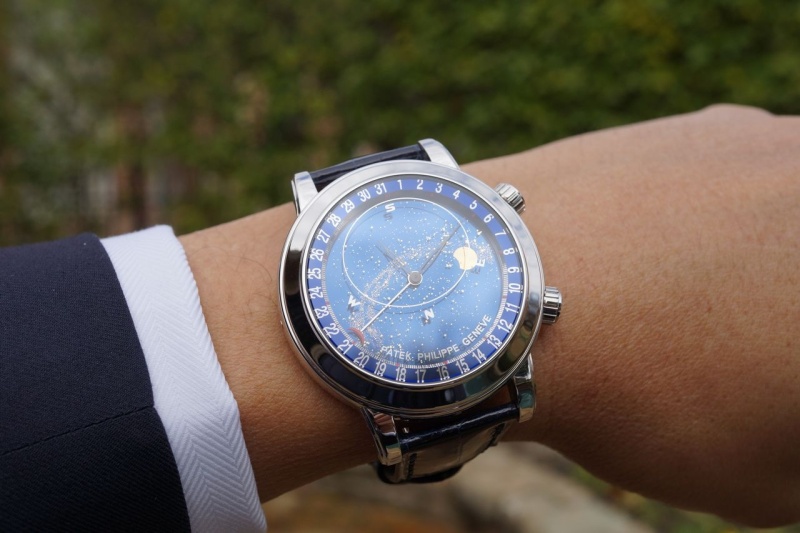

I trust you.
I have a love affair with 240

240 Caliber started my love for Patek Philippe

Universal Geneve was using the first micro rotor...
... if I am not wrong.
Best
Moritz
Learned something new!
Many thanks for that Oliver!
These are the tidbits a watch fan is craving for.
Best
Moritz