Comments:

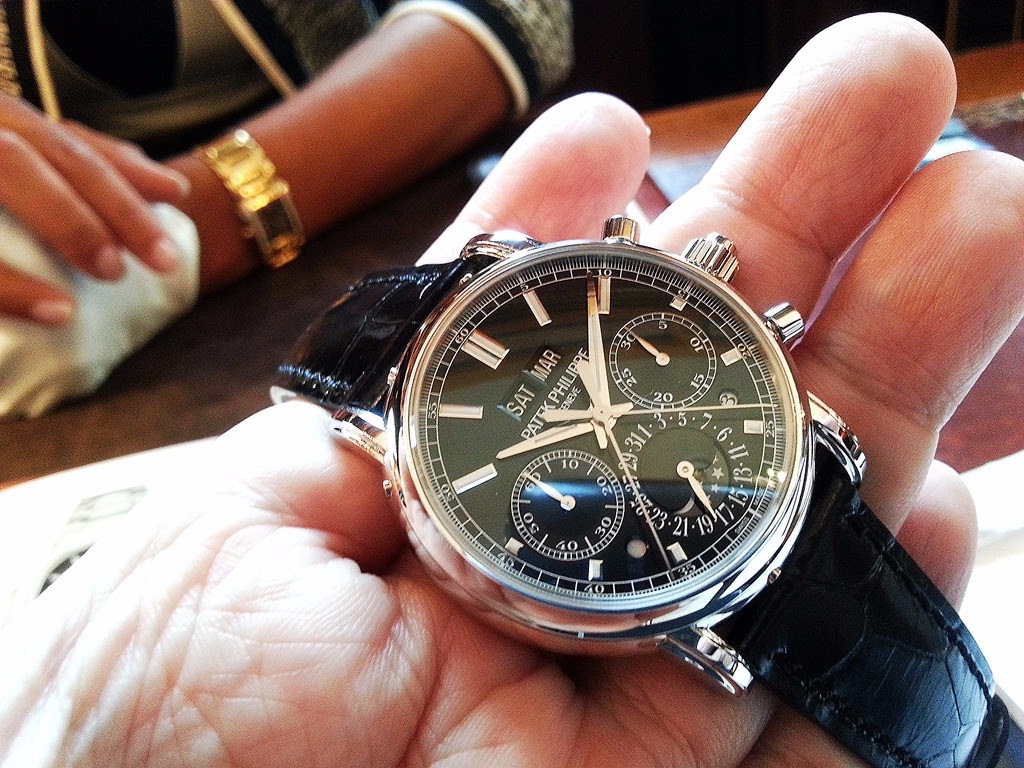
Please explain to me about Patek Chronographs
I started collecting watches about 4 years ago back in early 2013 where I bought my first serious watch is an Omega Planet Ocean ( before that was Tissots and Casio ). Then I caught the Rolex bug, bought and flipped a few and subsequently the AP bug. I am more into sports watch and buy watches based more on their external appeal more than anything which may explain why my collection is dominated by AP ( I have 6 of them out of 9 ). I do have a Patek which is my 5205R that I love. My latest haute horology timepiece acquisition is the Duometre Chronograph in WG that has a ( to me ) fascinating movement.
I now have this dream of collecting a Patek super-timepiece, something of much more prestige and substance, or put it this way, horological significance. I have in mind the Split Second 5370P or the Perpetual Calendar Rattrapante 5204P. Probably going to take few years of savings due to immense price barrier and not even sure if Patek will sell me one.
But here's the question, because I want to know what I am getting into
1) Why are manual chronographs much more well regarded and revered ( and cost more ) by the WIS community than automatic chronographs? Sure the movement is nicer to look at but are they much more difficult to make? And is it not the the former is just the latter without the rotor?
2) Why are split-second chronographs costing 2 to 3 times more than normal manual chronographs? Sure a split second is very cool but are they much more difficult to make? Or the pricing is more a reflection about it's exclusivity?
3) Is there a reason why most manual chronographs can only time until 30 mins? Tradition? Or a technical limitation?
Thanks in advance.
Rgds
Ben
Here's a picture of the 5204P I saw when I visited the Patek Salon Geneva back in 2014

Thanks for the questions...
As someone who's fairly new to this hobby, I have often asked myself these exact questions. So count me as someone who is also extremely interested in these answers. Cheers Ben!

Great questions, ben!
I look forward to reading the answers. 
Marcelo
And I think that a manual winding Chrono & Perpetual Patek is the epitome of high watchmaking.
Best!
Marcelo


Let me attempt to answer some...
1. The general idea of a manual being more revered for WIS is due to not having the rotor obstruct the view of the movement. With an automatic, you'd typically have a fullsize rotor that coveres up half the view most of the time - and rotors themselves are usually not a star attraction of a movement visually. Furthermore, the rotor itself would require bridges to support - which further hides any components underneath.
With a high-end manual wind chronograph, you have none of that blocking the view. You are able to clearly see all the components individually and how they even function through the caseback, as you activate the chronograph. All these components have to be visually elegant in design and finished to a high degree to give the appeal, so they are usually expensive to produce. Typically you'd see lots of anglage, straight grained steel surfaces, some black polished parts like the column wheel, and some elegant curved detent springs.
On a related note, bear in mind there are also two general categories of chronographs. Horizontal clutch, and vertical clutch. To put it simply, high-end manual winds chronos are typically of the horizontal clutch variety - the parts are laid spread out across the movement which gives it more visual impact. The Lange Datograph, Patek 5170/5070/5370/5204/..., Speedmaster Moonwatch with 1861/1863 movements etc. are all horizontal clutch. Meanwhile, a vertical clutch has most components stacked - you guessed it, vertically. This has less parts visible through the caseback. Examples are the Omega 9300, current production Rolex Daytonas, Grand Seiko chronograph, Patek 5960. Usually, since these movements already don't have much mechanisms visible, these are equipped with automatic rotors to make them more practical to use (couple that with the technical advantages of a vertical clutch vs horizontal - but I digress).
2. Both honestly. A quick history off the top of my head recalls that split seconds/rattrapantes used to be categorised as a "Grand Complication" - they are not easy to manufacture due to the finer than normal tolerances involved than what was already complex a standard chronograph (which were mostly horizontal clutch back then. I only recall Seiko or Frederic Piguet movement that did vert clutch during those days). It was only until Habring came about when he designed a simplified rattrapante while at IWC that they became much more accessible to the general public.
However, to construct a traditionally designed split seconds chronograph today is still not much simpler, and still a technical marvel. At this point since its more of a matter of prestige, they are constructed usually over horizontal clutch chronographs because there is so much mechanical visual appeal. Also, since the layout of the components of a horizontal clutch chrono are spread over the movement flat, it is easier to simply construct the rattrapante module on top of existing chronograph like a tower (see 5370 or Lange Double Split versus 5170 or Datograph). Here is an example gif animation that shows how similar a rattrapante is basically built upon a standard chronograph as a base https://i.imgur.com/4od8Rkq.gif

I'm no watchmaker, but if I had to guess why its so much more difficult to do is that first, you know have to deal with an extra shaft going through the centre of the watch, so there are four hands on the centre of the watch (hour, minute, chrono seconds, rattrapante seconds). The thinnest shaft running through the centre, the rattrapante seconds, I heard are as thin as a human hair. The extra module of a rattrapante when activated, imposes extra load onto the mainspring which means the base movement requires enough torque to power it (otherwise, the usable power reserve I imagine is significantly shortened). All this requires quite abit of adjustment to make them work right I reckon. Also, usually a rattrapante would also be activated by a column wheel - that means two total in a typical high-end rattrapante.
3. Probably an hour subdial is not included to prevent too much clutter on the dial. Most people usually would not use the chronograph to time things beyond an hour in practice...However, of course there are some popular chronographs that have hour subdials such as the Speedmasters (both the 1861/1863, and the newer 9300 models)
Technically for most chronographs, the chronograph seconds has a little finger on it that "flips" the chronograph minute counter by one space forward when it finish revolving across 60 seconds. To have the chronograph minutes having a finger to do the same to a chronograph hours counter would impose quite alot of load onto the mainspring. So instead, most chronographs with hour counters just directly couple the chronograph hour counter to the mainspring barrel. It constantly slips - since the mainspring barrel turns so slowly - but when the chronograph is not in use there is a lever which holds down the chronograph counter stationary so it points to 0 hours. When you activate the chronograph, the lever releases and the hour counter starts rotating slowly together with the mainspring barrel.
Regards,
skyeriding

Thanks Ben for the question, and skyeriding for this reply. Saturday morning learning :) [nt]
No message body

What a great answer. Very informative and educational. Thank you. [nt]
No message body

Very good post, as always
From my understanding "Grand Complication " is a marketing concept and not watchmakers lingo.

Thank you so much
for your very detailed reply. Chronographs are indeed fascinating and I learned so much from your write-up. Really appreciate it. Now I can appreciate what makes Patek chronographs, and indeed split-second chronographs so special. Thanks again.
BTW, is there any website that I can read up on more detailed inner workings of chronographs?
BTW, is there any website that I can read up on more detailed inner workings of chronographs?
Thanks benlee,
I'll shamelessly link a chronograph article I've written awhile back, click here.
Regards,
skyeriding

education, education and once more education
To answer the questions fully in depth would need a perpetual calendar to measure the time for it.
Therefore some quick answers:
- a manual chrono is traditional as it started as a manual pocket watches long, long time ago, 1816.
- an auto chrono was very difficult to build and Zenith was the first in the 1969 to make one, hence El Primo name,
- a split second is even more difficult to realise and a speciality of a manufacturer.
- a chronograph runs for the whole pr time. The display can be 1 minute - 7 days (Omega).
- prices? That is something that is not connected to the pieces that we discuss here.
Hope the answers are not too harsh, but detailed answers are in books, articles, here in the forum ...
Best
Moritz

Great question. For me it is because.
In my mind I love simple Chronographs as well as complications. So for me a chronograph should just be that. A simple Chrono function and nothing more. With Automatic movements being a relatively new creation manual wind watches are the traditional Patek Philippe. I can't explain it properly but there is something really magical about winding a manual Patek Philippe Chronograph it makes me feel like I'm helping it come to life in a way just wearing a watch doesn't. Without me it would stop. Romantic I know but true. As already said you can't compare the aesthetics of a manual over Auto just so beautiful. Can't really comment on split second because they are not for me but appreciate why they send lots crazy.
Hope my poor attempt helps you.
M
Hope my poor attempt helps you.
M

These are questions many have
I'll just add a few remarks to what was previously said.
There is much more complexity than we think in mechanical watches.
Putting more complications in smaller volumes is an achievement, the more you include parts, the more they have to work together and thinner they are. Hence, watchmakers have to develop parts in order to remain reliable while keeping the movement accurate.
Hence, a Split-Second chronograph is much more than adding another number of parts and hands. Furthermore, this complication has to work while creating as less frictions as possible to preserve timekeeping. That's why the 5959 Split-Second is even more expensive (the diameter of the watch is 33mm). www.watchprosite.com
It is not only about crafting some pieces but also the ability and experience of a watchmaker to tune and finish the parts in order to craft the movement the right way. There are not so many watchmakers able to care of such complications as there are not many watchmakers able to create a movement from a blank paper.
Finding the right people and having the right experience to ensure the movement works well (timekeeping, reliability) is not something found everywhere.
Of course, there is a part of the price increase that is explained by the volumes sold and by the place it has in the brand's collection. But that's depending on the market and the field we are talking about (especially when luxury is concerned).
About the Manual Chronograph. A movement has to be rigid to resist the barrel's torque or to preserve the small space between the parts (shocks etc...). The easiest way to achieve that goal is to have a single plate on both sides. The more you add different bridges, the more you have space, the more it is a challenge to make the caliber able to achieve this goal.
The more it is open, higher is the number of parts you can see. Hence, the number of parts you have to decorate and finish. Furthermore, you can see the activation of the mechanism when pushing the pushers which is something very nice too.
This is not the kind of decoration you have in Automatic wound movement and it wouldn't be as nice as the rotor hides a part of the movement. However, there are very interesting automatic chronograph movements like the 28-520, in very beautiful watches (like the 5960 for instance), more practical and they surely deserve attention.
This is why it is important to discover and understand watches but also determine what we really like.
About the 30-minute, it is indeed more a traditional standard today. As brands like Patek Philippe also have a long history and that we are talking about traditional and classical watches (and art) the choices of decoration are different than just considering the practical side.
The 5204 is a gorgeous watch indeed (I reviewed the R version here www.watchprosite.com
).
You can use our Search function and you'll be able to find many articles about the questions you may have.
Enjoy it!
Best, Mark
Dear Mark,
Thanks for your response. Yours and the other replies in this thread let me appreciate the inner workings of the chronographs and why they are such master piece.
I do have one more question though. How do you compare the inner workings of the Patek Lemania based movements ( 5070/ 5970/ 5004s and earlier ) with the more recent in-house Patek chronographs like 5170/5270/5204s ? Which is a better movement?
I do have one more question though. How do you compare the inner workings of the Patek Lemania based movements ( 5070/ 5970/ 5004s and earlier ) with the more recent in-house Patek chronographs like 5170/5270/5204s ? Which is a better movement?
I think they both have their appeal
It is another question people like to debate quite much as well.
I made a sort of comparison between the 5070 and the 5170, there is a little part on the two calibers: www.watchprosite.com
In fact, my opinion would be there is no 1st and 2nd as they appeal for different reasons.
On the finishing level, they are around the same. The 29-535's finishing is excellent, at the level of the 27-70. The latter has a few finished inner angles while the 29-535 doesn't but this is not the main element to consider and many high-end calibers don't have inner angles either. For instance, I prefer the design of the 29-535's bridges better, but that's a matter of taste.
On the technical level, the new 29-535 is better. It has been designed by the brand's watchmakers from a blank paper (not many brands are able to do this, especially the way Patek Philipe did), taking into account many clever and often simple improvements. It is a fantastic movement.
The 27-70 has this little old charm and historical origin that makes it an important caliber from for the brand and in watch making in general. It is specific to a certain era of the brand (1986 in the 3970 to 2010 for the 5970).
I would say, if you consider getting such complication, that both choices are excellent.
Best, Mark
Thank you Ben and to those who provided their perspectives...
Extremely informative and a very enjoyable read. It has me rushing out to become even more educated on the subject.
Obrigado!!
Tavio
Obrigado!!
Tavio

5204p
I'm curious. The 5204p you saw at the Geneva Salon, was it for sale? As you mentioned in your post that you aren't sure if Patek would even sell it to you?
It's just a specimen piece
In Patek Geneva Salon, one can preview all timepiece in the current Patek catalog. That's how I got to try the 5204P. That visit was an unforgettable experience.