
Ornatus-Mundi
[Zenith]
7136

The Foudroyante
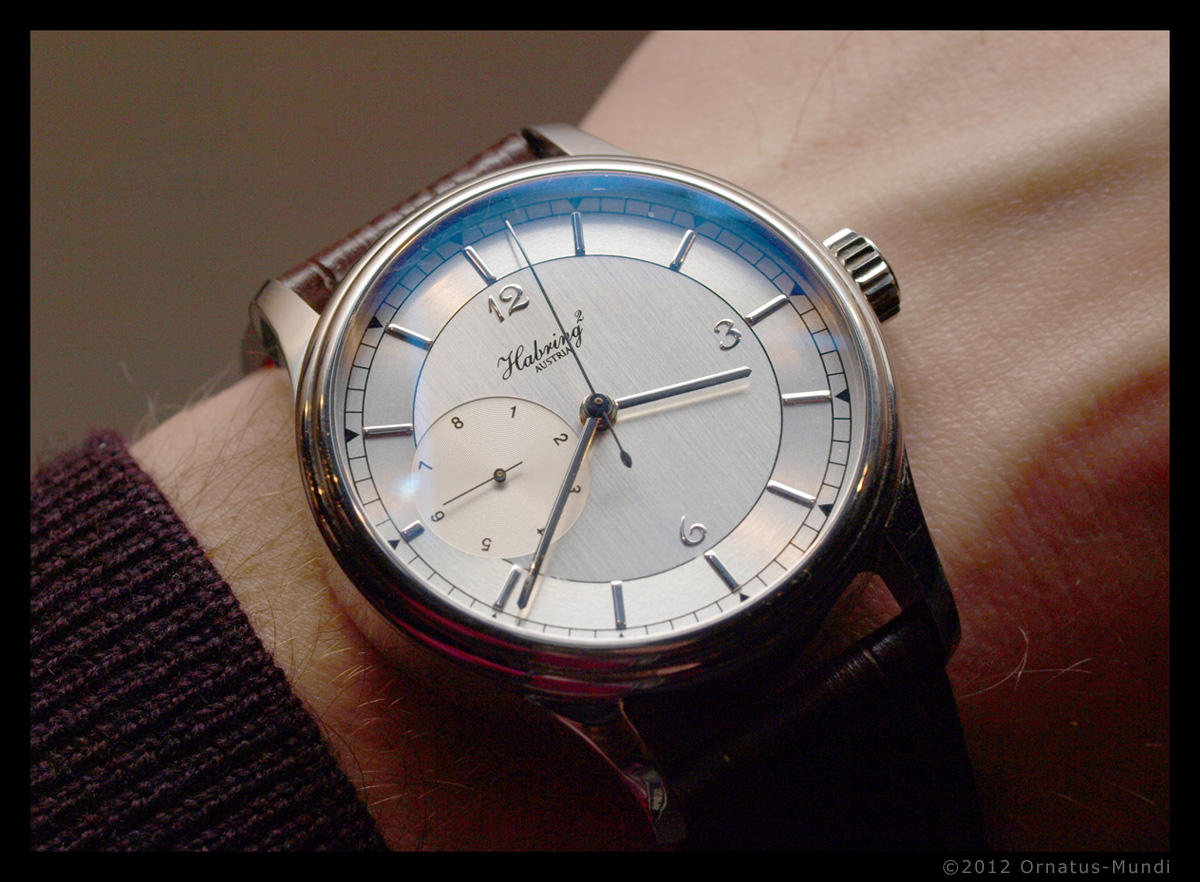
As one of the rarest complications at all, the Foudroyante à la Habring2 is additionally unique in that it is an addition to a Chronograph mechanism (e.g. Girard-Perregaux), but it is added as a stand-alone complication (well, together with the jumping seconds, of course!). Thus, with a Habring2 Foudroyante one acquires a timepiece with two fast jumping time indications (Foudroyante & Jumping Seconds):


What is so mesmerising with a Foudroyante is not only the optical appeal of this complication, based upon the speed and precision (of the jumping hands, if implemented well ;-)), but also the care and precision needed to actually realise such a watch.
As one can anticipate, Habring2's implementation is simple and straightforward. One the escapement wheel's pinion a large Foudroyante wheel is mounted that interacts with a second, small Foudroyante wheel. On top of the latter's pinion we find the Foudroyante hand. One main difference compared to other Foudroyante constructions is the lack of a separate spring barrel to drive the hand!
The primary challenge of the Foudroyante is thus that it is driven from the same mainspring barrel than the going train. This implies that the necessary energy needs to be considered for the overall energy balance of the movement.
What Habring2 managed to accomplish is nothing short of amazing: Surely, the energy drain from the mainspring barrel is higher and the torque as well (due to the fact that the Foudroyante mechanisms interacts with the escapement wheel). Thus, also the balance's amplitude is lower but still within the specifications of the ETA Valgranges base movement!
How is that possible? Well, the reason is that the functional components of the mechanisms are nearly weightless!
I'd like to highlight three separate issues to illustrate how it is achieved. First, we look at the Foudroyante hand: Note how tiny it is compared to the balance wheel:

It is quite obvious that specific production techniques are needed to produce such a watch. In this case, the hands are stamped into extremely thin aluminum sheets and subsequently cut out with scissors:


Second, the large Foudroyante hand merits a closer view:

With patience and care Richard puts together wheel and bearing:

To illustrate how tiny and lightweight the wheel is I asked Richard to tell me the weight of the wheel. His answer: "Sorry, we don't have a balance that would be sensitive enough... but its so light it swims on water!" - which he gladly proved to me:

Mounting the bearing on the wheel requires patience, a steady hand and good eyes:


Fixing it:

(Almost) Finished:

Only the axis needs some polishing:

The third part is the small Foudroyante wheel. Its also of minuscule dimensions:

Like the Foudroyante hand, it comes as a sheet of galvanised aluminum:


Polishing of the hole:

Now the components of the mechanism are finished and can be assembled:

The results is a watch that certainly demonstrates watchmaking aptitude in an unusual implementation. Like my neighbour said: "Its a watch that really mirrors my very hectic life!"


A Carinthian Journey - a visit with Maria Kristina and Richard Habring (Part 3b - LAST!)
Dear All: our Carinthian Journey is close to its end. But we will do so with a real treat on some of the most exciting watches created in Völkermarkt. Thus, following Part 1 (location and environment), Part 2 (watchmaking itself, restoration) and Part 3a ...
The Crown-Operation-System (COS) Chronograph
One of the iconic Habring 2 watches, and one of those that really convey the message of the producers. By modifying the Valjoux base movement such that the pushers could be omitted (Chronograph is entirely controlled by the crown), the watch gains eleganc...

i really like the simplicity of the COS without subdials
you do of course lose out on a constant second hand, but you can always use the chrono a la MIH. thanks for all the detailed info Magnus. Graham
The Doppel 2.0
I wrote about this new edition of the legendary split-second mechanism already recently . However, I now have real-life image material and thus decided to repost an amended version of my original text. The IWC Doppelchronograph is one of the iconic classi...

It might sound
too technical but to me its pure poetry and seeing this innovative work landing again at the lap of the creator leaves a wide smile on my face... let alone the seduction of the design, color combination and sure the complication... did i forget to say pri...
The Foudroyante
As one of the rarest complications at all, the Foudroyante à la Habring 2 is additionally unique in that it is an addition to a Chronograph mechanism (e.g. Girard-Perregaux), but it is added as a stand-alone complication (well, together with the jumping s...
The Tourbillons
The last part of this post shall deal with the 'crown of (watchmaking) creation ', the Tourbillon . With Habring 2 , you have the choice of two entirely different versions: On the left you see the traditional Tourbillon with a centrally mounted balance, o...
Some final words!
I think I can spare me a final conclusion or appraisal. I am sure this series of articles shed some light into one of the most likeable contemporary watchmakers. The products speak a clear conceptual language (with in part a bit derivative design, but thi...

Thank you very much indeed, Magnus...
Due entirely to your insightful series, the Habrings now have another customer. Cheers, pplater.

A good choice...
...from a watchmaker with a special connection to the complication. Can't wait to see pix of it on your wrist! Cheers, Daos
Magnificent work, Magnus!
I feel very lucky to have you as a colleague here on PPro, and believe we both have a real connection to the work the Habrings are doing. I really admire where they seem to be heading with their brand. Thanks for all the wonderful insights and photos. It'...
Wonderful report, Magnus!
I have one of those gorgeous brown dials "in the oven" for my wife. It will be our second Habring2 (not that she knows yet ) It won't be our last...

Great visit and insights..
.. Into a young and great watch brand. And as is seems, some great people as well Best Hans

what an oustanding report!
My sincerest thanks Magnus for this wonderful report. It is almost as if we were with you in visting Habring2 at Voelkermarkt. The write up was so personal and at the same time very informative and detailed. I must say that i am seriously tempted by the H...

Super posts Magnus.
Actually, I was expecting a lot this part and I wasn't disappointed. Glad to see "real" pictures of the Doppel. Thanks for this comprehensive view on Maria Kristina and Richard Habring's work. Fx

Informative post.
... I like what they make and actually own one, nice jumping second with my choice of colors in 37mm case. I just wish they make 37mm Doppel 2.0 in 37mm case again in the future. Watches including chronos used to be in 36 or smaller case and why can't the...


Thank you for this marvelous report, Magnus!
What a masterful combination of visual, technical, and emotional content! I learned a great deal about the movements and got a much better sense of the makers. The Habrings are fortunate to have a friend like you who takes the considerable time needed to ...

Excellent report Magnus.............
Thank you. I have learnt so much from your brilliant collection of essays and photos. They look such a perfect couple and their watches are first class. Regards Tony

This series of posts, is one that I will bookmark for continual future reference
Thank you Magnus for the entire series. The quality of your writing and photography is wonderful. But even more so, thank you to Maria and Richard for letting you and us into their lives. I like my jump seconds immensely. I will like it even more now that...
Thanks again!
This series of Introduction to the Habrings is fabulous! Their Doppelgraph 2.0 is just stunning and indeed great value for money for such a high quality complication!
Thanks Magnus.....
What a wonderful series of reports on a wonderful independent. The Habrings have carved out quite a niche within the watchmaking world - I live virtually every timepiece they put out. Darren
Many thanks
Hi Magnus, Many thanks for the reports, especially the techie details (just what the doctor ordered in this world of marketing fluff ). I hope Richard and Maria realise what a great ambassador they have in you. Could they use some of your images on their ...
A terrific series of posts--thank you!
Richard and Maria are wonderful people producing wonderful watches. I am happy to be a patron of their business, and frankly, would buy another of their watches in a heart-beat dead-second if they had another case design option! If I may, there is one thi...