
Bruno.M1
4823

The long-term price divergence of the rolex submariner date (1995–2040): inflation vs market value growth ( and watches in general)
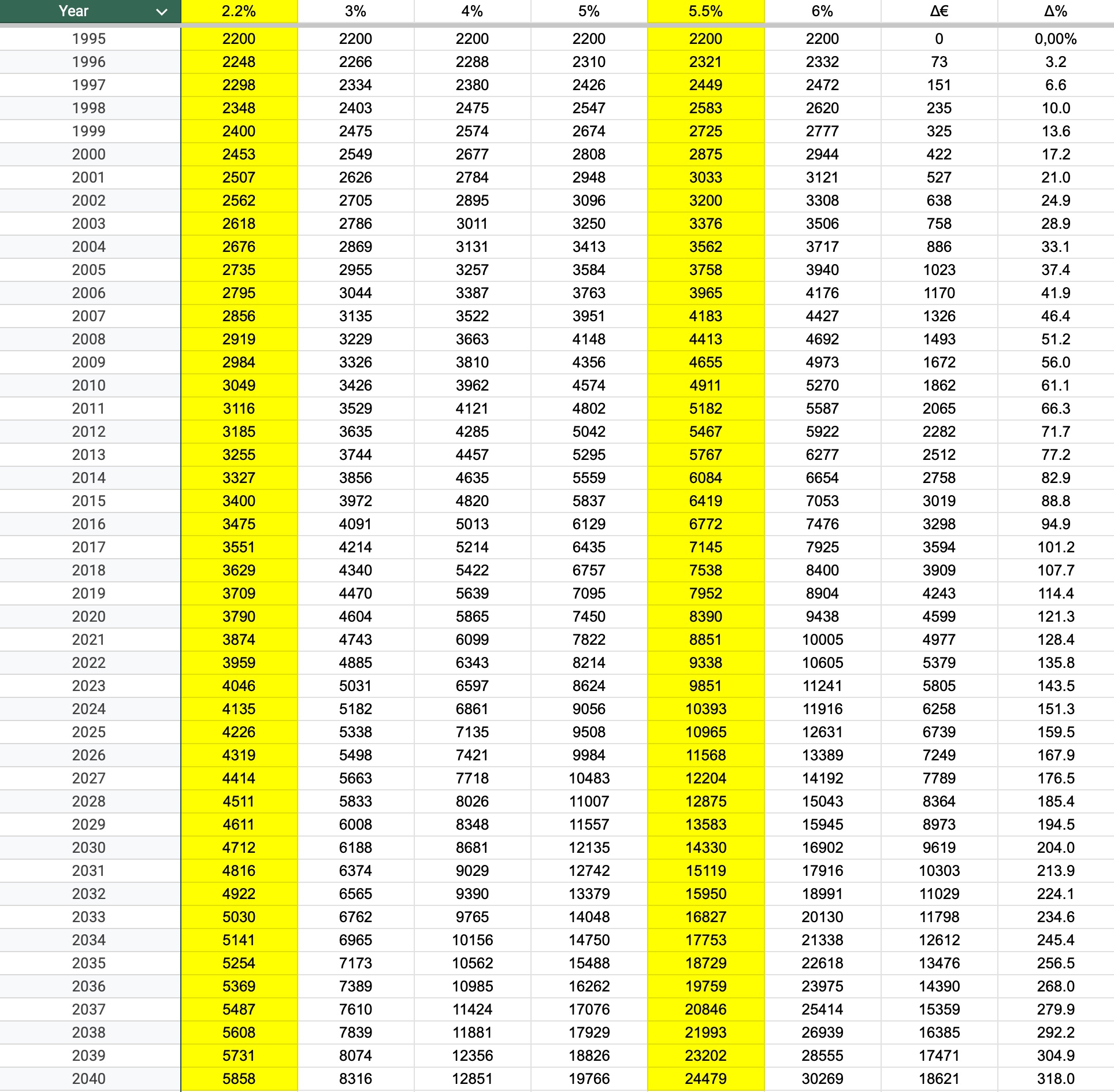
This chart shows the price evolution of a steel Rolex Submariner Date since 1995. I chose 1995 because that’s when I bought my first 16610. I still remember the price very well, it was €2200 at the time.
Of course, that is converted into euros, because in 1995 we didn’t yet have the euro. But let’s assume that the price you paid back then in Belgian francs, French francs, Dutch guilders, Italian lire, German marks, or whatever currency you used, corresponds to roughly €2200.
The left yellow column represents average inflation in Europe and the United States. Not exact year by year, but over a 30 year period the average increase across all those years. There are spikes such as during the Covid period, but also lower or negative periods such as the 2008 financial crisis. Overall the average in the US is slightly above 2.2 percent, while in Europe it is slightly lower, but 2.2 percent is a good overall average.
Now let’s look at today, 2026. The Rolex Date costs around €11500 today, in Belgium I believe it is about €11200, which matches very well with the other yellow column showing that a Rolex has increased on average by about 5.5 percent per year.
Again this is an average. In some years the increase is lower, in other years there are stronger price increases or even multiple increases per year. But if you compare the original 1995 price with today’s price, you arrive at an average annual rise of about 5.5 percent over the past 30 years.
The last two columns show how many euros the price has increased above what it would have been if it had simply followed inflation. The final column expresses this difference in percentage, meaning how much more expensive the Submariner Date has become compared to normal inflation.
And in essence it is still the same watch. Yes, over the years it evolved from aluminium bezels to ceramic ones, and the middle links of the bracelet used to be hollow while today they are solid, but that really does not fundamentally change the product. It feels like a normal evolution that should not necessarily justify a massive price increase, certainly not to this extent.
What I genuinely wonder is how long this strong divergence can continue. The gap keeps increasing every year, and at some point it must become too expensive.
Do you think that in 2040 you would be willing to pay 25000 euros for a steel Submariner Date? Because that will likely be the price.
Honestly, I used the Submariner as an example because it is probably the most well-known watch, and most collectors have likely owned one at some point. But of course, this is not just a Rolex issue. Other brands have increased just as much, if not more.
Years ago, you could still buy some independent watchmakers at relatively reasonable prices. Today, I fear those have become even more extreme. They are still making beautiful pieces, but for something simple and well finished, they now ask 50 to 100K without hesitation.
Do you see this trend stopping anywhere in the future, or will we have to accept that we are being priced out of the market?
Or do you think that where we used to be able to buy, for example, three nice watches in one year, we will now and especially in the future have to accept that with the same comparable budget we can only afford one piece?
The long-term price divergence of the rolex submariner date (1995–2040): inflation vs market value growth ( and watches in general)

can't agree more to every point you've mentioned !
and BTW ... Its only luxury watches


Darn UNstable Currency is the problem.

+1


