Kong
[Moderator]
7855

SIHH 2011: Panerai Novelties
WORKSHOP OF IDEAS
The history of Officine Panerai tells of a long journey of research and technical knowledge in the service of man and his achievements. Panerai has been prominent for its accuracy and innovation since the end of the second half of the 19th century, when the founder Giovanni Panerai and his family ran the Orologeria watch making shop which still exists today in the centre of Florence. During the 20th century, and in particular in the years from the 1930s to the 1950s, watches and precision instruments supplied to the Italian Navy permanently defined the identity of Panerai watches, a strongly distinctive identity which arises directly from the functions for which they were intended.
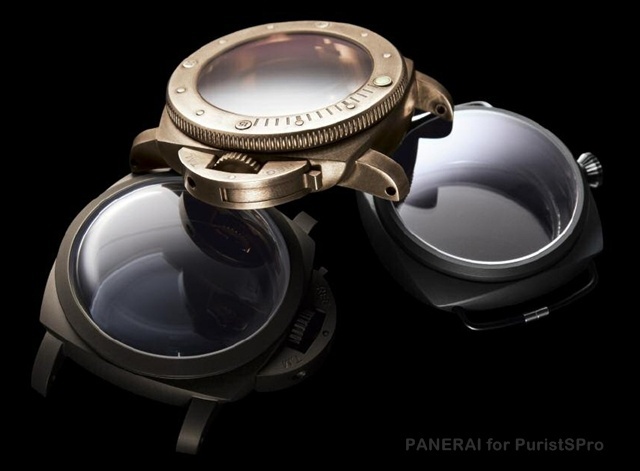
The authenticity of a Panerai watch is expressed in faithfulness to the history of the brand and in the search for innovation in the form of technical excellence. The collection presented at SIHH 2011 combines these two elements in an original way and the result is a series of watches which bring together the most recent developments in relation to movements and materials technology, and forms and functions which are derived directly from Panerai’s historic heritage.
THE CASES
In the 1930s and 1940s, the names Radiomir and Luminor identified the luminous materials used by Panerai to increase the night-time and underwater legibility of the watches designed for the commandos of the Italian Navy. Over the years, these two terms have come to identify the two different case shapes of the iconic watches of the brand, one of which is a development of the other.
The Luminor case came into being in the late 1940s as a result of the need to increase the strength and water-resistance of the classic cushion case which today is identified by the name Radiomir. This development saw the application of an exclusive Panerai patented device: the bridge with clamping lever which protects the winding crown and makes it more water-resistant. At the same time, the large, straight lugs, milled with the case from a single block of metal and therefore much stronger, replaced the wire strap attachments, welded in place, which were characteristic of the earlier models.
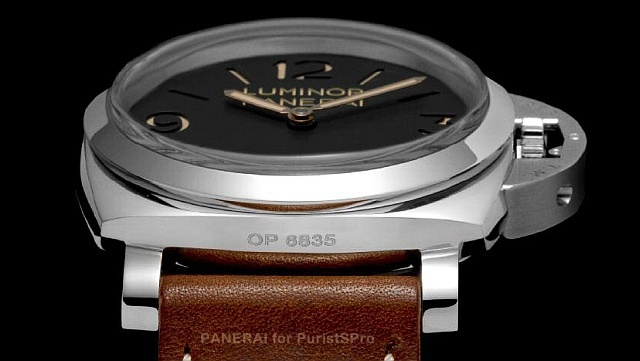
The new Luminor 1950 3 Days – 47 mmoffers for the first time a historic case which marks a transitional phase: while having the characteristic Luminor features, the new case has a rounded, cusp-shaped caseband, which was evidently derived from the cushion form of the Radiomir case. Other small details mark the faithful relationship of the new model to a few extremely rare historic examples: the slimmer lugs, the engraving of the reference details between the lugs, the Plexiglas® crystal instead of a sapphire one and the wide, flat back with the words “Officine Panerai” engraved upon it.
THE DIALS
A Panerai watch dial is immediately recognisable both by its simple, minimalist appearance and by its sandwich construction. Both these characteristics originated from the historic function of Panerai watches, arising from the need to guarantee the commandos the maximum visibility and legibility even under conditions where the light was poor.
The sandwich construction is an evolution to the normal structure where the luminous material is placed in incisions engraved in the dial. With it, the dial is formed of two superimposed discs attached to each other. A generous quantity of the luminous material is placed on the lower disc and its radiance emerges through openings in the upper one, which correspond to the hour markers and figures. In this way the legibility of all the elements is at its maximum and the dial acquires an unusual intensity.
The classic appearance of the Panerai dial consists of a simple alternation of large linear hour markers and figures at all or some of the cardinal points. Existing examples of watches of the period show that there were several dial variants, but their features in common are simplicity and the absence of decorative elements. Many models carried neither the Panerai brand name nor the terms Radiomir, Luminor or Marina Militare: as instruments covered by military secrecy, Panerai watches had to remain anonymous in case they were captured by the enemy.
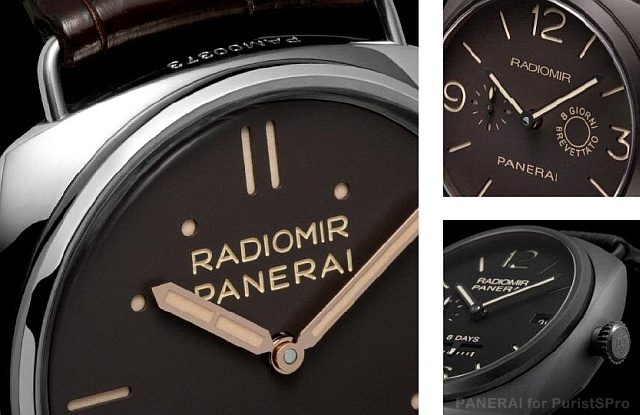
The new Radiomir 3 Days Platino – 47 mmpresents for the first time a rare, mysterious dial of which only two examples are known. Appearing at the end of the 1930s, these had a unique, original design consisting of an alternation of bar-shaped hour markers – double ones at 12 o’clock and single ones at 3, 6 and 9 o’clock – and dot markers. The origin of this dial is not easy to identify.
According to some historians, the two surviving examples were possibly test samples, which were not followed up until the re-edition of today.
THE MATERIALS
The choice of materials, particularly those used in making the cases, is one of the areas in which the ability of a brand to innovate can be most strongly expressed.
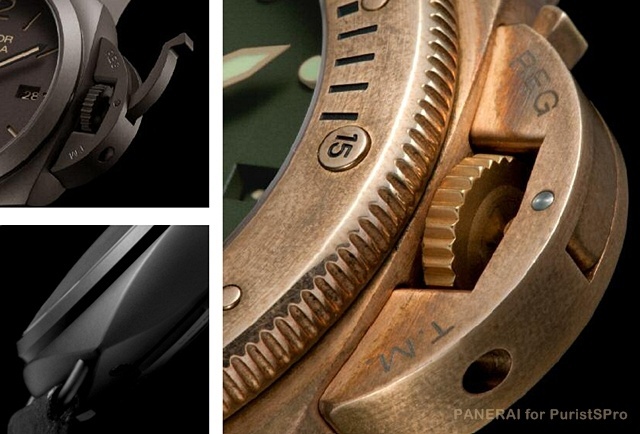
New in 2011 in terms of materials is the introduction of bronze, a material which immediately evokes the world of the sea with which Officine Panerai is historically associated. The new Luminor Submersible 1950 3 Days Automatic Bronzo – 47 mm has a case made of CuSn8 bronze, an alloy of copper and tin in the pure state which, as well as being resistant to the corrosive action of sea water and atmospheric agents, has a high structural strength and an appearance which completely preserves the warm shades of the original while acquiring the aged appearance which is a feature of this material. With the passage of time bronze forms a patina which is the result of its reaction to external agents (air, humidity, heat and wear); this does not alter the properties of the material but is rather a sign of its ageing, making each example unique and personalised.
At SIHH 2011, Officine Panerai is also presenting Panerai Composite, a special synthetic ceramic, produced by a process of aluminium ceramisation, which is remarkable for its lightness, ductility, hardness and strength. The cases of the new Luminor Composite Marina 1950 3 Days Automatic - 44mm and the Luminor Composite 1950 3 Days - 47mm are all made of Panerai Composite.
The new Radiomir 8 Days Ceramica – 45 mm has a case of zirconium oxide, a synthetic ceramic made by applying isostatic pressing process to the material in powered form. This material has a particularly consistent, even appearance as well as providing the characteristics of hardness and resistance to scratches, corrosive agents and high temperatures which have made ceramic one of the materials of choice in the world of haute horlogerie.
THE MOVEMENTS
The creation of a complete new range of movements, entirely developed and created internally, is one of the areas where Officine Panerai has stood out since the opening of the Neuchâtel manufacture in 2002. Naturally a history of innovation and technical development must be fed by a continuous commitment to research and development and in a few years Officine Panerai has created a collection of calibres which are notable for their strong aesthetic and functional identity, in keeping with the codes of the brand.
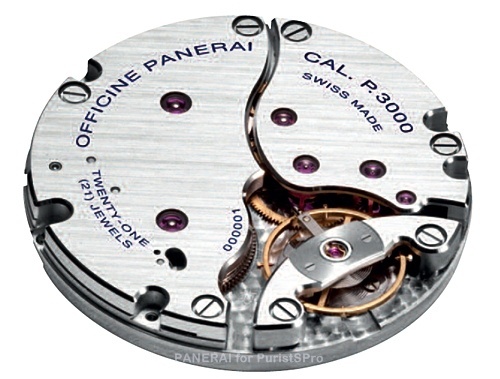
On the occasion of SIHH 2011, Officine Panerai is adding the new P.3000 movement to its collection. This is a hand-wound mechanical calibre with a power reserve of three days, distinguished by its two spring barrels, its 13,2 mm balance wheel, its solid structure with large bridges and its exceptional size (16½ lignes in diameter, 5.3 mm thick), reproducing a classic size of period Panerai models.
--------------------------------------------------------------------------------
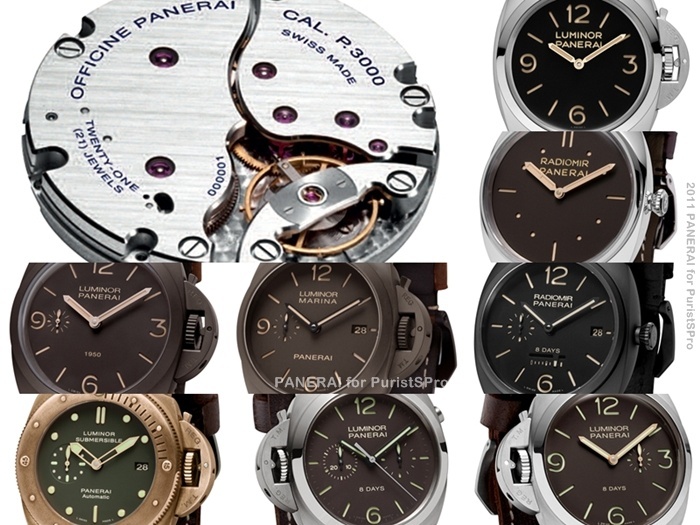
Please find the 8 models of the 2011 Novelties and the new Calibre P.3000 after this main post.
This message has been edited by AnthonyTsai on 2011-01-22 08:52:49

Manufacture
Panerai partners with "O'Clock - time design, design time" exhibition at CAFA Art Museum, Beijing, exploring time and design.
0 replies939 views

New Release
Explore Officine Panerai's SIHH 2012 collection: new Luminor and Radiomir models, ceramic innovations, tourbillons, and historical re-editions. Discover key references.
57 replies94470 views

Review
Anthony Tsai reviews the Panerai PAM305 Luminor 1950 Submersible. Discover its 47mm titanium case, unique dial, and Paneristi appeal.
50 replies56196 views

Review
Pifpaf's in-depth, passionate review of the Panerai PAM382 "Bronzo" (Gonzo). Discover why this bronze watch challenges traditional luxury and ages with its owner.
24 replies13100 views

Reference Guide
Explore Jaeger-LeCoultre's diving watch history, from the rare Memovox Deep Sea Alarm to the iconic Polaris. An in-depth guide on JLC's dive watch legacy.
111 replies82413 views

Vintage
Explore the Panerai Radiomir 3646, a true piece of history. Amanico shares insights on its Rolex origins, sandwich dial, and unique vintage appeal. Discover why this reference is crucial to Panerai's heritage.
30 replies5219 views
SIHH 2011: Panerai Novelties
WORKSHOP OF IDEAS The history of Officine Panerai tells of a long journey of research and technical knowledge in the service of man and his achievements. Panerai has been prominent for its accuracy and innovation since the end of the second half of the 19...
SIHH 2011: Panerai PAM00372 LUMINOR 1950 3 DAYS - 47 MM
In the 1930s and 1940s the names Radiomir and Luminor identified the luminous materials used by Officine Panerai to increase the night-time and underwater visibility of the dials of the watches designed for the commandos of the Italian Navy. Over the year...

now it's for Real.!!
THIS Model has been a Dream for many Panerai Lovers.!! GLAD it's a Regular Production , so everyone will have a Chance to Own it. Kong. thanks for the Infos..Cheers. Tony


Finally i can obtain my very 1ST Luminor!
Everything about this particular model is perfect, the size, the material, the colour of the dial ( always preferred my Pams to be black dialed over brown), Plexiglass and yet have a water resistance of 100 metres, and of course, NO SECONDS HANDS! ( Which...


A beautiful piece to start off with by Panerai....
I saw this picture yesterday and I couldn't stop thinking about it. The other picture that I saw looked odd... But on this one here, it shows the beauty of this watch, well, to be fair, I need to see it in metal... I really think that this is close enough...

SIHH 2011: Panerai PAM PAM00373 Radiomir 3 Days Platino - 47 mm
In Officine Panerai’s earlier days there was a rare, mysterious version of the Radiomir of which only two examples are known. This appeared at the end of the 1930s and was unusual for its unique and original dial design. The new Radiomir 3 Days Platino - ...
Gorgeous.!!
but a Shame cause it ONLY comes in Precious Metal. just like the Two Models: 376 & 379. how about a Steel Version for a Poor Sould like me.??! Cheers Tony
A very promising piece!
And i finally get my wish that OP decides to re-homage the fantastic and mysterious Ref. 2533! Although i am a Platinum lover, no doubt about this, BUT not for a Pam. And to make matters worst, a BROWN dial?! I think i just might give this a pass just yet...
oh. !?
you surprised me Stephen.!! i thought of you when i 1st saw it..and i figured you'd jump on it.. but then again, you have your Good Reasons not to. and i can understand why you'd pass up on this Piece. IMO, this thing Cost some serious Dough.!! so you got...
That's right Tony!
Be 1000%, or move on! This is the same case as back in 2006 when OP played the same game with the 249/262 duo. Years later i could still find the 262 BNIB at AD's all over! No one wanted them. Which is sad and i figured OP should have learnt their lesson ...
will i be getting the 373 ??!
no. it's beyond my Means. but as for the 372 ?. yes. i'd get one in a Heart Beat. Salute
That's the one everyone will be getting!
Finally OP makes all a one big happy family! Ciao Stephen
I realise this will be the hottest piece,,,and its a fantastic piece
but with just 199? pcs...and platinum..the movement needed to be more special.................
Beautiful....
My next favorite after the 372... I really like the unique dial and the large font "RADIOMIR PANERAI", it looked similar to the one in PAM21.. Now I just wished if this one comes in steel... Maybe with blue hands?? I'm really hoping that Panerai will come...
SIHH 2011: Panerai PAM00375 Luminor Composite 1950 3 Days - 47mm
Officine Panerai presents a new Special Edition in Panerai Composite, the synthetic composite used in haute horlogerie for the first time by Officine Panerai and produced by an electro-chemical process of transforming aluminium. The new Luminor Composite ...
my wish turned SO TRUE , Finally
lets hope they just solved the alcohol issue . Faisal
Alchol can wipe out the surface of ceramic?how if I spilled some beer or wine on the piece
? would it change the color a little?
The panerai composite is NOT a ceramic
Apparently it will change colours indeed. It will turn whitish. Ciao Stephen

Stephen...
...this alcohol issue was discussed in another thread. So far, I've been unable to find a source for the claim aside from a comment from an AD. Can you shed any more light on it?
Yes i know about that thread Ben
As for me, i actually checked through with the boutique, who checked it through with Richemont Japan, and that is the caution being given from within Panerai. Apparently they got some alcohol spilled internally at one of their workshops, therefore it's co...
Thanks lot for your information Stephen
It was really kind of you to provide such info. on the composite!!!!!!! I did see you once at the Tokyo Ginaza bouqtiue last summer. You really "live" there eh? Best Regards, ??? FAi
My pleasure!
Oh ! Why did you not give me a yoller?! I would be more than happy to talk to another Panerai enthusiasts! Hoho, yes , i do LIVE in the boutique! In fact, i just returned from there just then! Ciao Stephen
Cheers, BluNotte
Thanks for the extra-background information. I completely understand your aversion to the beer thing...not for the watch, but because the beer would taste baaaad afterwards. As for the alcohol vulnerability...again, I understand your protectiveness, but I...
Nothing could be worst than a bad beer!
Especially in Asia where it's already hot and all i want is an icy cold beer! You're welcome Ben! This message has been edited by BluNotte on 2011-01-18 23:58:35
Beautiful
A very exciting release I must say! Hard to decide b/n the 339 and the 375 Thanks for sharing! J
Now this is HOT...
I think this is one of the combos I wished for last year and the year before :-P This is one heck of a watch - now if only they could combine this with the 8 day movement with the PR indicator on the back like on the PAM368 I know - I'm demanding -Sam

Really like this watch, BUT...
...are the days of the domed crystal over, at least at a "reasonable" price? I prefer this font to that of the 372, but a true dome a la the 127 or 233 would make it over-the-top for me. I hope to get to see one.
I knew it was only about time when Panerai gonna make this one...
I think combination of new composite material and classic 127's design makes it very unique... Do I want one? Not so sure about it.... Best, Sam
SIHH 2011: Panerai PAM00386 Luminor Composite Marina 1950 3 Days Automatic - 44mm
With its automatic Panerai P.9000 movement, its Luminor 1950 case in Panerai Composite and its strict adherence to the functional and aesthetic codes which make every Panerai watch unique, the Luminor Composite Marina 1950 3 Days Automatic - 44mm is a cla...
considering the 47mm wonders.. I still love this
and so happy its regular production, which gives time to get one later..
Have to agree with you
This is also a very nice pieces and would be one of the 44mms that will be talked about if the pics weren't released to early by Panerai.
SIHH 2011: Panerai PAM00384 Radiomir 8 Days Ceramica – 45 mm
With the new Radiomir 8 Days Ceramica – 45 mm, Officine Panerai presents the combination of a high-tech material, ceramic, and a Panerai movement entirely developed and produced in the manufacture in Neuchâtel: the hand-wound P.2002/3 calibre. Ceramic has...

Will the display back be available for the 292..?
as it's also 45mm is the back the same size..? Some great pieces coming out today..!! Yours, Andy.
I was wondering the same thing
I still think the 292 looks a little cleaner on the dial. Maybe these will drop a little on the grey market. I was hoping for a 47mm 292, with p3000, display back with 9 instead of sub sec. They did it in gold though which is also very handsome.

I doubt a display back will be available on the PAM292
Ceramic models seem to only have display back when the movement inside is one of the in-house movements, so I don't think a PAM292 w/ display back will ever happen. But then you never know - Panerai may surprise us one day. Cheers, Anthony
That makes sense...
I wonder if it is the same size thoughand therefore could be purchased seperately...probably expensive even if it was available..!! Great report Anthony, Yours, Andy.
SIHH 2011: Panerai PAM00382 Luminor Submersible 1950 3 Days Automatic Bronzo – 47 mm
A powerful, fascinating reminder of the sea makes the new Special Edition Luminor Submersible unique. This professional underwater watch is the development of the model made by Officine Panerai more than half a century ago for the commandos of the Egyptia...

hugh ?? No replies on this one
I think I love that one the most of all The non limited 1950 base is nice, so is the 1950 composite but this green dial with bronze case ..... what a stunning combination !
Great watch
I like the fact that they are not recycling the same idea over and over with this watch. It's pretty unique in the world of Panerai.
But I wish it had a solid bronze back
The stainless and saphire back kind of ruin the look of the watch.
I agree
it looks wrong, the back should have been the same color as the case But since this part of the watch is on your wrist you won't see it I could live with it
risk of skin allergies
while I agree about the solid case back, it would still need to be SS or Ti. Bronze alloys carry an increased risk for skin allergies
I will beg, borrow and steal for this one...
Still having trouble catching my breath.....
Just when you think that they wouldn't do it....
I never thought that Panerai would do a Bronze case after the SLOB... But they did it... It's interesting to see Panerai comes out with new kind of metal... I've seen a bronze watch, the GEFICA by gerald genta, I like the way the case can produce patina t...

Definitely......
interesting but I wonder how it would look after a couple of years of wear.... I would have preferred it to have a bronze back but I assume that there isn't one for allergies.... Thanks for posting... Cheers

There's also the new Regatta which uses the same PAM305 dial
but looks like it's blue colored instead of black. Cheers, Anthony


Want one!
I have requested my AD in UAE to allocate one piece to me. I find it just the right size, hue and the case color. Since i dont wear gold watches this would be a perfect suppliment to that and off course one need not to mention the uniqueness of this time ...
SIHH 2011: PAM00345 Luminor 1950 Chrono Monopulsante Left-handed 8 Days Titanio 44mm
In the history of Officine Panerai, wristwatches for left-handers appeared for the first time in the early 1940s, when the first examples were produced for the commandos of the Italian Navy with the winding crown and bridge protecting the crown on the lef...
This is a beautiful watch...
...well balanced dial with an incredibly well-displayed movement. Lefty or not, this thing is impressive.
SIHH 2011: Panerai PAM00368 Luminor 1950 Left-handed 8 Days Titanio – 47 mm
In the history of Officine Panerai, wristwatches for left-handers appeared for the first time in the early 1940s, when the first examples were produced for the commandos of the Italian Navy with the winding crown and bridge protecting the crown on the lef...

The second view revealed flaws :-((
May be I am too purist but ... Look at the movement size compared to case size - they are not matched that ruins watch's historical proportions: 1. second circle on the dial stands overly far from number "3"; 2. metal back case is overly wide to hide idle...

Great work Kong..
nice reporting and I love the discussions guys! I am on the fence about PAM this year... I love the 372 but at a regular edition I can wait... Love the Composite Fiddy..but I am still battling with the brown tones like the 339 Love the WG Cali and the Pla...
This would have been the one I go for....
If I didn't pull the trigger on my 217 last year... A titanium case and brownish dial would've been great for a change + the 8 days movement would be a very practical feature... But then again, 217 has its own charisma, "MARINA MILITARE".... But a fantast...
P.3000 Calibre
Entirely designed, developed and produced in the Officine Panerai Manufacture in Neuchâtel, the hand-wound P.3000 calibre presents the main characteristics of the Panerai movements both in terms of structure and in terms of performance, robustness, a...
The year of 47mm
for panerai.. a smaller number of watches is being introduced this year BUT a one with concentrated essence i believ . Thanks again KONG. Faisal

Thanks for the post Kong. Appreciate it!
So far from my initial read from Kong's postings, I guess this year is a year of consolidation and groundwork for new things to happen the following years. Definitely not as impressive as last year's offerings but the release of the 47mm Luminor Base will...
The 372 is going to make me a VERY happy man when i do get it Anths!
At long last i can own a Luminor, especially one that meets ALL my criteria for a Pam, this is just God given! Ciao Stephen
Thanks for the wonderful post Kong!
Very excited with all the new releases this year and agree with Anthony that there is plenty of models to go around.
Thanks Kong!
Thank you Kong for the post! Assuming OP will have all the 2010 and 2011 models release in 2011 (highly unlikely), looks like this year will be a money saving year for me. While I am still waiting for my name to be called up for a 339, this year's 376 and...
Thank you for the fantastic report Kong...
I'm looking forward to see the live reports at the SIHH.... I see a great year for Panerai ahead... Thanks again Best, Sam
Tks KONG for report, they have saved a 339 lookalike in 45 mm to 2012
they are churning out 375 386 luminor composite but 2012 we will see another rehash on 45mm composite 3 days on the 339 similar case. Good news is 339 stays as the first and only 8 day MM rad composite. I still have no idea why it had been delisted from t...
Yeah right! and after that
the 26 came..................the 28 came.....(not counting the 360 as that was just an extra SE).................Therefore what is said doesn't always mean it won't happen again........Guillermo
As Minerva....
was bought by Montblanc, and they can only manufacture a limited amount of movements, it is only logical to assume that those movements will be reserved for Montblanc... Cheers

Thanks for the report!
Highly appreciated, My favorites are the 372, 375, and 382. 373 and 376 are amazing but out of my league price wise! ill wait for the steel of 373 and buy the 349, haha.


