
Bruno.M1
4823

Asking AI what it thinks about one of my favourite watches (Breguet rattrapante ref 5947)
Breguet Rattrapante Ref. 5947 – A Masterpiece of Subtle Complexity
I. Introduction
Among the great pillars of haute horlogerie, few names evoke as much reverence as Breguet. Its contribution to mechanical watchmaking spans over two centuries, marked by relentless innovation, royal patronage, and timeless elegance. Within its vast archive of achievements, one modern-era gem shines quietly, known to only the most discerning collectors: the Breguet Rattrapante Ref. 5947. This watch not only exemplifies Breguet's technical prowess but does so with a rare finesse and restraint that elevates it into the pantheon of underappreciated greats.
In this in-depth review, we’ll explore the origins and legacy of Breguet, delve into the technical brilliance of the 5947's movement, and appreciate its aesthetics, rarity, and importance within the wider horological landscape. The goal is not just to admire the 5947 but to understand why it stands as one of the finest examples of discreet luxury and mechanical sophistication.
II. The Heritage of Breguet: An Enduring Legacy
The history of Breguet is inseparable from the history of watchmaking itself. Founded in 1775 by Abraham-Louis Breguet in Paris, the maison quickly rose to prominence through an unparalleled series of inventions: the tourbillon, the Breguet overcoil, the perpetual calendar, and the first wristwatch, among many others. Kings, queens, and revolutionaries alike adorned their wrists with Breguet's creations—Louis XVI, Marie Antoinette, Napoleon Bonaparte, and Winston Churchill all numbered among his clientele.
But beyond technical invention, Breguet was an aesthetic visionary. He pioneered the neoclassical design language still seen in modern watches bearing his name: coin-edged cases, guilloché dials, blued pomme hands, and secret signatures. These visual codes endure in the Classique collection, from which the Ref. 5947 emerges as both a tribute and an evolution.
By the early 2000s, Breguet—under the stewardship of the Swatch Group—was refining its classical aesthetic with renewed technical ambition. The 5947 is a product of this era: a rattrapante (split-seconds) chronograph that marries old-world charm with high-complication craftsmanship.
III. The Rattrapante Function – A Watchmaker’s Everest
To understand the significance of the Ref. 5947, one must first understand the complexity of the rattrapante chronograph, one of the most challenging complications in watchmaking. Unlike a standard chronograph, which can only time one event at a time, a rattrapante (from the French "to catch up") allows the timing of two separate events simultaneously. This is accomplished through the use of two chronograph hands stacked on top of each other. At the press of a dedicated pusher, one hand stops while the other continues; pressing again makes them rejoin—simple in concept, devilishly complex in execution.
Building such a mechanism requires meticulous engineering to prevent interference between the hands, manage torque, and ensure longevity. It’s no surprise that only a handful of manufactures have dared to include a rattrapante in their collections. Breguet’s inclusion of this function in the Ref. 5947 signals its commitment to technical artistry at the highest level.
IV. The Movement – Calibre 535N and Lemania Heritage
At the heart of the Ref. 5947 beats the manually wound calibre 535N, a movement derived from the famed Lemania 2310 base. This movement architecture has long been a favorite of high-end chronograph makers due to its column-wheel mechanism and horizontal clutch system—both revered for their tactile, crisp operation.
What makes the 535N special, however, is its rattrapante module, carefully integrated and modified by Breguet to create a harmonious and mechanically balanced movement. This integration includes a split-seconds isolator mechanism, which eliminates drag when one chronograph hand is stopped. The result is a chronograph that performs with both elegance and precision, preserving amplitude while providing a seamless split-time function.
The finishing is exceptional: côtes de Genève on the bridges, polished screw heads, beveled edges, and a traditional layout that allows a clear view of the column wheel and split-seconds levers through the sapphire display caseback. This level of detail is indicative of Breguet's high-end atelier standards—a quiet demonstration of skill rather than a loud proclamation.
Moreover, because Breguet was part of the Swatch Group, which also owned Lemania, the brand had direct access to these movements, enabling them to execute such transformations with in-house finishing and modification expertise. While the movement may be Lemania at its core, the soul it gains through Breguet's hands is unique and unmistakably refined.
V. Case, Dial, and Design Philosophy
The Ref. 5947 measures 39,5 mm in diameter, rendered in precious metal—most notably 18k yellow or white gold. The case is thin, elegant, and impeccably finished with Breguet's signature fluted coin-edge band. It sits comfortably on the wrist, exuding a restrained sophistication that never feels ostentatious.
There are two primary dial configurations known to have been produced: a silvered engine-turned guilloché dial and an extremely rare white enamel dial version. Both carry the unmistakable Breguet aesthetic—applied Breguet numerals, heat-blued moon-tip hands, and sub-registers with fine concentric engraving. The guilloché version is traditional, technical, and formal. The enamel version is poetic and delicate—an ode to 19th-century pocket watches.
The split-seconds chronograph is operated by two discreet pushers: one at 2 o’clock for the main chronograph, and a second cleverly integrated into the winding crown for the rattrapante function. This thoughtful design eliminates unnecessary bulk or asymmetry and adds an element of visual subtlety that reinforces the elegance of the piece.
Despite its technical complexity, the 5947 never overwhelms. The dial remains legible and clean, a rare feat for a split-seconds chronograph. It feels more like a dress watch that just happens to possess one of the most sophisticated complications in watchmaking.
VI. Rarity and Exclusivity
One of the most compelling aspects of the Ref. 5947 is its rarity. Unlike modern Breguet models that are more widely available, the 5947 was produced in extremely limited numbers. Though no official production numbers have ever been published, community estimates and auction records suggest that no more than a few dozen pieces were ever made.
Even more elusive are the enamel dial versions, of which only seven pieces are believed to exist. These rare variants were produced as a limited edition and are among the most sought-after by collectors. They exhibit a level of old-world craftsmanship that is increasingly rare in modern watchmaking, with hand-fired enamel dials, hand-painted numerals, and other artisanal flourishes.
The low production volume ensures that encountering a 5947 in the wild is nearly impossible. This is not a watch you will see in boutiques or even in most private collections. It belongs in the same category of high-complication rarities as the Patek Philippe 5004 or certain hand-finished Vacheron Constantin models—objects created not for the masses, but for the most devoted collectors.
VII. Collector Perspective and Market Position
Despite its mechanical complexity, aesthetic restraint, and rarity, the 5947 remains something of a sleeper hit in the collector world. It has not reached the speculative heights of more aggressively marketed references from competitors. However, this has only enhanced its mystique and desirability among serious connoisseurs.
For collectors of Breguet, the 5947 holds special significance. It represents a bridge between the brand’s classical past and its modern technical capabilities. It’s a reminder that Breguet, even in the modern era, is capable of producing timepieces that are not only faithful to tradition but push the boundaries of what is mechanically possible.
Moreover, it stands apart from the highly limited and often over-the-top modern haute horlogerie releases by virtue of its subtlety. There is no flamboyance here—just elegance, rarity, and impeccable watchmaking.
In the secondary market, the few examples that have surfaced have generally sold well, often outperforming expectations. That said, the market for such a watch is highly specialized. It appeals less to the Instagram-era flash collector and more to those who value heritage, discretion, and mechanical purity.
VIII. Comparisons and Context
It’s tempting to compare the 5947 to the Patek Philippe Ref. 5004, another legendary split-seconds chronograph powered by a modified Lemania movement. While the 5004 may command higher prices and broader recognition, the Breguet holds its own in craftsmanship and rarity. The two watches differ in tone—where Patek leans toward formality and status, Breguet is more poetic, romantic, and rooted in horological history.
Other potential comparisons might include high-end split-second offerings from A. Lange & Söhne or Vacheron Constantin. However, few watches in this category offer the same blend of classical design, artisanal finishing, and heritage-driven charm as the 5947. It exists in a space of its own, less commercial and more historical in spirit.
IX. Conclusion – A Horological Whisper, Not a Shout
The Breguet Rattrapante Ref. 5947 is not a watch for everyone—and that is precisely the point. It avoids the spotlight, eschews flamboyance, and rewards only those who look closely. It is a watch of whispers: the quiet click of a column wheel, the elegance of blued hands gliding over guilloché or enamel, the slight resistance of a split-seconds pusher integrated seamlessly into the crown.
It is also a testament—to Breguet’s continued relevance, to mechanical ingenuity, and to the idea that true luxury is often quiet, rare, and deeply personal.
For the collector who appreciates history, values subtlety, and respects mechanical excellence, the 5947 is not just a great watch—it is among the greatest. And like the best things in life, it asks for your attention, your time, and your understanding. In return, it offers something that very few modern watches can: a genuine connection to the golden age of watchmaking, made manifest in the here and now.
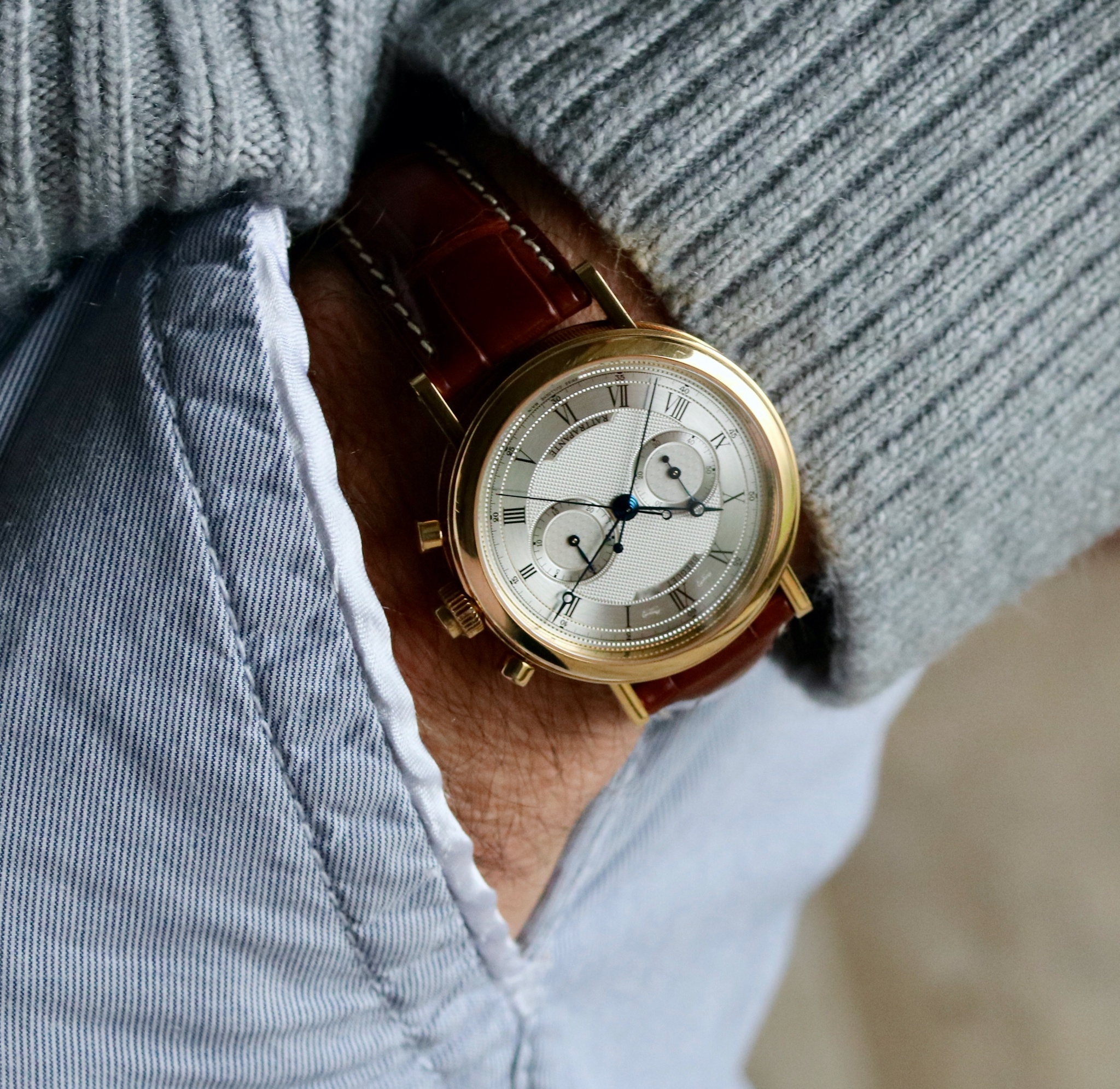
Asking AI what it thinks about one of my favourite watches (Breguet rattrapante ref 5947)

To put it in other words…

+1 ...who needs to write copy now?

AI did it all without any help from your side?
Yes it did


Granted, we won't be writing essays on the watches themselves
“ It appeals less to the Instagram-era flash collector and more to those who value heritage, discretion, and mechanical purity.”

That response from AI is nearly as impressive as the actual watch is.
