
Marcus Hanke
[PuristSPro Moderator]
11297

Two retrogrades by Rainer Nienaber: an experience review
Retroman’s Delight
Marcus Hanke checks out
two retrograde watches made by Rainer Nienaber


The development of enthusiasm for mechanical timepieces follows a more or less rigid or predetermined path in most cases of “infection”: The infamous “bug” bites after the acquisition of an entrance range mechanical watch, mostly with visible movement parts, that spark the fascination for these most complex micromachines ever made. Then, several solid, steel-cased watches with one or more additional complications will enter the scene, followed by one or several in precious metal outfit. The brand names on the watch dials become more and more exclusive and/or prestigious over the years, but, sooner or later, nearly all watch lovers will end up at the entrance of the true holy temple of horology, the “Académie Horlogère Des Créateurs Indépendants”, in short: AHCI. This union of independent and creative watchmakers was founded in 1985 and is now the symbol for the most exclusive category in watchmaking.
One of the reasons for the AHCI watchmakers’ big popularity gain during the last years might be the booming watch industry with ever-increasing production output and sales figures. Small workshops of yesterday are big brands of today, and what has to be sacrificed to the success in business is the direct contact between manufacturer and customer, the impression that the customer plays a role in the manufacturing process.
However, at a certain stage, watch enthusiasts develop a self-confidence, preferring them to be a contractor rather than a simple consumer who has to swallow what is confronted with by the big manufacturers. The communication with an independent creative master is a much more personal process, and as a customer and owner of such a product one has the impression of being a part of the creation process. This is a very satisfying feeling indeed.
The problem is that this directness and creativity is not cheap. Independent masters cannot benefit from the better sales conditions that suppliers of cases, crystals, wheels etc. offer to big manufacturers ordering several thousand pieces each time. All production processes that have to be subcontracted are more expensive and need longer to be fulfilled for independents than for a big company, like the Swatch Group. As a consequence, independent watchmakers are often forced to make parts themselves, which large companies can simply order from a catalogue for a much lower price. This makes timepieces made by independents, be they AHCI members or not, generally more expensive than mass-produced watches.
So staring at the beautiful pictures shown here at the PuristS, or visiting the AHCI booth at the yearly Basel watch fair is as near as most watch enthusiasts will ever come to an AHCI piece. Tragic, isn’t it?
But there is a solution, and it is hidden in the definition of what a customer is expecting from a watch made by an independent creative watchmaker: If a - more or less - completely self-developed and self-produced movement in the finest and most meticulous hand-applied finish possible is mandatory, well, you have to keep waiting and saving, or hoping for a lucky lottery ticket. The same applies to watches with a ton of complications hitherto unheard of, handmade enamel or engraved dials, and so on.
Although, if the customer satisfies himself with a complication that is nice, but not too difficult to realise, and that is based on a commonly used movement, it is not necessary to spend a year’s income at least for a timepiece exclusively made by an AHCI watchmaker.
To prove my point I hereby present two watches made by the German watchmaker Rainer Nienaber. Rainer is located in Bünde in the province of Westfalia and started his watchmaking career only after working as toolmaker for precision measuring equipment. Joining the AHCI already in 1993, he is a senior member of that exclusive circle. Originally, he concentrated on the production of large precision regulator clocks (due to the current wristwatch hype, it is an often forgotten fact that the AHCI always incorporated the most creative clockmakers as well!), but over the years, he also started making his own wristwatches. First, he made a very cleverly designed big date mechanism for standard movements, then he presented the first historically correct regulator layout of a wristwatch (seconds at 12, hours at 6). Finally, he developed such a great enthusiasm for retrograde indications, that he even uses the nickname “retroman” when participating in a German online watch community.

His first retrograde was a retrograde hour, that jumped back twice a day. The watch’s success motivated Rainer to continue with retrograde indications, and so his next creation was retrograde minute with a jumping (analogue) hour. Two years ago, he succeeded this with a retrograde second, and finally, with a wonderful timepiece, a combination of all three retrograde displays, the “TriRetrograde”, that is Rainer’s current top-of-the-line piece. Meanwhile, he produces about 50 examples of the various complications per year.
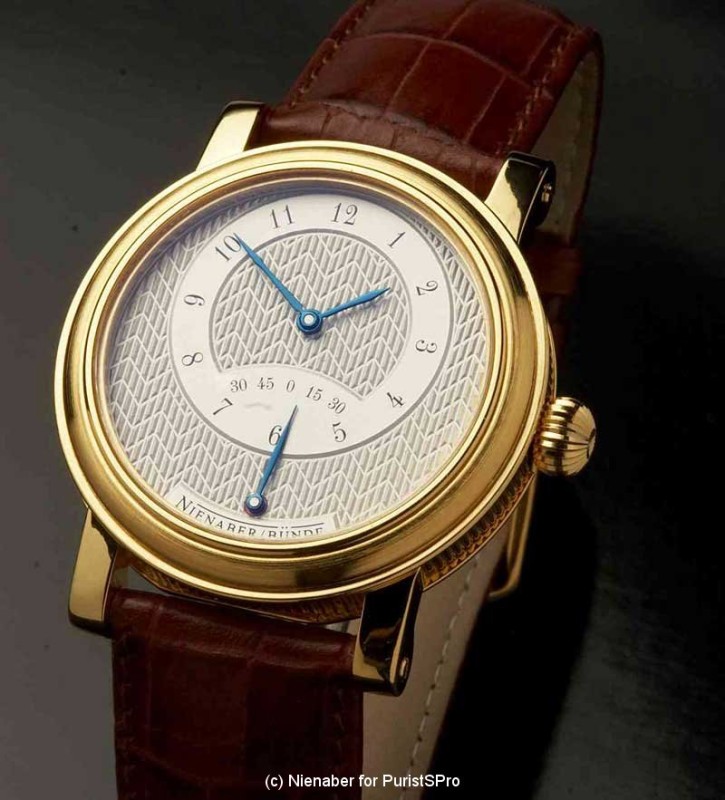
The Retrograde Second in a self-made 18k gold case
And the best of all is the price, that is way below what is normally due for one of the typical AHCI-watches. Of course, Rainer Nienaber is no magician, and cannot offer a cheap price for a watch that is more expensive to be produced. The customer has to accept certain compromises, but none in technical quality and reliability. The following experience review will show the strengths - and weaknesses - of these rare beauties.
1. Case, crystal and crown
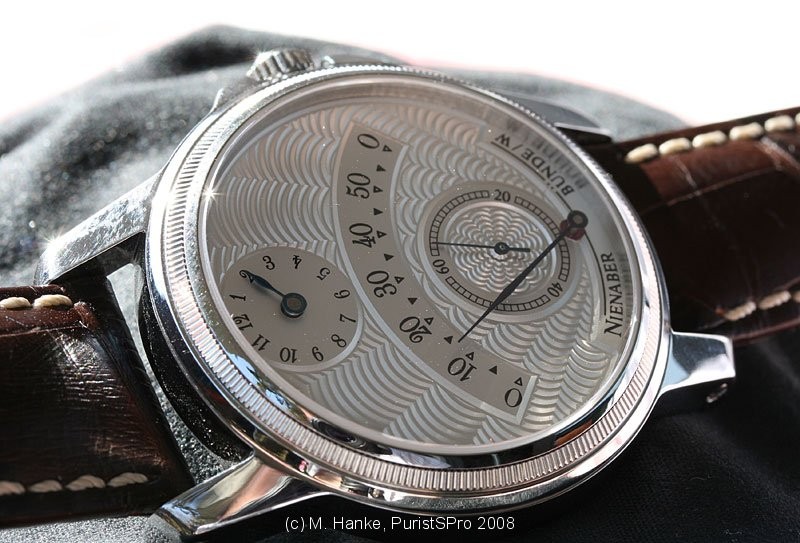
Both watches, the Retrograde Hour and the RetroLator (=retrograde minute in regulator configuration), share the same case. This stainless steel case is already the first compromise a future customer has to accept - and a proof of why independent watchmakers often have it more difficult than larger brands.While its proportions (41mm diameter without crown, 11mm height) permit a very elegant timepiece, the design of the stainless steel case is somewhat old-fashioned and does not really match the spectacular dial. Around the polished bezel is a finely coin-edged ring (so much for the “old-fashioned”), and the crown is protected by two rather prominent crown guards (so much for “not really matching”). In my opinion, crown guards are a design element typical for sports watches and those expecting rough treatment, but not for fine and elegant watches.


When I mentioned my reservations to Mr. Nienaber, his reply was typical for a watchmaker working outside the sterile workshops of a manufacturer, and within practical life: “Why don’t you like the crown guards? They are so practical!” Yes, dear Rainer, I am fully aware of the fact that bent or even broken stems from collisions of the crown with hard objects are far from rare. But this does not make crown protectors more attractive.
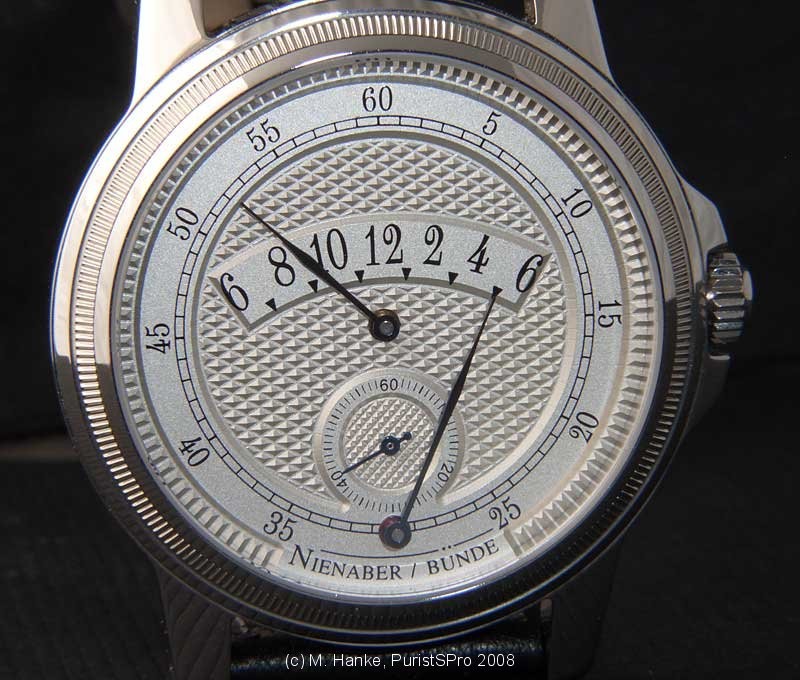
Of course it would be easy to ask for a different case. But here is the problem common for all independent watchmakers: With a production rate of 50 pieces a year, you cannot approach a case manufacturer and ask for 10, 20 or even 100 cases. The people there would at best laugh at you, or - more probably - simply ignore you. You have to take several hundred at least, and of course pay for them. for an individual watchmaker it would be economic suicide to throw them away, only to satisfy a newly developed taste. So you have to wait until your stack is used up, then you can think about a new case design.
When I saw the original press pictures of Nienaber watches shown on his website, I was sure I would never buy such a watch, so much did I dislike the case with the crown guards. However, when I saw the real pieces in Basel, my reservations were gone. When looking at the stunning dial, the case became meaningless.

Aside from the unliked crown guards and the coin-edged bezel ring, the case is of very good quality. The caseback features a sapphire crystal and is screwed to the case by means of a full-size thread. The strap is attached to the lugs by screwable bars, which is not my favourite solution. For an amateur like me, the lugs are too easily scratched during fruitless efforts to change the strap. A standard springbar is much easier to handle for me.
On the top is a flat sapphire crystal, too. Maybe an anti-reflective coating would further enhance the impression of the marvellous dials, but it is not really missing.
The crown fulfils its purpose, although it is a bit small for my clumsy fingers. The crown guards also compromise the grip on this hand-winding watch.
These cases are also available with an 18k gold bezel, but if the pocket is not too tight, I would strongly suggest looking at the new gold cases. Since a year, Nienaber is offering absolutely stunning, heavy and classic-looking gold cases which he is making himself (except the turned bezel and the caseback). The lugs of these cases are not simply soldered on, but the complete case is worked from a whole block of gold.
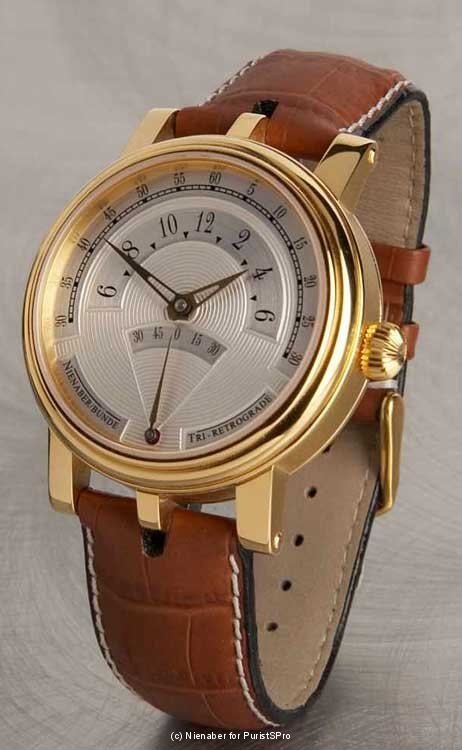
The new TriRetrograde, a combination of all three retrograde displays, in a self-made 18k gold case
2. Dials and Hands
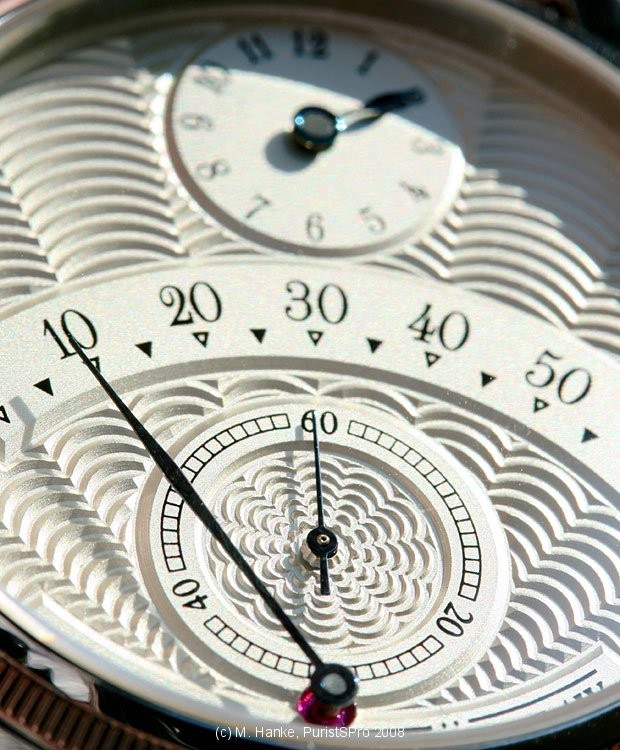

All hands are heat-blued by Mr. Nienaber, but produced by suppliers to his specifications. However, in special cases, he is making also the hands: the TriRetrograde, for example, has hands from titanium, since Rainer tried to keep the moving mass of the hands as low as possible. These he is making himself.


Under a loupe, both, dials and hands, look marvellous. Even larger magnification reveals minor flaws on the hands; tiny polishing flaws, and sometimes traces of “mistreatment” as a result of the master making sure that the retrograde hand would sit on its pinion firmly enough that it won’t be shaken loose even after many thousands of “rejections”. These tiny flaws, invisible to the naked eye, are the other compromise one has to accept when opting for the good price of Rainer Nienaber’s watches.

3. Movements
The mechanisms of the retrograde indications in both watches are based on a classic 13 lines hand-winding movement, the Schild AS 1130, a solid and reliable movement produced in huge numbers during the Sixties. This movement beats with 18,000 A/h and has a power reserve of 38 hours.
To offer a nice sight to the customer’s eyes, Nienaber is decorating the movement with Geneva stripes and a solar grinding on the winding wheels. All screw heads are very well polished. On very close inspection with a large magnification loupe, the stripes are a bit rough; another tribute to a watchmaker who is concentrating on the mechanical engineering. However, I have seen the movement of his TriRetrograde to have a considerably finer finish. This watch costs several times more than those shown here, though.
The main reason to buy such a watch of course is not the base movement, but the modifications executed by Nienaber.
As the name discloses, the “Retrograde Hour” features a long retrograde hand, based at the 6, that is indicating the hours in a circle segment placed slightly above the dial centre. The minute and the small second are shown conventionally. The result is a fascinating, yet highly irritating display of hands. Especially when the minute and the retrograde hour hand are intersecting, it is impossible to read the time without a prolonged and concentrated effort. Inevitably, the wearer will believe the minute hand to show the hour, and the relatively short span of the hour segment concentrates twelve hours in a compressed display. This makes it also difficult to identify the correct time.

Regarding the mechanical reliability, Nienaber invests some effort to ensure a flawless operation for a long time. The main problem, common to all retrograde designs, is the energy released by the spring, hurling back the hand to its start position, where it is stopped violently. The jumpback movement of the hand has to be as quickly as possible, otherwise too much time would be lost in the process, making the time display unreliable. On the other hand, the rapid acceleration and deceleration of the hand subjects all components to a massive stress. This is the reason why it is so difficult to get a really well working vintage (pocket) watch with retrograde displays.

In the last few years, retrograde displays have become popular again, and can be found even in very cheap watches. The longevity and flawless operation of these indications is what makes the difference, though. For example: Even if the retrograde hour hand of Nienaber’s watch is flinged only twice a day, it has its own ruby bearing. For the great TriRetrograde, Nienaber not only used titanium hands with their tiny mass, but also developed a specific brake mechanism that smoothly decelerates the hands, without loosing too much time.

My difficulties to read the time on the Retrograde Hour finally were the reason why I replaced this otherwise wonderful watch with the RetroLator. This watch got its name from the retrograde minute indication and its regulator dial layout: the small second at 6, and a small hour dial at 12.

This watch is a lot easier to read: The circle segment showing the minutes has a wider span, offering a tolerable “resolution” with markers every five minutes. The small hour hand does not move constantly, but is a jumping indication, with the two actions of the hour jump and the hurling of the minute hand being perfectly synchronised. There is absolutely no visible delay between these two jumps, which is a proof for the care invested by the master in designing the parts and adjusting the mechanism.

In spite of that, my RetroLator unfortunately had troubles: After some time in my possession, the watch showed a weird behaviour. The minute hand started moving too quickly during the first half hour, meeting the “30” after but twenty minutes. Then it slowed down, until the jump at the full hour was executed exactly at the correct time. I sent the watch back to Rainer for what I thought to be a small repair surgery. But you should never underestimate an AHCI watchmaker! The mails I received told about parts and mechanisms I had never heard of, and the summary was that he developed a new construction and would completely modify not only my watch, but all future ones as well. When I received back the watch after some months (I was on vacation in that time and told Mr. Nienaber not to hurry and to take his time), it worked perfectly, and the hour jump should now be even more reliably in perfect synchronisation with the minute hand for the next 250+ years. Great, I will publish a real long-time experience review then.
An additional bonus for replacing the Retrograde Hour is that now chances are bigger to observe the spectacular movement of the hands. The Retrograde Hour switches at 6 and at 18 o’clock. Since many people, including myself, are still asleep at 6 in the morning, 6 in the evening is left as the only opportunity to witness the jumpback. Unfortunately, I regularly missed it.
The accuracy of both movements was good, or better: there was no lack of accuracy that I noticed. I think you will agree with me that watches like these are not purchased for their timekeeping performance. And since I don’t wear mine every day, I have to rewind and set it each time I wear it, anyway.
4. Straps and Clasps:
Both watches came with very fine and smooth black ostrich straps. Personally, I am not a big fan of black straps, they are too formal in my eyes. Consequently, I replaced them every time with a brown Hirsch strap with white contrast stitching, which I consider a bit more casual.

The anonymous double folding clasp is of good standard quality, with the two pushers being well rounded and without sharp edges, so they do not dig painfully into the wrist’s underside.
5. Conclusion:
Not only are Rainer Nienaber’s watches exclusive, rare, and fascinating. They are the result of a mutual communication between the master and his customer, which is the quintessence of our desire for watches made by independent creative watchmakers. And above all, Rainer permits to fulfil our wish to own an AHCI timepiece a bit earlier, which could even be considered an act of horological mercy ...Copyright March 2008 - Marcus Hanke & PuristSPro.com - all rights reserved
PuristSPro Homepage | ThePuristS Homepage
Comments, suggestions, and corrections to this article are welcome.

This message has been edited by Marcus Hanke on 2008-03-30 11:03:28 This message has been edited by Marcus Hanke on 2008-03-30 23:59:09 This message has been edited by MTF on 2008-04-05 08:41:12
Two retrogrades by Rainer Nienaber: an experience review
Retroman’s Delight Marcus Hanke checks out two retrograde watches made by Rainer Nienaber The development of enthusiasm for mechanical timepieces follows a more or less rigid or predetermined path in most cases of “infection”: The infamous “bug” bites aft...


How deep are my pockets?
Marcus (and Herr Nienaber), Thank you for the report. Long ago, I remember reading a list of AHCI members and indeed it was at the transition when a clockmaker started making wristwatches. I agree that the character of the watch changes with the case that...

