Ger
133

Small theory.
Hi Stephen,
Imagine a simple system, where the balance is only one point, rotated around an axis by the spring.
1. Momentum (of balance) contains mass and velocity values. Position of mass can be variable by the construction, velocity will change continuously during oscillation.
2. Work (of spring) contains some "specialities" like "elastic couple", "elastic modulus". Those physical values are depends on the physical properties of your spring, eg. width, thickness, lemgth, material. You can change those by construction, especially the length. Unfortunatelly, temperature change them also 
3. in the neutral position of the balance wheel, the work of the spring equals the momentum the balance. In the neutral position the momentum value is the maximum (maximum velocity). From that, the oscillation could be calculated, so you can determine the sizes of your system.
For adjusting you have to define first, what to adjust: of course, the most important will be the time (oscillation, beat, etc. - depends on the applied math). These gadgets are TIMEkeepers. There is a lot of effect on the time, and a lot of solution born already. All of them tries to decrease the error (gain or loss).
Purpose of swan-neck in Lange 1815 chronograph

The swan-neck is again a spring itself ...
Yes - but
I can see clearly the "lever" = Rueckerhebel ...
Actually I think the answer is a little different
It looks deifferent but should do the same job...
Sorry but that's incorrect
I am not a watchmaker, that is true but ...
Inertia vs. hairspring length

It's a freesprung system....
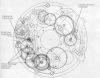
confusing: is the spring length fixed one or movable = variable???
Hello, Moritz,
Thank you for the details, Suitbert ...

I loved your explanation
Hello, Stephen,...
Thank you for this
Small theory.