
cazalea
[Seiko Moderator]
20996

Why is the Kodo so expensive?
Because there are so few people in the world with the ability to conceive, refine, explain, patent multiple aspects of it, design and actually build it. And then train someone else to build and service it!
Just take my word for it, mortgage your house, and order one now: ORDER KODO

OR
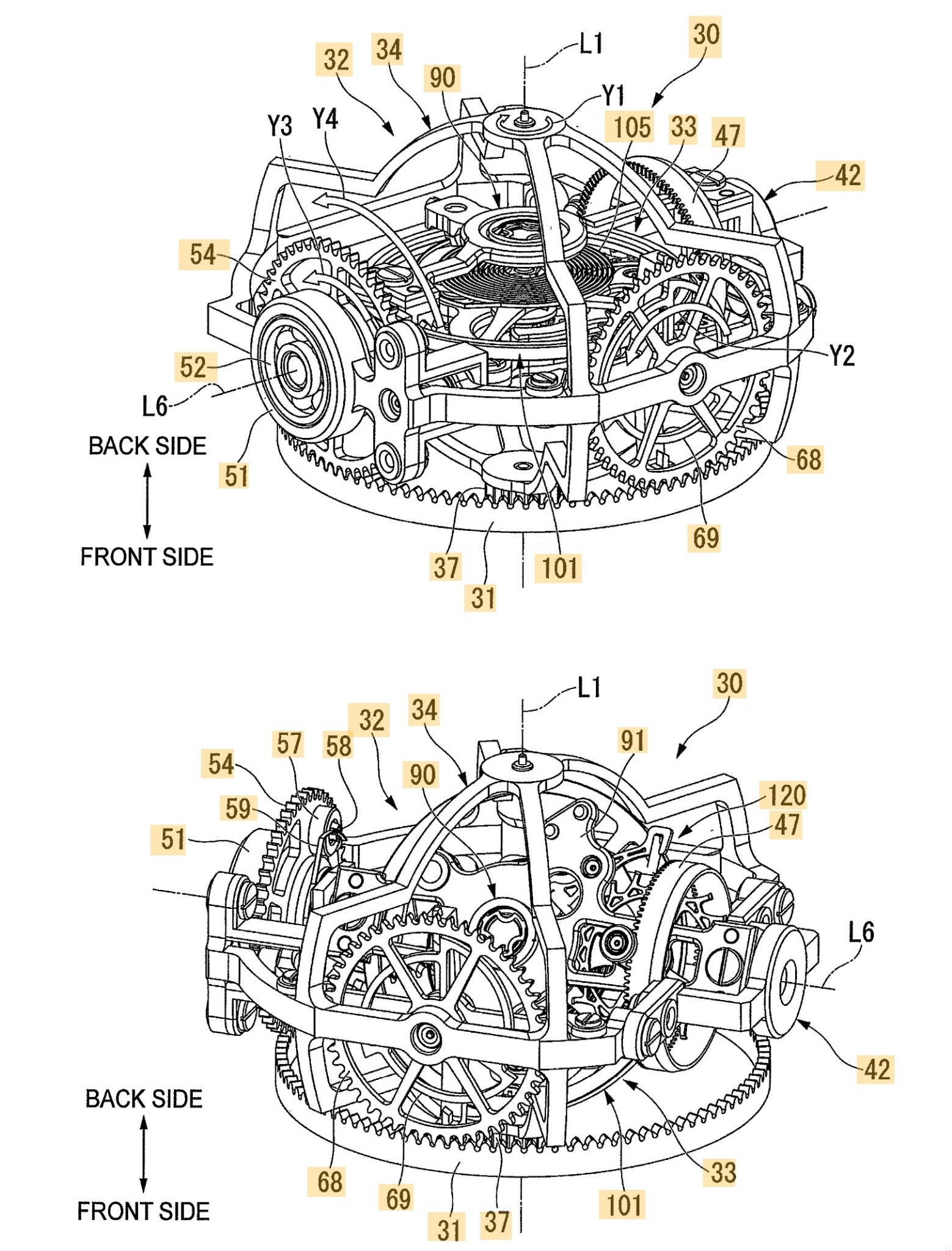
Try to understand it: PATENT LIST and summary below:
BACKGROUND OF THE INVENTION
1. Field of the Invention
This invention relates to an operation stabilizing mechanism, a movement, and a mechanical timepiece.
2. Description of Related Art
As main mechanisms determining the precision in rate of a mechanical timepiece, there exist a governor and an escapement. The governor is composed of a balance with hairspring and a hairspring. The balance with hairspring is caused to oscillate at a fixed cycle by the spring force of the hairspring. It is desirable for the gravitational center position of the balance with hairspring to be situated on the axis of a balance staff. When the axis of the balance staff and the gravitational center position of the balance with hairspring are deviated from each other, there is generated, if the timepiece is in an erect attitude, unnecessary torque due to the biased gravitational center of the balance with hairspring. As a result, depending upon the direction in which the gravitational force is exerted, there is generated an error in precision in rate. This error is referred to as the erect attitude difference.
Further, the hairspring is also formed in a spiral configuration, so that, because of the characteristics due to its configuration, there is generated an erect attitude difference depending upon the direction in which the gravitational force is exerted when the timepiece is in the erect attitude. In this way, the governor of a mechanical timepiece involves an erect attitude difference due to two factors.
As a mechanism for solving this problem of erect attitude difference, there has been known a tourbillon mechanism (operation stabilizing mechanism). In the tourbillon mechanism, the governor and the escapement are arranged in a single carriage, which is rotated at a fixed cycle. As a result, it is possible to average the error in the precision in rate generated by the gravitational force, making it possible to suppress the erect attitude difference.
However, in the above tourbillon mechanism, rotation is effected around a single axis, so that it is difficult to eliminate the error in the precision in rate (hereinafter referred to as the flat-erect difference) between the case when the timepiece is in the flat attitude and the case when it is in the erect attitude.
In view of this, there have been proposed various techniques for simultaneously suppressing the erect attitude difference and the flat-erect difference.
For example, there has been proposed a technique capable of simultaneously suppressing the erect attitude difference and the flat-erect difference through rotation of the governor and the escapement by a plurality of carriages of different rotational axes (See, for example, International Publication No. 2004/077171 (Patent Literature 1) and European Patent No. 1465024 (Patent Literature 2)).
Ideally, the governor oscillates at a fixed oscillation frequency. Actually, however, the amplitude of the balance with hairspring varies under the influence of various error factors, resulting in fluctuation of the oscillation cycle of the balance with hairspring. As a result of this fluctuation of the oscillation cycle, the precision in the rate of the timepiece deteriorates.
The balance with hairspring oscillates due to the spring force of a power mainspring, so that, as a result of unwinding of the power mainspring, the oscillation angle of the balance with hairspring is reduced, resulting in fluctuation in the oscillation cycle of the balance with hairspring. It is difficult to eliminate this fluctuation in the oscillation cycle of the balance with hairspring even by using the above-mentioned tourbillon mechanism. Thus, to enhance the precision in rate, it is desirable to supply a fixed amount of energy to the governor.
As a mechanism for supplying a fixed amount of energy to the governor, there have been known constant-force mechanisms such as a remontoire mechanism. And, there has been proposed a technique which further enhances the rate precision by providing this constant-force mechanism separately from the tourbillon mechanism (See, for example, U.S. Pat. No. 6,948,845 (Patent Literature 3)).
However, in Patent Literature 3, the mechanism as a whole is rather large in size, and when the mechanism is arranged in the timepiece limited in space, it is rather difficult to efficiently arrange the other mechanisms.
SUMMARY OF THE INVENTION
It is an aspect of the present application to provide an operation stabilizing mechanism, a movement, and a mechanical timepiece which allow a reduction in size while achieving an improvement in terms of rate precision.
To achieve the above aspect, there is provided in accordance with the present application an operation stabilizing mechanism including: a plurality of carriages arranged in a multiplex fashion and provided so as to be mutually rotatable; a constant-force spring provided between two adjacent ones of the plurality of carriages and configured to impart a rotational force to the other of the two carriages such that the other carriage rotates with respect to the one carriage; a stop wheel provided on the one carriage; and a stopper configured to perform engaging and releasing operations on the stop wheel upon the rotation of the other carriage, wherein the rotational axes of at least two of the plurality of carriages cross each other.
By thus arranging a constant-force spring between two adjacent carriages, it is possible to impart a rotational force to one carriage in a stable manner without involving an increase in the size of the mechanism as a whole. Further, through the construction consisting of a plurality of carriages, it is possible to eliminate the flat-erect difference. Thus, it is possible to provide a small operation stabilizing mechanism while enhancing the rate precision.
According to the present application, there is provided an operation stabilizing mechanism, wherein the stopper and an escapement/governor mechanism are provided in the one carriage.
Due to this construction, it is possible to impart a rotational force in a stable manner to the one carriage provided with the escapement/governor mechanism. Thus, it is possible to stabilize the rotational torque transmitted to the escapement/governor mechanism, with the result that it is possible to stabilize the operation of the escapement/governor mechanism.
According to the present application, there is provided an operation stabilizing mechanism, wherein there are provided two carriages; the drive force of a train wheel is transmitted to an outer carriage arranged on the outer side, and the stop wheel is provided on the outer carriage; and the stopper and the escapement/governor mechanism are provided in an inner carriage arranged on the inner side.
Due to this construction, it is possible to impart a rotational force in a stable manner to the inner carriage provided with the escapement/governor mechanism while achieving a reduction in size.
According to the present application, there is provided an operation stabilizing mechanism, wherein the escapement/governor mechanism is equipped with an escape wheel & pinion configured to rotate on the inner carriage with the rotation of the inner carriage, and a balance with hairspring configured to rotate and oscillate on the inner carriage with the rotation of the escape wheel & pinion; and the balance with hairspring is arranged such that the rotation axis of the balance with hairspring and the rotation axis of the outer carriage cross each other.
The fact that the rotation axis of the balance with hairspring and the rotation axis of the outer carriage are thus arranged so as to cross each other means that the rotation center of the balance with hairspring is situated at the rotation center of the outer carriage. Due to this construction, it is possible to prevent generation of useless space in the inner carriage and the outer carriage. Thus, it is possible to reliably reduce the size of the operation stabilizing mechanism, and to achieve an improvement in terms of design.
Further, since the balance with hairspring is mounted in the inner carriage, it is possible to stabilize the rotational torque transmitted to the balance with hairspring. As a result, it is possible to suppress fluctuation in the oscillation angle of the balance with hairspring.
According to the present application, there is provided an operation stabilizing mechanism, wherein the rotation axis of the inner carriage and the rotation axis of the balance with hairspring cross each other.
Due to this construction, the provision of at least two carriages of the outer carriage and the inner carriage makes it possible to orient the balance with hairspring in all directions. Thus, it is possible to provide an operation stabilizing mechanism simplified in structure as much as possible and enhanced in rate precision while achieving a reduction in size.
According to the present application, there is provided an operation stabilizing mechanism, wherein the center of gravity of the balance with hairspring is situated in at least one of the rotation axis of the inner carriage and the rotation axis of the outer carriage.
Due to this construction, it is possible to make it difficult for the centrifugal force due to the rotation of each carriage to act on the balance with hairspring. Thus, it is possible to stabilize the operation of the balance with hairspring.
According to the present application, there is provided an operation stabilizing mechanism, wherein the center of gravity of the inner carriage is situated in the rotation axis of the inner carriage.
Due to this construction, it is possible to minimize the requisite rotational torque for rotating the inner carriage. Thus, it is possible to enhance the drive efficiency, and to enhance the rate precision.
According to the present application, there is provided an operation stabilizing mechanism, wherein the center of gravity of the outer carriage is situated in the rotation axis of the outer carriage.
Due to this construction, it is possible to minimize the requisite rotational torque for rotating the outer carriage. As a result, it is possible to efficiently perform the winding-up of the constant-force spring by the outer carriage, making it possible to stabilize the winding-up amount of the constant-force spring. Thus, it is possible to enhance the drive efficiency, and to enhance the rate precision.
According to the present application, there is provided an operation stabilizing mechanism, wherein the stopper is equipped with an arm swingably provided with respect to the outer carriage and configured to swing upon the rotation of the inner carriage, and a pallet portion provided on the arm and capable of being engaged and disengaged with and from the stop wheel; the swing axis of the arm is set in a direction crossing the rotation axis of the stop wheel; and setting is made such that the vector of a mesh-engagement force generated when the stop wheel and the pallet portion are engaged with each other extends along the direction of the swing axis of the arm.
In the case where the swing axis of the arm is thus set in a direction crossing the rotation axis of the stop wheel, it is possible to prevent the mesh-engagement force generated when the stop wheel and the pallet portion are engaged with each other from affecting the inner carriage. Thus, it is possible to minimize the requisite rotational torque for rotating the inner carriage.
According to the present application, there is provided an operation stabilizing mechanism, wherein the stopper is equipped with an arm swingably provided with respect to the outer carriage and configured to swing upon the rotation of the inner carriage, and a pallet portion provided on the arm and capable of being engaged and disengaged with and from the stop wheel; the swing axis of the arm is set so as to extend along the rotation axis of the stop wheel; and setting is made such that the vector of a mesh-engagement force generated when the stop wheel and the pallet portion are engaged with each other passes on the swing axis of the arm.
In the case where the swing axis of the arm is thus set so as to extend along the rotation axis of the stop wheel, it is possible to prevent the mesh-engagement force generated when the stop wheel and the pallet portion are engaged with each other from affecting the inner carriage. Thus, it is possible to minimize the requisite rotational torque for rotating the inner carriage.
According to the present application, there is provided an operation stabilizing mechanism, wherein the arm is equipped with a balancer; and the center of gravity of the arm is situated in the swing axis of the arm.
Due to this construction, it is possible to prevent the gravitational force of the arm itself from affecting the swinging operation of this arm due to inclination of the operation stabilizing mechanism. Thus, it is possible to maintain a fixed force required for the swinging operation of the arm, making it possible to further enhance the rate precision.
According to the present application, there is provided an operation stabilizing mechanism, wherein there is provided a regulating portion regulating the relative rotation amount of the two carriages connected by the constant-force spring.
Due to this construction, it is possible to prevent the constant-force spring from being unwound to a predetermined degree or more. Thus, it is possible to impart rotational force to a desired carriage in a stable manner.
According to the present application, there is provided an operation stabilizing mechanism, wherein, of the two carriages connected by the constant-force spring, the carriage on the outer side is provided with a constant-force spring winding-up wheel for winding up the constant-force spring; the constant-force spring winding-up wheel is provided with a regulating plate; of the two carriages connected by the constant-force spring, the carriage on the inner side is provided with an engagement pin that can be engaged with the regulating plate; and the regulating plate and the engagement pin constitute a regulating portion.
Due to this construction, it is possible to reliably prevent unwinding of the constant-force spring with a simple structure. Thus, it is possible to reliably enhance the rate precision while achieving a reduction in the size of the operation stabilizing mechanism.
According to the present application, there is provided an operation stabilizing mechanism, wherein the respective rotation cycles of the plurality of carriages are set to mutually indivisible numbers.
Here, in the case where the respective rotation cycles of the carriages are set to mutually divisible numbers, there increases the number of times that the relative attitude of the escapement/governor mechanism (balance with hairspring) provided in one of the carriages and that of the other carriages are the same. For example, assuming that the proportion of the rotation cycles of the two carriages is set to 1:1, and that the balance with hairspring is provided in one of the carriages, the balance with hairspring assumes the same attitude when the other carriage makes one rotation. Thus, by setting the rotation cycles of the carriages to mutually indivisible numbers, it takes the balance with hairspring longer to assume the same attitude at the same place. Thus, it is possible to disperse the influence of the gravitational force, making it possible to more reliably eliminate the flat-erect difference, and to disperse the stress applied to the rotation shaft, etc.
According to the present application, there is provided an operation stabilizing mechanism including: a stationary wheel provided separately from the plurality of carriages; and a stop wheel driving wheel integrally fixed to the stop wheel and in mesh with the stationary wheel, wherein the number of teeth of the stationary wheel and the number of teeth of the stop wheel driving wheel are set to mutually indivisible numbers.
Due to this construction, in the case where the respective rotation cycles of the carriages are set to mutually divisible numbers, it is possible to reduce, with a simple structure, the number of times that the escapement/governor mechanism (balance with hairspring) provided in one of the carriages assumes the same relative attitude as the other carriages.
According to the present application, there is provided a movement equipped with an operation stabilizing mechanism as described above.
Due to this construction, it is possible to provide a movement allowing a reduction in size while enhancing the rate precision.
According to the present application, there is provided a mechanical timepiece equipped with a movement as described above.
Due to this construction, it is possible to provide a mechanical timepiece allowing a reduction in size while enhancing the rate precision.
According to the present application, a constant-force spring is arranged between two adjacent carriages, whereby it is possible to impart rotational force to one carriage in a stable manner without involving an increase in the size of the mechanism as a whole. Further, through the formation of the mechanism by a plurality of carriages, it is possible to eliminate the flat-erect difference. Thus, it is possible to provide a small operation stabilizing mechanism while enhancing the rate precision.

If you got this. far, here's your reward=the description in plain English:
In 2020, Grand Seiko unveiled the T0 "Constant-Force Tourbillon,” a concept movement that brings together a tourbillon and a constant-force mechanism in one unit on a single axis for the very first time in horological history. Two years later, Grand Seiko has brought the concept movement to life in a dedicated timepiece called Kodo (Japanese for heartbeat), powered by the new 9ST1 caliber.
The SLGT003 case is constructed from both Platinum 950 (inner case) and Grand Seiko’s Brilliant Hard Titanium (outer case). With its open design, Kodo showcases the inner machinations of the impressive caliber on both sides of the case. But despite its complexity, with Kodo being a Grand Seiko timepiece, legibility and functionality remain critical. Therefore, there is a dedicated sub-dial for timekeeping, where Grand Seiko’s dauphine hands draw the eye, and the hour hand even has an extra facet at the tip to avoid confusion with the minute hand. The constant-force carriage has a ruby on one of its arms, which acts as a small seconds hand. The caliber also features a hacking function to ensure precise timekeeping.
As the inner tourbillon carriage rotates fully once per 60 seconds, the balance vibrates at eight beats per second while the outer constant-force carriage follows its rotation at exact one-second intervals. The sounds of the active escapement and the once-per-second impulse of the constant-force mechanism harmonize to create a deeply satisfying and re-assuring heartbeat, similar to that of a musical 16th note, and it is what inspired the name.
Because there are no components between the tourbillon and constant force mechanism, there is no change to the torque transmitted from the constant-force mechanism to the balance wheel. This results in a duration of 50 hours for the constant-force mechanism, as well as a more stable balance amplitude, which improves movement accuracy. Caliber 9ST1 establishes a new standard for accuracy. Each movement is fully wound every 48 hours (as opposed to the typical 24 hours) in six positions and at three temperatures. This is twice as long as the Grand Seiko standard and other industry standards. Individual movements are tested over a period of 34 days, and the performance of each movement is recorded in an individual certificate that accompanies every watch.
SLGT003 is offered with a Himeji Kurozan calf strap, which has been called the “black diamond of natural leather.” It is treated in the same traditional way Samurai armor once was to enhance durability. To achieve its distinct sheen, the surface of the strap is painted by hand with multiple layers of Urushi lacquer. It comes fitted to a platinum three-fold clasp. SLGT003 also comes with an alternative crocodile strap with crocodile leather on both sides to maximize resistance against moisture.
Grand Seiko Kodo is a Boutique exclusive and will be available as a limited edition of 20 pieces.

Complications
Explore the Grand Seiko Kodo Constant Force Tourbillon, Caliber 9ST1. Discover its integrated constant-force mechanism, tourbillon, and precision testing.
13 replies4608 views

Complications
Explore the Grand Seiko Kodo Constant-force Tourbillon Ref. SLGT003, SLGT001, and SLGT005. Discover its unique caliber 9ST1, design, and GPHG award.
20 replies718 views

Complications
Grand Seiko Kodo Constant-force Tourbillon SLGT003 wins Chronometry Prize at GPHG 2022. Discover its innovative Caliber 9ST1 movement.
1 replies590 views

Community
Cazalea's '77 Walks With Seikos' summary: a unique project blending watch collecting with outdoor exploration. Revisit the journey.
15 replies254617 views

Reference Guide
Learn how to identify Seiko watches using case back and dial markings. Cazalea's guide covers model codes, serial numbers, and specific details for models like the 'Samurai'.
5 replies27734 views
Collection
Explore cazalea's '50 Walks With My Seikos' index, showcasing a diverse collection of Seiko watches. Discover unique models and community insights.
16 replies26859 views
Why is the Kodo so expensive?
Because there are so few people in the world with the ability to conceive, refine, explain, patent multiple aspects of it, design and actually build it. And then train someone else to build and service it! Just take my word for it, mortgage your house, an...

Good news
That the housing market has been so hot. Can use that equity for these important things 🤣


I will read (and maybe understand)...
...the patent after I receive my degree from MIT...


The patent shown is actually for something else (that's even bigger)
That's a patent for a double-axis tourbillon with constant force! Didn't realise Seiko was working on one I believe the rationale of the design is that a remontoir will provide a smoother constant force to the rotation of the tourbillon cages. Having a sm...
Thanks for the explanation / I love that Video
I'm not sure if it's the 4 cups of tea or the mesmerizing music or the giant animation on my 27" screen, but I can't get the action out of my head... Cazalea ...