
Updated Report! - Introducing the Centigraphe Souverain - New Photos!
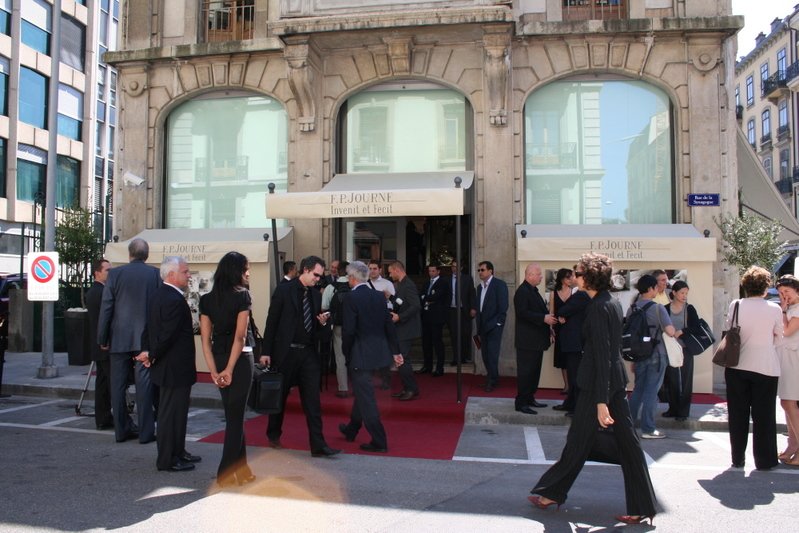
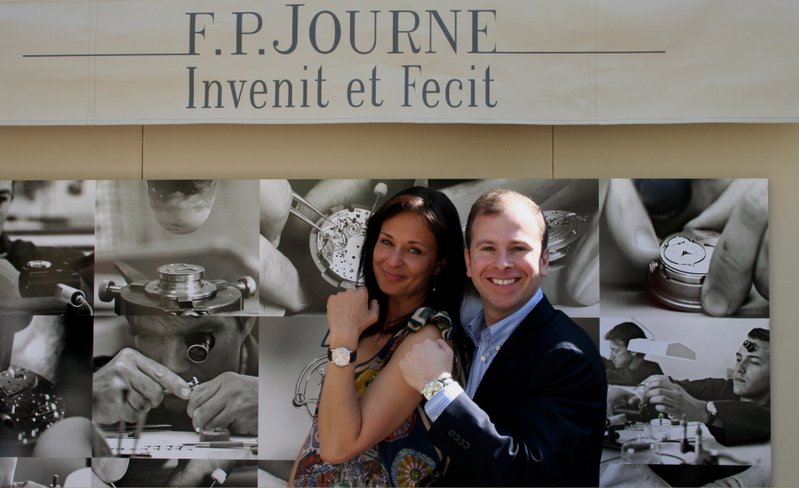
Our gracious host Mr. Francois-Paul Journe.
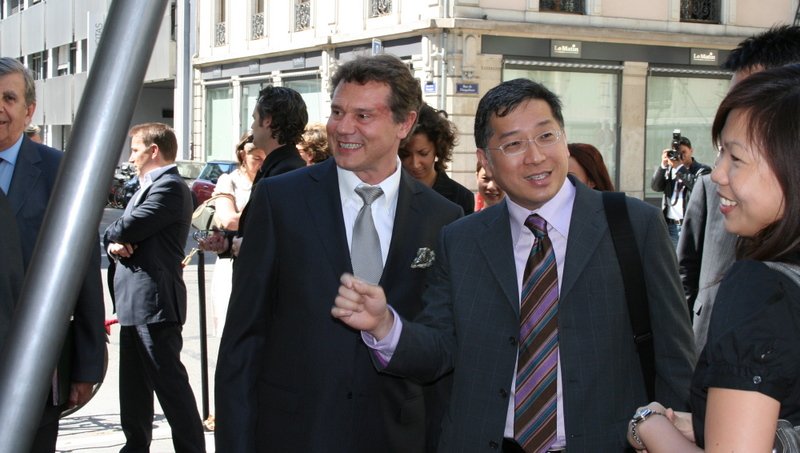
Distinguished guests, all accompanied by something familar on the wrist.
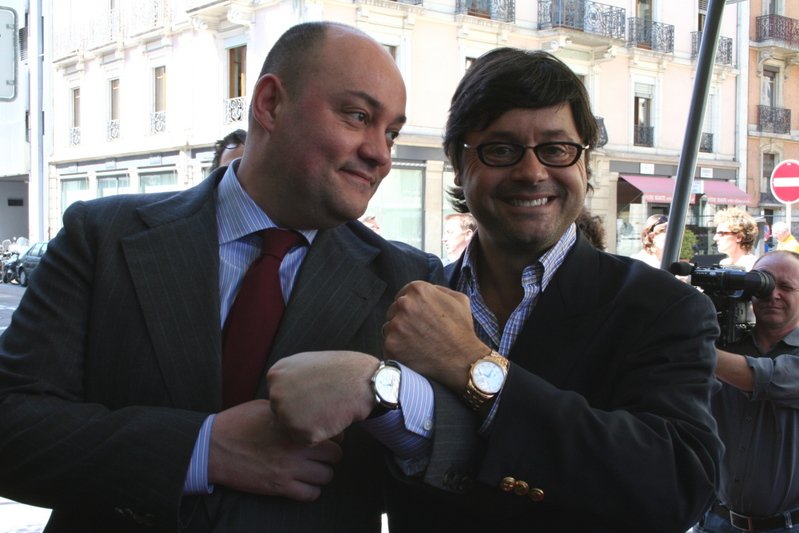
Wait! Is that really a rose gold bracelet attached to a Chronometre Souverain?
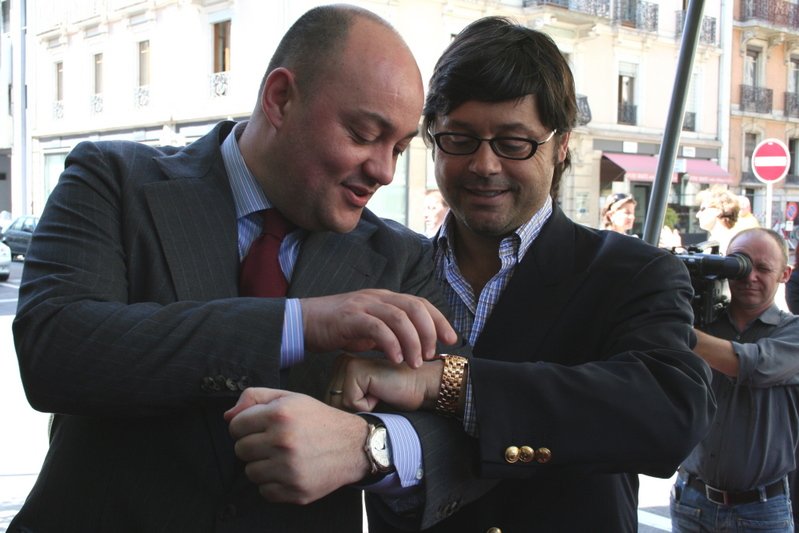
YG Resonance and Ruthenium Remontoir - a perfect pair!
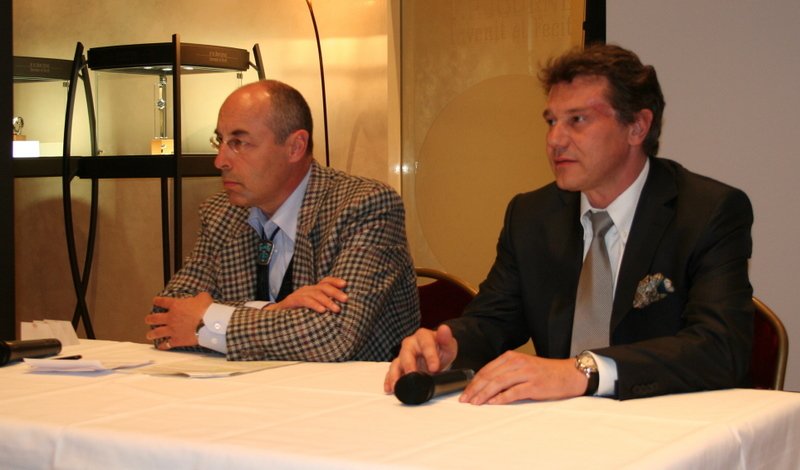
The presentation began with Mr. Journe joined by master watchmaker Dr. Ludwig Oechslin, Director-Curator of the International Watch Museum in La Chaux-de-Fonds. Among his many accomplishments Dr. Ludwig Oechslin is his creation of the Trilogy of Time and a perpetual calendar watch that bears his name.
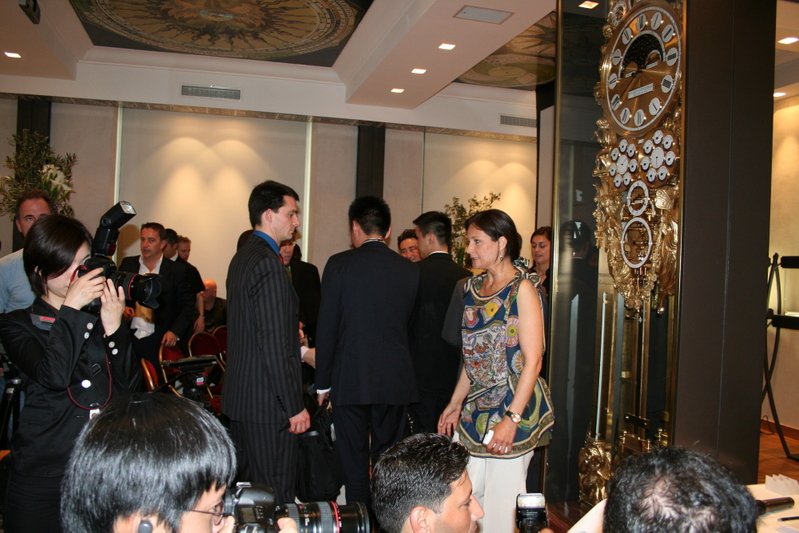
Dr. Ludwig began by speaking about the fascinating restoration of the astronomical clock built by CL Detouche that now is prominately displayed upon entering. This was followed by a short video.
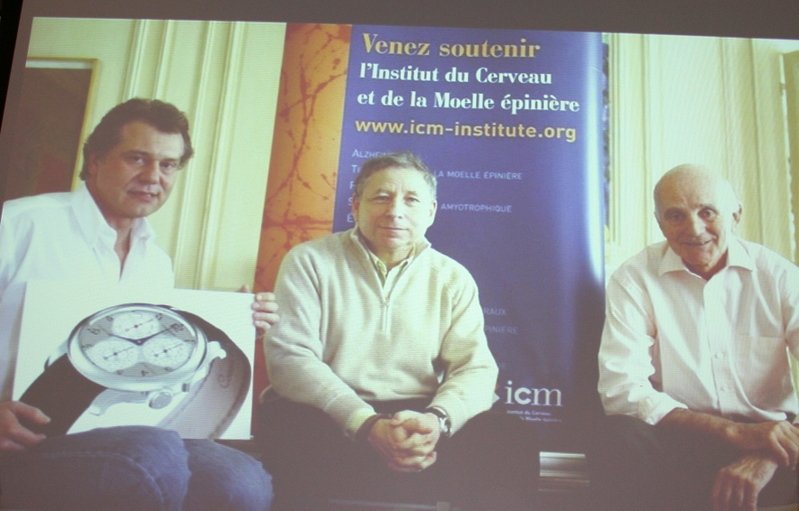
Next we were joined by conference call with the Jean Todt, Ferrari CEO. Mr Todt discussed how part of the proceeds from the sale of the Centigraph would be donated to ICM to help with their important plans to build a research center to help treat those with certain brain and spinal cord diseases.
And finally, the moment all of us were waiting for, the official launch of the new Centigraphe Souverain! Mr. Journe spoke about how 15 years ago he was asked to find a mechanical solution to build an exponential chronograph which at the time he could not providing the inspiration for the Centigraphe. He also spoke about how Chronograph's in the 19th century were made with 2 buttons and decided he should do it better! This gave him the idea for the rocker which he obtained a patent for. He also received another patent for the mechanism that seperates the chronograph from the timekeeping movement. When asked how difficult it all of this was he said "After making the Grand Sonnerie, everthing is easier!"

For those of you who could not join please take a look a the video!
www.fpjourne.com
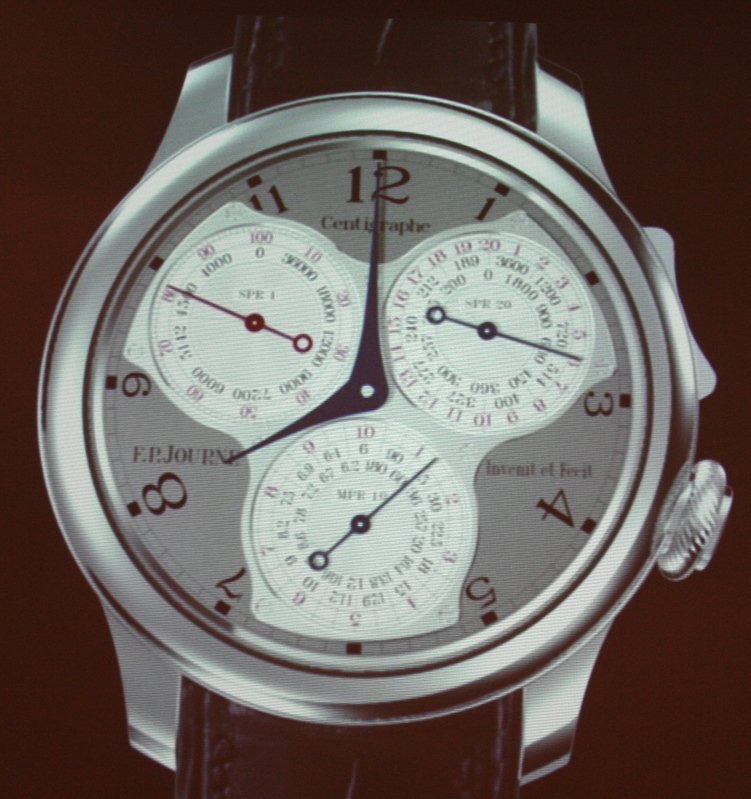
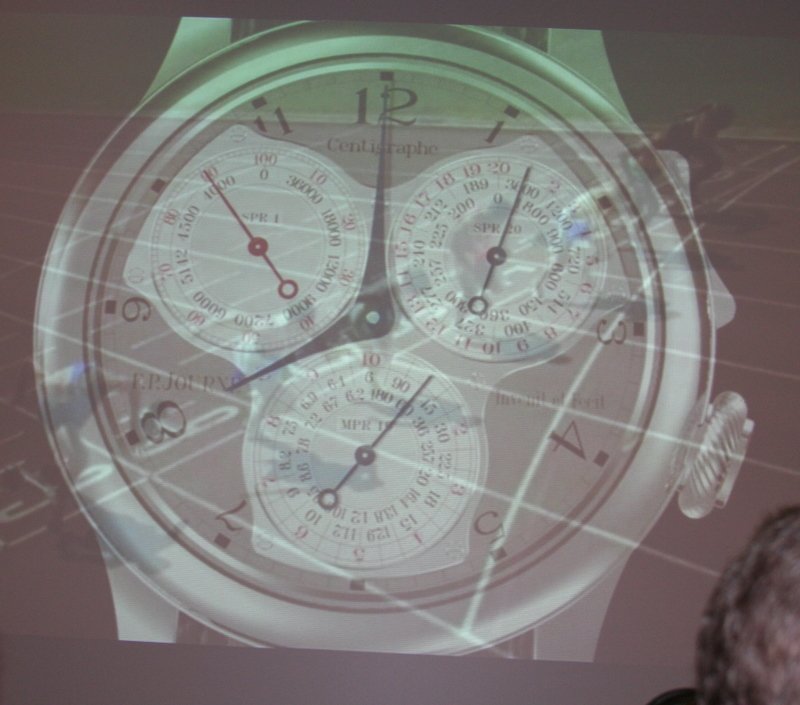
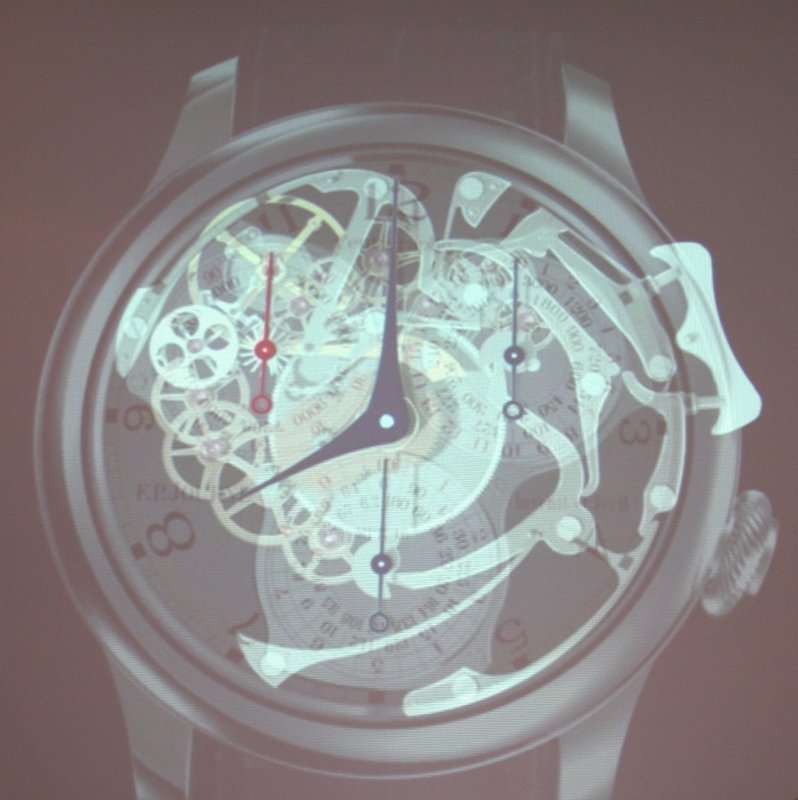
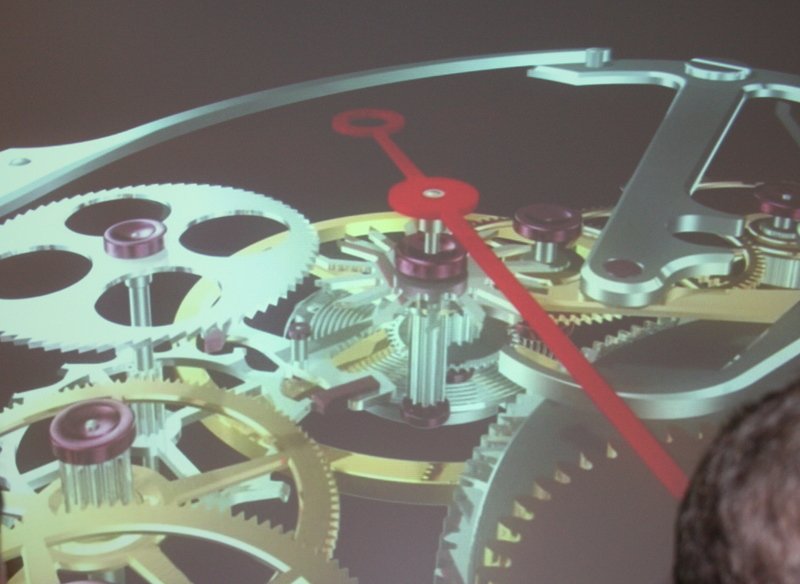
During the video you we see multiple computer images of the Centigraphe.
Some superimposed on track runners.
Others with a view from the inside.
Particularly of the the flying second hand.
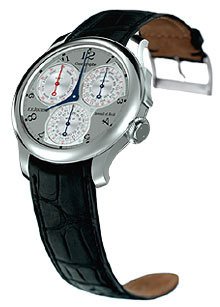
Presenting the Centigraphe Souverain in PT
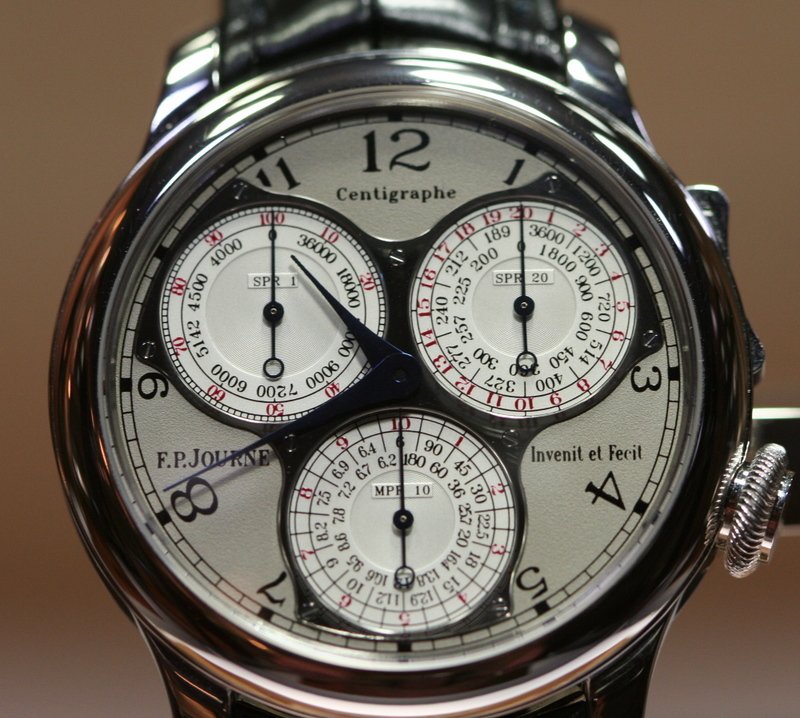
Now look closely at the actual photo above. There is a subtle change from the image in the video presentation. This was because one of the parts could not be ready in time for the exhibition. Can you guess what it is?
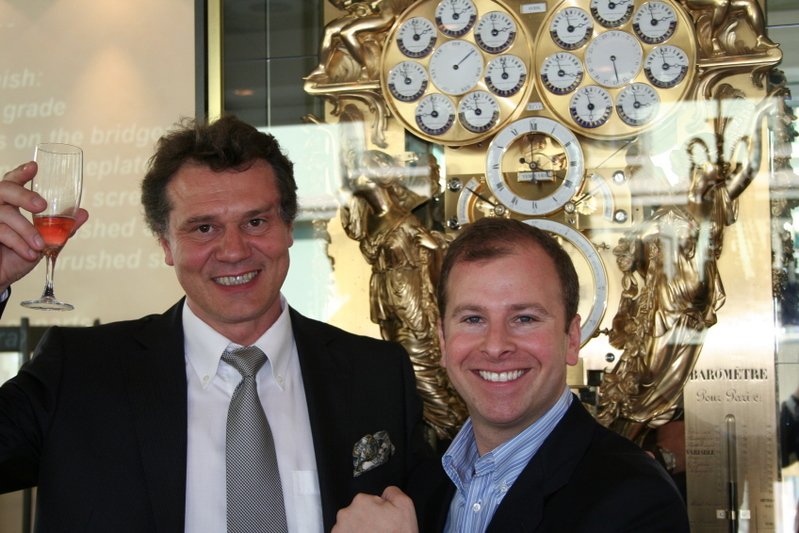
Celebrating the successful launch of the Centigraphe Souverain with Mr. Journe.
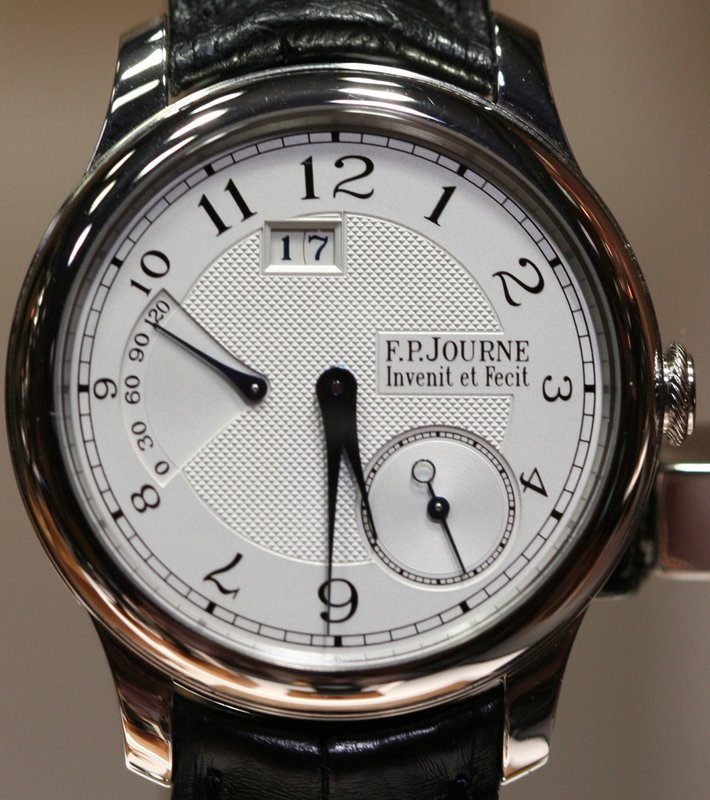
After the exhibition I had time to admire the previously announced Octa automatique series.
Octa Automatique Reserve de Marche
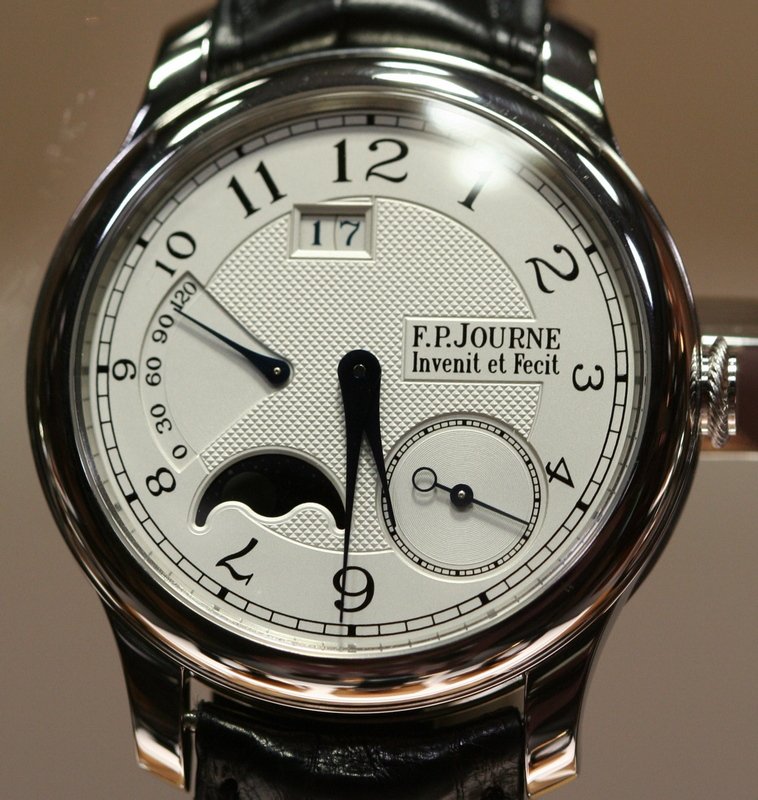
Octa Automatique Lune
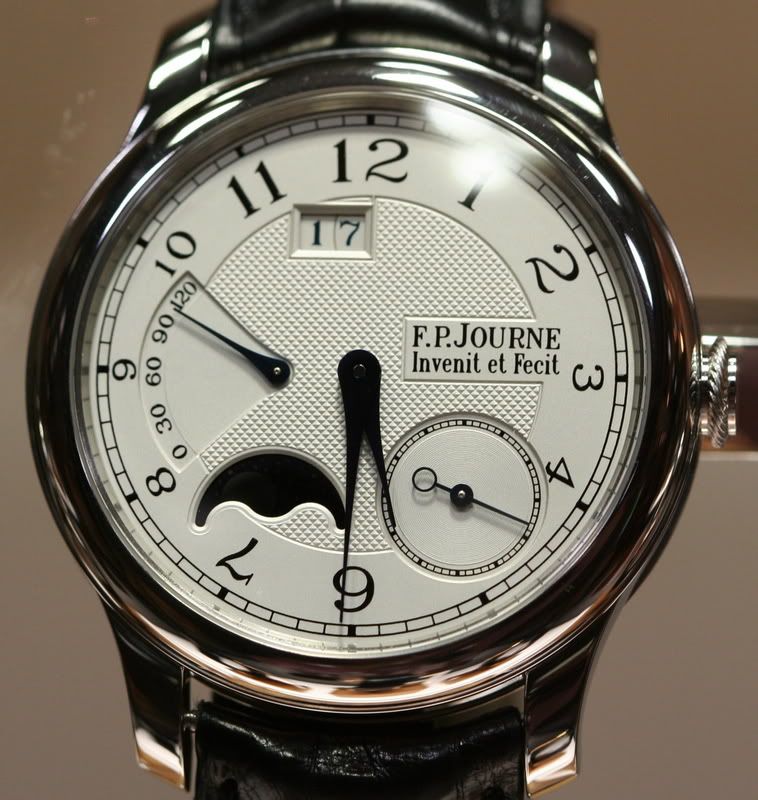
I want to congratulate Mr Journe and his entire team for a wonderful exhibition! Once again he has proven to be a brilliant watchmaker and creator. Invenit et Fecit.
CENTIGRAPHE SOUVERAIN
360,000 KM/H AT YOUR FINGERTIPS
THE ART TO CONVERT 6KM/H IN 360.000KM/H
François-Paul Journe’s spectacular new watch for 2007, the Centigraphe Souverain, is a mechanical
chronograph unlike any that has ever been made before.
The hand-wound movement measures elapsed times from one hundredth of a second to 10 minutes on
three dials, each with a time scale in red and a tachometer scale in black.
The tachometer scales convert times into speeds ranging from 6 km/h — walking pace — to 360,000 km/h,
well above the escape velocity of a rocket going into low-level orbit.
The indications
The flying-seconds hand at 10 o’clock goes around the dial in one second against a scale marked in
hundredths of a second, making it theoretically possible to time an object moving at 360,000 km/h, or
approximately 1/3000ths of the speed of light.
On the dial at 2 o’clock, the hand goes around in 20 seconds and the time scale is marked in seconds. The
outer tachometer scale shows the speed against odd numbers of seconds — 1, 3, 5, etc. — while the inner
scale corresponds to the even numbers of seconds.
The third dial, at 6 o’clock, where the hand goes around in 10 minutes, has a similar tachometer scale with
speeds corresponding to 20-second markers. Thus a kilometre travelled in three minutes 40 seconds
represents a speed of 16.4 km/h (to one decimal place).
Ergonomic chronograph control
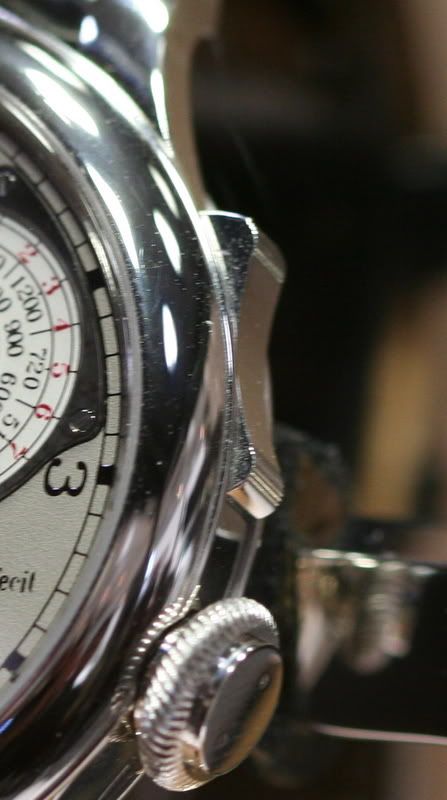
The chronograph is started, stopped and zeroed by a rocker at 2 o’clock in the caseband instead of the usual
buttons on either side of the crown — an ergonomic solution that has been granted a patent.
The rocker turns a column-wheel that activates the levers in the start, stop and zero sequence in the
conventional way.
Patented chronograph mechanism
A second patent has been granted for the ingenious configuration of the mechanism, which effectively
isolates the chronograph from the timekeeping function. This means the amplitude of the balance is
unaffected when the chronograph is running.
This is achieved by using a single mainspring that unwinds at both ends, driving the chronograph trains
from the barrel arbor, and the going train of the movement from the barrel itself.
(This is similar to the mainspring system used in the Sonnerie Souveraine clockwatch).
The one-second counter and the 20-seconds counter are driven by two wheel-trains departing in either
direction from a single intermediate wheel working off the barrel arbor.
A separate train of wheels, also driven by the barrel arbor, moves the 10-minutes chronograph hand.
Flying seconds
The high-speed, flying seconds, released by the escapement of the watch, jumps around the dial 16 times a
second. A wheel, mounted on the fourth wheel of the movement engages a pinion carrying the flying-
seconds hand. This means that the flying seconds are driven by both the going train of the movement,
working off the barrel, and the chronograph train, working off the barrel arbor.
One ingenious feature of the flying-seconds hand is that it can be stopped anywhere along its one-second
journey around its dial, even between two 100th-second divisions, enabling an approximate fractional
reading.
This is done by vertically disengaging the pinion of the flying seconds from the escapement. A device
converting lateral movement into vertical movement pushes the pinion down onto a brake.
Back to zero
The 20-seconds hand and the 10-minutes hand are zeroed by hammer levers acting on snail cams. This
eliminates the play inherent in the conventional heart-pieces while ensuring that the two hands return to
zero anti-clockwise.
The flying-seconds hand is stopped at zero by a beak protruding from its pinion coming against a lever.
Maintaining power and power reserve
Maintaining power ensures that the watch can be wound without interrupting the driving power to the
movement or running chronograph.
The mainspring delivers at least 90 hours of power reserve, and 45 hours with the chronograph running. This message has been edited by bs22fly on 2007-04-19 19:27:15
Brad help me with this. (And pardon me if my question is dumb)...
Another question, how can a watch beating at 21,600 vpm and there about, accurately measure one hundredth of a second.
Finally, how did you like the feel of the rocker ?
Merci
The 1/100th of a second accuracy claim is hard to understand
It doesn't say this is a foudroyante mechanism...and I don't understand how it could be.
Thinking some more about this.....does the hand simply fly around at a rate of revolution in sixteen stages per second, meaning when you press the rocker to stop the chronograph the hand stops and allows you to read the time off the 1/100th scale?
If so this is very approximate, at best.
It moves around the dial "16 times" in one second.
Yes.. measuring speed.
With regards to the frequency of 21,600 v/h (3Hz) this really isn't relevant to the seconds hand. The flying seconds hand actually "jumps around the dial 16 times a second" and "are driven by both the going train of the movement, working off the barrell, and the chronograph train, working off the barrel arbor."
I really liked the feel of the rocker. It was complete natural feeling and very easy to use. Great concept!
That's very interesting. F. P. Journe is always pushing the limits of design. The use. .
and I love the rocker mechanism.Jack

More than 0.1 sec
Athletes and trained persons e.g. 'Quick-draw McGraw' can get close to 150 milliseconds (0.15s).
Complex reaction times (responding to varying stimuli) should be higher.
Regards,
MTF

Thanks Brad for the details. I gain more appreciation of this marvel.
Still curious to learn more about it. Bottomline is that I have liked this watch just from the pictures. Very cool and innovative, yet somewhat it has a romantic old look and feel (for me).

Technical Specifications Summary
Central hours and minutes
One-second chronograph hand at 10'clock
20-seconds chronograph hand at 2 o'clock
10-minutes chronograph hand at 6 o'clock
Dimensions:
Total diameter 34.4mm
Casing-up diameter 34.0mm
Overall height 5.6mm
Movement features:
Central mainspring driving through the barrel and the arbor 15-tooth,
Free-sprung balance with four adjusting weights
Anachron balance-spring
Mobile stud-holder
Pinned collet and stud
Three-position winding crown
Against the case, disengaged
Position 2, winding
Position 3, tiem-setting
Calibre: 1506
Characteristics:
Manual winding
100th-second chronograph
Gold movement
Balance:
Frequency: 21,600 v/h (3Hz)
Inertial: 11.0 mg/cm2
Angle of lift: 52%
Amplitude:
0h dial up: >300 degrees
24h dial up: > 240 degrees
Power reserve:
60 hours without chronograph.
30 hours, chronograph running.
Jewels: 49
Finish:
High grade
Circular stripes on the bridges
Circular-grained baseplate
Polished and bevelled screws
Pegs with rounded, polished ends
Bevelled steel-work with brushed surfaces
This message has been edited by bs22fly on 2007-04-19 07:50:24

Thanks Brad!!!
The pictures are great too.
You are simply superb
LovelyLovely*CL

Thanks for the report Brad!
Don't have the time to read it now but can't wait till I can sit down and read in detail info about the Centrigraphe!
Cheers,
Anthony

Great post Brad. Thanks for the update.
Ohhhh, man. F. P. Journe does it again. This is just a deliciously clever. . .
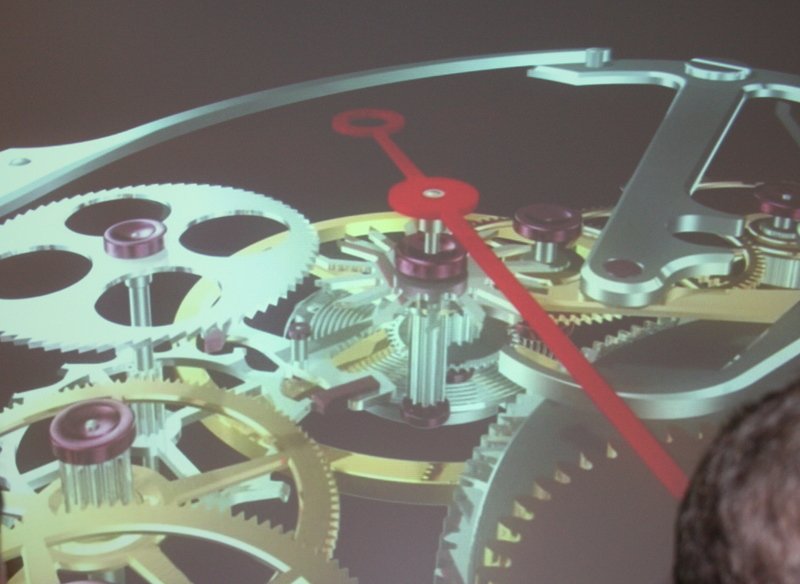
This is exactly the kind of creative mechanical solution that characterizes M. Journe's work IMVHO- you can see the sawtoothed wheel that catches and releases the centigraph hand mounted co-axially with the escape wheel. It's a neat concept -one of the interesting things about it is that it looks like when the chronograph is engaged, you've actually got the centigraph hand 'helping along' the escape wheel.
As usual I would love to see full clear schematics for the whole thing and as usual I bet I have to piece it together on my own from press release pictures
. Still, this just continues M. Journe's incredible saga of both classically harmonious and traditional, yet incredibly novel horological thinking -and all within the idiom of classic watchmaking. No weird materials you need a supercomputer, a cyclotron, and a positron collider to work with (uh, not that there's anything wrong with that  ) .
) .Thanks Brad, great report, and thanks F. P. Journe for keeping the bar set high!
Jack
