
Cartier: The Watchmaker
All the text that follows here and in the follow-up posts are from a recent press release. All the images are from Cartier. However, the press release is informative and the images are excellent, hence this deserves a multi-part post.
Text in italics are my comments, all the rest is from Cartier.
- SJX
Part 1: History
Cartier : The Watchmaker
When Louis-Francois Cartier at the age of 28 established his first, somewhat modest, business in Paris in 1847 there were very few indicators of the great developments and future that lay ahead. Six years after the establishment of his jewellery workshop and first boutique Louis-Francois Cartier realised that fine timepieces would be as important to his clientele as were his jewellery creations. Thus in 1853 the first watches find their way in the Cartier archives and a great watchmaking story begins.
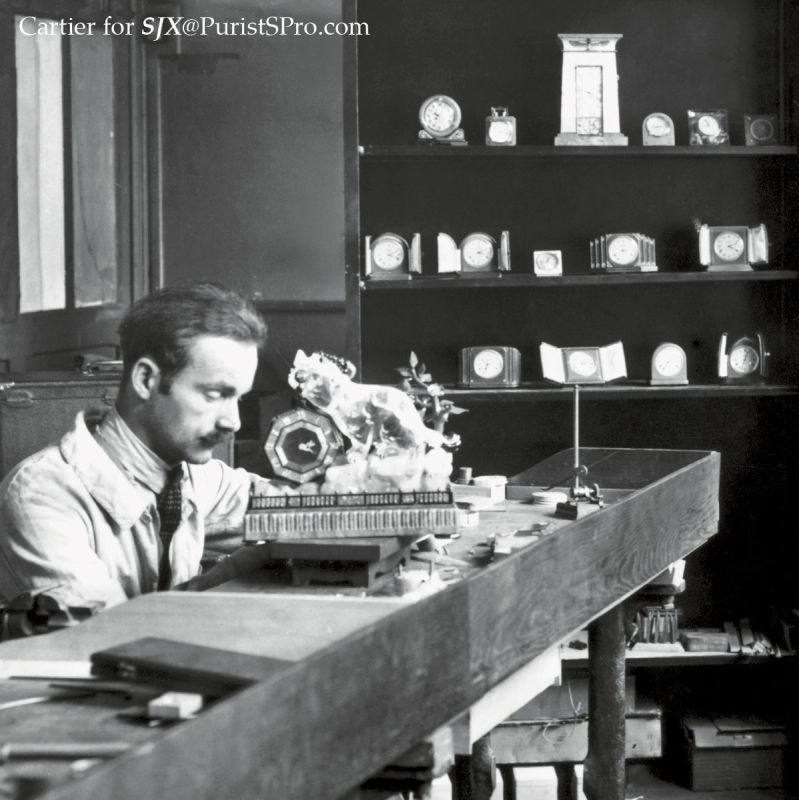
Above: The Cartier clockmaking workshop on rue Lafayette in Paris, headed by Maurice Couet, 1927. On the shelf at the back is the famous Egyptian clock. On the workbench, a Chimera mystery clock is being made.
Between 1853 and the 1890's Cartier timepieces consisted of mainly pocket watches and ladies jewellery watches in the form of pendants, necklaces and rings. Cartier at the time already had created a watchmaking department and was employing its own watchmakers based in Paris. By the early 1900's the passion for fine timepieces had engulfed the grandson of the founder, Louis Cartier, and the modern era of Cartier watchmaking starts with the design of the first wristwatch for men on a leather strap in 1904, the Santos watch.
The Santos watch was immediately followed by a number of other iconic wristwatches such as the Tonneau in 1906, Tortue in 1913, Tank in 1917. Movements were produced either in France or Switzerland and Cartier watches continued to flourish with the introduction of innovative complications that resulted from the exclusive collaboration between Louis Cartier and Edmond Jaeger at the time.
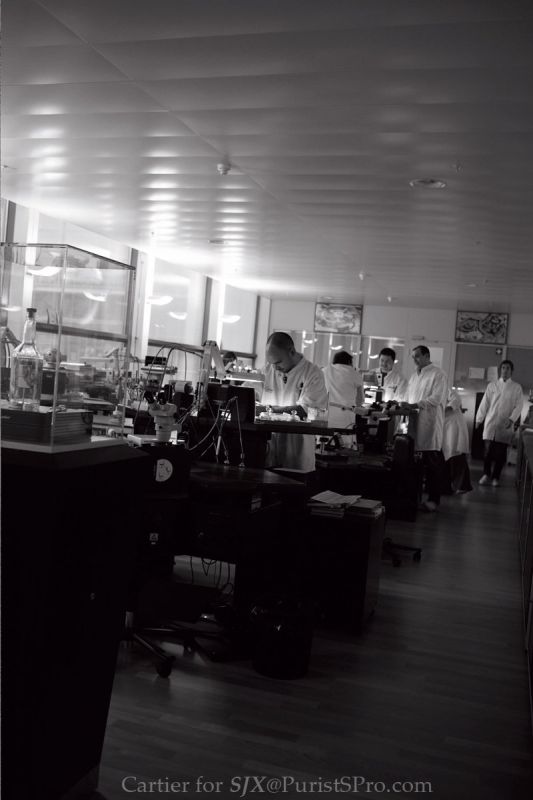
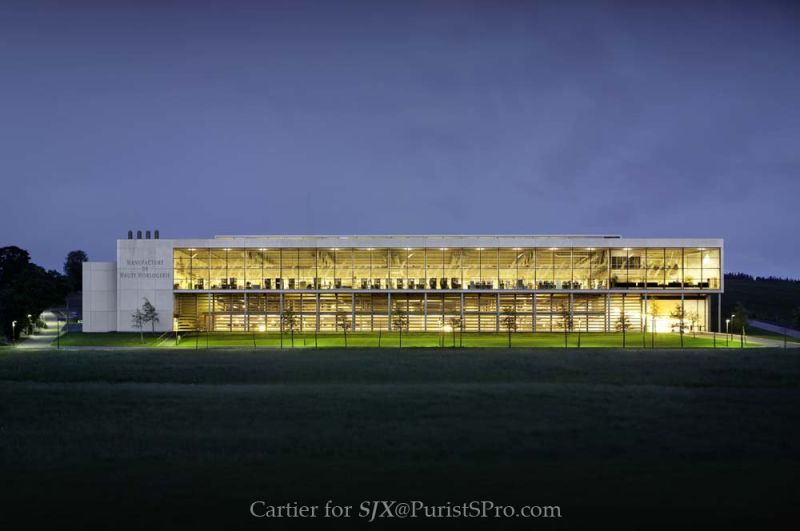
Over the years that followed, Cartier timepieces continued to be highly sought after and production was concentrated in various sites in Switzerland. In 1972 Cartier realized that in order to fully control its own movement production was to embark on a plan to create a fully integrated manufacture. The quest for the brand to reach autonomous manufacture status finally became true in 2003 with the integration of all the brand's watchmaking facilities under one roof, at the Cartier Manufacture in La Chaux-de-Fonds.
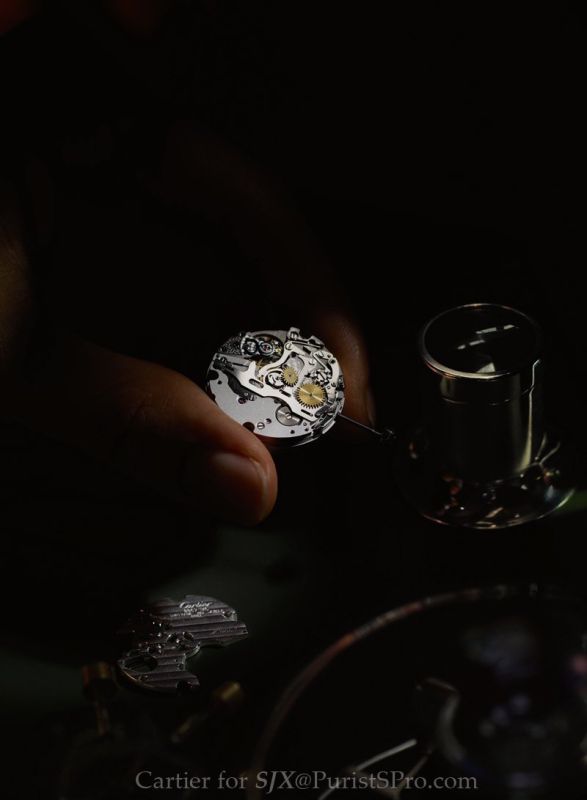
Above: Assembly of Central Chronograph movement
Inside this Manufacture and the brand's Geneva tourbillion workshop is where the movements of today and tomorrow are designed and build. It is from here that a new era in Cartier watchmaking begins.
This message has been edited by SJX on 2009-06-19 09:01:43 This message has been edited by SJX on 2009-06-19 09:20:18
Part II: The Cartier Manufacture in La Chaux-de-Fonds
The Cartier Manufacture in La Chaux-de-Fonds
Cartier has united all the stages of watch making, from design to manufacturing under one roof.
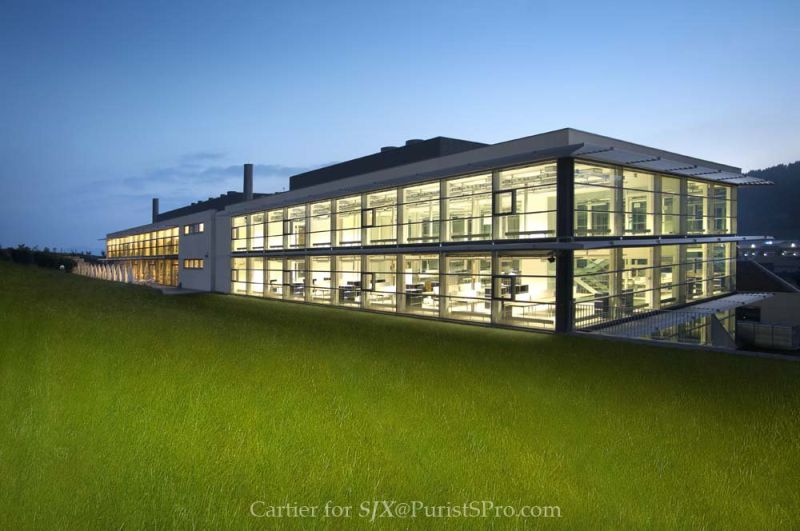
With its priceless watch making heritage, famous shaped watches and expertise transmitted and enriched from generation to generation, the Cartier manufacture has created a unique style and special universe that have won recognition around the world from the very beginning.
Today Cartier is one of the largest, fully integrated Manufactures in Switzerland.
Since 2003, it has brought together all the crafts required to produce Cartier watches in a seamless creative process that extends from the design of the movement to the finished piece itself.
It is a place where watch making modernity and tradition blend together with ease. Here, creativity, precision and innovation are free to explore new horizons, ensuring that Cartier remains a truly exceptional brand.
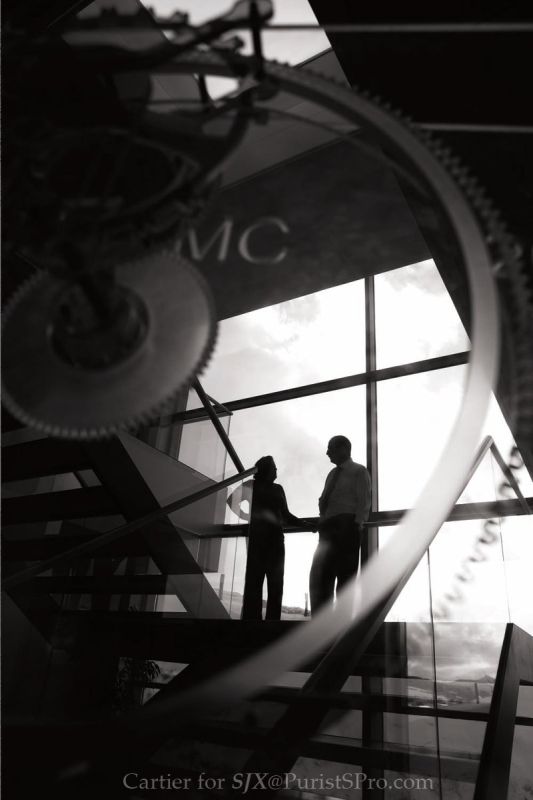
The Home of Tradition
The Manufacture has been in operation since 1972 in La-Chaux-Fonds, at the heart of a region rich in watch making tradition.
In 2001, seven local production sites were consolidated into one single building designed to accommodate 1000 people. It’s total surface area exceeds 33,000 square metres, of which 13,000 square metres are devoted to production.
More than 50 crafts are practiced under this one roof, which cover all the stages of watch production including the development and manufacture of cases, metal bracelets, hands and crystals, gem-setting, the assembly of watches and movements, the repair of old or complicated models and decorative arts.
An Architectural Gem
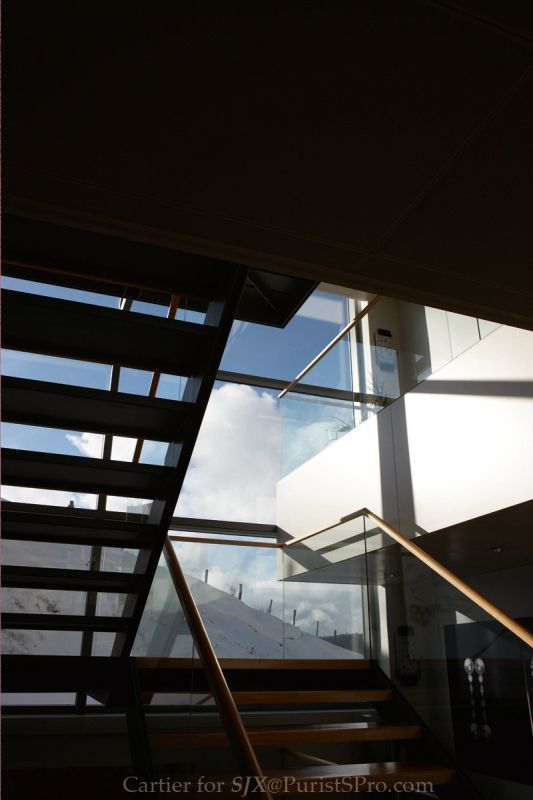
Seen from the road, the building has a simple, compact appearance dominated by large bay windows. It respects its urban surroundings, as well as the valley and panorama of the Jura mountains, and has a remarkable effect of transparency that enables it to fit quite naturally into the landscape.
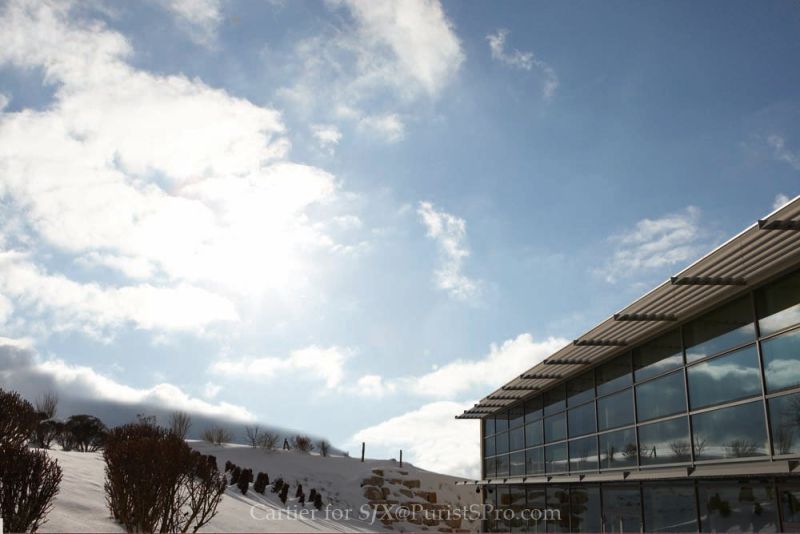

An expansive wall of glass greets the visitor. The classic elegance of the entrance hall offers a contrast of noble materials, with marble, glass and light beech wood creating an atmosphere that is unmistakably Cartier. Watches are displayed in illuminated niches, or small show windows set into large panels of pale wood.
On the upper floors and in the offices, the colors are simple: blue, grey and beige, punctuated with pale wood. Designer furniture by Stark, Mies van der Rohe or Eames set the tone.
The administration and production buildings are linked by a corridor that serves as a spinal column. The axis ensures the flow of internal traffic between the two architectural units.
The Production buildings
The front view of the manufacture is impressive with its long and uninterrupted lines. Among the first to build here when the zone was opened for development, Cartier took the opportunity to set high aesthetic standards in architectural design and materials. The light color of the building is a reflection of the local stone. Five silkscreen-printed Cartier logos punctuate the 90 metre façade.
From the planted roof to the wooded site, everything has been designed to generate a feeling of calm and respect for the environment, a feeling that is as noticeable in the offices and the workshops as it is from the outside.
An Architectural gem: From design to development
The manufacture is organized around three principal axes: development, production and customer service. Its mission is to design, develop and deliver watches in the style of yesterday, today and tomorrow, while safeguarding its future and expertise.
The entire enterprise is motivated to support and strengthen the training environment because, for Cartier, the skills and crafts of watch making are the guarantors of quality and expertise.
Training is an essential dimension at Cartier and underpins its constantly advancing research into the, mastery of watchmaking.
A new wing a new era:
In 2007, a new 3,000 square metres wing with four floors was opened, devoted entirely to development activities: R&D, design, prototypes, industrial methods, mechanics and a laboratory. “One team, one place” is the motto of the Think Tank project (a “Think Watches” idea laboratory) which involves almost 100 people.
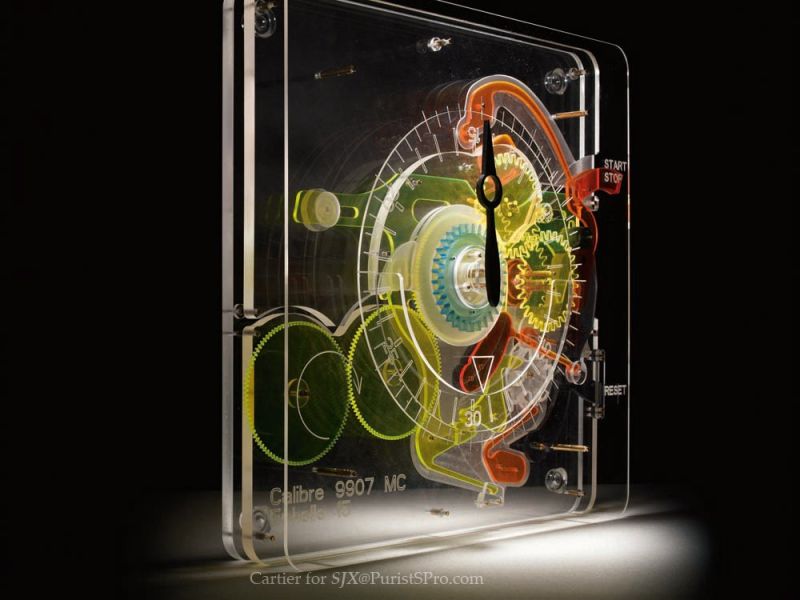
In these offices, the new Cartier watches slowly take shape in a series of meetings between product managers, creative teams and marketing teams; all disciplines are involved from the very start of the process. The average length of time required to move from design to delivery is 18 to 24 months and, today, more than 200 new projects are being developed.
In addition to these “classic” models, jewellery watches, the fine watch making collection and special orders are also created here.
A model of the watch is made, showing its features, components and details in three dimensions.
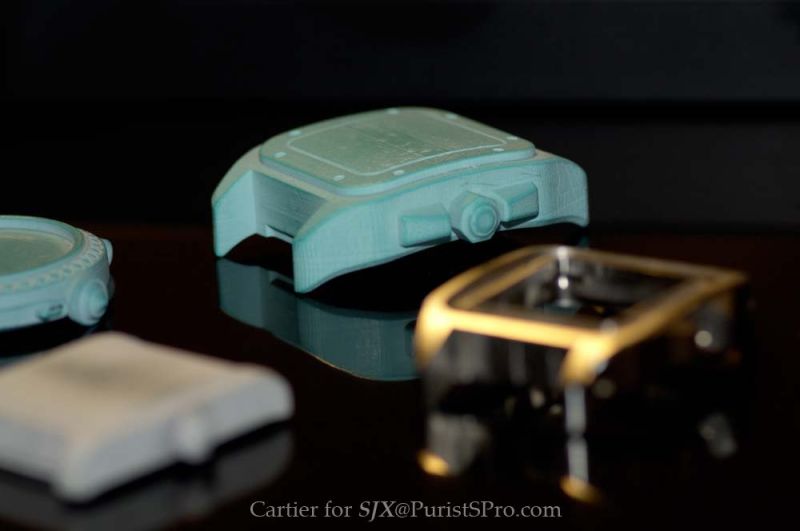
These are then analysed and improved where necessary. The watch that has hitherto been a mere idea or dream now becomes reality. This is the first step towards bringing it to life.
Based on these models, the prototypes are built. Modifications and improvements are made progressively, both in terms of the design itself and its production. To help select the most appropriate methods of manufacturing, machining simulations are prepared. This is the final step before production begins.
Inspired production
In the Exteriors Department, which enjoys an extensive surface area of 4,000 square metres, several components are manufactured every year from gold bars, steel or titanium, then machined, polished and inspected.
In a production process focused on achieving the highest possible quality, samples of every raw material and provision are carefully tested. This rigour reflects a highly selective supply policy that requires suppliers and sub-contractors to meet very strict criteria. In this way, Cartier clearly lays out its expectations in the watch making industry, upstream of production.
The newly produced watch cases, together with the links and other components of metal bracelets, are carefully machined before they pass through the traditional watch making stages of polishing, assembling, adjusting and , for precious watches, gem-setting.
Polishing is an essential and highly demanding skill that can only be acquired thought years of practice. It is an example of artisanal and personal expertise that demands great dexterity to create polished and brushed finishes on the same piece.
Polishing is a slow operation that can require as much as two hours of manual work per watch.
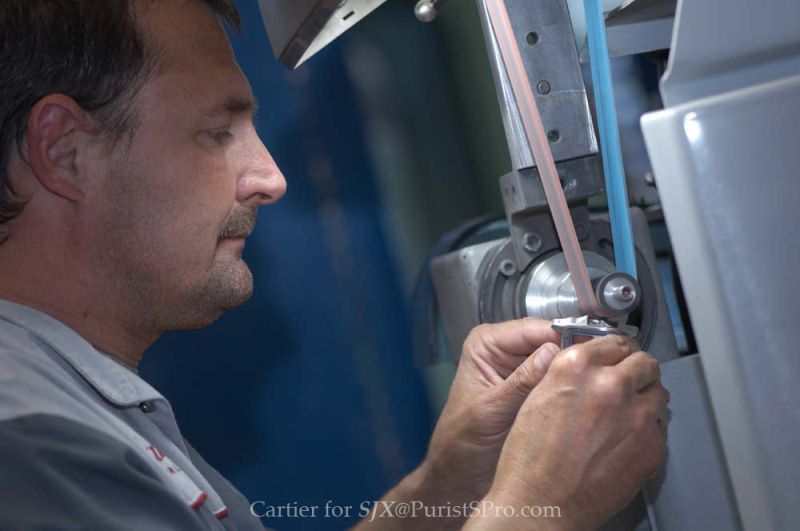
The Ballon Bleu de Cartier needs an average of 20 separate polishing operations on the case and 30 on the bracelet. Today, 150 independent, totally modular polishing stations operate in the manufacture.
At the same time, similar finishing operations are performed on large volumes of gold each year.
Due to the value of this precious metal, they are carried out in a special, private zone that is subject to close control.
The Artistic Crafts
In the Jewellery Workshop, the precious cut stones are set into bracelets, cases and bezels, or onto shafts. The air of quiet concentration recalls the workshops of another era as craftsmen, seated in front of their binoculars and jewellers wax, create pieces that are always rare and often unique.
This is slow, meticulous work. To set the case of a paved Ballon Bleu de Cartier watch, for example, requires three full days.
(NB: Cartier also does enamelling in-house, examples are shown below. - SJX)
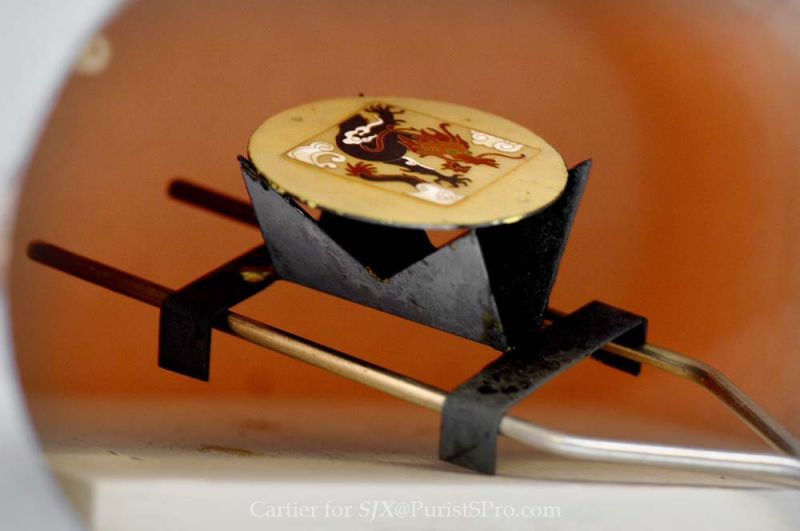
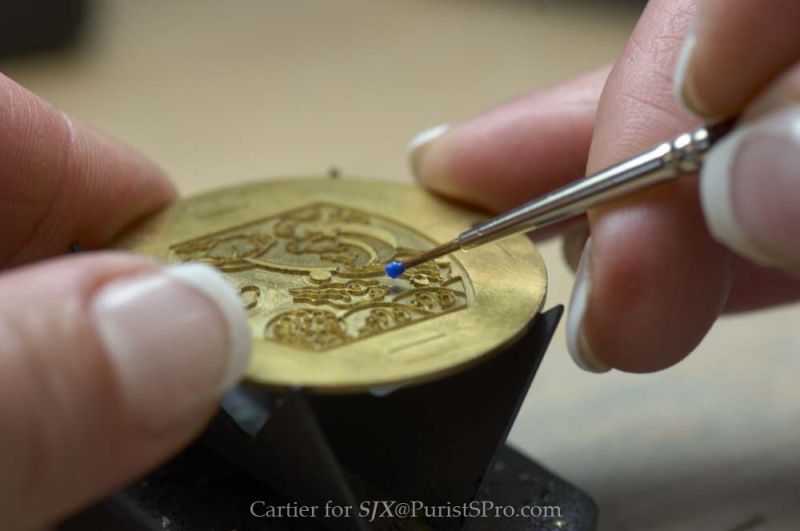
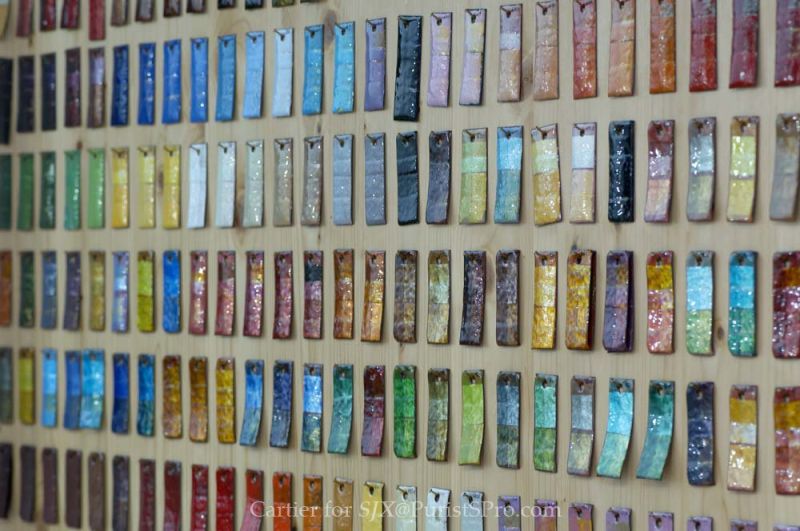
The Watchmakers Room
After manufacture, the parts are transported into a 2,000 square metre hall known as The Watchmakers Room. Here, the movements watch heads and bracelets are assembled. To reduce the presence of dust – the arch enemy of this operation – the air is filtered and recycled continuously, while the use of special overalls and slippers are obligatory.
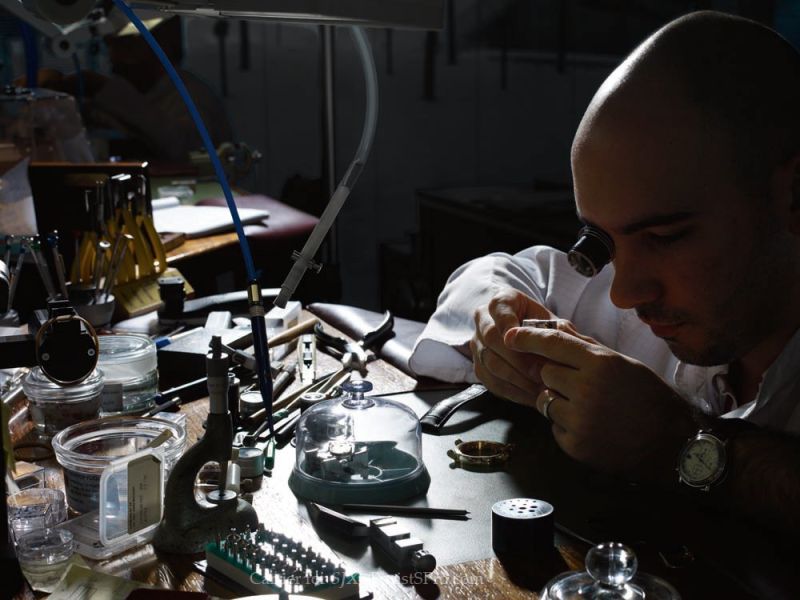
The dial and the hands are fitted to the movement, which is then positioned on the case. These elements together form the watch head.
(NB: Naturally Cartier also assembles and finishes movements at La Chaux-de-Fonds; assembly of movements is shown below. - SJX)
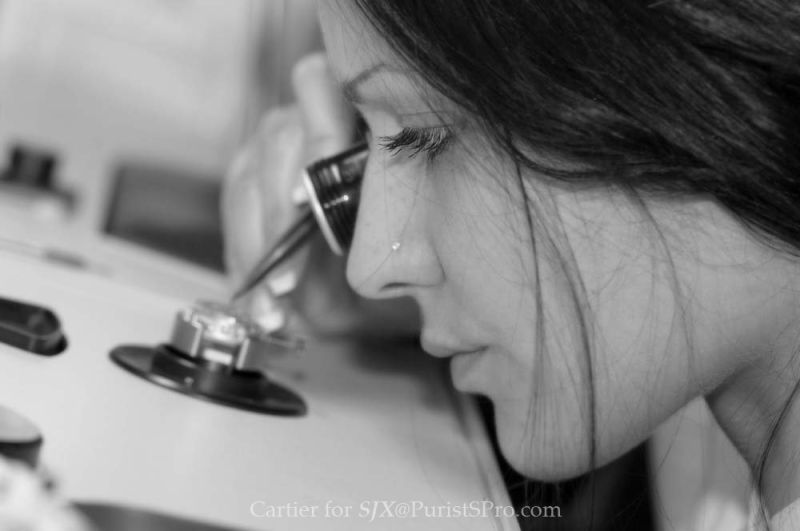
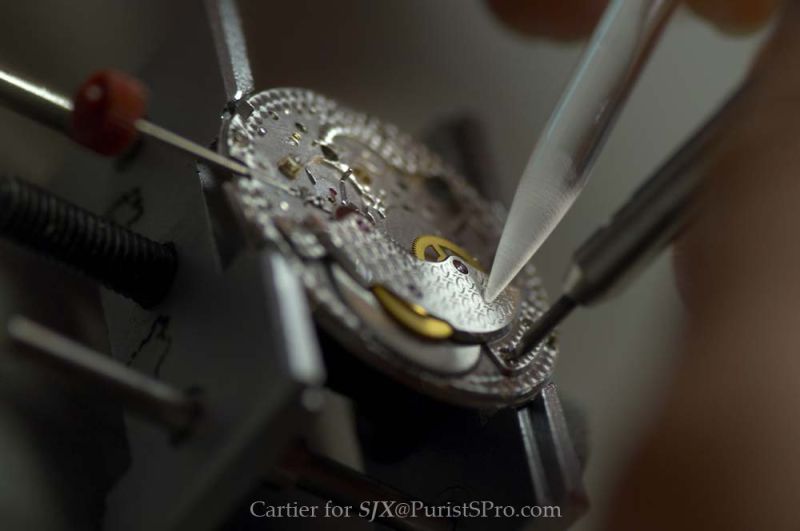
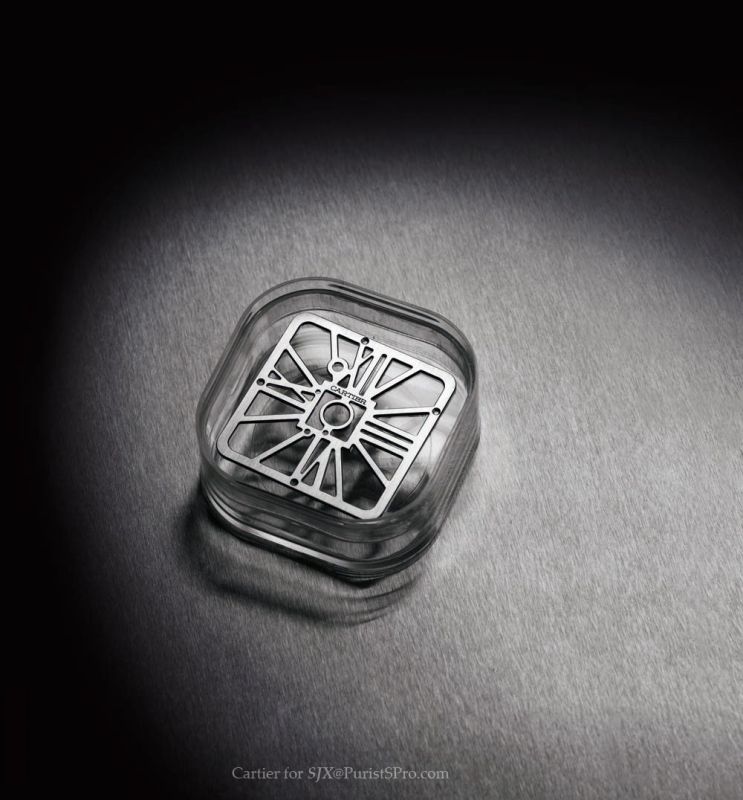
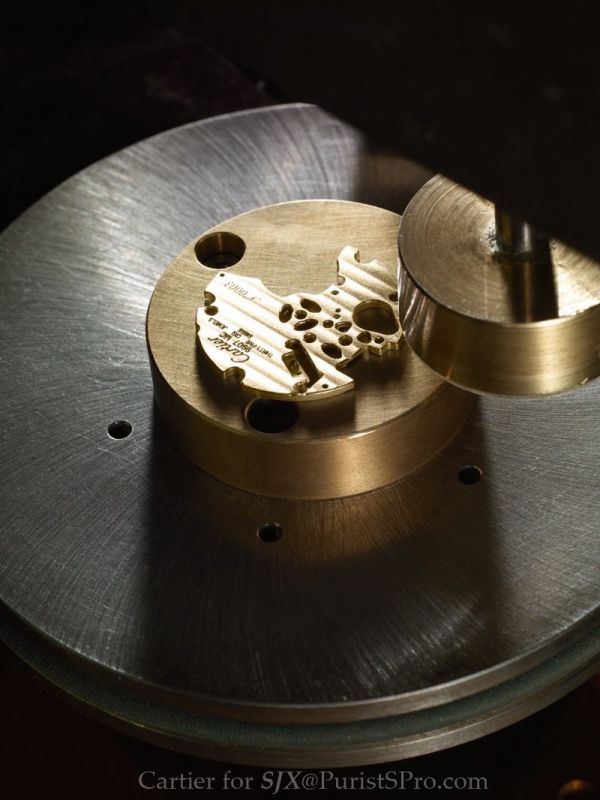
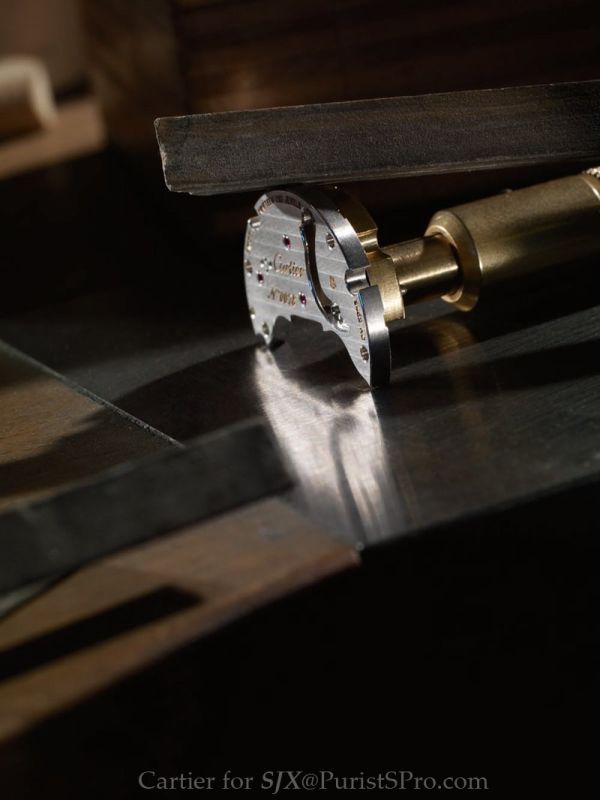
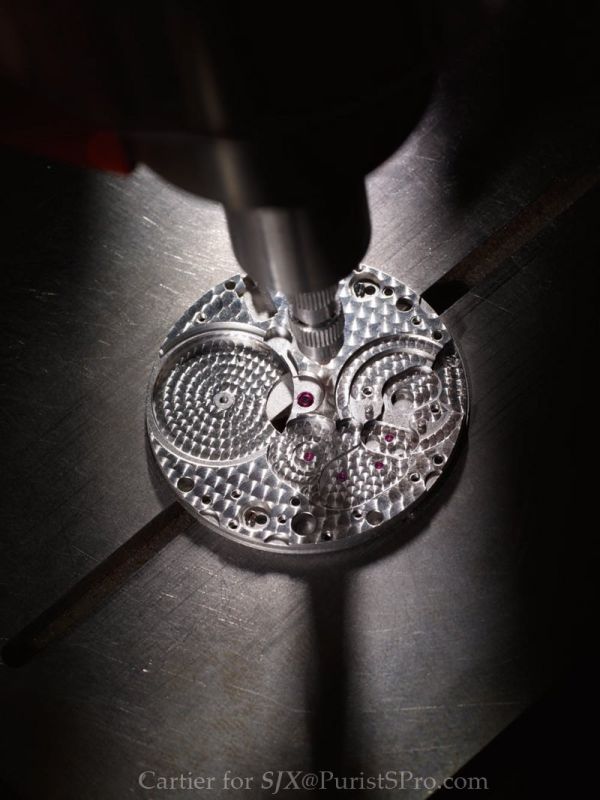
(NB: Cartier performs significant finishing, especially for its high-end models. The first three pictures below depict finishing for the skeleton bridges of the Santos 100 Skeleton while the other pictures show the decoration of the movement found in the Central Chronograph. - SJX)
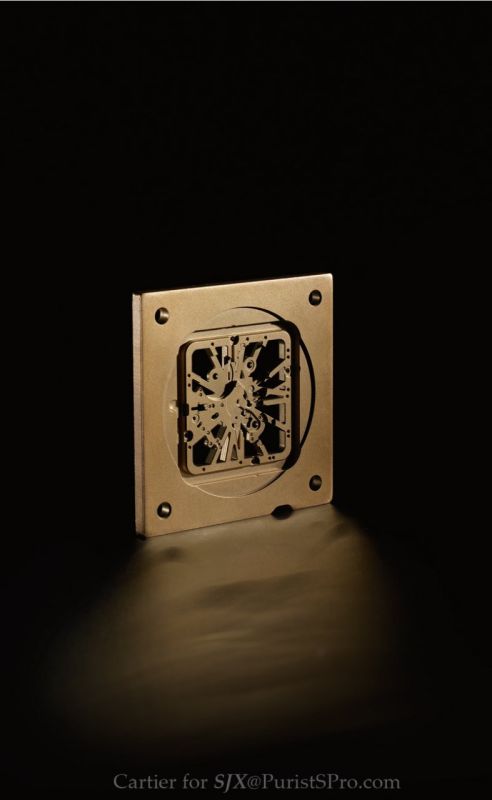
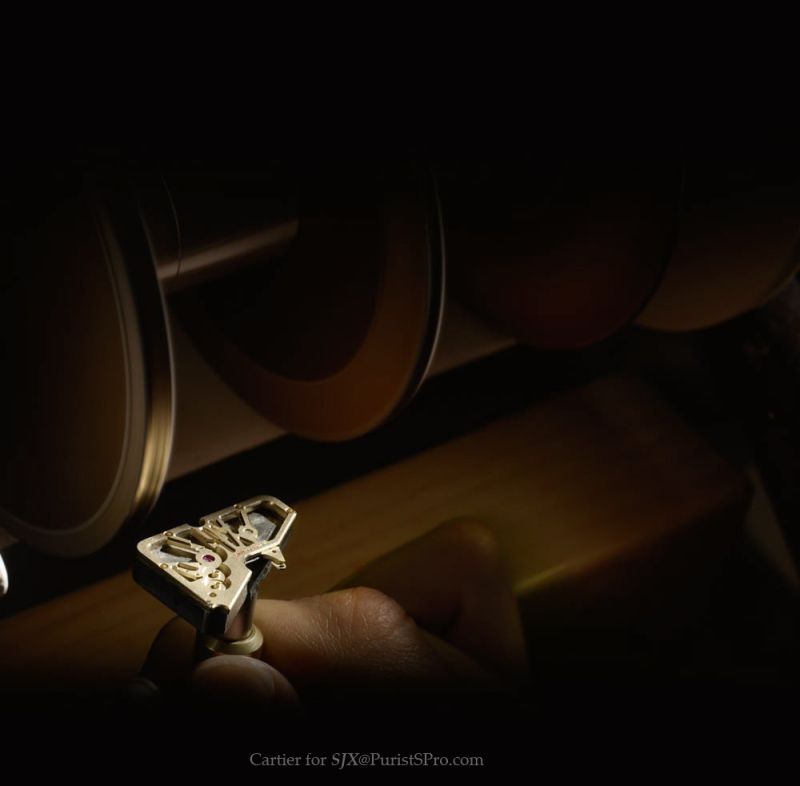
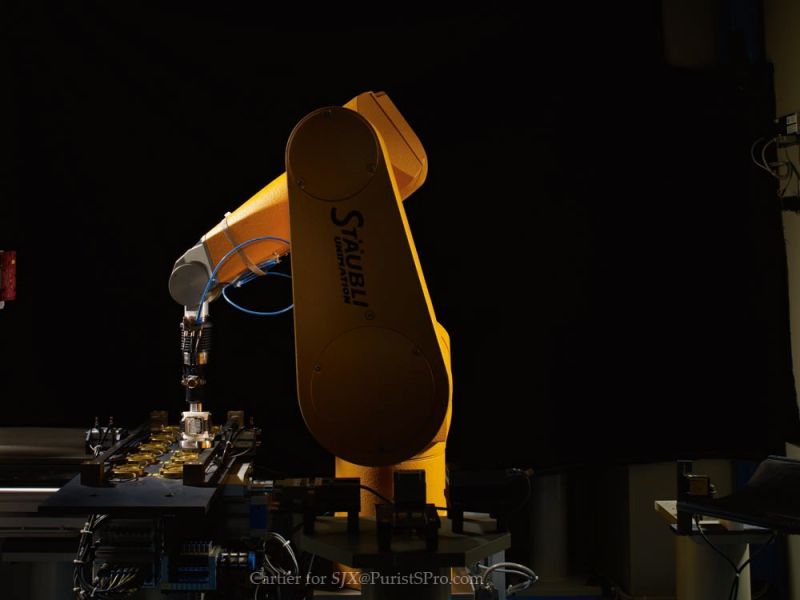
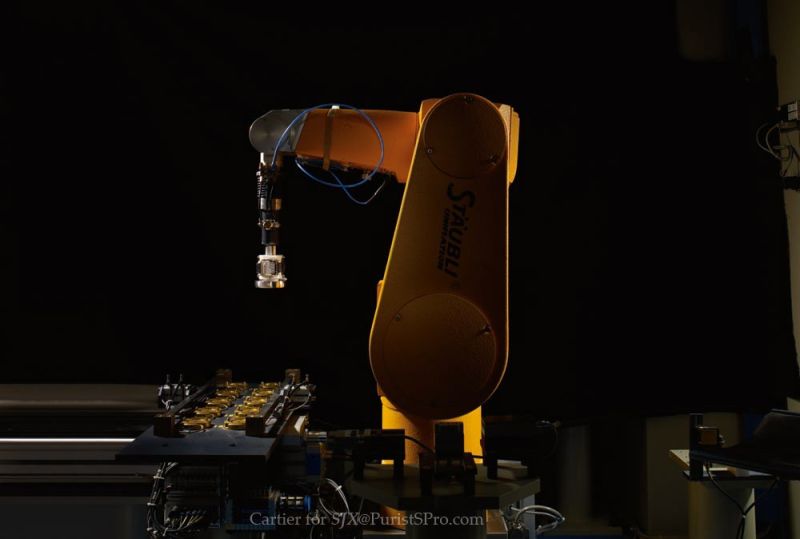
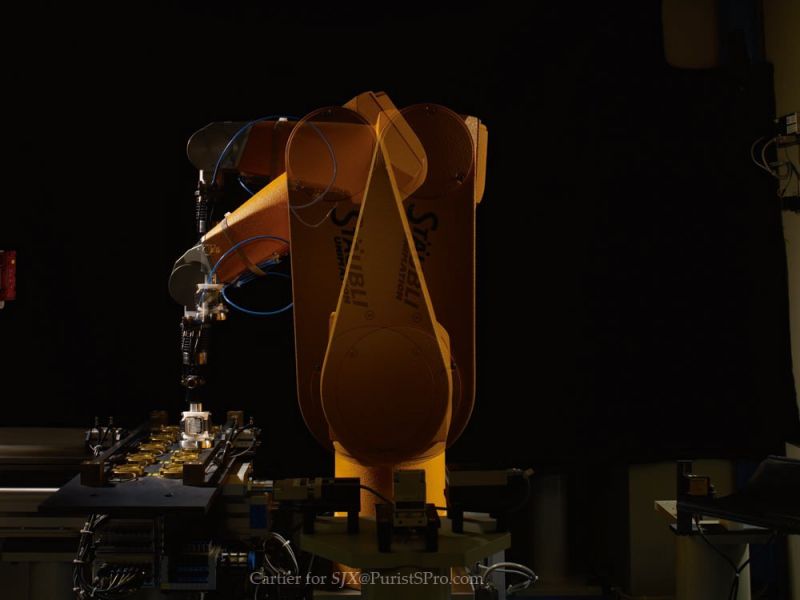
Tests and checks: a rigorous approach.
Te watch case is mounted on the bracelet only when a series of checks confirm the parallelism of the hands, the correct operation of the movement and water-resistance of the case.
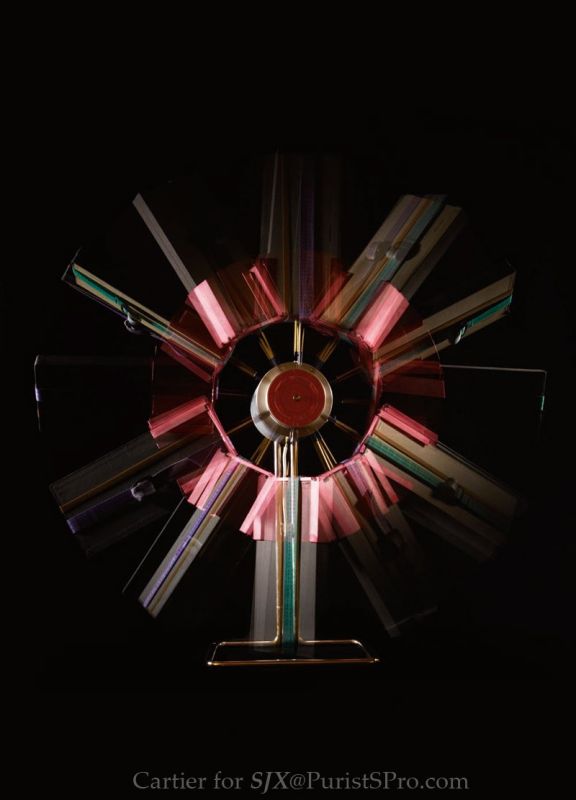
Tests are also performed whenever an anomaly is noted. Nothing is left to chance: the dimensional, aesthetic, electrical, mechanical and chemical aspects of every watch are all analyzed.

Corrective action is proposed, carefully considered and, if structural, integrated into the production process. When testing is complete, the watch is sent to the distribution unit and then onto the boutiques.
The Tradition Workshop
Complication watches – vintage Cartier watches
Cartier has always been a prominent creator of shaped watches and of models that’s reflect the greatest watch making traditions. A room has been entirely reserved for complication watches and for the repair of watches and movements.
Representatives of the traditional crafts of watch making are grouped around small, dark wooden benches. They concentrate on the assembly of watches and movements, the restoration of vintage Cartier watches and the repair of movements of Fine Watch making models.
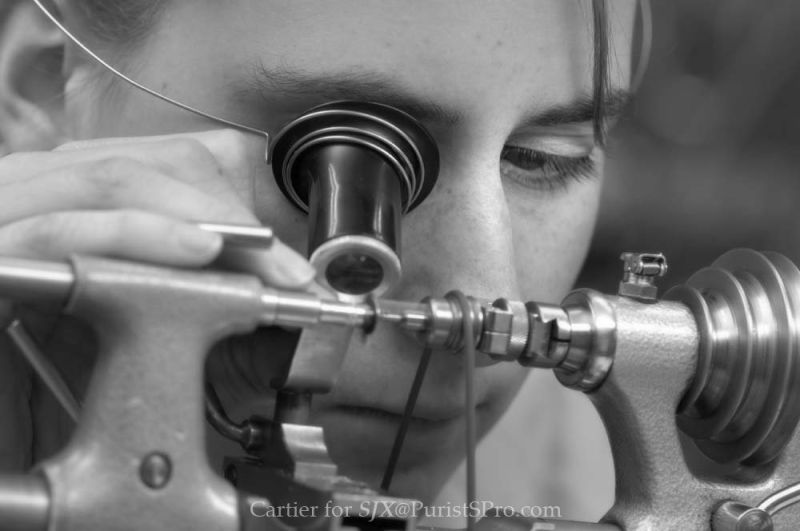
Above all, watchmaking is an art. Its roots are linked to the creation of beautiful objects and it draws on numerous artistic crafts to enhance its products. Goldsmiths, engravers, painters, sculptors and gem-setters all contribute to producing a splendid timepiece. Today, watch making is one of the few sectors in which these crafts still thrive, finding new horizons to explore and new forms of expressions. They create exceptional movements that contain 300 to 500 miniscule components, truly exceptional movements.
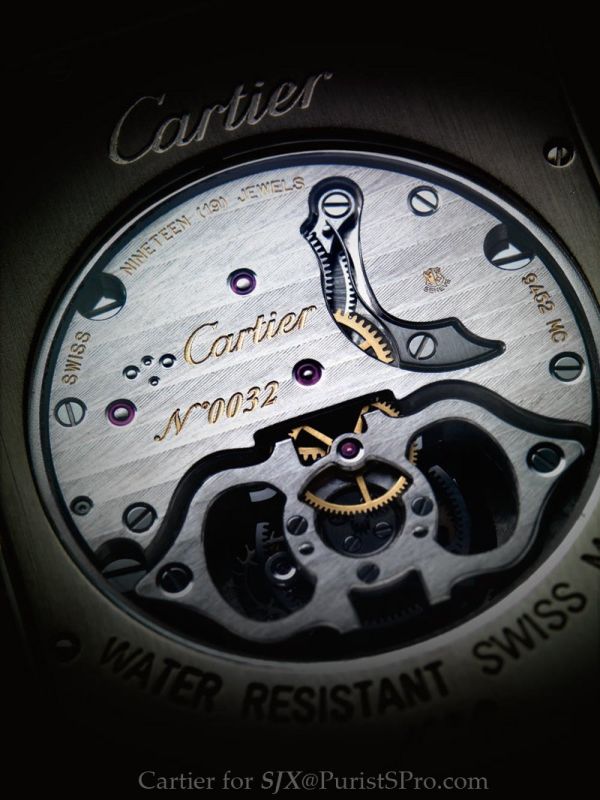
Serving our Clients
To ensure that a watch functions correctly and accurately, it must be serviced regularly. This applies particularly to models in the Fine watch making collection: they are more complicated and contain larger number of parts, all of which are subjected to constant force and friction while operating in a limited space.
To meet the requirements of the clients, the Customer Service Division has been incorporated into the Manufacture. It is “tailor-made” service responsible for the repair of watches and movements, the production of certain watches, and the preparation of technical documents. It can also remake components of extremely old watches, by using a surviving model as a reference for example, without the help of any technical drawings.
The Fine Watch making collection includes extremely delicate timepieces and requires very specific knowledge. Each master watchmaker specializes in a certain type of “Grande Complication” and a timepiece that requires servicing will been trusted to the craftsman who assembled it.
More than a watch…. a legacy. Cartier watches are eternal – and can always be repaired. The earliest models are already into their second century.
Meeting the challenges of tomorrow, ensuring the long life of its creations and the survival of its crafts – that is the mission of the Cartier manufacture, which has assembled, in La Chaux-de-Fonds, all the people and tools necessary to anticipate the future demands of watchmaking.
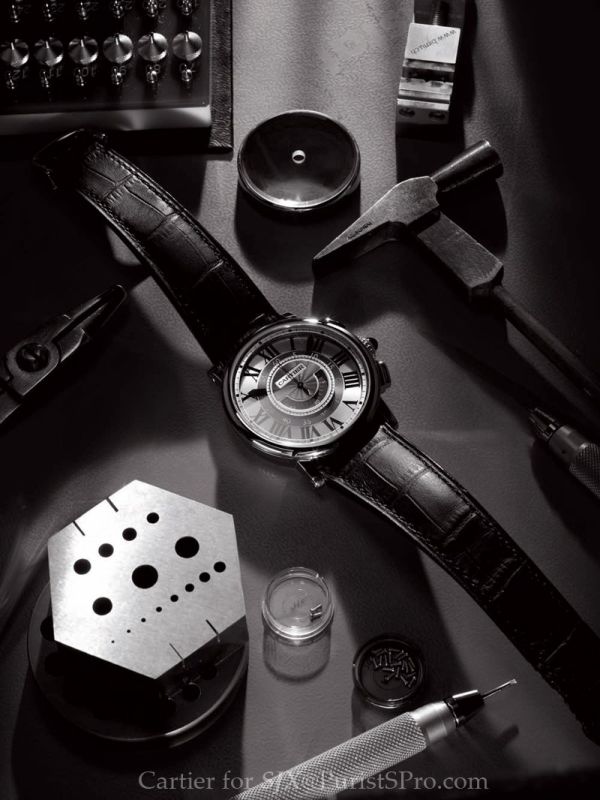
Part III: Cartier in La Chaux-de-Fonds – Timeline
Cartier La Chaux-de-Fonds – Timeline
1972: Cartier is established in La Chaux-de-Fonds. Until this point, Cartier watches were produced in France and equipped with Swiss movements. In 1972, Cartier finds a company with impeccable credentials, Ebel, in Neuchâtel; a master of watchmaking that is able to match Cartier’s ambitious new plans.
1976: Cartier’s industrial equipment is strengthened by a partnership with Cristalo. This is an important step, not only in the careful and progressive building of a production channel but in gaining control of expertise.
1977: Introduction of the Tank Must watch – inspired by the Tank Louis Cartier model.
1978: Launch of the Santos de Cartier watch – inspired by a 1904 model.
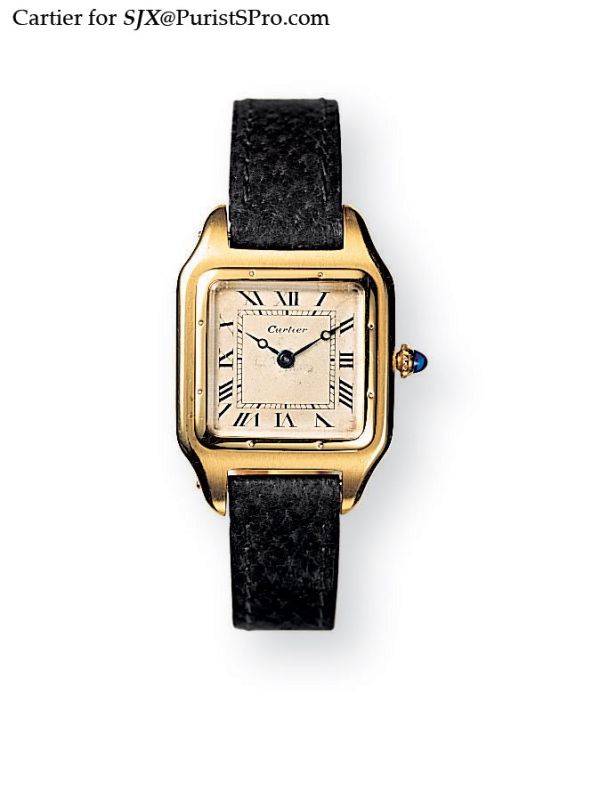
Above: Cartier Santos circa 1914
1983: Introduction of the Panthère de Cartier watch.
1985 : Launch of the Pasha de Cartier watch.
1989 : Development of the Tank Américaine watch. Acquisition of Paolini SA, a specialist manufacturer of cases and bracelet clasps, and of Michel Leuenberger SA, a specialist in the polishing of cases and bracelets. Founding of a Manufacture at Saint-Imier, with 180 staff engaged in developing and assembling watches. This new geographic association led to the integration of CEC (Compagnie Ebel Cartier) by Cartier, and in turn to the centralisation of the manufacture of cases, bracelets and clasps. By absorbing this company, Cartier was thus able to draw on the expertise of 430 employees.
1991 : Cartier groups certain activities together, such as the production and assembly of movements for mechanical and quartz watches (CEC2), before the Saint-Imier company transfers its product development activities to a new building in Villeret, designed by the architect Jean Nouvel.
1994 : Cartier groups together its operations based in Sonvilier that specialise in hot-stamping equipment (SOFAC) and in polishing (Michel Leuenberger SA).
1995 : Introduction of the Pasha C watch.
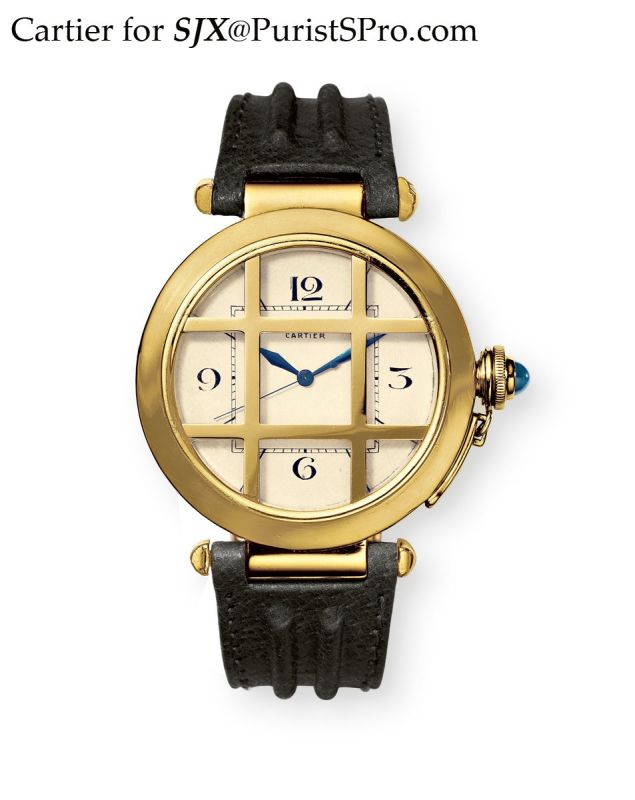
Above: Cartier Pasha
1996 : Launch of the Tank Française watch.
1998 : Creation of the Collection Privée Cartier Paris.
2001 : Construction of a new building to the west of La Chaux-de-Fonds, which brought together a range of operations, hitherto dispersed over 5 sites. Design and production of the Roadster watch.
2003 : Cartier Watchmaking takes ownership of the new 30,000 m2 building and brings all the activities required for the production of watches to La Chaux-de-Fonds. Creation of a centre for training in the watchmaking crafts.
2006 : Introduction of La Doña de Cartier watch.
2007 : Construction of a new 3,000 m2 wing on four floors devoted entirely to development activities: R&D, 3-D modelling, design, prototypes, industrial methods, mechanics and laboratories. Launch of the Ballon Bleu de Cartier watch.
2008 : Cartier Watchmaking introduces an environment protection policy as part of the Cartier Corporate Responsibility Programme.
This message has been edited by SJX on 2009-06-19 08:56:59Part IV: Vintage pieces from the Cartier archives
A selection of notable pieces from the Cartier collection.
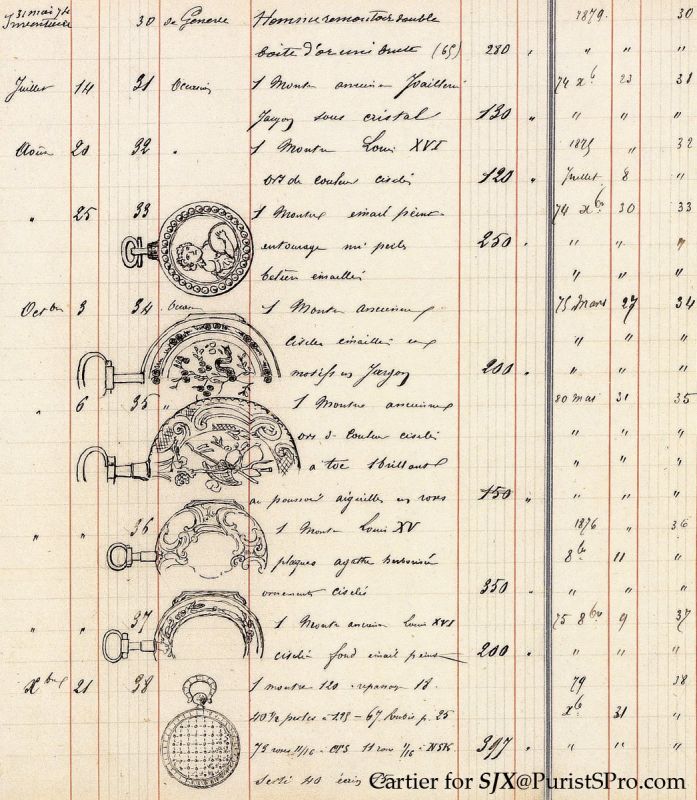
Above: Cartier sales ledger c.1875-76
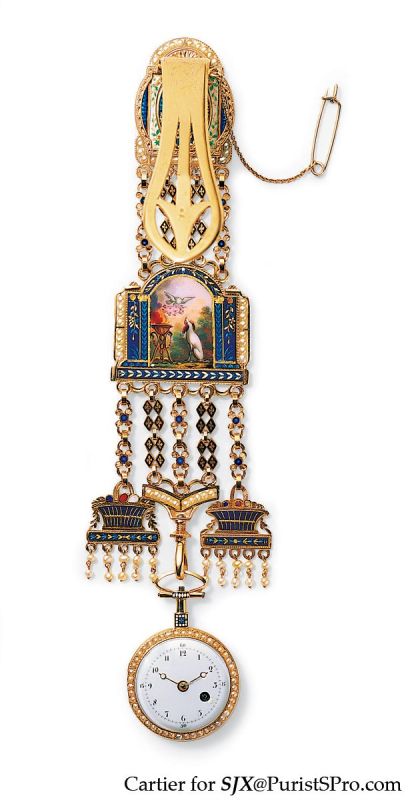
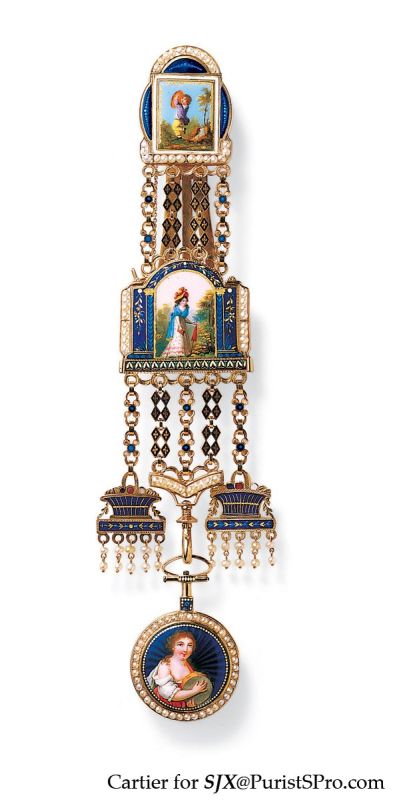
Above: Enamelled pendant watches, Cartier Paris, c. 1874
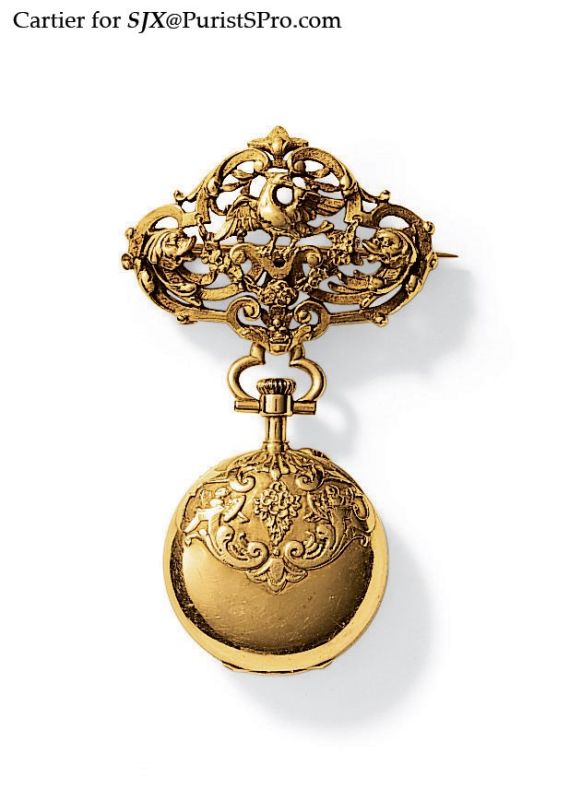
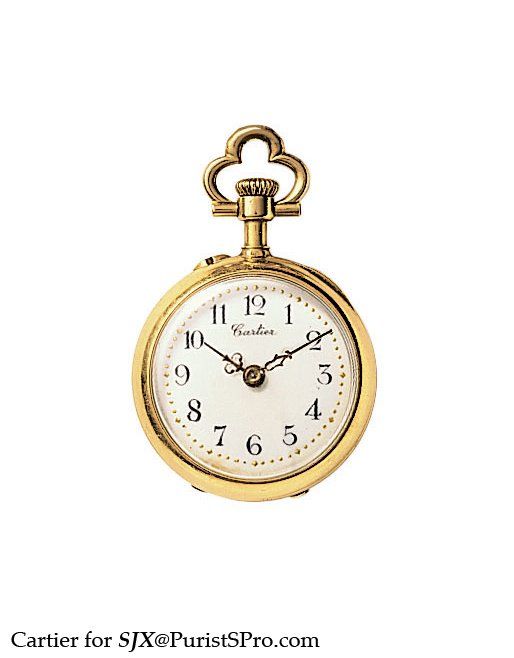
Above: Brooch watch, c. 1880
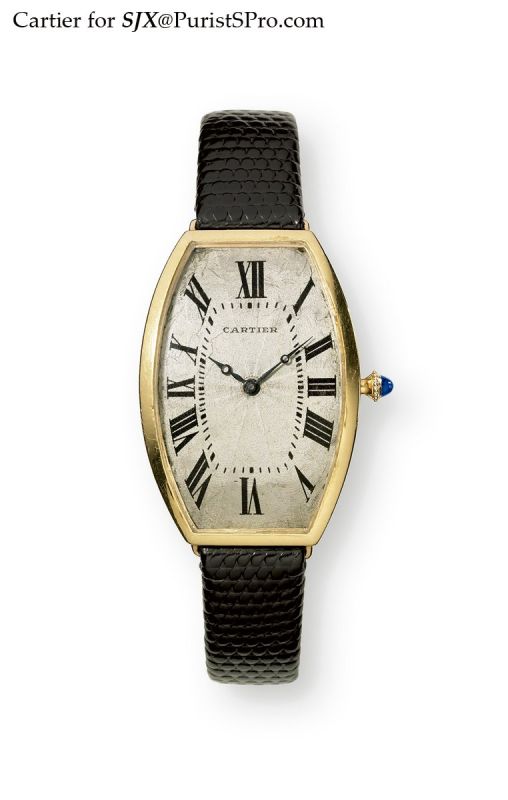
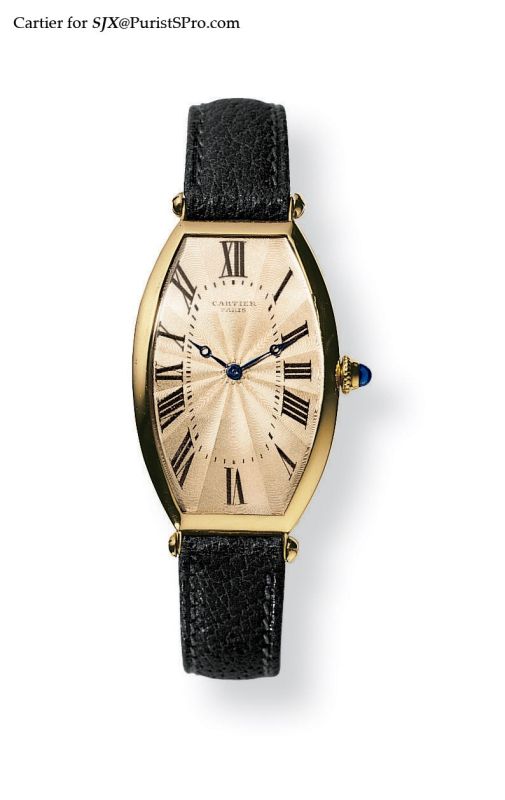
Above: Pair of Cartier tonneau wristwatches, c. 1908 and 1911 (top and bottom respectively); inspiration for Bagnoire
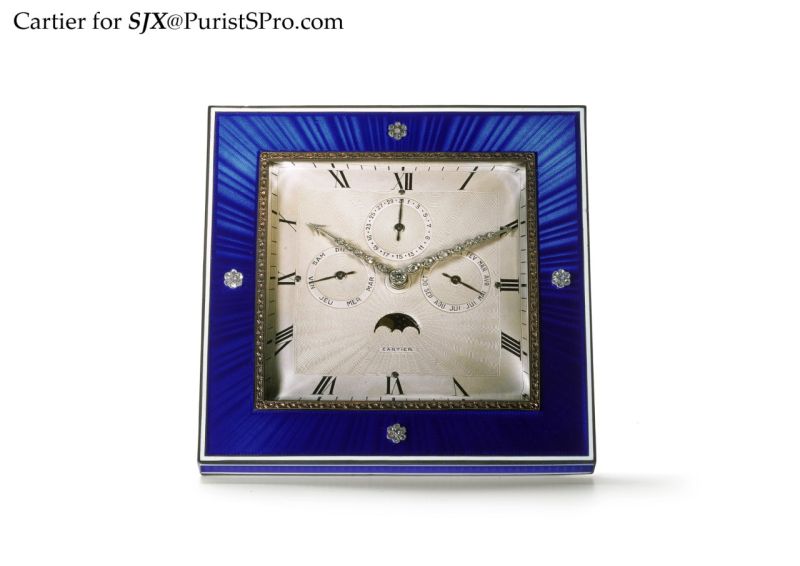
Above: Strut clock with calendar and moon phase, Cartier Paris, c. 1912
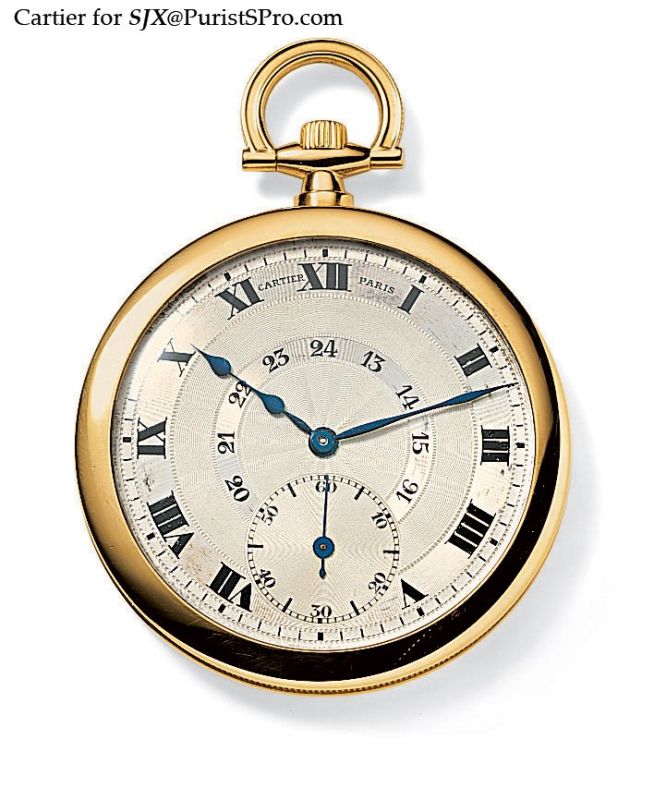
Above: Minute repeater wristwatch with double chapter ring, c. 1912

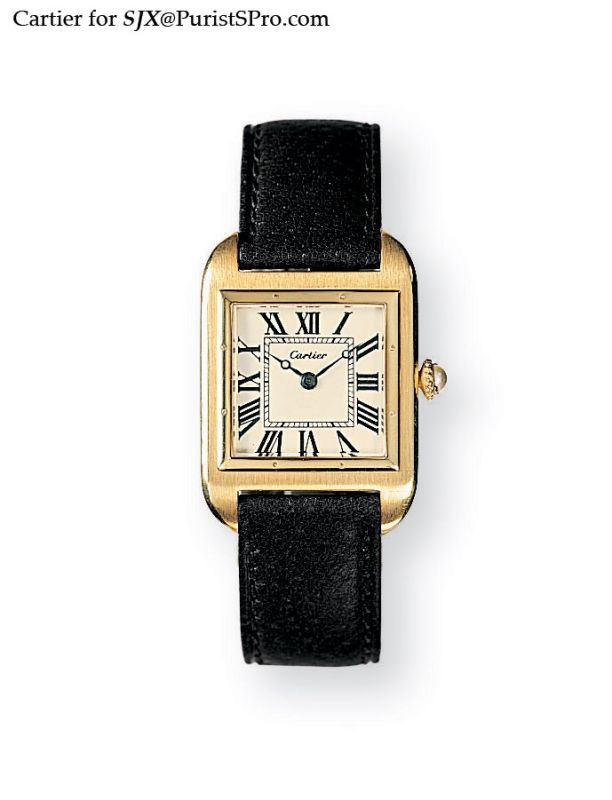
Above: Santos, c. 1914, and Santos Droit, c. 1915 (top and bottom respectively)
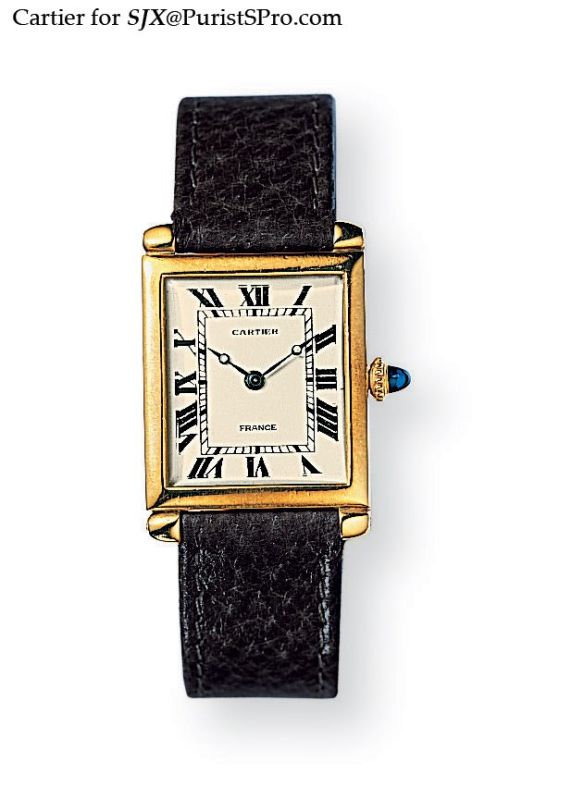
Above: Wristwatch from Cartier Paris, c. 1924
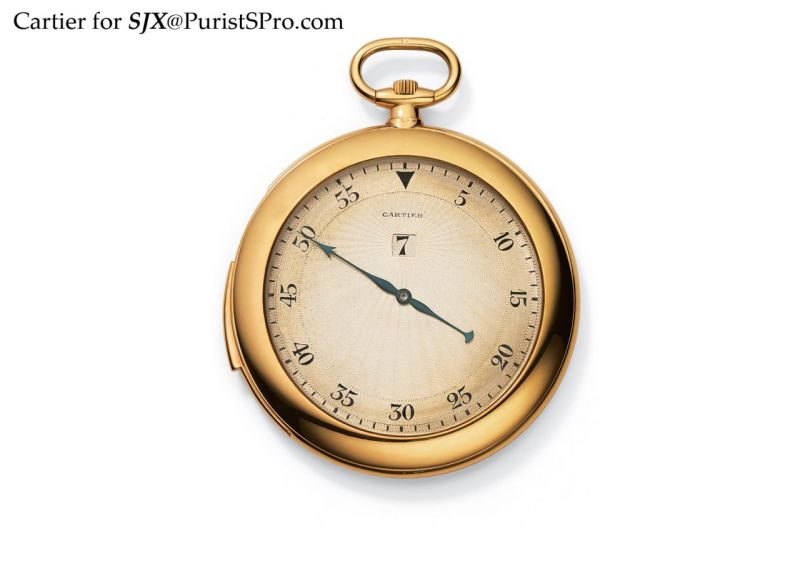
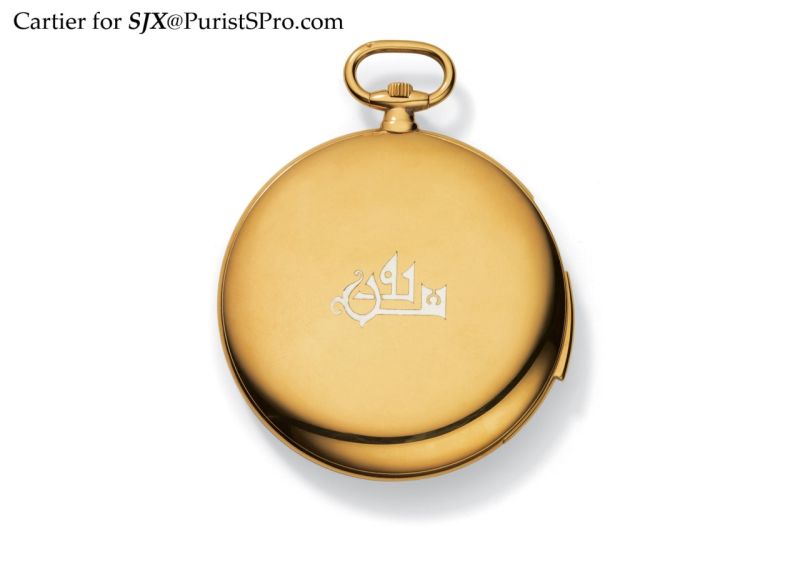
Above: Minute repeater pocket watch with jumping hours, c. 1921
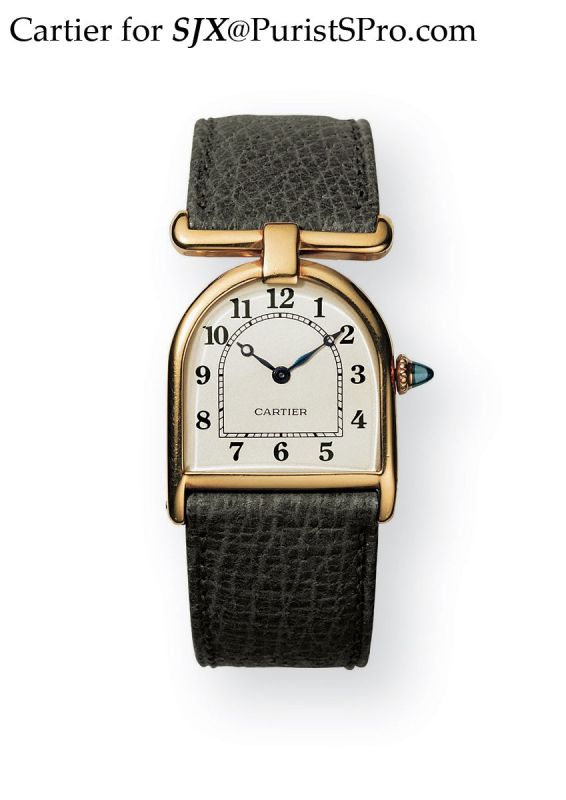
Above: Cloche shaped wristwatch, c. 1923
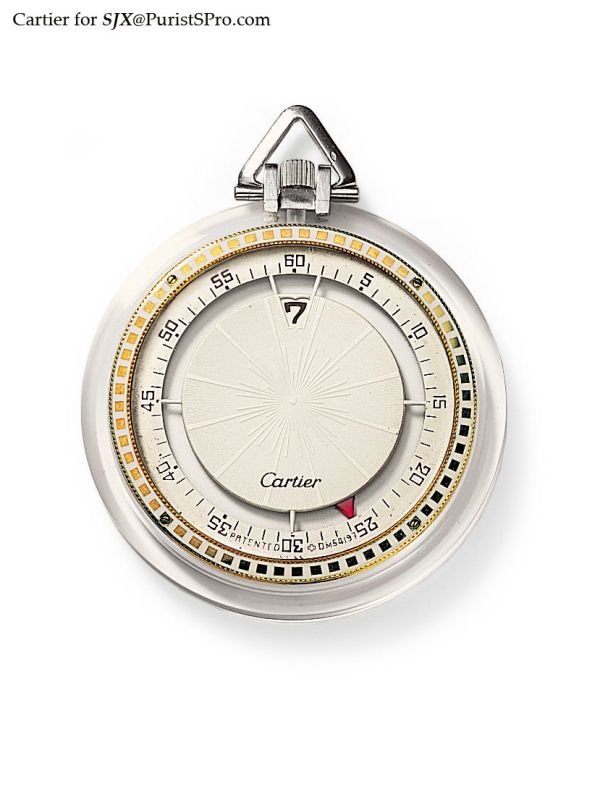
Above: Jumping hour pocket watch with display back, c. 1923
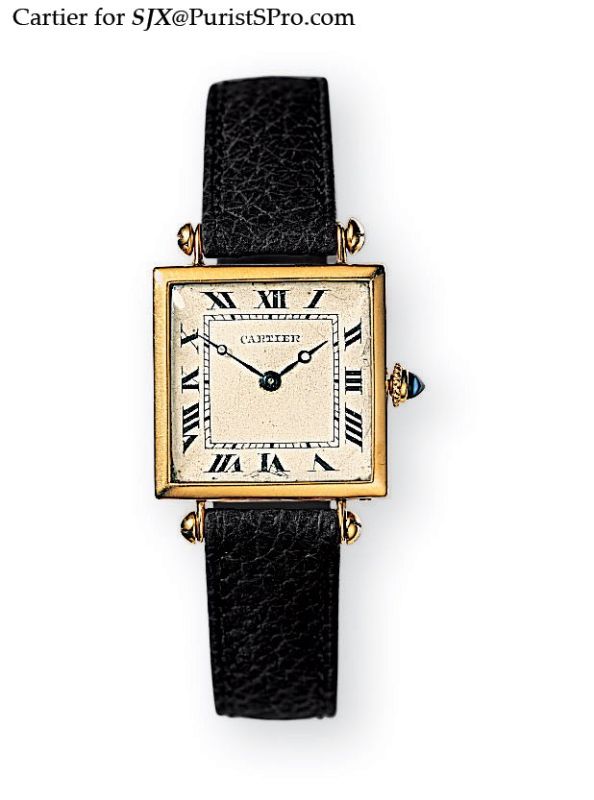
Above: Wristwatch from Cartier Paris, c. 1924
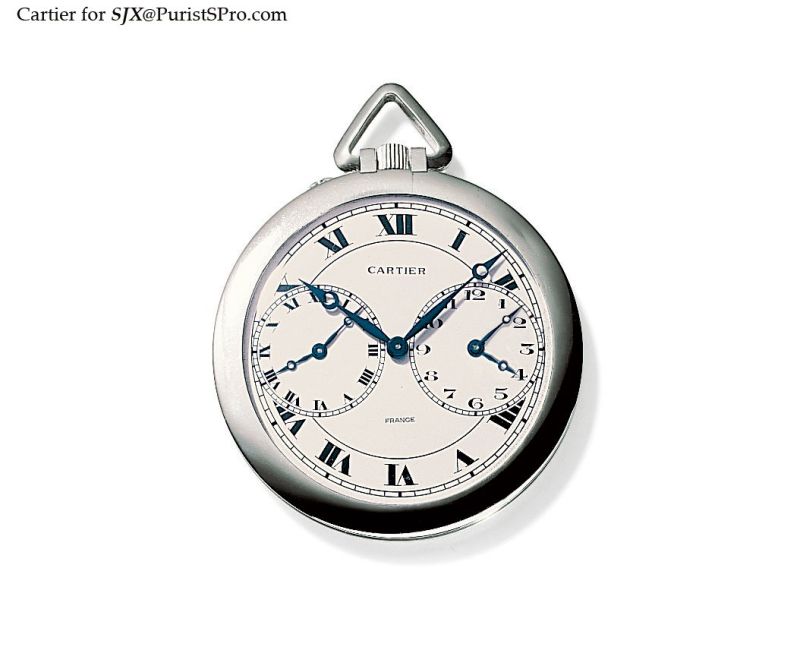
Above: Triple time zone pocket watch, c. 1927
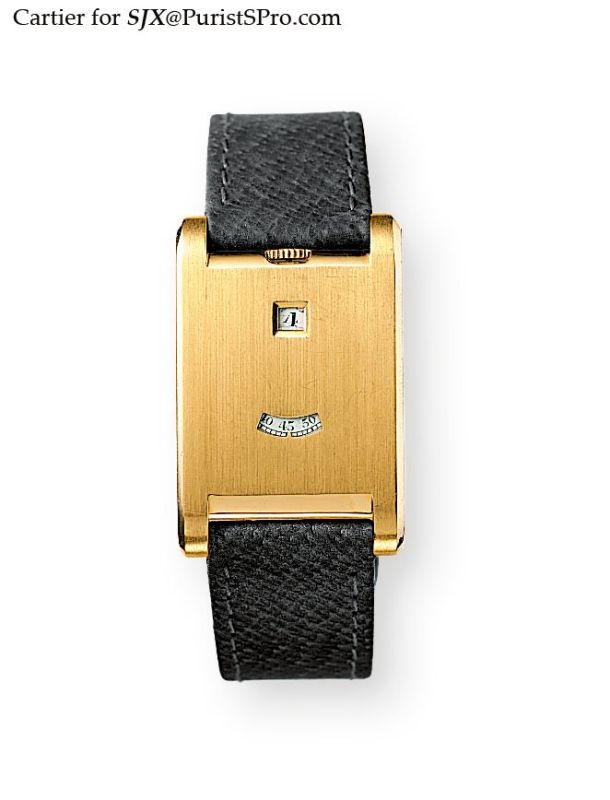
Above: Tank a Guichet, c. 1928
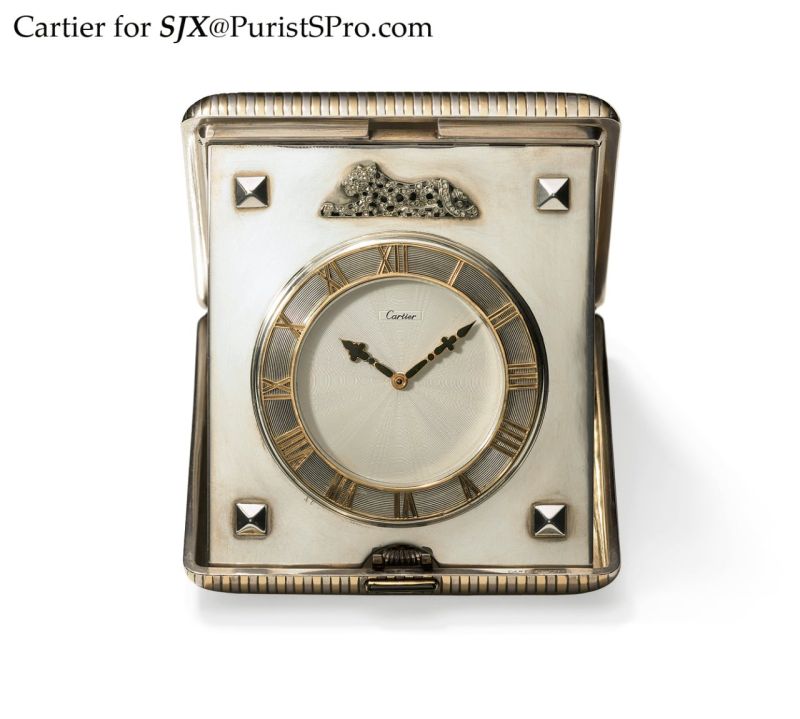
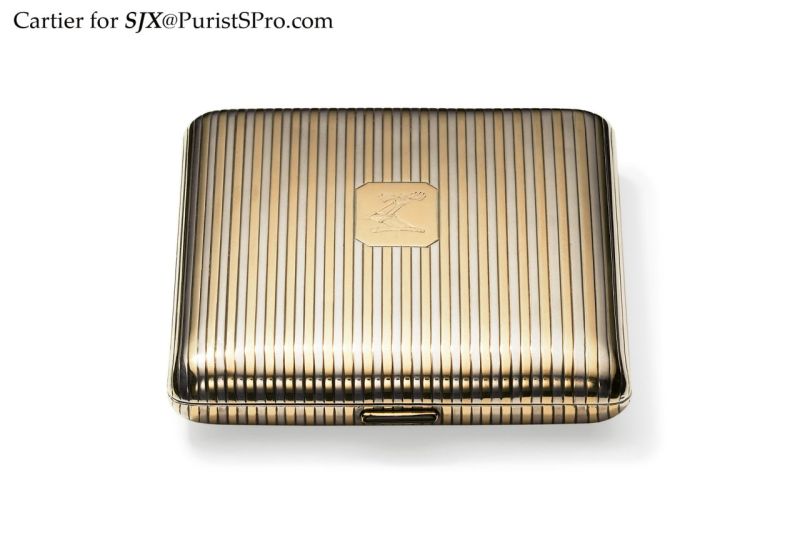
Above: Travel clock, c. 1928
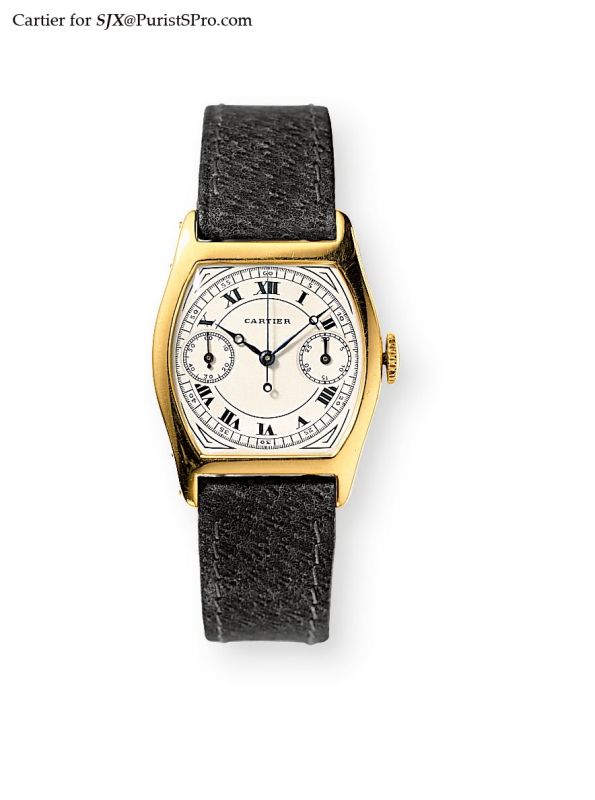
Above: Tortue Monopusher chronograph, c. 1929
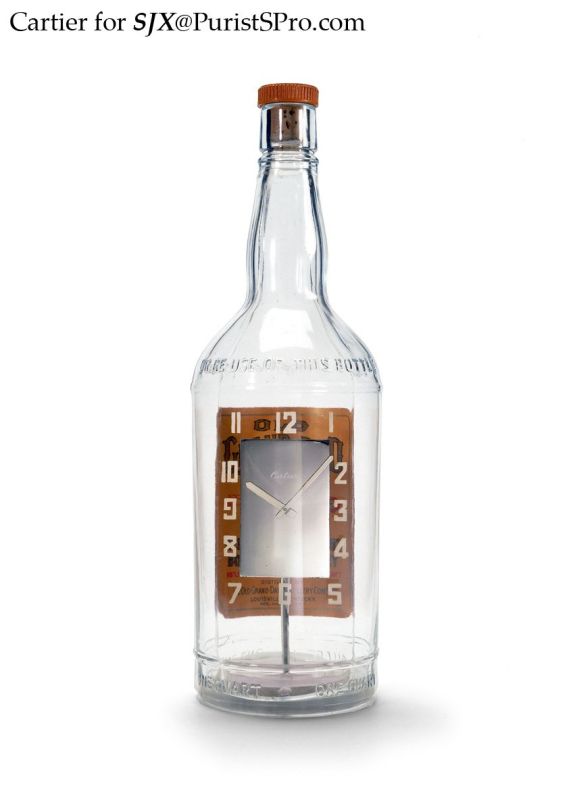
Above: Whisky bottle clock, c. 1930
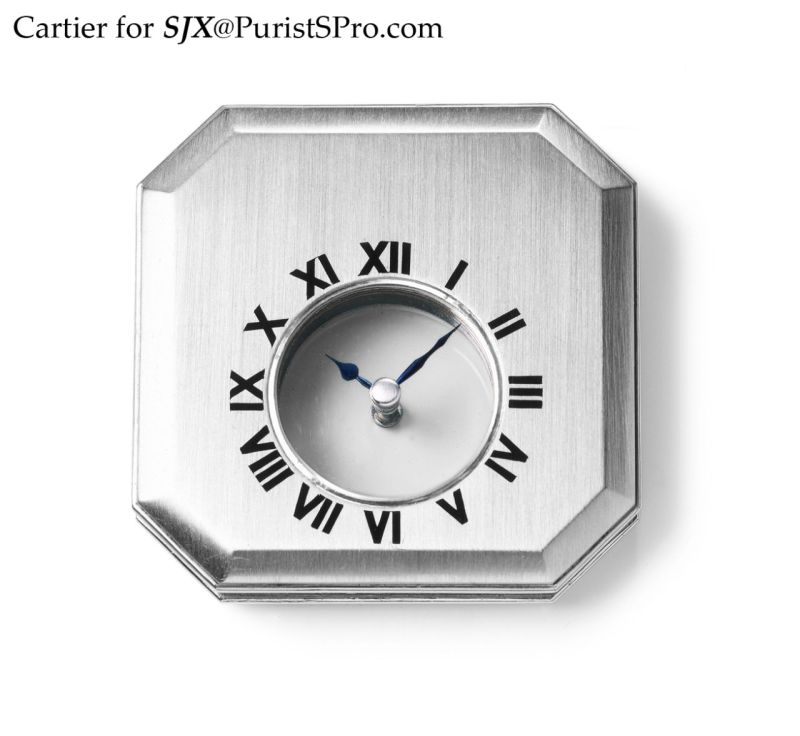
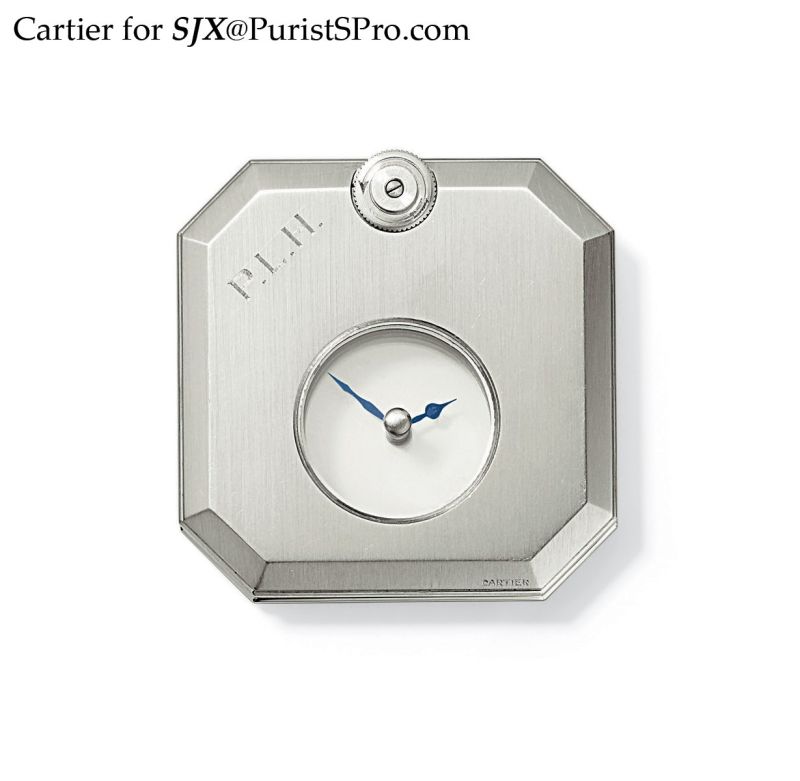
Above: Mystery pocket watch, c. 1931
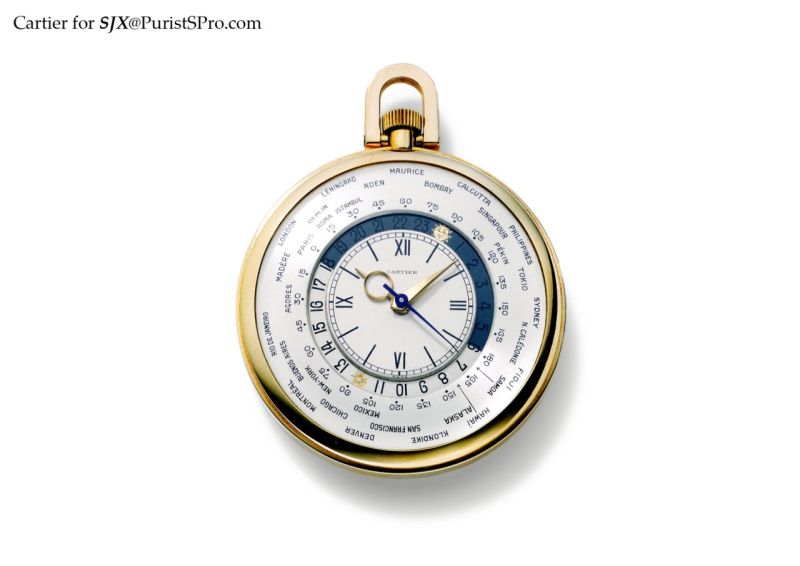
Above: World time pocket watch, c. 1940

Above: Double strap wristwatch, Cartier London, c. 1970
This message has been edited by SJX on 2009-06-19 09:18:10
Double strap Wrist Watch
Jia Xian
Has Cartier made any more of the double strap watches since 1970?
Cartier has no made such a watch recently
for at least a decade. Such models can only be found as vintage watches on the secondary market.
But as Geo notes, Roger Dubuis does make a double strap wristwatch, though it is quartz.
- SJX
The Roger Dubuis model is "Too Much" and predominantly
I had in mine the "Follow Me"
the cross-shaped watch with double strap. But you are right, the Too Much rectangular mechanical is also available with double strap.
- SJX
This message has been edited by SJX on 2009-06-20 09:04:50
Saw the Whiskey Bottle Clock in Beverly Hills boutique...
Some beautiful pieces. Some pieces seem to be inspired by Patek Philippe movements; possibly reflective of Cartier's partnership with Patek in the early 1900s.
Great read SJX, thanks!
that makes so good and successful use of their past.
Many models have hardly changed and are still in the collection.
From what I know there was only one Double strap wristwatch, in the collection of Cartier,
a smart concept, made by Wright & Davies, for Cartier,
that now can be seen in the collection of Rogier Dubuis.
GEO

Great informative post, SJX!
Cheers,
Daos

My dream ring -- Cartier Trinity, pave diamonds in rose, yellow, and white gold bands. (Photo courtesy Angleje)

Cool ! At least a CD-ROM......
worth of data.
Thanks SJX and Cartier for the information.
Does Cartier have a dedicated archivist and Internet liaision personnel? There is a lot of history to find and it may not be electronic-friendly.....
Regards,MTF

Wow thanks for the post SJX
That must have taken at least an hour to comple and assemble all the pics and text together from the press kit and then add in your own comments.
Great work and thanks SJX!
Cheers,
Anthony

Another treat SJX ... thank you ...
Regards
Damian