
Things that make you go hmmmmm...
Happy new year to everyone.
Before the end of the year, I was lucky enough to rediscover a piece that I've always been attracted to, even though it surprisingly (to me) elicits "eh, not bad..." from those around me whom I'm stupid enough to ask.
I've been mulling over a more detailed photo essay on this piece - about its moonphase; about the (to me) successful mash up of the Royal Oak and Nautilus aesthetics; about how easy it is to wear, especially it's lack of sharp or hard edges or corners (I just came off many months of the great Bulgari P10 piece, which practically speaking is almost the ideal watch, but it has many sharp or hard edges...that are unkind to cuffs, finger tips, etc); the easy to read and beautifully done big date; the very successful AR coating that seems to make the domed crystal disappear; the ever romantic (and yes, dare I say it? USEFUL) power reserve indicator...unjustly underappreciated, in my humble opinion...
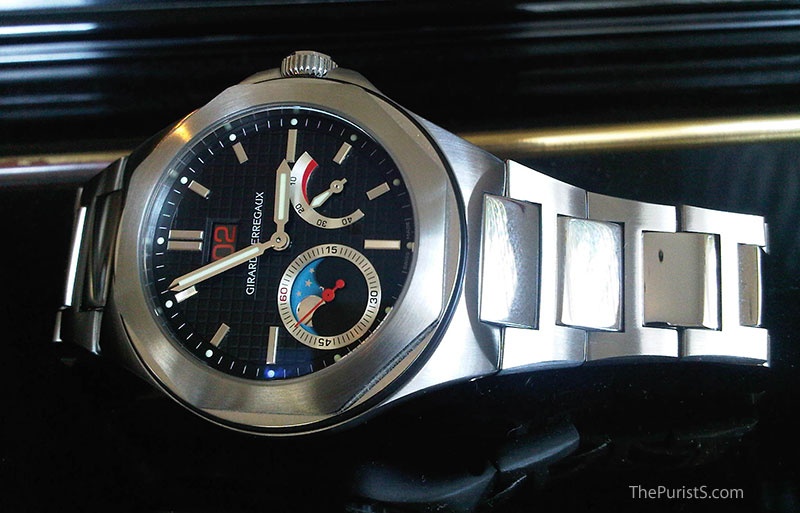
Because it has been worn for periods of a few weeks, then put away for months and even years, I haven't obssessed about the fact that it is fast 15-25 seconds a day, crown up or crown down; better fast than slow, right?
And really, besides a general approximation of the current time, for this particular piece, the moonphas and RDM indicators are more important to me...
So today, I went out for a ride in the rare morning mists and low cloud covers of Southern California ...
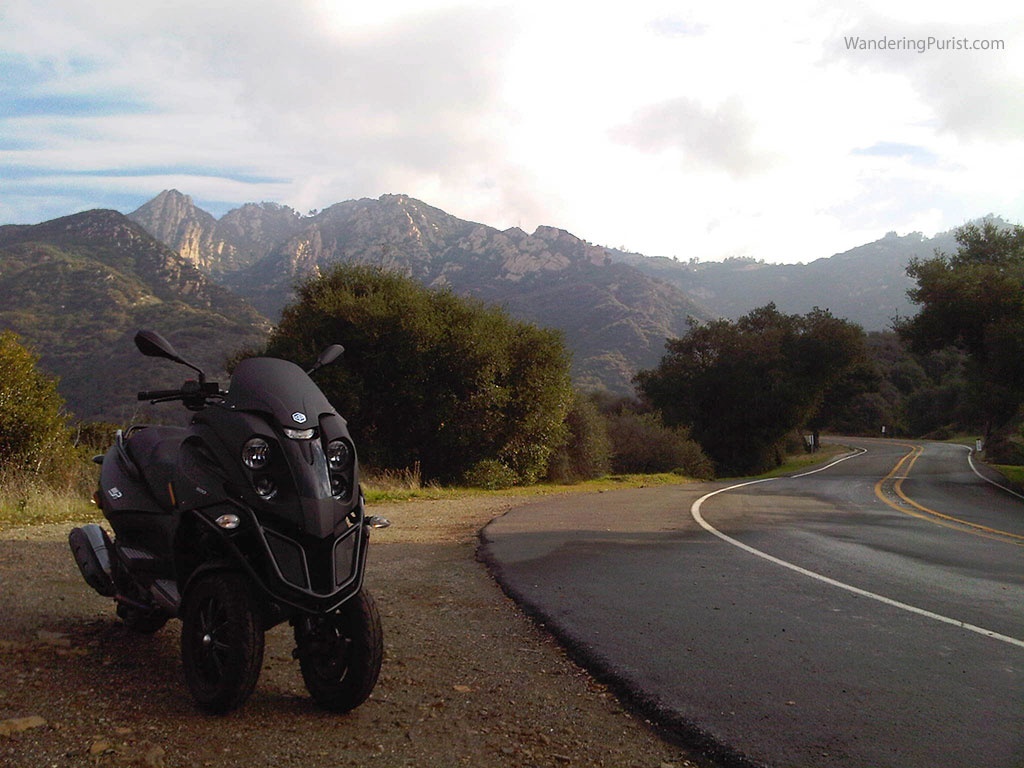
When I got back, it was 45 minutes slow...
Hmmmm...
(for the techno-geeks among you, though the engine is a big 500 cc four stroke engine, the vibrations and noise are fairly minimal, it has a CVT transmission that is fairly smooth, and the suspension is, again, fairly soft and smooth.)
Cheers,
TM

Well, I can't address the timing results after your ride...
I would be happy to wear the watch myself!
Cheers,
Daos
the watch started to ride out 7 minutes fast...
Which crept forward 2 minutes from my usual 5 mins fast setting, over the course of a week.
When I finished the ride, 90 minutes later, it was 45 min slow. So it "lost" 52 minutes over a 90 min ride.
It could have been a loose hands; it could have been the vibrations of the engine interfering with the timekeeping; it could be a combination of the vibrations with the fact the watch probably needs a service and regulation.
It could have been something else.
I've ridden with other watches that weren't obviously effected by the ride; that doesn't mean one is better than the other.
Shooting "hot" rounds at the driving range; playing golf; riding a motorcycle.
Hmmm...
(No conclusions implied or intended...)
Cheers,
TM

I'm intrigued by the gray dial
I agree with you about the colors, Mostel, but
That doesn't bother me. I rather like the "splash of color" with the red. I agree the moonphase background is a bit too light blue, a daylight blue rather than a night sky.
I didn't know they made this model with a quartz movement.
Cheers,
TM

It may be Love .
Time stops, when you're in love...
That is a well known phenomenon, with GP watches.
Hmmmm...

I am generally not keen on moonphases except on Perpetual Calendars for a reason: I am tired of trying to set the correct moonphase each time I decide to wear the watch, after some says, weeks or months in the safe.
And not very crazy about the power reserve, which ruins a bit the dial, and which has no real justification, in my opinion, except if the power reserve is short ( 36 hours... It will remind you that you have to wind your watch everyday, and if you forgot, this is a good reminder before your watch stops ) or long ( 7 days: same reason than previously mentionned on short power reserve watches ).
But I must admit that on this one, which I also saw with a white dial, the outcome; aesthetically speaking, is far from being unpleasant.
Best, Thomas, and have a much better year.
Nicolas
This message has been edited by amanico on 2012-01-02 23:02:04The moonphase on this watch is rather unique...
The moonphase disc is constantly moving, rather than by discrete one or two jumps per day - the disc is affixed to the mainspring barrel. So theoretically, it is accurate to the hour / minute if set correctly.
I have heard all the arguments about RDM indicators, on auto movements, on manual movements; and their counter arguments as well.
For me, RDM indicators act as a third time indicator - that of hours passed since the watch was off wrist.
In this case, with an automatic movement, it also reminds me that I am still alive - if I have the watch on my wrist, and it goes from full wind to zero, I'm probably a spirit looking at my own dead body.
Or a little more positively, it is a reminder that I need to get up and move around; in that sense, it is an aerobic reminder.
Cheers,
TM
Happy Dragon Year to you, Thomas!
What is the top speed of that three wheels cool road runner? I am sure it is faster than Mr. Bean's three wheels car.
That GP looks clean and the case looks very well executed.
Have a great and healthy Dragon Year.
Regards
Ling
Rowan Atkinson, aka Mr. Bean, is quite a motorsport enthusiast...
The Piaggio MP3 500ie is good for 90MPH; it's not a superbike but quite adequate for a city tourer scooter.

Very heavy though, and the COG is rather high, so not that nimble. Loads of fun...
Thanks, Happy Dragon year to you.
TM

yes, do tell...
Just like a 900 pound door that moves with a finger because it is hinged just right, with well machined and well lubricated hardware...
So, Mr. Engineer, how high is too high and how low is too low?
I'm not an engineer; I just know that a bike with a lower CoG feels "lighter" and easier to change lean angles.
Oh, wait, is that like two cars with the same laden weight, but with the engine / battery / lead weights hanging outside the axles, versus weight inside the axles? And esoteric concepts like polar moments of inertia...?
hmmmm...so ceteris paribus, do carbon fiber roofs make a difference or not?
;-)
On a car....
..the aim is to get the CoG as low as possible. You do what you can to reduce weight transfer, to get the most benefit from all four tyres. Low CoG is the starting point.
On a bike weight transfers are *massive*, the CoG is inherently high and can move about, so it's all about controlling it. The CoG has to be in the right place. The 'right place' depends on the bike - its purpose, its size, its mass, available grip...
Without writing an essay on bike dynamics (which allows me to neglect Moments of Inertia, steering geometry, spring rates and damping, tyre widths, chain to rear pivot location) CoG effects can be summarised as
Longitudinally,
A low CoG will reduce the weight transfer onto the front wheel under brakes, with a tendency to push the front tyre. (think of cruisers)
A low CoG will reduce weight transfer onto the rear wheel under acceleration (look at drag bikes)
A high CoG will have more weight transfer, with a tendency to want to lift the rear wheel under brakes
A high CoG will have more weight transfer under acceleration, wheelie time (think how easy it is to pop the front up on a dirtbike)
Transversely,
a higher CoG means less lean angle for a given speed and radius of turn (sounds wrong, but isn't)
Of course, the CoG on a bike is heavily influenced by rider positioning - a big mass sited a few feet above the ground - which is why you see riders clambouring all over bikes, this is to get the weight where you need it. Back wheel lifting under brakes? move back in the seat to get more weight over the rear. Front wheel not turning in? Hunch over the handlebars to get some weight on the tyre.
The above can be summed up as: ratio of height of CoG v Wheelbase. Long and low, stable. High and short, twitchy.
This isn't just from theory, ride a Harley
Next up, does a light bike go around a corner faster than a heavy one?
Very interesting details, thanks...
that's the sort of detail I was hoping for.
In thinking further about the issue(s) I think nimbleness might be a misleading term; yes, one can feel a difference in the shifting of weight from left to right, right to left, between a higher COG and a lower one (engine weight up high versus engine weight down low, even by inches) but the main impact, especially for a newbie rider, is balance - the "point of no return" where a normal human can keep the bike (relatively) upright is earlier / narrower with the COG higher, versus when it is lower.
This is of course manifest in how a bike handles on the road dynamically, but there I'm sure it is much more complex and the differences are more difficult to describe or even identify by a newbie.
The image you describe - an experienced rider clamboring all over the bike - is a particularly vivid one, and really underscores the much more intimate experience a "rider" has compared to a "driver" along with things like smells, the flow of air, temperatures, etc.
An altogether refreshing and wholly enjoyable experience!
Cheers,
TM
Smells...
...like getting caught behind a row of livestock trucks on a blazing hot day on some winding country road?
One of the few times I'd much prefer to be cocooned in a car with the recirc. button ON.
You're pretty much bang on with the balance point, particularly at a crawl... BUT

Hi TM,
the mountains in Switerland are great for that, maybe next time we can make a nice combo...Best,
Michel
You might get bored...
Waiting for me, but yes, would love to try it.
I just had my first "cold weather" ride that day - the temp ranged from a balmy 60F down to a VERY bracing 39F on the shadow covered stretches in the canyons. BURRRR...quite an experience, though, going through the "heat pockets" where it suddently felt very warm for 100 yards, then cold again, for no apparent reason. I am coming to understand the appeal and obsession for riders vs drivers...
Hope to catch up again soon, my friend!
TM

No idea why you stopped the time but....
Happy new year my friend. We all needed a new year and now we got it. Let's do some good out of it.
I have no idea (of course) why you stopped the time but I can say that I love this watch and if I was not a Patek Philippe forum moderator in hope of a Nautilus I would have already bought it. In fact each time I loose faith in ever getting a 5711 I think of buying this one!
Does your watch need to be serviced?
See you
Dje
May 2012 bring all that you wish for...
And more, my dear friend.
Yes, most likely the GP needs a service, but this is not what is indicated by the sudden "loss" during the ride. Since the ride, and after correcting the time setting, it is back to the pre-ride rate. So there was something specifically about the ride that caused it to lose 50 minutes during the 90 min ride. (See sub-thread; some good hyopotheses expressed...)
Cheers,
TM

Your black speeder passed a wormhole?
Regarding the Laureato itself, it is one of the most attractive GPs I know. I like this dark dial variant much more than the silver/white dial version, which I think to be spoilt by the too gaudy colours of the red second hand and the by baby blue moonphase background. But GP is well known for colourful watch dials, one either likes them or not.
If this watch had the possibility to switch the bracelet for a leather strap, I would have one already since long.
Regards,
Marcus
Thanks, Marcus, I remember you are a fellow "trekkie"...
Hi, Marcus,
There's actually nothing so weird about the basic normal condition timing - it probably needs a service to clean and regulate; it's been several years.
The loss of time during the ride is hypothesized well by the sub-threads below.
I too wish I could switch to a strap on occasion...who knows?
Cheers,
TM

Piaggio, Thomas?
Health, please health, and happiness for you and your family in 2012.
All the best,
CaliforniaJed
Yep, and thanks.
Unfortunately, it looks like no such luck; some pretty serious carry over issues from 2011...(actually goes back quite a few years... :-( )
Cheers, Jed, all the best to you and your family.
TM

Perhaps...
Not just the balance wheel....
...anything in the watch could be affected. One culprit could be the escape lever getting excited and mislocking. Or the mainspring could get all buzzy and not paying out properly...
Which brings us to:
Vibrations at the handlebars:
The main source of vibration through handlebars is the engine, so on the MP3, the first mode of vibration will be between say 25Hz (idle) and 120Hz (approx max rpm). Of course, over this you have other vibration inputs (suspension, road/tyre) and various areas of damping (the whole engine-frame-steeringhead-handlebars set up, through the gloves/handlebar, then to the wrist/watch bracelet), so the vibration profile is going to be pretty complex.
Regardless, the range is wide, so it isn't unfeasible that the watch stopped due to some resonance (or it could be that Thomas just forgot to wind it (RdM or not) and the ride started it up )
From my experience with mechanical watches and bikes (thousands of hours of exposure), I've never noticed a problem...definitely nothing of this magnitude.
I think your suggestion of wearing another watch for comparison is an excellent one.
Good ideas, Nomer, Ben...
Hi,
I've worn other timepieces while riding the MP3, no noticeable problems.
And as noted elsewhere in this thread, once OFF the MP3, no issues with that GP Laureato Evo either.
So something about the MP3 and that GP.
Cheers,
TM

That is one cute and cool bike. You're right about GP being under appreciated though.
cheers
PAt
