Straumann Double Hairspring vs Tourbillion
Been stumped by this one for a while.
Have been trying to figure out which is actually better both technically and/or practically.
The Tourbillion is aesthetically and visually more appealing and most people like the way it looks (even though they don't understand it) and is visually more 'grand' and legitimate complication looking (apologise for the weird language, cant really put it in words)
The Double Hairspring escapement at first glance seems to people as ordinary as any regular escapement though technically it seems sound in principle.
Had quizzed an independent watch maker (cannot name the same) and they sent the following (see below)
As far as my limited knowledge in horology and physics allows me, my understanding is that for an Tourbillion to effectively negate the forces of gravity at various positions the watch might turn inot has a few caveats.
For e.g. - a 60 second tourbillion - the escapement has to complete one complete cycle (60 seconds) for it to effectively work, if the tourbillion escapemet moves around within the 60 second cycle it effectively cancels out the use of the cage.
Where as in the double hairspring escapement , due to the paired hairsprings negating the inertia of each other in a continues cycle and the center of gravity alternating between the two springs works in almost any position.
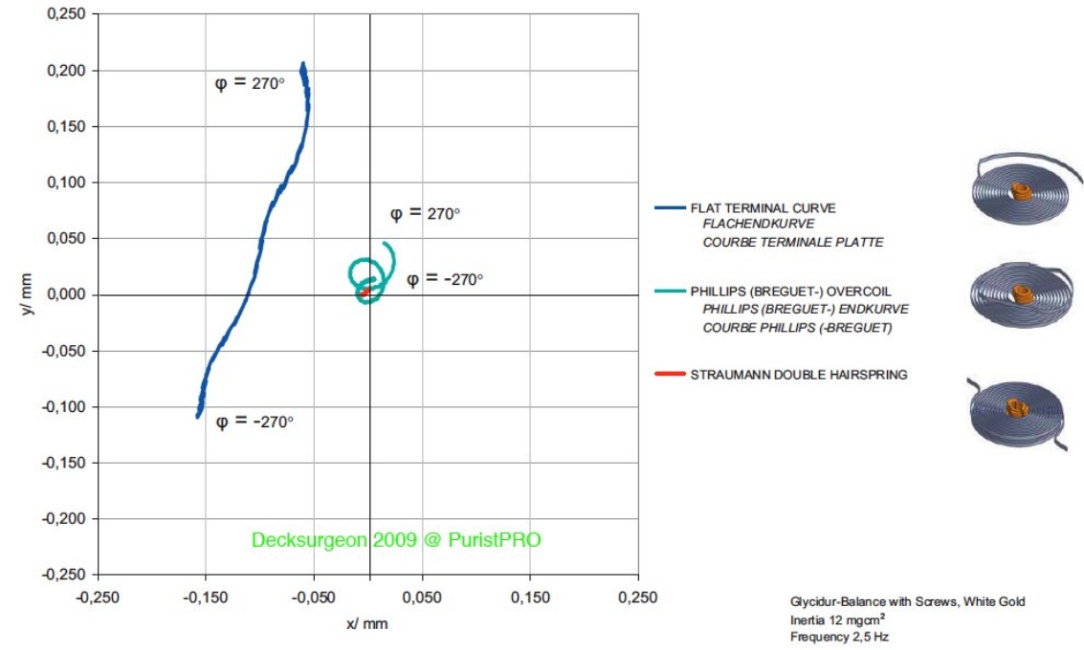
In the diagram below, it seems that the gravitational influence on an escapement with a Straumann Double Hairspring is miraculously low !
Can someone please help me out and shed some light on the same.
Straumann double hairspring
In any watch movement, the balance wheel and its hairspring are subject to gravitational forces that influence their rate and therefore the accuracy of the watch. That is especially true with a flat hairspring, like a Straumann.
Several ways of compensating these effects have been followed during the history of watchmaking.
One was to act on the hairspring directly, either on its shape (cylindrical or spherical hairsprings) or on its attachment to the balance and to the stud, with terminal curves (best known, the Breguet overcoil).
A second way, also compensating for the effect of gravitation on the balance itself, was to mount the entire escapement device (balance wheel, hairspring, pallets, escape wheel) on a rotating carriage which is known as “tourbillon” or “carrousel”.
The double hairspring. Two hairsprings on top of each other and their spirals are opposed (one turning clockwise the other anti-clockwise). So when the hairsprings are beating, they expand and contract in the opposite direction to each other. When the gravity center of the lower hairspring moves to the right, the gravity center of the upper one moves the same amount to the left, compensating each other and keeping the gravity center in the center of the balance wheel. Thus guaranteeing that timing accuracy is the same in every position on the wearers wrist.
See the graphic underneath to view the movement of the gravity center of different hairsprings.
This message has been edited by MTF on 2011-10-06 21:08:56 This message has been edited by AndrewD on 2011-10-09 20:20:08
Not sure
Here's my extremely imperfect understanding. All corrections more than welcome (Jonh, Suitbert, you know who you are
 ).
).The "center of gravity" displaces in a normal balance even when the balance is horizontal, and I'm assuming this is what your graph shows. This is due to the attachment points adding a variable force into the spring as it oscillates. It creates a problem as the balance staff is forced against the pivot in a variable way, whcih introduces errors. The double balance spring corrects this, if I've understood correctly. The variable forces due to the points of attachment also mean that the frequency isn't constant at different amplitudes. I'm not sure if the double balance compensates for this: intuitively I don't see how it would, but this is just guessing.
When the balance is in a fixed vertical position another set of forces come into play due to gravity. The balance staff has a permanent force pulling it against the pivots in addition to the forces due to the points of attachement. The balance spring has a permanent force that makes it "sag" and that has to be added to the variable forces. This makes the "center of gravity" behave differently. It's not clear to me how the double balance spring compensates for this, as both springs are "sagging" together in the same direction and I don't see where a compensating force comes from. I've read the Moser blurb several times, and I think they're being slightly disingenuous in their comparison with the the tourbillon.
I'm going to guess that the double balance spring removes the errors inherent in the spring and so makes the watch much easier to adjust across positions.
Like I say, educated guesswork.
As for which is better, as no manufacturer will ever release data we'll probably never know.
nick
Still stumped
Interesting points.
The Bayer guys say this about the gravitational 'sag'
Apparently since the two hairsprings oscillate in two different directions simultaneously and asymmetrically the center of gravity is kept in the the center on average
i assume something like this
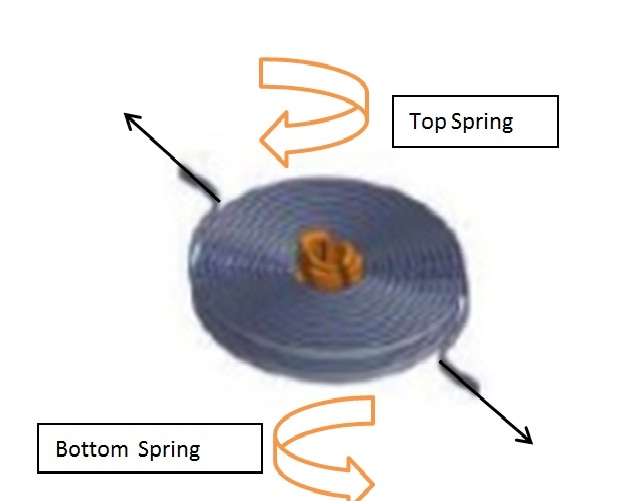
Their explanation below, im still stumped!!!
Moser's Double Hairspring
escapement with two opposing Straumann Hairsprings prevent the gravitational
error from occurring in the first place.
In a watch, the gravitational error disrupts the stability of
its accuracy. This means that when the watch is in a horizontal position – i.e.
when the dial is at the top – the watch runs differently than when the dial is
positioned vertically, i.e. laterally. The watchmaker counteracts this
phenomenon by adjusting the watch so that the slower vibrations of the
balance in vertical position are compensated for as precisely
as possible by the more rapid vibrations in the horizontal position. This
produces an average level of accuracy, although this is dependent on the way in
which the owner wears his watch. This is because the average level of accuracy
is only achieved if both positions occur with approximately the same frequency.
In practice, the vast majority of watches are therefore adjusted in fi ve
standardized positions in order to minimize the discrepancies. At Moser we
pursue this practice to the limit, as we adjust our watches in all six possible
positions. So where, then, does this gravitational error come from? And how can
we reduce its impact even further?
These questions have preoccupied watchmakers for many decades.
In this respect, it is important to know the type of attachment at the outer
end of the balance spring. This is realized either by a flat curve or a Breguet
curve. The socalled flat curve, which is used in most mechanical watches, can
be implemented very easily. It does, however, present the disadvantage that the
balance spring assumes an asymmetrical shape when it vibrates. In doing so, the
centre of gravity in the spring moves away from the middle. If we now imagine
that the spring adopts a vertical position, it then becomes clear that due to
the shift in the centre of gravity, the vibrations in the “downward” direction
are accelerated by the earth’s gravitational pull. At the same time, vibrations
in the “upward” direction are impeded, and consequently slowed down. On the
other hand, if the spring is in a horizontal position, this effect does not
play a role. This is not a good starting position for the stability of the
accuracy.
In contrast, the Breguet curve was developed in order to avoid
precisely this asymmetrical vibration of the fl at curve. It does this by
ensuring that the outer end is curved upwards over the high edge, and is then
further curved inwards. This task demands all the skills and ability of the
adjusters, since the procedure is predominantly carried out by hand. This
complicated and from the point of view of craftsmanship highly demanding form
of manufacture is the reason why the Breguet curve is only found in watches of
very high quality. As a result, the vibrations of a spring with a Breguet curve
are almost completely symmetrical. But only almost. There is still a small
residual error.
The
approach to the double hairspring escapement with a pair of Straumann
hairsprings is now very simple: the springs are arranged one above the other,
with one vibrating to the left and the other vibrating to the right. If both
springs have the same mechanical characteristics, then when they vibrate, the
centre of gravity moves outwards from the centre – just as it does with a
single spring and a flat curve. However, as both springs are vibrating
asymmetrically in opposite directions as a result of the different direction of
rotation, the centre of gravity, on average, remains exactly in the centre. A
gravitational error due to the asymmetrical vibrations of the springs can
therefore not occur in the first place. So why was a tourbillon invented
to compensate for the error caused by gravity?
At first, the tourbillon was developed to compensate for the
gravitational error in a cut bimetallic balance with a steel spring. With this
type of balance, the effect of temperature on the accuracy of the watch was
prevented by the individual arms of the bimetallic balance bending outwards or
inwards with changes in temperature. It is easy to see how the two arms of the
balance never moved in a uniform fashion, which invariably caused a much
greater gravitational error than the asymmetrical vibrations of a spring with a
flat curve. This technique was used in pocket watches, which under normal
conditions would be in a vertical position in the waistcoat or gilet
customarily worn at the time. A tourbillon therefore made perfect sense,
because the entire escapement could, for example, complete one revolution
around itself per minute. The changing centre of gravity thus had an
accelerating effect before slowing down half a minute later in the opposite
direction. On average, the existing error was therefore compensated for within
one complete revolution. This only works, however, if the watch remains in the
same position for at least as long as the tourbillon requires to carry out one
complete revolution. It is easy to see that this would rarely be the case with
a wristwatch.
Nowadays, with the use of self-compensating alloys – as in
Straumann hairsprings – combined with a Glucydur balance, an imperfectly
working bimetallic balance is no longer used. The tourbillon can now be used to
compensate for the much smaller gravitational error relating to the vibrations
of a fl at curve spring. However, this too only works properly if the watch
remains in the same position for as long as the tourbillon requires to complete
one revolution around itself.
As a general rule, we can therefore certainly say that it is
better for an error not to occur in the fi rst place than to try and compensate
for it afterwards. It is for this reason that we at Moser have developed the
Straumann double hairspring escapement system.
This message has been edited by dennis.raul on 2011-10-08 01:06:14
my opinion

good thread - but a strange comparison

Additional benefits of the tourbillon …
I always assumed that gravity also acted upon the pallet fork and escape wheel, and there was additional benefit to have these rotating with the tourbillon cage, at least in a watch held vertical in the plane of the balance.
Andrew
AP on board as well ? Audemars Pigurt Millenary Minute Repeater Escapement
The new Audemars Pigurt Millenary Minute Repeater Escapement also uses a similar 'Double Hairspring'
Have pasted two articles from two watch reporters i follow and respect.
If one of the big three have put their faith behind it, must be something to it ?
Article 1
The intriguing large balance wheel beats with 21.600 half beats per hour and has an even more impressive power reserve of 168 hours!
|
| Also introduced with Cabinet piece No.5 is a double hairspring. One on top of the other and attached to the studs 180° opposed as this was found to cancel out the imperfections known to affect flat hairsprings. Pretty much like a conventional overcoil hairspring, commonly called a Breguet hairspring. Reportedly this solution was born by necessity; having already chosen a large high inertia balance wheel, it was found that a matching hairspring was not readily available. |
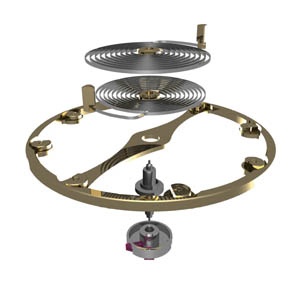
Reportedly this solution was born by necessity; having already chosen a large high inertia balance wheel, it was found that a matching hairspring was not readily available. To start right away, with height not being an issue in this specific design, the watchmakers at Renaud & Papi simply assembled two weaker but available hairsprings one on the top of the other. Instead of being a poor replacement for the 'real thing' it worked extremely well and eventually was chosen for the final design!
Source : www.tp178.com m
Article 2
Here in the Millenary Minute Repeater, the movement has slower 21,600 bpm movement, but AP uses one of those trendy new "double balance spring." These are pretty neat and are supposed to help cancel out error making the movement more accurate. Basically the balance spring attaches at two points (versus the older Breguet over-coil style attachment). If I had larger images I would show you a closeup of the escapement so that you could see what I am talking about.
Double balance springs (also called "double flat spiral here) work pretty well I hear, but I don't have a quantifiable number as to how much better they are. It is part of a brand new movement which is the Caliber 2910
Source : www.ablogtoread.com /