Comments:


Increased power reserve
Dear friends,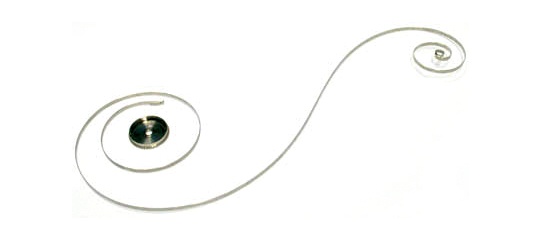
More and more watches are coming with increased power reserve. I assume this means increase power in the mainspring. Doesn't this increase the "stress" on the movement ? At least on some wheels ?
Best regards.
At least in some cases, as I
understand it, the opposite might in fact be the case.
For example, the IWC 500X watches with a 7-day reserve have an extremely long but very low-torque mainspring driving what must be a very efficient, low-friction power train, at a leisurely 18k bph. This sounds like less stress to me.
For example, the IWC 500X watches with a 7-day reserve have an extremely long but very low-torque mainspring driving what must be a very efficient, low-friction power train, at a leisurely 18k bph. This sounds like less stress to me.
it depends
Hello Ulysse,
There are a few different ways that you can increase the power reserve.
You can decrease the power demands by reducing the size of the balance, decreasing the beat rate or increasing the efficiency of the escapement. Then you change the gear ratios so that the (now) excess power of the mainspring will be released more gradually. Most extended power reserve movements these days have smaller balance wheels and some of the modern, high-tech escapements are more efficient. These possibilities don't in-and-of themselves introduce more stress in the power train.
You can use a stronger mainspring and simply add an extra wheel to the gear train. This is the way 8-day alarm clock movements worked primarily and yes, this does introduce a lot more stress on the barrel and the first wheel in the power train.
You can use a longer mainspring, which will give more turns of the barrel but needn't be particularly stronger.
Or you can use multiple barrels, which also doesn't necessarily mean more stress in the power train. Barrels working in series will have the same general effect as using a longer (not stronger) mainspring, and barrels working in parallel will have some amount of balancing effect on the wheel they drive which may mitigate some of the additional stress.
Every solution is a trade off and there are no absolute or truly optimized answers, just different engineering choices and priorities, and these can change with the demands of the consumer market, advances in the mechanical solutions available and advances in materials.
_john
parallel main springs and "resonance"
"barrels working in parallel will have some amount of balancing effect on the wheel they drive"
Hmmm…might this be the way that Journe's Resonance achieves "resonance"?
Not the case...
In the bearing of a wheel there is an effective angle and force between the energy source, the driving pinion and the energy sink, the driven wheel. This has an influence on the friction and wear in the bearing. If a wheel is driven by two pinions this force and angle will be different and if well designed the force will be less reducing the wear in the bearing.
This has nothing to do with the oscillating system, the balance and hairspring. In a resonance watch there are two oscillating systems that are brought into resonance through an energy transfer of some kind. As resonance can improve the quality factor of the oscillator, meaning among other things that it will need less energy for the same amplitude, it can increase the autonomy. But I don't know if this is in practice significant or not.
Don
This has nothing to do with the oscillating system, the balance and hairspring. In a resonance watch there are two oscillating systems that are brought into resonance through an energy transfer of some kind. As resonance can improve the quality factor of the oscillator, meaning among other things that it will need less energy for the same amplitude, it can increase the autonomy. But I don't know if this is in practice significant or not.
Don
Parallel main springs gives the appearance of "resonance"?
Thanks Don,
Unfortunately my question probably wasn't very clear, so please allow me to elaborate. First, I don't really buy into the "resonance" theory as applied to the balance wheels in the watch because I haven't really seen anything that actually shows that there really is "resonance". Apparently you haven't seen any either. This issue has been debated ad nauseum in the past in the forum so enough said.
Second, I don't know if the two barrels in the resonance are in parallel; however, I do believe that they are in some way connected. Here's why: on my Resonance I once noted that the click spring on the barrel drum on one of the two movements was stuck in the non-engaging position. Now, it's my understanding that these two movements work independently of each other, though they are wound by the same stem. If I understand correctly that the function of the click spring is to allow the main spring to be wound but then engages the drum to prevent it from moving backward and the spring from unwinding when the stem is not being turned, how is it that the main spring didn't unwind when the click spring didn't engage? It is apparent that the click spring that was correctly engaging the main spring drum for the other movement was also serving the same function for the first one. Doing double duty so to speak. If that's so, then the two main springs are somehow connected to each other not just in the winding action but also in the "unwinding".
Thus my question about the possibility that the two main springs are working in parallel and therefore are releasing energy into the two going trains in approximately equal amounts. Might this give the appearance of "resonance"?
I hope I've stated my thinking in more clarity this time.
Best regards and TIA.
BTW I like your new tourbillon, but you already know that I like those gadgets!
thx for the concise response
I actually understand, if only in part, what you are saying