
New pictures of an old watch: U.G Polerouter Sub.
Someone recently posted a question about the Polerouter Sub, which gave me the idea to take some fresh pictures of mine, an old beauty, for sure.
A perfect illsutration on how a simple look can be powerful.
The photos:


The 60ies at their best.
Nicolas.

Stuning condition , Nicolas
for a vintage watch which dates back to the 60's ... the case size is of a 41mm correct me if im mistaken, please .
Thanks for sharing.
Faisal
42 mm, my friend, You were not too far.
Thanks for your input, Faisal.
Alll the best,
Nicolas.

A sleeping giant
great size and classic looks with an inhouse movement - what more could you ask for?
I've tried one on before and it wears beautifully. The market is starting to awaken
to just what a great watch this is.
In my opinion, this U.G is in the Top 3 of the Big Compressors...
Along with the Polaris and the .. Which all 3 house " in house " movements, and take the benefit of a nice quality.
This is not the most known, this is not the less desirable, either.
It is time to give it the justice it deserves.
Best, Eitan.
Nicolas

whats the 3rd Nicolas ??
it wouldnt be the Enicar Sherpa with in-house movement would it ??
best
Graham
Longines!
But I could also have mentionned the Vulcain Cricket Nautical, too.
Best,
Nicolas.
you upset me my friend....
compressors are of a lower level to yours

Naaah.
You can't compare the Polaris, the U.G , the Vulcain and the Longines with any other.
Then, you have the Enicar, the Bulova, the Benrus, the Droz, and the Lip.
Then, all the others.
This is a wide thema, which will require a lot of efforts, time and money to try to close it.
Best,
Nicolas.
i only have the Enicar...
aquired a nice Bulova Snorkel 666ft automatic from a common year. beautiful
patina, original condition. at 36mm not quite a submariner or sm300, but just as
capable at the time and a bit more than fifty quids, but not much

Well, I try to avoid the 36 mm compressor cases, or ...
I will end by opening a Museum.

Best,
Nicolas.
this is not a compressor,...
when i have time, but it only arrived on wednesday and i've been absent for a
couple of days.
Nicolas, your command is my...
for air.


Like it a lot!
I saw some spotting here and there, and have to say that I was tempted.
Congrats, Graham. That's the Fifty Quids watch I love a lot!
Best,
Nicolas.
thanks Ubik. i'd actually...
frog, but it took a while to arrive due to our lovely customs &
excise.

Really?
These can't be compared to 'the others'? No IWC in there? No Sherpa OPS?
What drives this hierachy?
ENICARs rule !
For sure the Enicar SuperCompressor should fit the bill too (manufacture movement, XL case, historic significance...)
However, I think that the fact that the brand has died since then makes it less attractive to some, as opposed to vintage watches from brands that are still a live today (I guess the vintage ones benefit from side-effects of current marketing efforts for the moderns, and vice-versa).
Still, I believe the Enicar 'Supers', including the OPS, are an important part in the hierarchy of the Compressor family.
eg:
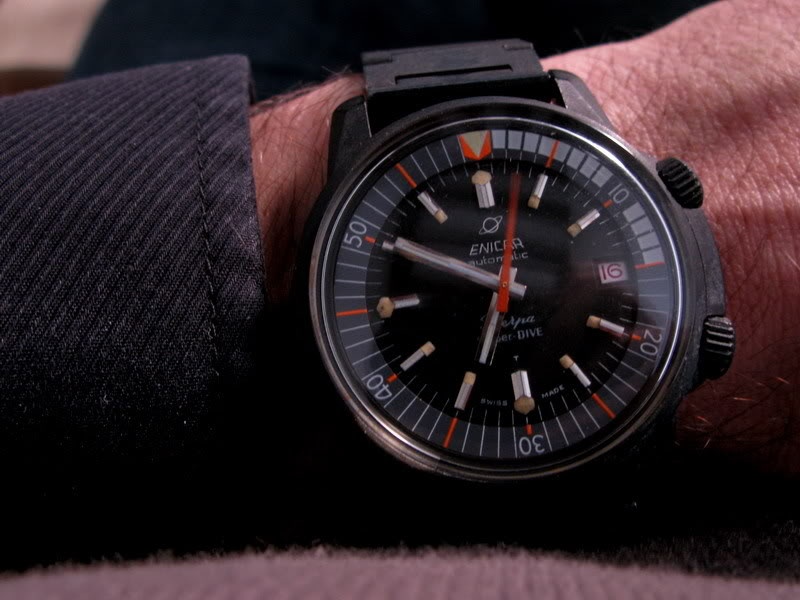
(PVD way before PVD became fashionable...)
very nice Clavi, it reminds...

Great one, Clavi.
A superb patina, and a pvd case when, as you said, it was not trendy.
I like it!
Best,
Nicolas.
Killer Enicar
Here it is in the 1970 Chronosport catalogue.
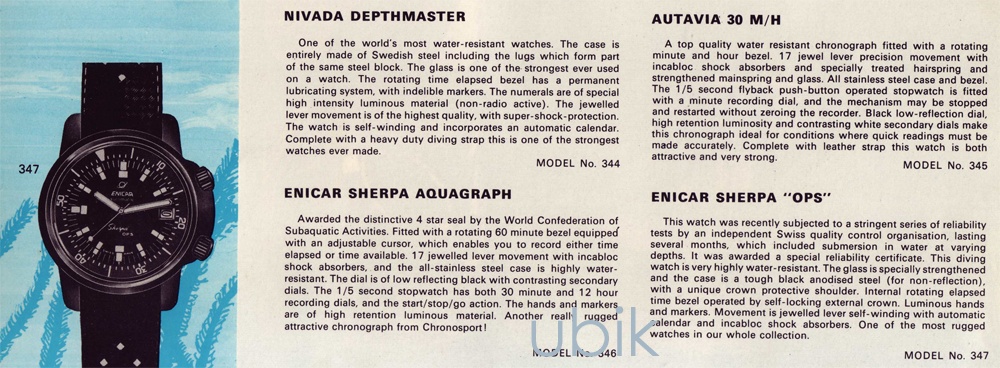
Thanks for these very interesting documents, Eitan.
Do you own the watch?
It wouldn't surprise me, though.
Best,
Nicolas.
Sadly not
A few times I came close to getting one, they also did a steel version, but I was always beaten to the prize in the end.
Just to add insult to injury I passed on an Australian military issued Droz about 6/7 years ago as well.

However I finally bagged my Polaris 68, so it's not all gloom and doom.
Well, the Droz is one of my targets, too.
Will we end with getting these damn birds?
Best,
Nicolas.
It is only in my book, Ben ...
42 mm case, and in house movements, which are the two most important criterias, to me.
Why in house movements?
Because the case were all outsourced, so if the movement is also outsourced, what is the interest, except an aesthetical one?
Therefore, if I want to get them all, there were so many that it will be a hell of a game.
I HAVE to make a severe selection.
Best,
Nicolas. This message has been edited by amanico on 2011-02-21 07:30:26
Then, 'movementwise'
If we are to create a hierarchy between the compressor / supercompressor watches, I would then rank:
- 1st, the anteriority.
Regardless of the manufacture / non manufacture aspect, I think that from a collectors point of view it is good to know which are the brands / models that have used the Piquerez SC case first ( --> I don't have the answer from the top of my head, nor do I know if the information is known, but I believe this is the first criteria to consider)
- 2nd, the 'manufacture' factor
Of course, when many different brands have been using the same (or similar) watch case / construction (twin crown / internal bezel), then if we want to discriminate them, the 'in-house' movement factor becomes important.
So then, I would rank equally, Enicar, Bulova, Longines, Universal Geneve, IWC, Jaeger LeCoultre and to some extent LIP (in-house electric), as all these brands did equip the EPSA cases with their their own in-house movements. Jaeger LeCoultre (Polaris), and Vulcain (Cricket Nautical) of course stand out as they have an extra complication (and an extra crown)
All the others would come next according to this criteria (and there are many other examples, using AS or ETA movements). But then, the XL cae (42mm), and the thin profile would be more attractive than the smaller (36mm case), or the thick profile...
So as always it is not simple.
Especially when you take dial design into account. Some with in-house movements / thick profile can look less desirable than some with ebauches / thin profile.
A collector's life is never simple..........
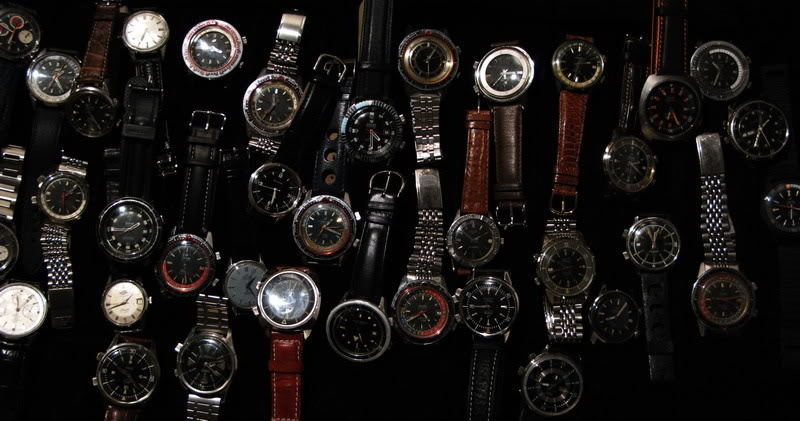
hey Clavi, looking at...
made in 1964 which so far, in the case of twin crown SC's, i've only found an
Enicar 42mm. if you ever find out which others were made in that year please let
me know

enough.
The U.G Polerouter Sub can be found with a 1964 year of production.
As well as the Longines ( mine was from 1964 ).
Best,
Nicolas