Comments:

I believe John was right about the balance in your pocket watch. Just going by pictures it's very likely a "normal" steel/brass split bimetallic balance.
Furthermore the Stowa deck watch, I believe this is not a Guillaume balance as well.
The subject isn't that easy, especially for internet discussion and pics only.
One simple hint can be the age of the movement (or to be more precise - the time of completing the movement - some high grade movements
from middle of 19th century were finished and equipped with up to date escapement parts much later in the 20ties or 30ties - or even later...), if likely before turn of the century -
it's almost sure not a Guillaume balance.
If you can inspect the movement in the flesh (or you have a very good picture in dead on vertical angle - or good view of the cross section of the "cut" area):
steel/brass balance wheels tend to have the steel part slightly thinner than the brass part - be carefull, as due to the bevelling at the inner edge of the rim
one can often be mistaken.
A true Guillaume balance usually has the nickel steel and brass part at same thickness.
BTW, if I remember correctly, there is a typical high grade steel/brass bimetall balance which often is mistaken as Guillaume balance, because of the cut
leaving one or two wheight screws on the short part of he rim just like an original Guillaume balance - the "Crauzat balance" spelling?).
But perhaps there are other names for it as well.......
Hope this makes some sense - and hopefully some experts add corrections and additions here.
Best regards
Suitbert



regarding that Guillaume Balance
Several pages ago I posted about my Tiffany pocketwatch:
home.watchprosite.com
to which ei8htohms was kind enough to respond in part:
"The balance is not Guillaume in my opinion, but rather a traditional split bi-metallic balance. At least, it does not have the
usual tell-tale sign of Guillaume balances: the rim on the short side is usually extended. "
which sent me amateur researching the question of visually distinguishing between a Guillaume and an ordinary bimetallic
split balance. I found a few threads at the NAWCC website bemoaning the lack of absolute clarity on this subject. I found a
few pictures at Google image search, alas, most of them were mine.
In an effort to add to the discussion, here are pictures of a few ordinary bimetallic split balances:
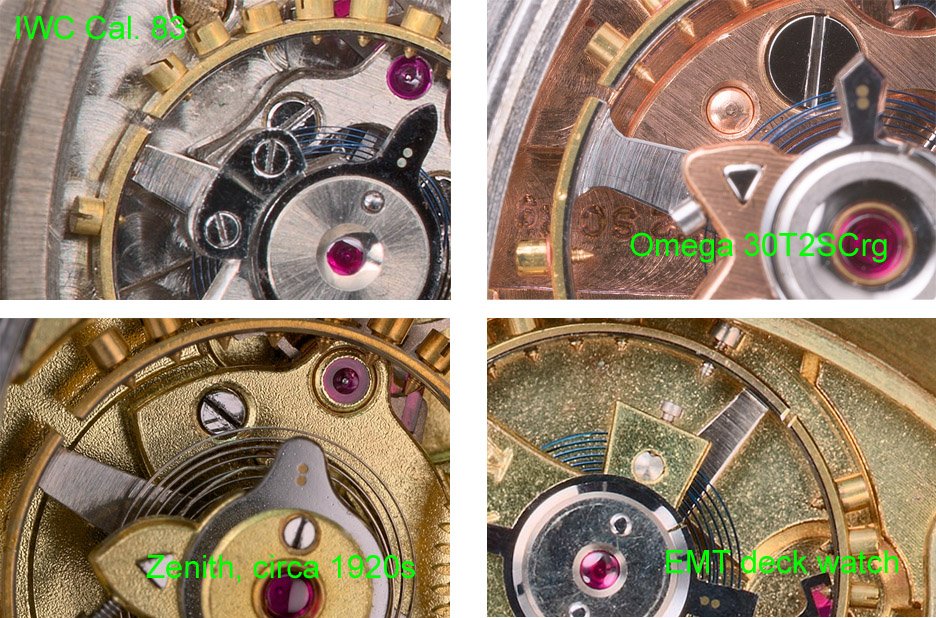
This seems pretty straightforward, each is split just barely past the balance arm.
Here are pictures of watches for which the seller (usually somebody I can safely assume is more knowledgeable than myself)
has indicated a Guillaume balance:
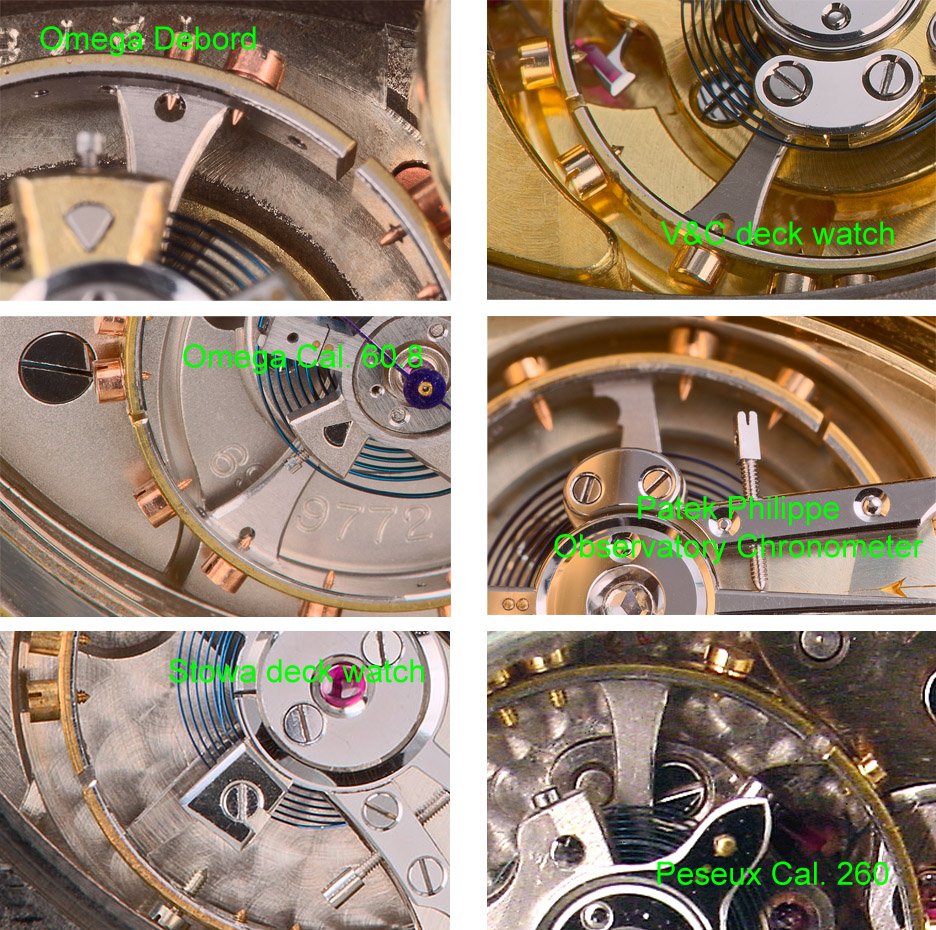
Here things are bit more complicated. Some balances show one screw past the balance arm, some two (or two holes), some
also have a screw directly at the arm. The outlier here is the Stowa, which shows only a distinctly elongated tail.
Finally, here is a picture of the subject Tiffany balance:
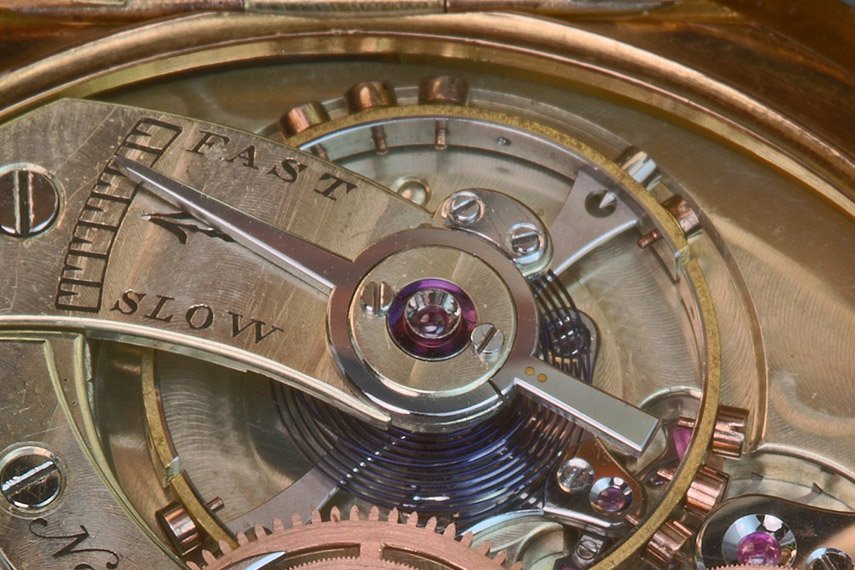
This seems to me to have a lot more in common with the latter group than with the former, mixing a modest (but not immediately
truncated) tail with space for one screw plus a screw at the balance arm, yet another variation.
I hope this helps a bit at least as stimulation!
home.watchprosite.com
to which ei8htohms was kind enough to respond in part:
"The balance is not Guillaume in my opinion, but rather a traditional split bi-metallic balance. At least, it does not have the
usual tell-tale sign of Guillaume balances: the rim on the short side is usually extended. "
which sent me amateur researching the question of visually distinguishing between a Guillaume and an ordinary bimetallic
split balance. I found a few threads at the NAWCC website bemoaning the lack of absolute clarity on this subject. I found a
few pictures at Google image search, alas, most of them were mine.
In an effort to add to the discussion, here are pictures of a few ordinary bimetallic split balances:
This seems pretty straightforward, each is split just barely past the balance arm.
Here are pictures of watches for which the seller (usually somebody I can safely assume is more knowledgeable than myself)
has indicated a Guillaume balance:
Here things are bit more complicated. Some balances show one screw past the balance arm, some two (or two holes), some
also have a screw directly at the arm. The outlier here is the Stowa, which shows only a distinctly elongated tail.
Finally, here is a picture of the subject Tiffany balance:
This seems to me to have a lot more in common with the latter group than with the former, mixing a modest (but not immediately
truncated) tail with space for one screw plus a screw at the balance arm, yet another variation.
I hope this helps a bit at least as stimulation!
Hello, Steve,....
I believe John was right about the balance in your pocket watch. Just going by pictures it's very likely a "normal" steel/brass split bimetallic balance.
Furthermore the Stowa deck watch, I believe this is not a Guillaume balance as well.
The subject isn't that easy, especially for internet discussion and pics only.
One simple hint can be the age of the movement (or to be more precise - the time of completing the movement - some high grade movements
from middle of 19th century were finished and equipped with up to date escapement parts much later in the 20ties or 30ties - or even later...), if likely before turn of the century -
it's almost sure not a Guillaume balance.
If you can inspect the movement in the flesh (or you have a very good picture in dead on vertical angle - or good view of the cross section of the "cut" area):
steel/brass balance wheels tend to have the steel part slightly thinner than the brass part - be carefull, as due to the bevelling at the inner edge of the rim
one can often be mistaken.
A true Guillaume balance usually has the nickel steel and brass part at same thickness.
BTW, if I remember correctly, there is a typical high grade steel/brass bimetall balance which often is mistaken as Guillaume balance, because of the cut
leaving one or two wheight screws on the short part of he rim just like an original Guillaume balance - the "Crauzat balance" spelling?).
But perhaps there are other names for it as well.......
Hope this makes some sense - and hopefully some experts add corrections and additions here.
Best regards
Suitbert
Thanks so much Suitbert!
I have inspected all but one (not currently in my possession) of these watches, they are exactly as you have described.
The Patek, V&C and two Omegas clearly have steel halves as large as the 'brass' (V&C maybe even slightly thicker), while the Stowa and Tiffany are thinner (Peseux is at servicing).
This "Crauzat balance" I will look into, I have never heard of it.
Thanks again for your most splendid assistance!
The Patek, V&C and two Omegas clearly have steel halves as large as the 'brass' (V&C maybe even slightly thicker), while the Stowa and Tiffany are thinner (Peseux is at servicing).
This "Crauzat balance" I will look into, I have never heard of it.
Thanks again for your most splendid assistance!
Terrific- Thanks!
Thanks for the post ...And wonderful pocket watch. I believe it uses the same ebauche that E.Koehn was using for his watches.
Thanks again,
Sebastian
Thanks again,
Sebastian
Thank you, Sebastian! I looked around
a bit regarding Mr. Koehn, seems he was a lead watchmaker at Patek Philippe and left to his own firm somewhere near this time. The few pictures i turned up so far of his signed work do not seem all that similar (but then i am not that expert, plus a few were repeaters, at least one was much earlier). Anyhow, I would love to be able to attribute any aspect of the movement's creation, thanks for giving me a lead tot work on!
A picture for comparison
Dear Steve,
Here is an E. Koehn pocket watch movement for comparison to your Tiffany one. I've seen various Tiffany Koehns in the past so it's not a far fetch. The most promiment trait that made me think of the Koehn when I saw your pw are the curved bridges. I.e. the balance cock and the other bridges all have a very curved feature to them, which various Koehns movements I've seen share (but of course there are many more differences we can site, but it's a start
here I'll post a Koehn movement and your picture for comparison:
thanks again for having shared!
S
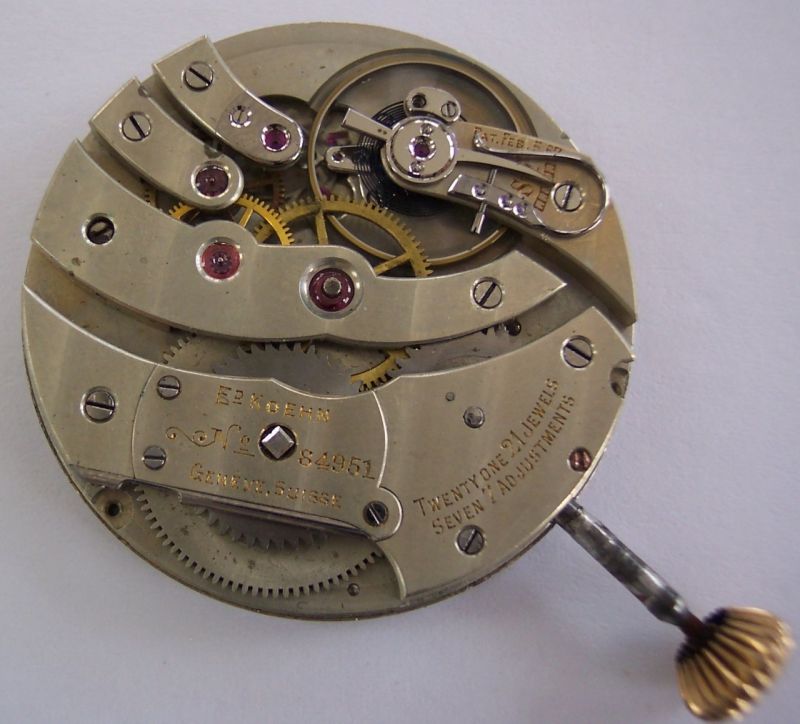
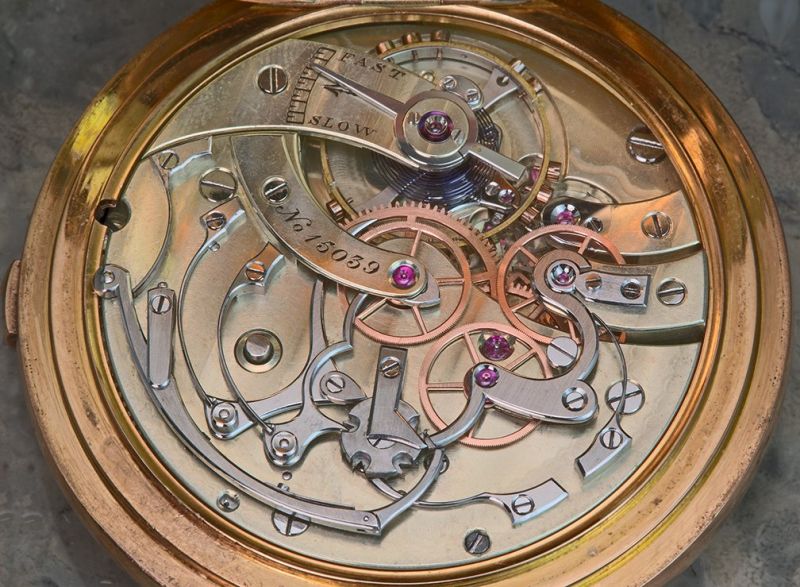
Here is an E. Koehn pocket watch movement for comparison to your Tiffany one. I've seen various Tiffany Koehns in the past so it's not a far fetch. The most promiment trait that made me think of the Koehn when I saw your pw are the curved bridges. I.e. the balance cock and the other bridges all have a very curved feature to them, which various Koehns movements I've seen share (but of course there are many more differences we can site, but it's a start
here I'll post a Koehn movement and your picture for comparison:
thanks again for having shared!
S
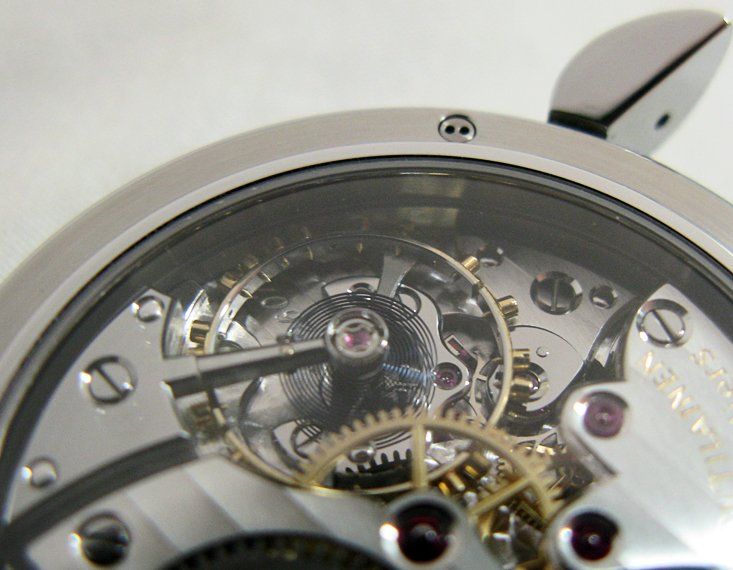
Thanks, Yes, indeed!
and a beautiful one of course!
My Peseux 260 with Guillaume balance is being serviced presently, I hope to have it returned someday as a wristwatch (although with its original finish, nothing as elaborate as Voutelainen's!)
My Peseux 260 with Guillaume balance is being serviced presently, I hope to have it returned someday as a wristwatch (although with its original finish, nothing as elaborate as Voutelainen's!)