
A Timepiece Can't Get More Military Than This...
The papers that accompany the kit indicate that it was originally sent by the factory to military unit No 13815 in Balashikha town near Moscow.
This chronometer was designed exclusively for the cockpits of long-range Tupolev strategic bombers. It was used to generate precision time signals for navigation and targeting systems. Fold-down flanges on the sides of the oak box were bolted to the navigator's cockpit panel. The mechanical time signal it produced was converted to 1-second electric impulses that were transferred via the 3-dial 'calculator box' to the plane's navigation & targeting systems. The small silver-colored metal box is a signal filter.
The movement in this chronometer is a modified version of the one that is found in the more common 6MX marine chronometer. Specifically, a lever escapement mechanism has been added that makes the movement less sensitive to the high-frequency vibrations produced by the aircraft in flight. The movement is also suspended from a brass ring by 4 sturdy springs that further reduce the effects of vibration.
The chronometer is accurate to a 1/4 second a day and has a 50-hour reserve. There is also an automatic thermostatically controlled heater, an electrical fuse, and a light that comes on when the lid is lifted.
If you would like to see additional information and photos, send me a PM.
Eat your heart out Dr. Strangelove...
-- Mark


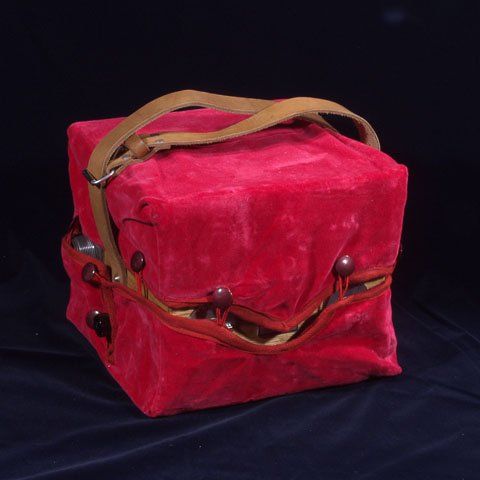


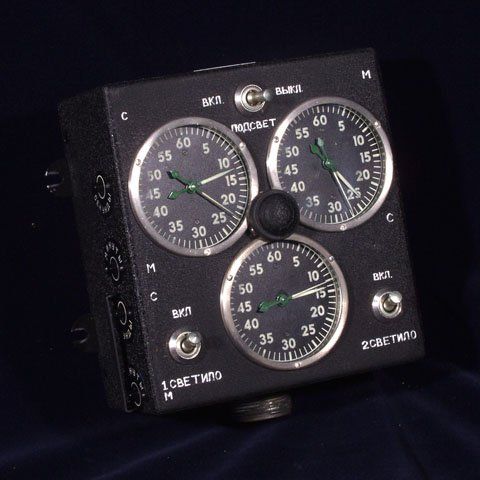
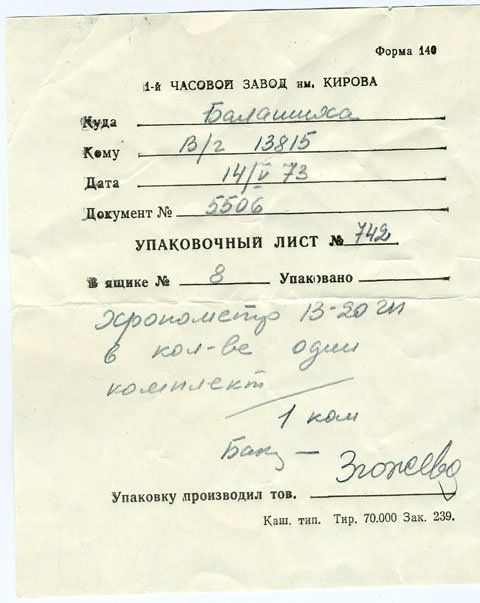


Soviet Time Piece
Wow Congrats you've got yourself a very important piece here
Any way I can get a similar piece?

Brings new meaning to the term NIB
Congrats on the fantastic addition to a fantastic collection.
- SJX

The World would be a different place
if your chronometer had been "used" in real life......er......death ! 
That is an absolutely marvelous find and historical record.
Thanks for sharing, Mark.
Regards,
MTF

i've owned several marine chronometers, but this beats them all
a great piece of soviet military history Mark.
best
Graham
1/4 second per day
If that is correct, it puts a lot of big brands to shame.
Congratulations Mark for sharing the historical timepiece with us.
Regards
Ling


How is it wound?
That's way cool. Great workmanship as well.
Thanks for showing us. Any possibility of seeing the movement?
Andrew

Movement shots
-- Mark

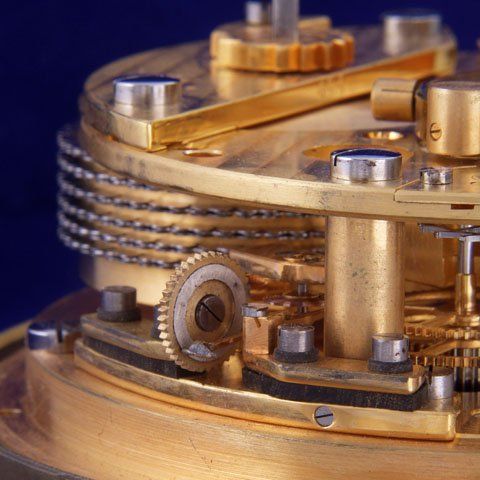

What is the wheel?
A
Paradoxically it doesn't turn...
Although it looks like a gear, the small wheel doesn't turn. It is stationary. It is, however, manually rotated every once in a while to allow the arm to beat against a 'clean' area. If you look closely, you can see 2 blackened spots on the wheel in the photo where the steel has carbonized a bit. These are areas where the beater arm previously made contact to close the circuit.
- Mark

Thanks…
Great Mark,
Fusee and chain, conical hairspring, lovely functional finish but still aesthetically beautiful.
Thanks again for sharing this piece and the winding procedure below.
A whole other area of horology I know little about and I am getting that ‘tingle’ again. The thirst for knowledge is a great human trait.
Andrew
And Diamond end-caps too !
-Mark This message has been edited by asiaassoc on 2009-02-24 16:28:51
Winding (w/photos)
These photos were not made from the new piece. They are shots of another chronometer of the same model in my collection (#0256). As can be seen in the photos, this one is in very used condition. It obviously lived a long and productive life in the skies before retirement.
-- Mark


