
Baselworld 2012: Peter Speake-Marin new serpent Calendar!
In the last
years I've had several opportunities to see some watches made by Peter
Speake-Marin, either in real at shows or here on PuristSPro. I've long
been fan of his style and seduced by his independent approach: different but
somewhat accessible, tasty but classic enough for me.
So far
I've been preserved from any serious temptation as his watches were in
general too large for me, at least those appealing to my taste. My small wrist
is a great advantage in fact. The Marin 1 is a great example: the watch is
perfect, thickness excepted for my taste.
But
that's over. This year Peter is showing and launching the new
"serpent calendar". This time the proportion are those I like. The
case is available in 38 or 42mm size (38 is perfect for me) and the thickness
is a reasonable (even if not thin) 12mm.
The watch is
launched in steel or pink gold.
Look at the
stainless steel 42 below (the 42 has a larger bezel than the 38, the pink gold
version on the third pic is a 38). It has all the charm of the very classy PSM
design: a strong case with gorgeous attachment bars and crown, a beautiful
white lacquered dial on two levels, 4 gorgeous heat-blued hands.

On the back the
watch shows an automatic calibre Eros 1 (this is not the SM2 calibre), it is
got from Technotime, a TT738, but hand refinished for or by Peter and gets the
PSM circular PVD blued rotor. This twin barrel 120 hours power reserve calibre
beats at 28800 vph and has a stop seconds function.
As written by
Peter this calibre is "re-designed, hand-finished and assembled according
to Speake-Marin style and quality standards established by the Foundation
watch".
And the
positive aspect of this calibre choice, nicely finished and deserving enough
for fitting your wrist, is a price point that makes it a dream that can come
true!

Retrospectively
I've had not enough time to spend with this watch at Baselworld. Peter is
really pleasing to discuss with and I had never imagined myself with one of his
watches before, for size and price reasons. This time I'm in trouble! At
least there's no reason I'll see his watches in real again before
November!
Below is the
38mm pink gold version!

Did I need this
watch? No! Do we need watches? No! Do I want this watch? Yes! Will I get it? No
idea, but hopes (but I need my Nautilus first). Thanks for reading!
Best
Dje

Two wristshots
I prefer the 38mm version, more elegant, I find the bezel a bit too thick with the 42mm case.
I will come back to these watches later.
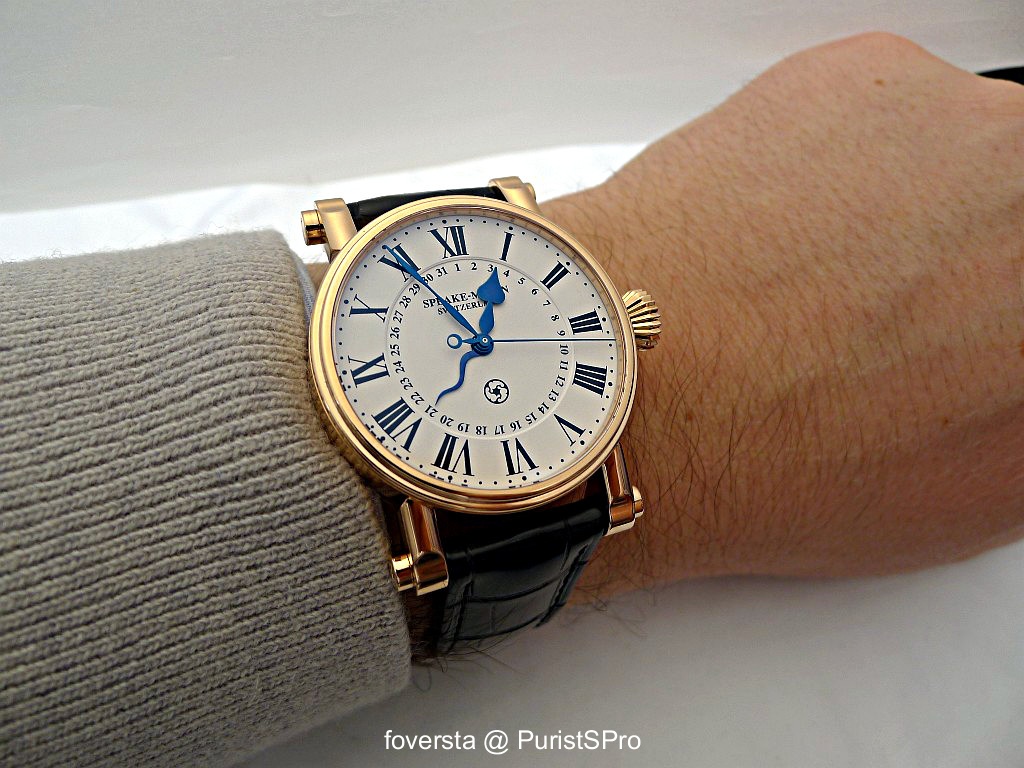
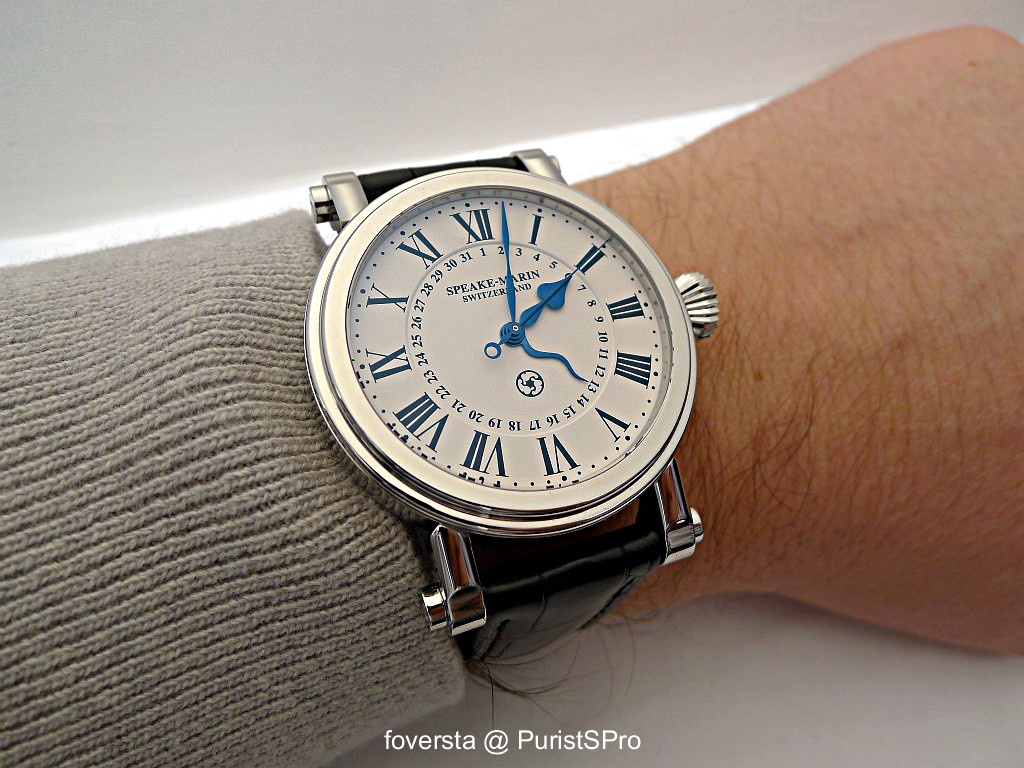
Fx

I agree the 38mm is the perfect case size.


What a difference 38 makes
And yes Mostel, it is really beautiful...
Fx
Thank you for your pics FX
Thank you for your pics.
I totally agree with your comments and wait to see your pics!
Temptations.....
Best
Dje

The Red Gold iteration is immaculate
Yes,and the 42mm bezel adds nothing for me!
My taste is clearly for the thinner lines of the 38!
Best
Dje

I think it is my favorite SM
maybe because of the roman numerals and the quite elegant overall look. This watch seems lighter but, in the mean time, it has maybe a less stronger character than other SMs.
Thanks for the details and the pics Dje.
Best,
Mark

Thanks for the report.

remember when Peter did a before and after PSM treatment of a regular ETA on timekeeping?
hope a similar excercise can be conducted on the Technoxxx movement.
best,
Horo
its was on the FW2012 vs ETA 2824..
written by mkt33.
extract below:
Power Reserve:
The test was performed by manually winding both watches. The first noticeable difference between the two watches is that the Piccadilly's second hand jumps immediately into action while the other remains at rest until enough energy has been stored in the mainspring. Fifty turns of the crown ensured that the mainsprings in both movements were completely wound and then the watches were left sitting flat with the dial up. The time it took for the mainspring to unwind was measured. This sequence was repeated three times and the results were averaged.
|
Comparison COSC ETA 2824 |
36.3 hours |
|
FW2012 |
39.5 hours |
Considering that the ETA 2824 has a specified power reserve of thirty eight hours, both samples fell within an acceptable 5% deviation.
Winding efficiency:
This test was performed with two different methods. First both watches were hand wound. The Piccadilly's crown was turned for ten complete revolutions while the comparison watch was wound for twelve and a half revolutions to compensate for the difference in crown diameter. This test was repeated twice and results were averaged.
|
Comparison COSC ETA 2824 |
19.2 hours |
|
FW2012 |
21.6 hours |
The second method was to determine the winding efficiency of the two different automatic systems. I wore both watches on the same arm for three hours and measured the time elapsed until both stopped functioning again. This test was repeated twice and results were averaged.
|
Comparison COSC ETA 2824 |
9.0 hours |
|
FW2012 |
10.4 hours |
In my eyes, this aspect of the experiment was the most important as it highlights the main modification of the FW2012. PSM's automatic system is 15% more efficient than a stock ETA 2824 based on my testing methods and sedate lifestyle.
The Piccadilly's rotor is almost silent and it's "wobble" is undetectable on the wrist. I presume this is an improvement brought about by Speake-Marin's modifications to the automatic mechanism but since these two movements are cased in different materials (white gold versus stainless steel) I cannot make verify this claim.
Accuracy:
The testing guideline from Peter Speake-Marin's workshop is as follows:
"Each movement is tested first for precision of the time keeping over a two week period, starting before the automatic mechanism is placed on the movement and then continued after the automatic mechanism is mounted. Excluding the time spent in the manufacture of the new components I presently spend approximately fifty hours on each movement before it leaves the workshop. The timing required is a variation of less than 10 seconds in 5 positions with a gain from +1 to +6 seconds per day."
When I purchased my Piccadilly the accompanying Control Sheet revealed its timing results (dated May 2005)
|
Before casing |
Average gain |
Positional variation in 5 positions |
|
Fully wound |
+5 sec |
(variation of 5 seconds) |
|
Minimum of 24 hours wound down |
+1 sec |
(variation of 8 seconds) |
|
After casing |
Average gain |
Positional variation in 5 positions |
|
8 hours on slow test simulator |
+ 5 sec |
(variation of 4 seconds) |
Although I do not fully understand the timing tests performed at Peter's workshop, I've casually observed that the Piccadilly has kept great time over the last year. However I decided to check the accuracy again.
The Piccadilly was left in the proper position and the time was compared to the USNO (United States Naval Observatory) Master Clock time each morning. The Piccadilly was wound with ten complete revolutions of the crown each evening. The temperature was not controlled.
|
Day |
Daily rate (s/day) |
Variation of daily rates (s/day) |
Position |
|
1 |
+3 |
3 |
Vertical, 12 o'clock up |
|
2 |
0 |
|
|
|
3 |
0 |
2 |
Vertical, 3 o'clock up |
|
4 |
-2 |
|
|
|
5 |
+4 |
|
Vertical, 6 o'clock up |
|
6 |
+1 |
3 |
|
|
7 |
+2 |
|
Vertical, 9 o'clock up |
|
8 |
+1 |
1 |
|
|
9 |
+6 |
|
Horizontal, dial down |
|
10 |
+7 |
1 |
|
|
11 |
0 |
|
Horizontal, dial up |
|
12 |
+2 |
2 |
|
The average daily rate: +2 sec/day
Mean variation in rates: +2 sec/day
Greatest variation in rates: 3 sec/day
Difference between rates in horizontal and vertical positions: +1.5 sec/day
Largest variation in rates: 5 sec/day
Perhaps a bit out of the original testing specifications considering the positional variation between days 4-5 and 10-11 but overall a bit better performance (less variation of daily rates) than when the Piccadilly left the workshop over two years ago. I believe the FW2012, after timing regulation by Peter Speak-Marin, could easily achieve COSC certification if tested.
-end-
best,
Horo
Thank you Richard!
Indeed the Technotime, once PSM finished, is deserving of ending up in this watch!
Of course it is not a Marin 1 calibre, but it is thinner and less expensive too!
A very well calibrated proposition IMO.
Best
Dje
I love this design. I think they got everything right on this one. [nt]

38 mm version in steel
May i ask where approx. the price point is? I couldnt find any information on the PSM website.
thanks,
Stefan
Sure, but you may email them to have a precise info
As I understood it the 38mm steel should be around 12000 euros French VAT included (19.6%). Slightly less in Switzertland.
Please check with Peter by mail for your precise location.
best
Dje
Also my daughter's favourite (she was 9 when she said this).
