Comments:


Please do not place links in an article title. Use the link button in the edit window to insert a link in your article.

This message has been edited by cazalea on 2025-05-28 05:20:32

A tuning fork watch, like the Bulova Accutron, operates using a unique mechanism that relies on the vibration of a tuning fork to keep time, rather than a traditional balance wheel and hairspring found in mechanical watches. Introduced in 1960, the Bulova Accutron was the first commercially successful electronic watch, offering unprecedented accuracy for its time. Here’s how it works:
Key Components and Mechanism
1 Tuning Fork:
Here are some illustrations:



Bulova Accutron
I have been working with an Accutron expert getting my fleet of Bulovas back into running condition.


For those of you who don’t know about Tuning Fork watches, they were an early development of electronic watch movements.
Here are a few pictures of a 214 series movement. Tomorrow I’ll write something explaining how it works, unless someone else wants to do it for me 


My Spaceview and an article of interest from Hoodinkee
The article is HERE
Please do not place links in an article title. Use the link button in the edit window to insert a link in your article.
Highlight the text to click, then go up to the window’s menu bar and touch the link button. Insert the link in the spot provided, and it should work, appearing in your text in blue with an underline.
This message has been edited by cazalea on 2025-05-28 05:20:32
Thanks.
I'm pretty sure I've pasted links in the text box before but I'll use the link button from now on. Thanks again. Greg
One of the more fascinating pieces for me 👏🏻👌🏻👍🏻
Yet to get a Bulova one but have a Citizen that’s not running, so might actually ask about your expert 👍🏻
He’s fixing an Omega f300 and I’m pretty sure he’s mentioned the Citizen variant
We can exchange info by private message
Thanks a lot 🙏🏻🙏🏻🙏🏻
Let me first sort our place of future residence and then I will get back to you 👍🏻
How the Accutron works (by Grok AI)
(Yes, I let the computer do some of my homework, but since I assigned myself the job, I reserve the right to outsource the research component… ) 😉
Key Components and Mechanism
1 Tuning Fork:
- The heart of the watch is a small, metal tuning fork, typically shaped like a U with two prongs.
- In the Bulova Accutron, the tuning fork vibrates at a precise frequency of 360 Hz (360 cycles per second), which is much higher than the oscillations of a mechanical watch’s balance wheel (typically 2.5–5 Hz).
- The tuning fork’s consistent vibration serves as the timekeeping element, acting like a pendulum but with far greater precision due to its high frequency.
- A small battery (usually 1.35V) powers the watch, providing energy to sustain the tuning fork’s vibrations.
- The tuning fork is fitted with a tiny magnet at the end of each prong. These magnets interact with electromagnetic coils in the watch.
- A transistorized electronic circuit sends small electrical pulses to the coils, creating a magnetic field that keeps the tuning fork vibrating continuously. When the fork moves one way, the circuit pushes it back, maintaining a steady oscillation.
- The vibrations of the tuning fork are mechanically translated into rotational motion to drive the watch’s gear train.
- One prong of the tuning fork has a tiny jewel (called a pawl) that engages with an index wheel, a small gear with fine teeth (often 300–400 teeth).
- As the tuning fork vibrates, the pawl pushes the index wheel forward in tiny increments, converting the rapid oscillations into a controlled, stepwise motion.
- This index wheel drives the gear train, which moves the watch’s hands to display the time.
- The gear train reduces the high-frequency motion of the index wheel into the slower, precise movements needed to turn the hour, minute, and second hands.
- Unlike mechanical watches, which often have a ticking motion, the Accutron’s second hand moves in a smooth, sweeping motion due to the rapid 360 Hz vibrations, giving it a distinctive glide.
- A battery powers the electronic circuit, which is simple but efficient, allowing the watch to run for about a year before needing a replacement.
- The Bulova Accutron’s battery was a significant innovation at the time, as it eliminated the need for winding like traditional mechanical watches.
Advantages of the Tuning Fork Mechanism
- Accuracy: The 360 Hz tuning fork provided accuracy within about 2 seconds per day, far surpassing most mechanical watches of the era (which could lose or gain several seconds per minute).
- Smooth Motion: The high-frequency vibrations resulted in a smooth sweep of the second hand, a feature later associated with luxury mechanical watches.
- Reliability: With fewer moving parts than a traditional mechanical watch, the tuning fork system was less prone to wear and required minimal lubrication.
Unique Characteristics
- Humming Sound: Unlike the ticking of mechanical watches, the Accutron produces a faint, high-pitched hum due to the 360 Hz vibrations of the tuning fork. This became a hallmark of the watch.
- Historical Significance: The Bulova Accutron was used in NASA missions, including Apollo, due to its reliability and accuracy in extreme conditions.
- Battery Dependency: The watch requires a battery, which was a novel concept in the 1960s but needed periodic replacement.
- Obsolescence: The rise of quartz watches in the 1970s, which used a quartz crystal vibrating at 32,768 Hz and were even more accurate and cheaper to produce, eventually overshadowed tuning fork technology.
- Maintenance: While innovative, the tuning fork mechanism requires specialized knowledge to service, and parts for vintage Accutrons can be hard to find today.
Example: Bulova Accutron Models
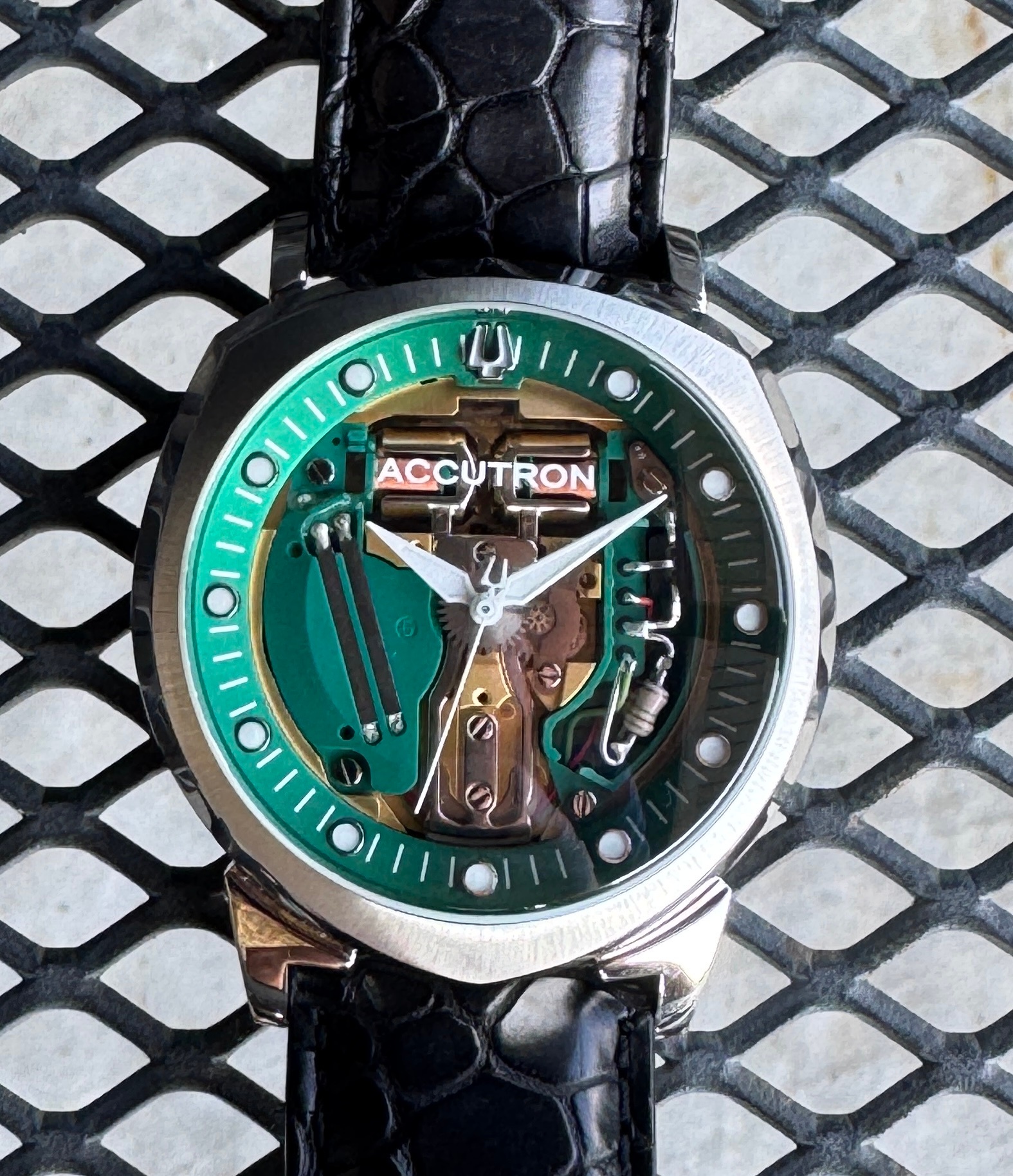
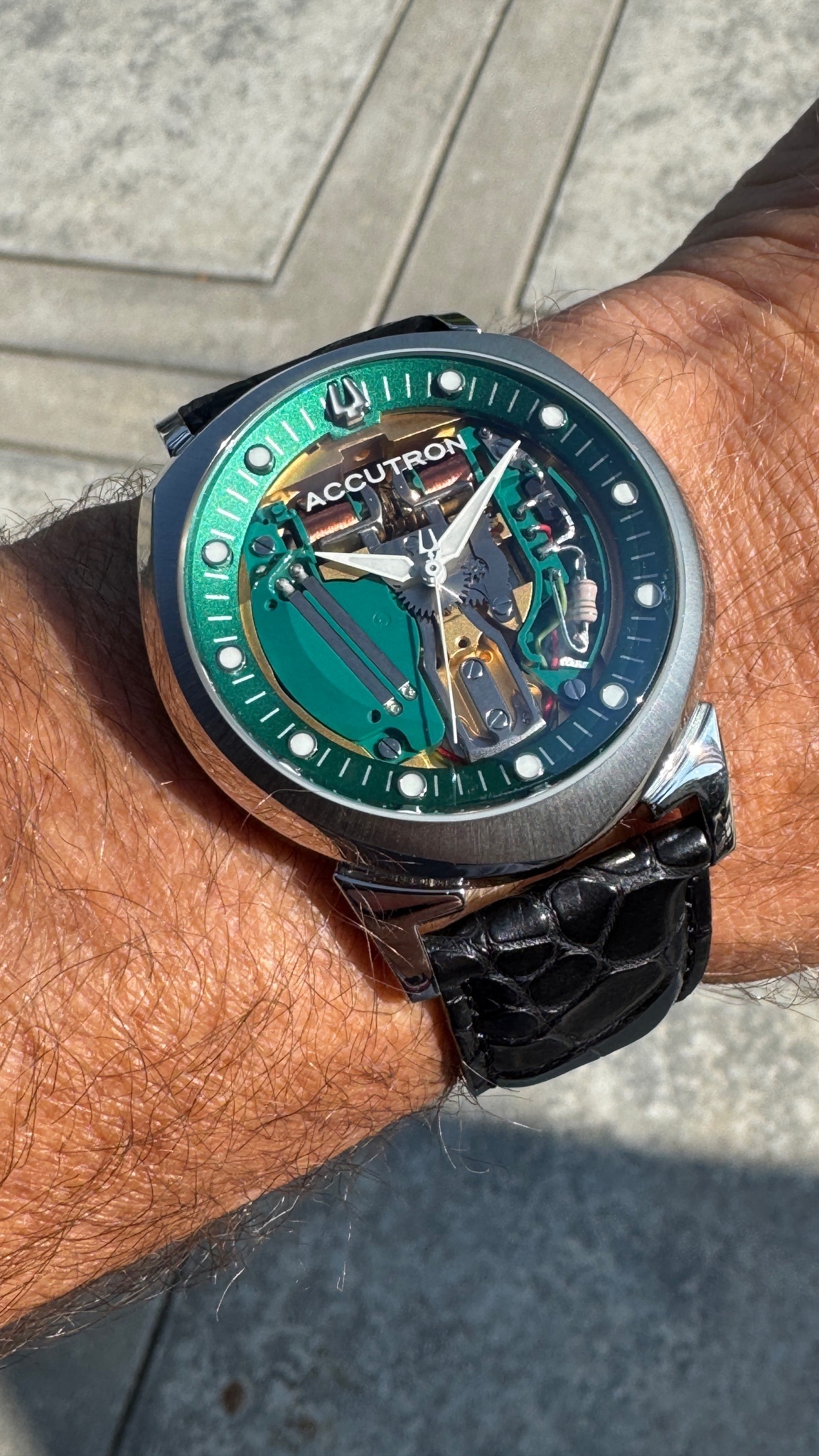
- The Bulova Accutron Spaceview, with its transparent dial showcasing the tuning fork mechanism, became iconic for its futuristic design.
- The Accutron 214 (the original model) and later variants like the 218 and 224 refined the technology, adjusting the placement of components or adding features like a date window
Here are some illustrations:

Here’s one I picked up in 2010
the anniversary model. I need to get it regulated so it’s been without battery for quite a few years.

Thanks!
Thanks!