
This is fun!

...on historical facts
Date: Apr 23, 2010,10:43 AM - (view entire thread)
"Indeed, Victorin Piguet should be included in the list of specialist firms that provided chrono calibers to PP. (Although, I was inder the impression that the majority suppliers since the 1960's were Valjoux cal. 22/23 and Lemania cal 2320.)"
Here's some information I wrote in 2002 on the Piguet watchmaking family, based on documentary and oral history research I had done in the context of AP -
"Because of the common last name in the company names for F Piguet and Audemars Piguet, it is often asked if there is any direct relationship between these two companies.
F Piguet is an indepedent movement maker that was instrumental in the re-birth of Blancpain. Until Swatch (then SMH) acquired both F Piguet and Blancpain, F Piguet was essentially the movement side of Blancpain, though many other high end houses used F Piguet movements, and have for quite some time.
F Piguet has no direct business ties to Audemars Piguet, though there are some ancestral connections. Piguet is a fairly common Swiss last name, but Le Brassus is also a very small town / village.
AP has used F Piguet movement blanks and ebauche in the past, and currently uses the Piguet 1185 chronograph movement in the Royal Oak Chronograph.
The Famille Piguet settled in the Vallee de Joux in the late 15th century. One of the first Piguet's to get into the watch making business was Charles August Piguet, who set up an ebauch manufacturing facility in the late 1700's. There came a long line of Piguets after this, and the name is an important one and is inextricably intertwined with watch making in the VdJ and the Vaud.
Interestingly, the Audemars and Piguet families were involved together before the famous Jules Audemars - Edward Piguet pairing of AP fame. There were two predecessor companies, Audemars Freres, which iteslf was a spionoff of Louis Audemars, and Piguet-Meylan, which involved Piguet cousins (?) and a brother-in-law of Louis Audemars.
By the late 1800's, several eponymous companies were extant, including Louis-Elysee Piguet & Fie of Le Brassus; Charles Piguet of L'Orient (the original home of Lemania); and Victorin Piguet in Le Sentier.
L-E Piguet evolved into Frederic Piguet in the early-mid 1900's (1940?), Frederic Piguet being the nephew of L-E Piguet (Oesterhausen)
There has been some question and speculation about the relationship of V. Piguet and F. Piguet. Les Fils de Victorin Piguet was doing some of their most famous work for Patek, including a large part of the famous Packer and Graves Super complications, in the early to mid 1900's (1905-1945?), so there would seem to be a bit of an overlap between Victorin Piguet and Frederic Piguet as extant companies. This would lead me to question any direct lineage between V Piguet and F Piguet, though there could very well be less over-arching ties between the two.
The common linkage between all these companies is the Piguet name, a mastery and focus on ultra sophisticated complications, and the family crest - a rearing horse with a flagstaff (or spear) and three stars.
Around the turn of the 20th century, L-E Piguet also supplied to AP many of the ebauche (rough movements) which were in turn supplied to Duerrstein and Glashuette Union, one of the leading watch companies in Glashutte at the time, currently the home of A Lange and Glashutte Original and most of the German watch industry. The L-E Piguet workshops in particular were famous for high complications, with a specialization in chronographs and rattrapantes. They also produced some incredible repeaters and sonneries, some of which are shown, with audio file, lower down on this reference page. One of the finished Louis-Elysee Piguet complicated pocket watches was to become the base for what will be the world's most complicated wristwatch when it is finished and officially unveiled sometime before the end of this year (there have already been plenty of sneak peaks on the work in progress.) This wristwatch is patroned by a regular member of ThePuristS community.
TM
copyright 2000, 2002"
"Also, to my knowledge, PP began production of own calibers only (some years) after the Sterns bought it in 1932. (LC tried to buy, but Sterns eventually got the company.)"
I don't recall the dates and details from memory, so I can't comment. JLC has documentary history of this aspect of the history, but are understandably reticent to offer public access, and those with past access are understandably reticent to speak publically on this subject.
"VC have had and still have an in-house production of the 13"' repeater movement. It was the only in-house wrist-watch movement they've had until recently. But they did have one  "
"
um...define in house. To my memory, the calibre was based on JLC base movements with a Dubois Depraz repeater design, and I believe this is (or has been) publically acknowledged by VC. (I'm a big fan of this movement and the watches that resulted, so please do not take my question or comments as any question on the "worthiness" of the movement or its watches.
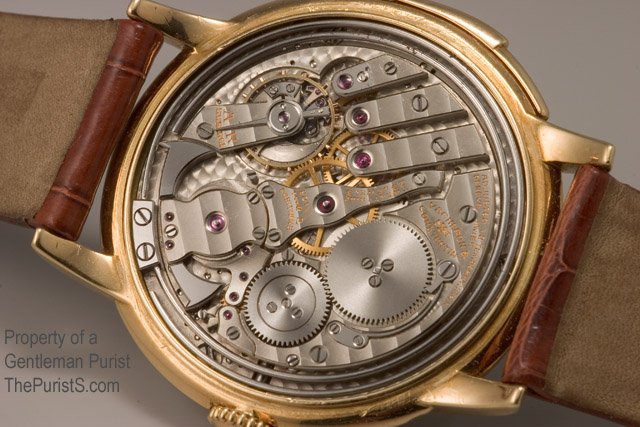
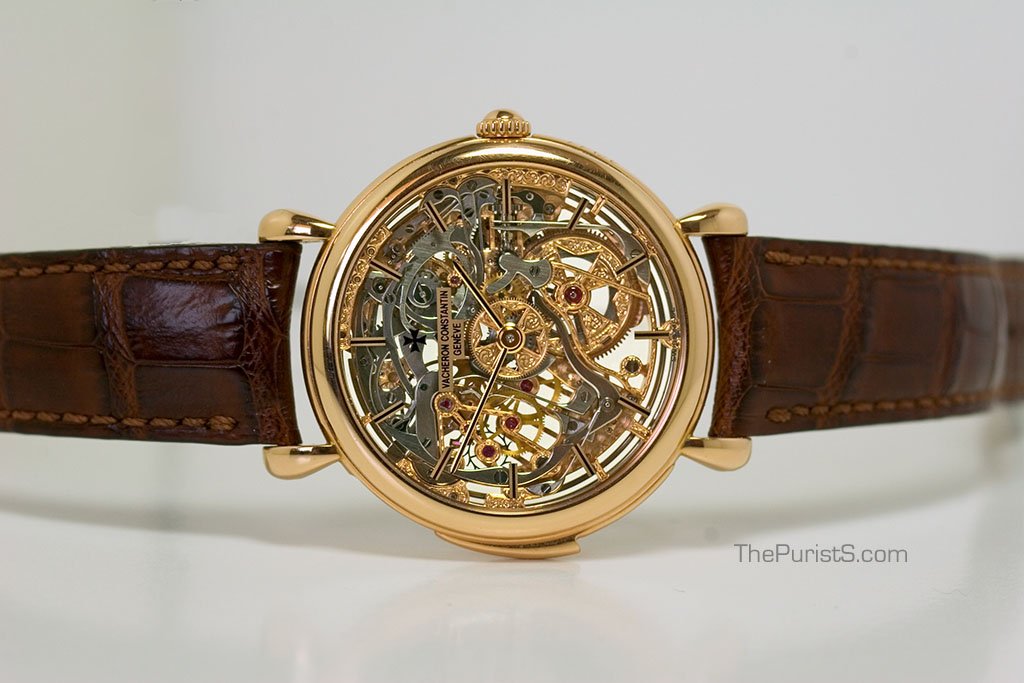
"As to the past, going back eones: after G.-A. Leschot (a talented engineer working for VC) modernized "serial" movement production in mid-19c, VC became a supplier of pocket watch ebauches to the Swiss industry. This is well known. (Who knows, maybe PP bought ebauches from them too.)"
um...I thought we were talking about wristwatches?
"AP did create from scratch many pocketwatch calibres, VC some as well, I believe."
By the way, a common misunderstanding by many enthusiasts (I'm not concluding you are included in this group) is that the pantograph designed and used by Leschot allowed for parts production that made them "drop and play" interchangeable. This is actually not true, the tolerances were pretty loose by todays standards and would be less than the equivalent of today's "rough cut" initial parts production, requiring quite a bit of handworking and fitting.
I wrote this back in 2000; in re-reading it, I would probably re-phrase some of the more potentially misunderstood statements.
"
Cheers,
TM

Thank you Thomas, Yves, Nicolas, all others for this discussion!
Now we have to meet with a bottle of Bas-Armagnac and all these watches to have a look at them!
Cheers
Dje

Now that's an excellent idea, Jerome.
I'm sure that a bottle of " Bas Armagnac " will help us a lot ot feed the discussion about the finish of these fine( de fine ) Chronos...
This time, let's just take our precautions and get some apsirin before!
))Best,
Nicolas
Except a pain in the hair, nothing else... :)
This message has been edited by amanico on 2010-04-24 01:15:53
I fully agree with what you write AJ!
And that was not my intention to state anything about Patek Philippe in fact. I wrote like I could have done on the VC forum.
Cheers
Dje
As the in house finish of the movement by VC
When I prepared the in depth review on the VC " Les Historiques " Chrono, I did some searches and fell on 2 theories.
One said that the finish was made by Lemania under VC specifications, as you said.
Others said that VC finished the Lemania movement.
I had no other choice than to contact VC, and it is of my " savoir " that VC finished the Lemania movement theirselves.
So, it is obvious to me that VC is not only an " assembleur ".
Here's a macro of the Lemania movement finished by VC:

Best, my friend.
Nicolas
The problem with these discussions, Nicolas, Yves, is that this sub-discussion
often violates a basic rule of discussion among intelligent, informed enthusiasts - the comments being batted back and forth DO NOT PROVIDE NECESSARY AND PROPER CONTEXT.
In this case, the time frame of the comments.
VC today probably produces much, maybe even all (except for hairsprings and crystals, for example) of their "manufacture" movements in house.
It is a FACT (that might be conveniently forgotten by even the inhouse marketing department) that at some points in the past, movements were brought in (mostly) finished, and mostly just cased and regulated.
Please, let's keep the discussion at the standards we respect and hope to maintain here on PuristSPro, including discussing the same context, point for point.
It is a non-sequitor to reply to dje that today everything is done in house as a sort of refutation to him when his original comment was a historical one.
Cheers,
TM

No problem here Thomas
On the topic, to me whereas it is a Patek, Breguet, Vacheron, Omega and many others, the movement is a Lemania belonging to Breguet. So to me all of those Chronographs should be regarded for anything else than their branded cosmetics values, safe for Breguet I guess.
The discussion started because of a comment reporting that VC did nothing. The very same things could be said about all of the above but Breguet. In this case and in the proposed topic, I do not find it fair to isolate one or the other, again the proposed topic was not about this.
All of the above Maisons are doing (organizing) more or less the very same, I say organizing because for example was the modifications made to the PP movement made by PP and was it always finished by PP?
I do not have any takes in this discussion other than fencing a little for the one that is being pointed out, not because I own one or more VC or one or more PP, but simply because those houses anyway present and provide myths which I personally find best left as presented and branded.
To me Vacheron Constantin till recently, found ways to coexist and provide an almost unique horology service to his clients (the only one that has always offered to make watches to clients requirements and expectations) and presenting small series of watches models. Now it is different, and so like for most renowned Maisons, Vacheron entered the new era and its future looks as promising as the others. I say and wish good luck to all of them and look so forward to see from them all fresher and newer implemented technologies as well as long lasting reliable and free from servicing mechanics.
For info, I like all those pieces, even if in the end Chronographs are not appealing to me because it is a function I do not use most days. When I need a chronograph the AMVOX 2 does perfectly the job I expect, and for my outings or lonely times nothing sings to me more my minute repeater.
I did not fell to be outside any standards in this conversation, safe for may be threading along in this website section instead of the other. If it is because I posted 2-3 times, this happens because I am posting from different computers, some aren’t on the network therefore readily info is not always all accessible
I fully understand your post, you can always trust my always good intentions.
I consider myself here as a welcome guest and my respect is entire.
Yves (PoyFr)
Thank you, PoyFR
I appreciate your friendship and I especially appreciate that you consider yourself a guest here; many of the "other guests" too often forget that.
Fairness and consistency is the anti-thesis of hyprocrisy, and you know how I feel about hypocrisy...
Cheers, mon ami.
TM
Thanks to you and Jerome for your historical inputs.
But we also were discussing about the finish on the " Les Historiques " and Malte Chronos, which use the same Lemania movement than in the current Patrimony Chrono, AFAIK.
So, it was interesting, and not out of topic, to discuss about it, IMO.
Best, Thomas.
Nicolas
This message has been edited by amanico on 2010-04-23 22:40:50


Very interesting review Nicolas
I like your approach of these stunning chronographs. You share with us your love for all these "high" valuable watches.
I re-read with pleasure your post and try to enter deeply in your photos.
Thanks +++++
Wear yours in good health, for sure.
Cheers,
patrickh
Thanks for your nice words, Patrick
Yes, I love all of these 4 beasts, for what they are: Very fine Chronos.
The comparisons have their own limits, indeed.
But they all share the status of Fine Chronos.
Best,
Nicolas

Thanks a lot, my friend.
I remember some of your tremendous wrist shots...
Best,
Nicolas

Thanks, Chris
Wish you the best in your hunt, and that one day, your dream comes true...
I had to wait 6 years for it!
BUT I got it, FINALLY!
Best,
Nicolas

THANK YOU !!!!!
Ofcourse I wa slooking forward to this review. It took quite some time but now I see why
For me, a BIG 5070 fan this is one of the best reviews I ever read. And I'm sure i will click this link many times in the years to come.
Can't agree on all your points when you're comparing the 5070 to other super chronographs but as you said, these are your thoughts
THANKS AGAIN
maybe one thing ... the 5070P , damn, that press release picture is so terrible , irl this watch really looks so much different
Don't get me wrong, Bruno
As I warned, comparisons have their own limits.
I said that the Dato and the Duometre could be compared to the 5070 only because the 5070 is claimed by many as THE best Chrono in the world, and because, of course it belongs to the category of Fine Chronographs.
Actually, the only 5070 competitors are the VC Chronos, to me.
The 5070 is a magic watch, which cannot be appreciated only on rational criterias, IMO.
Its presence on the wrist speaks very loud, and THAT too is important.
As for the 5070P, I had some opportunities to see it in the flesh, and can't agree more with you, it is muuuch better in the flesh.
Best, my friend.
Nicolas
Well, so much fun to read this review, Nicolas!
I know you have been thinking about these four chronos for a long time, and it is great to have a better understanding of your thoughts on these watches.
I was dying to see your comparison of the Duometre and the 5070. I was surprised by some of what you had to say about relative finishings and the overall conclusion, but I think you are right to finally say that they are not really competitors, after all.
Your comments on how PP dealt with a couple of visual issues due to the mismatch of the size of the case and the movement. I had not thought about how the design decisions work to ameliorate that issue. I think the strategy is less successful in my eyes on the rear view than on the dial side, as the movement still looks "sunken" into the case, as you put it. Nevertheless, I cannot argue with the overall coherent and beautiful result of the 5070. In particular, the blue dialed platinum is a triumph.
I will say that the side-by-side of the 5070 and the Duometre reveals how much larger the Duometre looks to me due to the design of the dial and the bezels respectively. The Duometre is perhaps less elegant looking, IMHO. The Duometre is, to me, however, much more interesting on several levels than the any of the other four.
And of course, when considering the Dato, I continue to prefer the dateless old version 1815. It is not just the lack of the date, but it is the relative thinness of the 1815 made possible by the lack of the date that gives the 1815 a much more coherent overall dimension than its more famous brother. Then, too, I also prefer the dial of the 1815, although I know others disagree on the placement of the subdials in particular. As you know, there are enough chronos in the world for all of us. LOL.
Thanks for another wonderful review. I learned and enjoyed a great deal.
respo
Thanks a lot, Respo
That's the Beauty of our Passion: Everybody has its own Champion, among these 4.
Some are better than others on some points, indeed, and wouldn't the Best of these 4 be a blend of each of them?
The thinness of the PP case, the innovation of the Duometre, the finish of a Lange, and the charm of the VC?
Best, my friend.
Nicolas
I salute to YOU ..... a wonderful report !!


Excellent comparative review!
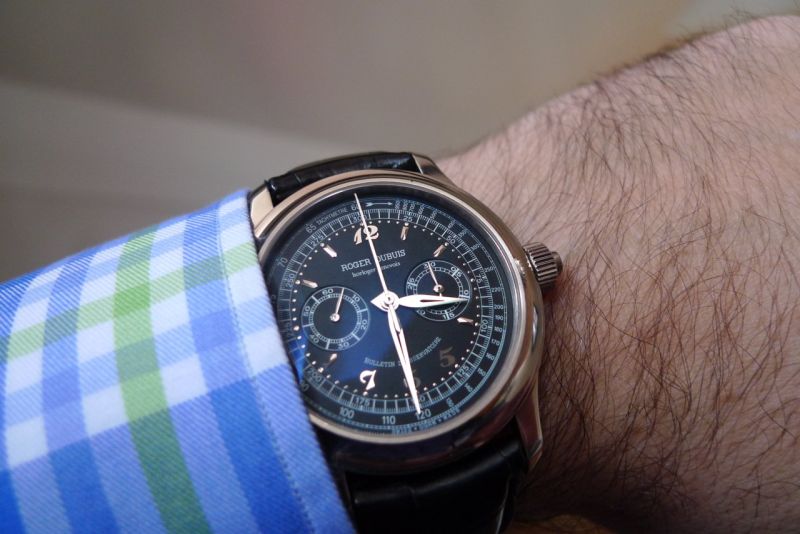
This message has been edited by radone on 2010-04-20 09:01:44
Of course, I could have included some more Chronos
Like this R.D ,or the U.N Chrono Monopusher:

Or THE Vintage Reference: The Longines 13 ZN or 30 CH, with the screw in case back, which are among the nicest ever made.
There is always something subjective in this kind of review, indeed.
And I'm very happy to see that you included this Roger DUBUIS.
Can you tell us more about it?
Best,
Nicolas