
stromer
2452

Let me try again
Hi Stefan, hi Stefan's son!
D..., I always mix up the "Insert" button and the "Igame
uploader" link..............
Sorry for the first post.
So here we go
again:
Basically I know of three
reasons to put two (or more) barrels into a watch:
1. You want to
drive different things in the watch independently like in a DuoMètre, a
Minute repeater or something similar.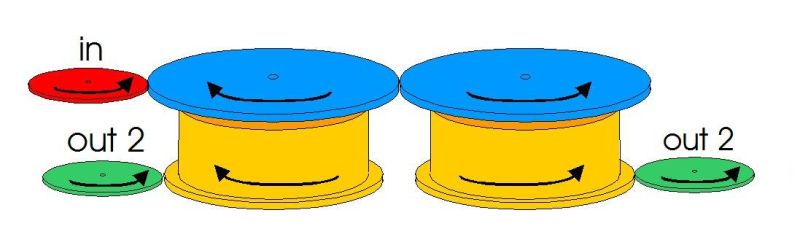
In this
case the crown wheel (red) would drive the click wheels (blue)
together or independently (like in a DuoMètre, where turning the crown
in one direction winds one barrel and turning it in the other direction
winds the other) and thus wind the barrels (orange). Both barrels would
then run independently turning their loads (green)
2. You want a lot of torque for
driving something big. 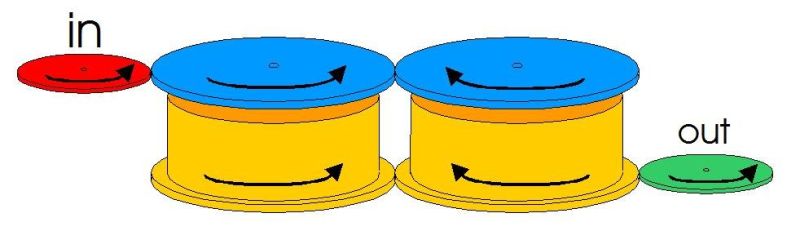
In this
case the crown wheel would turn both click wheels in parallel
winding both barrels at the same time. The two barrels then operate in
parallel, joining their torque to drive the load (green) together. This
will increase the torque, not the power reserve as both barrels
are operating all the time at the full speed required by the load. It is comparable to operating two batteries in
parallel.
3. You want a
long power reserve (as in your Reverso Grande GMT)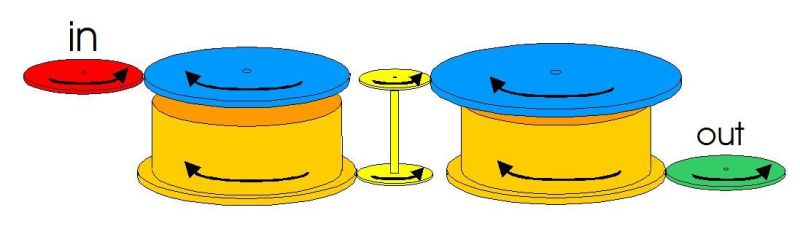
In this
case the crown wheel operates on the left click wheel only. As soon as
the main spring in left barrel is wound tighter than the one in the right barrel, the barrel will start to turn in the same direction
as the click wheel. So in this moment the left click wheel/barrel
combination starts behaving a little like a single gear wheel. (We are still
winding the watch.) Because the left barrel it is connected with the
right click wheel by an intermediate gear the red crown wheel is now
driving the right click wheel (blue) also and thereby winding the second
barrel (orange).
During normal watch operation the right
barrel will have the task of driving the load (green). The left barrel
assumes the task of turning the click wheel of the right barrel and
thereby helping to drive to right barrel. Sounds funny? Let's assume that both
barrels have the same specifications: Then the rotation of the right
barrel will be driven in equal parts by two sources:
- The left barrel drives the right click wheel through the intermediate gear.
- The main spring within the right barrel turns the barrel agains the right click wheel.
There are many variations to this scheme in reality. Barrels of different specifications are combined with intermediate gears that implement transmission rations other than 1:1. Reasons for this are many and too complex for me to grab. It is something about dealing with the fact that main springs have a non linear torque profile.
A more space economic way to implement the serial double barrel scheme is to leave out the intermediate gear and turn the right barrel upside down. But the principle remains the same;
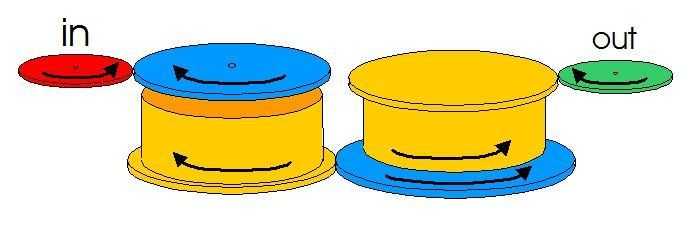
I hope I could give your son an idea of what is happening inside your great GMT. And please excuse the poor quality of my quick drawings.
Best,
Martin
This message has been edited by stromer on 2010-01-17 02:15:20

some questions asked by my son...

Your son's quesitons
thanks...
Let me try
Let me try again
excellent post - thanks for the education!


Three or more barrel combinations
You know that is cold and raining outside
I know....

Too many hints my elusive PP
Well Mo....
Thank you Martin,
Excellent, Martin, you did...
Winding multiple barrels

thanks
thanks once again...

Thanks Martin, Highly informative! Moderator, please...

Thanks a lot, Martin, for having taken the time to make it clear.

Thanks, Martin!
Thank you very much, Daos, I receive
Some illustration...