
bernard cheong
7182

Gustave Eiffel, Opus 3, Max Busser..legacies from 2003.
This larger portion, the beginning of, this post was written in the winter of 2003, and brings to an end the era of a wait for a legend. Opus 3.
It is also the beginning of a new era of my having left the moderatorship of thepurists.
The Beginning:
Dec 2003.
I met Max Busser just about a year ago, after they had planned Opus 3.
Max Busser could tell that I was NOT a typical Opus customer. And probably not even one who could afford an Opus.
I am a doctor. Most Opus customers, if not all, earn or will make amounts of money 10x if not 100x more than I do per annum.
However, I am a rare animal. Like John Krakauer and several others obsessed with pushing the “limits”…I wanted to possess what I felt was the VERY BEST that I could do with the money I had…at great sacrifice…but getting that sense of “being there” and that adrenaline.
I struggle to save for ONE MBF and for ONE Opus 5...most cutomers can buy them with loose cash.
I think Max saw that in me.
This was me..in 2003. Up at the tower. 6 years ago.
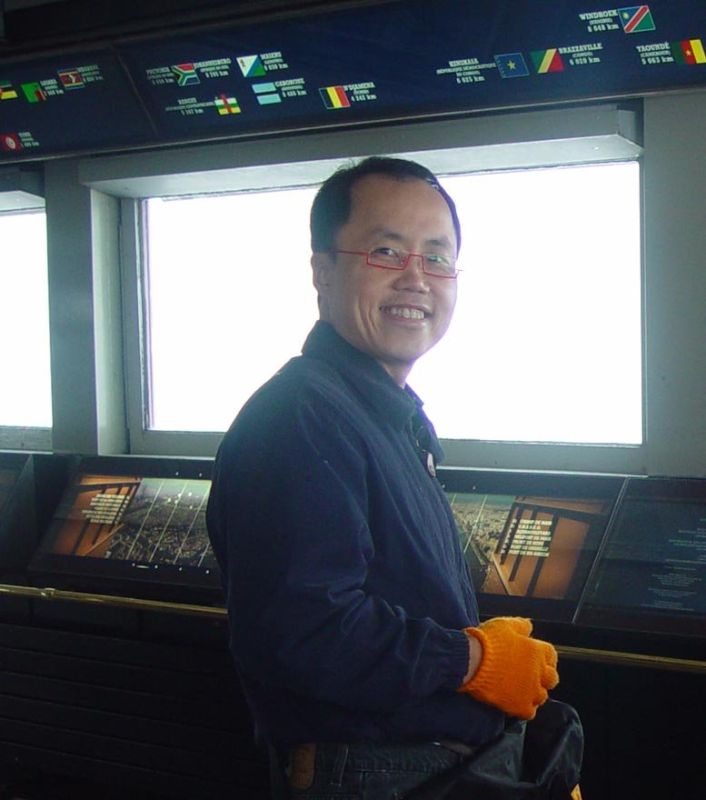
To understand Opus 3..I took a flight to Paris, and walked the entire Eiffel Tower for DAYS. I then went to the museum of contemporary art and walked it for DAYS. Then I came back…and I posted 3 posts on the Harry Winston forum.
That was the kind of guy I was.
This was before there was Revolutions, Timewerke, Timecraft..and so on. The year after, in 2004..New York called and asked for an interview. It was about the unlikely interest the world had in “independent” watchmaking.
I kept a large part of this post…because I felt it was not time for the world to read about MB&F ..until I had seen, owned and saw even further into Machines 4 and beyond.
Yes…Gustave Eiffel would have a comparison.
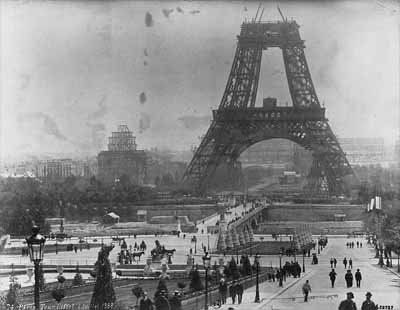
The Tower
It is 300 m (985 ft) tall. Built for the 1889 International Exhibition, Paris, the centenary celebration of the French Revolution. On the Av. Gustave Eiffel, by the river Seine.
It was not at all well received.. "...the tower was the greatest affront not only to the architecture of Paris, but also to the eye of the Parisian.”, its design was at first disdained by the city's artists and writers, who protested the tower's construction in 1889 for the Universal Exposition, a world's fair commemorating the 100th anniversary of the French Revolution .
The "Protest against the Tower of Monsieur Eiffel", published in the newspaper Le Temps. Signed by several big names from the world of literature and the arts: Charles Gounod, Guy de Maupassant, Alexandre Dumas junior, François Coppée, Leconte de Lisle, Sully Prudhomme, William Bouguereau, Ernest Meissonier, Victorien Sardou, Charles Garnier and others.
Insults like "this truly tragic street lamp" (Léon Bloy), "this belfry skeleton" (Paul Verlaine), "this mast of iron gymnasium apparatus, incomplete, confused and deformed" (François Coppée), "this high and skinny pyramid of iron ladders, this giant ungainly skeleton upon a base that looks built to carry a colossal monument of Cyclops, but which just peters out into a ridiculous thin shape like a factory chimney" (Maupassant), "a half-built factory pipe, a carcass waiting to be fleshed out with freestone or brick, a funnel-shaped grill, a hole-riddled suppository" (Joris-Karl Huysmans).
Eventually, however, the tower's beauty, originality, and engineering wizardry won it widespread praise and affection -- as well as a place on the canvases of artists such as Pissarro and Utrillo.
The classic and conservative layouts of the Parisian city were in stark contrast. Imagine for a moment a tower of ridiculous vertiginous height dominating Paris,just like a gigantic black factory chimney, its barbarous mass of brown, riveted steel frames. A skeletal monster.
It took a very short time to construct the Eiffel Tower…over 26 months.
Out of modular parts. Eiffel's drawings were so precise, giving details for more than 18,000 metal parts, that the tower was erected in just a little more than two years.
Number of Steel Workers: 300
Rivets: 2,500,000
Steel pieces: 18,038
It was revolutionary. Completed, it became the tallest building in the world, only over taken later by the Chrysler Building. Before the Eiffel, only the pyramids of Giza were of that height. The equivalent of a 105-story building. It is still the tallest structure in Paris by a very wide margin. Its size is very deceiving since there are no other structures close to it.
Maximum sway in wind: 12 cm Tallest Structure in the World: 1889-1930 (until Chrysler Building)
2nd Tallest Structure in the World: 1930-1932 (Until Empire State Bldg)
During its lifetime, the Eiffel Tower has also witnessed a few strange scenes, including being scaled by a mountaineer in 1954, and parachuted off of in 1984 by two Englishmen. In 1923 a journalist rode a bicycle down from the first level. Some accounts say he rode down the stairs, other accounts suggest the exterior of one of the tower's four legs which slope outward.


Parachute Descent: 1984 by two Englishmen
Bicycle Descent: 1923 Journalist Mountaneering Ascent: 1954 Visibility on a clear day: 67 kilometers (42 miles)
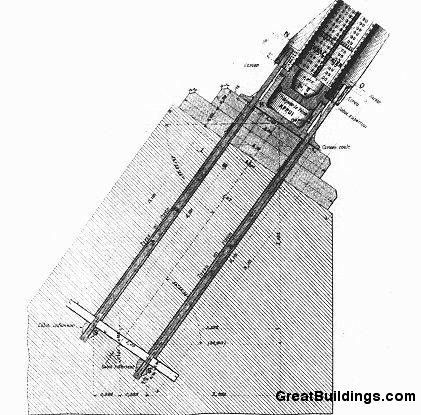
It had a circular geometric base with an ingenious spread of its four “legs”, hence distributing its weight away and even from its mass. Built on wet soil, it had water tight compartments driven into the earth and had a sophisticated system of support.
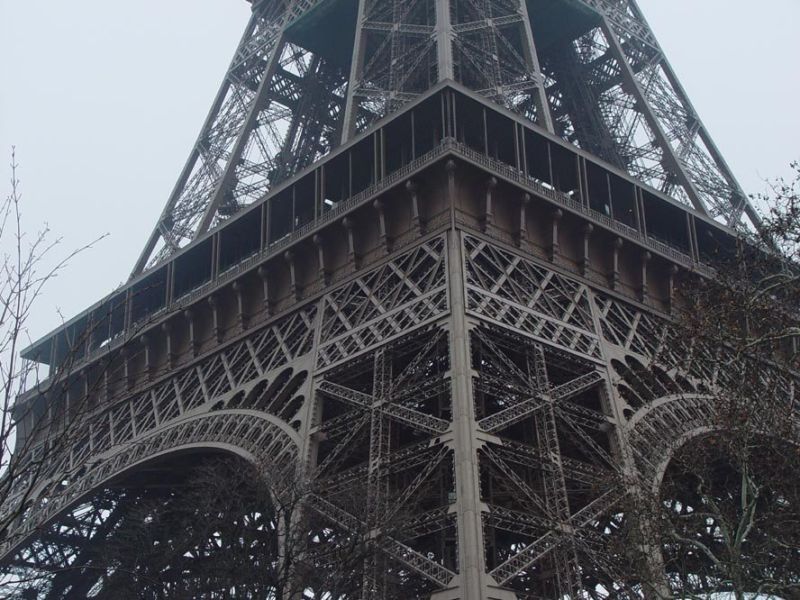
The four pillars supporting the tower are aligned to the points of the compass. You can use the tower as a reference to find you way in Paris. Another unique feature is the tower's base. The four semi-circular arches required elevators to ascend on a curve.
Eiffel made use of advanced knowledge of the behavior of metal arch and metal truss form under loading, including wind forces. His results started a revolution in civil engineering and architectural design.
The tower is built of puddled iron (very pure structural iron), and weights 7300 metric tons. It is extremely light. The tower actually weighs less than the air that surrounds it! If a scale model of the tower one foot (30 cm) high were constructed, it would weigh only as much as a nickel (seven grams)!
Weight: 7,000 tons (1,000 tons removed during 1990's renovation) Base: 412 feet square Foundation Pressure: 58.26 to 64 psi (9000 psf) Paint: 50 tons every 7 years Paint Color: Dark Brown
Architect Gustave Eiffel was a master at modular work.
Eiffel was a master of elegantly constructed wrought-iron lattices, which formed the basis of his bridge constructions and led to his project for the Eiffel Tower. He was mainly recognized as an engineer and bridge builder.
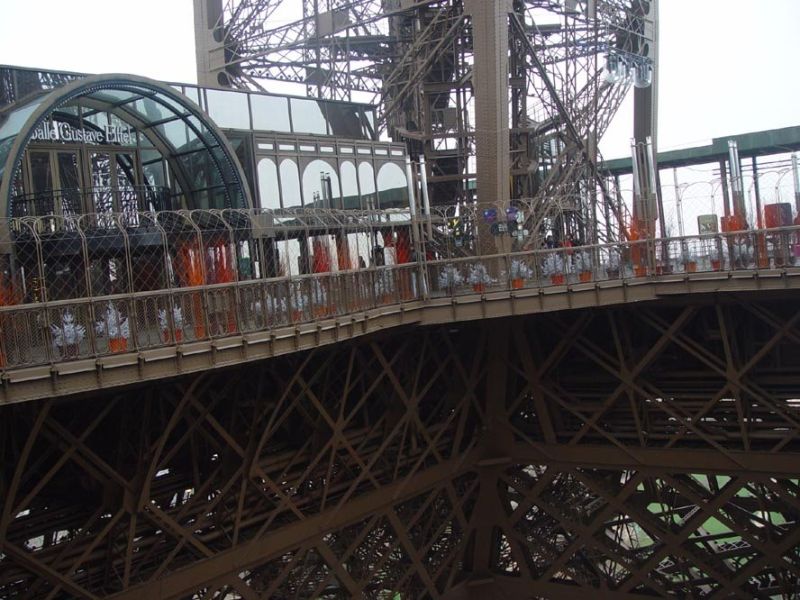
In an interview in the newspaper Le Temps of February 14 1887, Eiffel gave a reply to the protests, in his artistic tone.
"For my part I believe that the Tower will possess its own beauty.
Are we to believe that because one is an engineer, one is not preoccupied by beauty in one's constructions, or that one does not seek to create elegance as well as solidity and durability ? Is it not true that the very conditions which give strength also conform to the hidden rules of harmony ?
Now to what phenomenon did I have to give primary concern in designing the Tower ? It was wind resistance. Well then ! I hold that the curvature of the monument's four outer edges, which is as mathematical calculation dictated it should be (...) will give a great impression of strength and beauty, for it will reveal to the eyes of the observer the boldness of the design as a whole.
Likewise the many empty spaces built into the very elements of construction will clearly display the constant concern not to submit any unnecessary surfaces to the violent action of hurricanes, which could threaten the stability of the edifice. Moreover there is an attraction in the colossal, and a singular delight to which ordinary theories of art are scarcely applicable".
Gustave Eiffel

The tower has three platforms, and energetic visitors can tackle climbing the stairs to the first two, reached at 187 feet and 377 feet. From the topmost platform at 899 feet, the panorama can stretch for some 50 miles on a clear day. It has been said that the streets and environs of Paris below unfold like a giant map.
While you're high atop the Eiffel Tower, it's comforting to know that the structure was engineered to sway no more than five inches in a strong wind. Even more remarkable, the tower actually "grows" up to nearly six inches during hot weather -- a result of metal expansion.
Much of Eiffel's work had gone on to help expand the science of aerodynamics. NASA used many propeller and wind tunnel experiments in their trainer planes for astronauts.
The limited capacity of the available measuring instruments, led M. Eiffel to a more sophisticated knowledge in aviation and, eventually, to wind tunnel experiments. He built a wind tunnel on the Champ de Mars, which was in use from 1909-1911. The tunnel was sufficient for lab experiments bit inadequate for the study of airplanes. However, with the help of several other engineers, Leon Rith, Lapresle, and Eiffel made over 5,000 tests in this lab. Almost all the pioneers of aviation tested in this wind tunnel.
In 1911, a better wind tunnel which is still in use was built and between 1912-1914, Eiffel began experiments with military equipment for WWI fighter planes. In 1917, the Eiffel Laboratory designed a very advanced monoplane chaser.
The tower was never meant to be a permanent installation on the Paris skyline, and it was nearly dismantled in 1909. However, if its birth was difficult, it is now completely accepted and must be listed as one of the symbols of Paris itself.
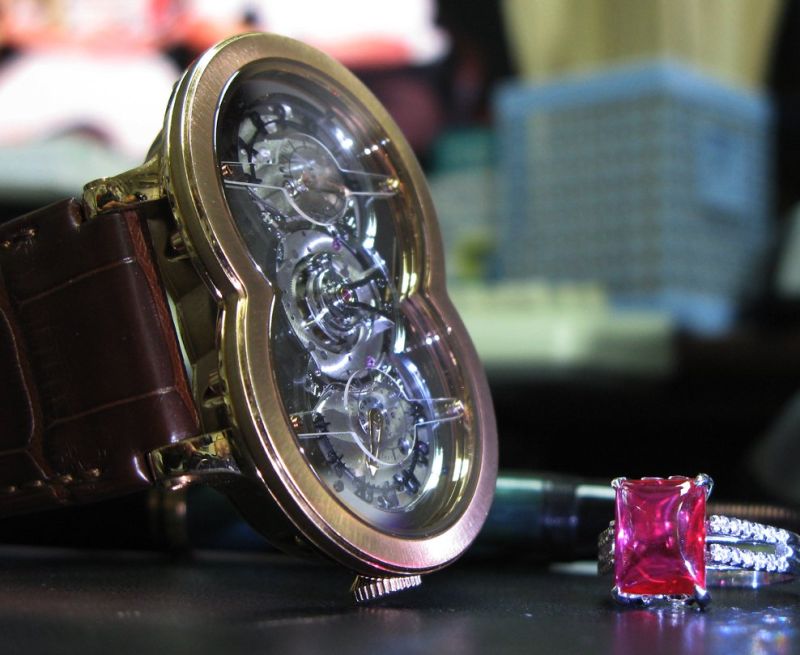
Why the Eiffel tower?
Sounds familiar?
“Technical rationale is about technical innovation but also about finesse and detail. Beauty can be bold with character than pretty and politically correct.”
“It seems to me that after a certain price, it would be ludicrous to consider one’s watch as only a timing device.”
“Owning a very fine piece of mechanical horology is one of the greatest luxuries, because it very rarely has any functional benefit.”
“Marketing is everywhere and more and more brands are “taking” the wealthy and unaware consumer, so he can show off to his unaware crowd. The emergence of the “cosmetic wannabes”..is terrible”
“Vianney Halter’s Antiqua remains on my top five list of most wanted, I am a great fan of the Freak, the creation of Opus 3 changed my life. Opus 3 and Opus 5 were for me more machine than watch, Opus 5 would be a runaway success. And it was. 3D machines which give time and that are finished in the highest horological tradition. A Jules Verne product, mixing the futuristic with the traditional.
“And that is the path I wish to take with MB&F.”
Max Busser
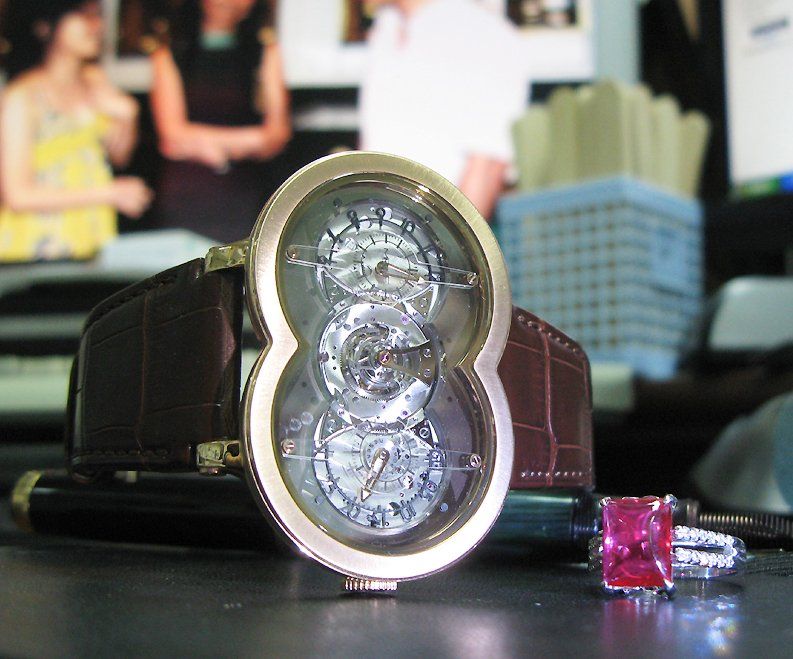
Today..2009
I had just had a quiet dinner with Max 2 days ago.
From a perspective of a watch collector...I must be crazy.
Collectors spend maybe 1% of their income on their hobby. I spent...I cannot measure it.
I believe that I have found not only a friend, but a visionary.
I remember that he told me..on our first meeting...that he could not stand the classical round watch anymore.
It's building an Eiffel Tower all over again.
But with the internet...the shadow and beauty of this new tower(s), will be cast over a whole world.
Congratualtions my friend.
MB&F is ready...and Opus 3 lives.


Gustave Eiffel, Opus 3, Max Busser..legacies from 2003.

Congratulation Sensei for your incoming Opus 3.....
u are a breath of fresh air to the purists once again....

If you are alluding to the Opus 3...
Thank God they took so long..I had no more funds!
Hey..you are a very astute buyer.
December is an exciting month

Bernard, so great to see you here again... Destiny wants that I'll arrive...
GREAT. On arrival..go immediately to Starhill and to Shook

Bernard, you always have unusual insights. I would not compare myself..
Ronald. I have this compulsion to take anything I do to the extreme

Beautiful watches...
MB&F appearance, construction and values, with Opus 3 and 5..

Watch out for the woman "married" to the Eiffel tower