
this_hobby_of_hours
3704

“tri-compax”= 3 subdials ? No
We often hear the term “tri-compax” with some thinking it means 3 subdials. ❌
Picture from the internet for illustration purposes
===============
The term "tri-compax" is not completely accurate when referring to the number of subdials on a watch. While it's commonly used to describe watches with three subdials, the term originally referred to a watch with three complications (chronograph, date, and moon phase), regardless of the number of subdials. According to Fratello Watches, "bi-" and "tri-" denote the number of registers (subdials) on a chronograph, but this is not the true origin of the term Compax.
According to www.watch-wiki.net, a watch with four subdials arranged at 12:00, 3:00, 6:00, and 9:00 is called Tri-Compax.
Here's a more detailed explanation:
Compax:
The term Compax originally referred to a chronograph with three complications (chronograph, date, and moon phase), not the number of subdials.
Tri-Compax:
A watch with three subdials is often referred to as a tri-compax, but the term can also be used for watches with four subdials, especially when those subdials are arranged in a specific configuration (12:00, 3:00, 6:00, 9:00).
Bi-Compax:
A chronograph with two subdials, often used to display running seconds and elapsed minutes, is sometimes referred to as a bi-compax.
Therefore, while "tri-compax" is commonly used to describe watches with three subdials, it's important to remember that the term's origin relates to the number of complications, not necessarily the number of subdials.
https://www.watch-wiki.net/doku.php?id=compax
Available on the marketplace
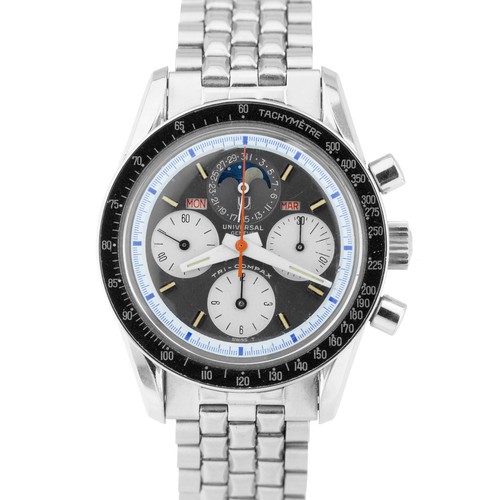
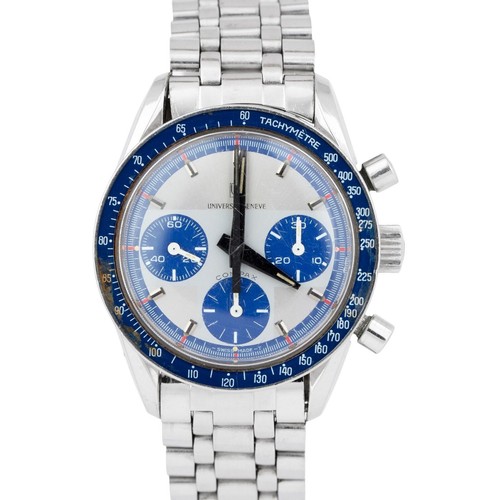


“tri-compax”= 3 subdials ? No


Thanks for this clarification 😊👍🏻
Technically yes … but

The word compax is a UG brand specific naming of complications.

Thanks for the education, Marc.

Thanks for explaining. I see how it can be a bit confusing.
☺️🫶🏼

Interesting. I wonder if this is a term that has been modified so much
Quite possibly so
100%!
Yes true dat 💯


Hello Marc! Very interesting post and a wonderful UG example you share here in all its glory. Of course the prefixs "bi" and "tri" relate with "two" or "three" ...
Hello Abel 👏