
PeterCDE
10167

Automated watch assembly - but GP style...
G'day,
this may be interesting, so here?s another glimpse at how watches are born within the SOWIND Group. I do hope you like it!
When asked to put the finger on what is so fascinating in a high-end mechanical watch, quite a number of enthusiasts and collectors immediately point at the movement. A delicate mechanism, often more than 100 individual parts which are carefully designed and meticulously crafted all for the proper function of the watch.
And when asking those who had a chance to visit a watch brand, particularly a manufacture like GP, the most catching department for many turned out to be the movement assembly. This is where the sum of the parts is put together and results in a mechanical, but almost living mechanism. I can?t deny being fascinated by this process myself, which did cause me to spend a lot of time watching how movements are born and start their life with a tick.
The skills on working with such small parts account for much of this fascination; to see those tiny watch parts and then the final outcome is an amazing experience.
As GP (and JeanRichard) did grow, it became a necessity to care for an effective production; today about 90 percent of GP?s watches come with a manufactory made movement, which is a steep increase. Alas, the brand is still relatively small and thus a little aid was installed.
Actually it is well possible to assemble a watch movement in a completely automated process, if caring for the final assembly when designing the movement and running the appropiate machinery.
But then, a bit of the "soul" in any watch is for me the process of putting it all together; during the assembly, small flaws can be worked out and the individual movement is tweaked and tested to perform accurately and stable. And when doing so, many details are easy to see for the human eye but hard to measure for a machine.
Therefore, the key element of the watch still is the one who makes it.
Now coming back to the assisting machinery, here?s how it looks like:
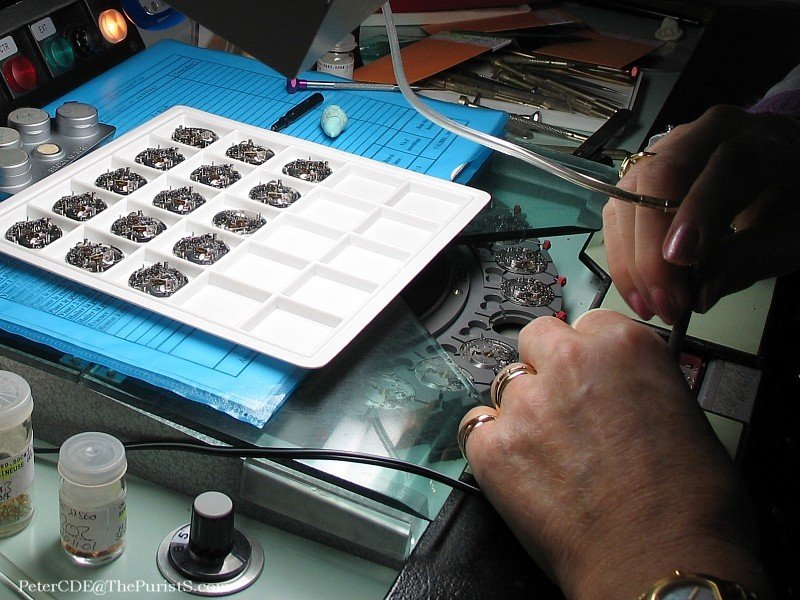
As you may notice, a number of GP3080 (or GP 30C0) column wheel chronograph movements is being assembled.
The batches in GP?s production are rather small, but the GP 3080 requires to assemble more and smaller parts than movements with less functions. In this instance, putting together all the parts in the right order and not to leave out one is a vital factor, which is the point where the machine comes to play. It is a kind of automated storage box; the machine is filled with a number of each of the various parts and subsequently releases one part after the other, in the correct order and as they are needed when the assembly process is followed through.
Actually this machine and a some few of it?s brethren in the "moyen factory" (where non-Haute Horlogerie pieces are made) is the only automated machinery that can be seen in the movement assembly; other than storing and providing the parts for mostly the GP chronograph movements, no robotized production takes place.
For me it?s another lovely detail at GP; another point that makes the brand and it?s pieces quite a bit special.
Greetings from germany,
Peter